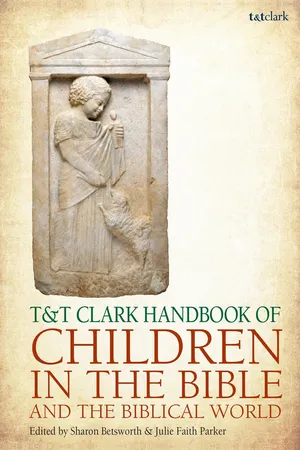
This ground-breaking volume examines the presentation and role of children in the ancient world, and specifically in ancient Jewish and Christian texts. With carefully commissioned chapters that follow chronological and canonical progression, a sequential reading of this book enables deeper appreciation of how understandings of children change over time.
Divided into four sections, this handbook first offers an overview of key methodological approaches employed in the study of children in the biblical world, and the texts at hand. Three further sections examine crucial texts in which children or discussions of childhood are featured; presented along chronological lines, with sections on the Old Testament/Hebrew Bible, the Intertestamental Literature, and the New Testament and Early Christian Apocrypha. Relevant not only to biblical studies but also cross-disciplinary scholars interested in children in antiquity.
eBook - ePub
T&T Clark Handbook of Children in the Bible and the Biblical World
- 496 pages
- English
- ePUB (mobile friendly)
- Available on iOS & Android
eBook - ePub
T&T Clark Handbook of Children in the Bible and the Biblical World
About this book
Trusted by 375,005 students
Access to over 1.5 million titles for a fair monthly price.
Study more efficiently using our study tools.
Information
1
Introduction
Sharon Betsworth and Julie Faith Parker
Only a few years ago, this book could not have been conceived. The academic study of children and childhood in the Bible and the biblical world was still in its infancy. Resources were sparse and academic discourses around these topics were isolated. Yet now, conversations are connected and publications are proliferating. We are delighted that the study of children in the biblical world has advanced so significantly in a relatively short time. And so we offer the T&T Clark Handbook of Children in the Bible and the Biblical World to recognize this progress and to guide continued work in the field ahead.
While academic studies related to children in the biblical world extend back to the late twentieth century, the year of 2008 was noteworthy in our discipline for two primary reasons. First is the publication of The Child in the Bible, edited by Marcia J. Bunge, Terence E. Fretheim, and Beverly Roberts Gaventa. This book brought together essays by well-established academics who addressed topics around children in the Bible from a range of perspectives. The focus on children was new for nearly all of these scholars, as this book was for the discipline of biblical studies. It provided a valuable resource that has sparked further reflection and research, as the essays in this new volume attest. The T&T Clark Handbook of Children in the Bible and the Biblical World is the first compendium on children in the Bible to emerge since The Child in the Bible. The second landmark event in 2008 was the launch of the Children in the Biblical World section of the Society of Biblical Literature, chaired by Danna Nolan Fewell and Julie Faith Parker. Prior to this year, the American Academy of Religion had a section devoted to research on children, but the SBL did not. In every year since its inception, the Children in the Biblical World section has hosted between two and four sessions at the Annual Meeting, and spawned the “Families and Children in the Ancient World” section in the Society of Biblical Literature’s International Meeting. These sections have provided a home for scholars to network, share ideas, and develop papers into publications. Some of the fruitful work growing out of these conference sessions also appears in this volume.
Now that serious scholarship on children in the Bible and biblical world is surging strongly ahead, this topic seems like an obvious area of study for many reasons. While explained more fully in the opening article by Reidar Aasgaard, it is important to highlight a few points as to why research on children is critical for biblical studies. First, demographers estimate that children comprise one third to one half of populations with short life expectancies, as in the ancient world. Scholars who study ancient Israel or the Greco-Roman civilization and ignore young people miss a great percentage, perhaps even the majority, of the culture that they seek to understand. Second, studying children adds new perspective and depth to our re-viewing of different institutions, such as the family and cult, as well as sociological and interpersonal issues, such as adoption, sacrifice, rivalry, inheritance, warfare, childbirth, etc. Third, many characters, both well-known and obscure, appear as children in the Bible; studying children adds depth to our understanding of famous characters and introduces us to minor characters whom we would otherwise miss. Fourth, children leave traces in the archaeological record that add to our knowledge of life in antiquity. Fifth, care for the survival of children was a significant part of family efforts and economics. Sixth, children have a critical theological role in both the Hebrew Bible (e.g., Deut. 4:9–10; 6:1–7; 11:19–21) and the New Testament (e.g., Mt. 18:2–5; Mk 9:36–37; Lk. 9:47–48). Seventh, the reception history of biblical texts has significant ramifications for many people, including those who hold the Bible as Scripture. While these reasons are certainly not exhaustive, they show some benefits of studying children in the biblical world. Children are integral to the Bible and the cultures that gave rise to its stories; therefore, children should be integral to the interpretation of biblical and related literature, as well as the study of the Bible’s literary and historical contexts.
Language for this burgeoning field is evolving, but increasingly scholars refer to childist biblical interpretation, as do most of the contributors to this volume. While the term “childist” is still new to many in biblical studies, it has been circulating in the academy for over fifty years and, indeed, has been used in both positive and pejorative ways.1 From a narratological perspective, childist biblical interpretation “focuses on the agency and action of children and youth in the biblical text, instead of seeing them primarily as passive, victimized, or marginalized.”2 More broadly, the word “childist” calls attention to the children and youth in the text, the archaeological record, and the interpretation of relevant material. Childist rightfully resembles its maternal disciplines of feminist and womanist biblical interpretation. Like these fields, childist interpretation looks to reassess the roles and impact of characters in the text and bygone persons from antiquity whose contributions and records have long been unnoticed or underappreciated. Along with other postmodern approaches, these fields further deconstruct portrayals of those relegated to the category of “other” and silenced or marginalized by writers and interpreters. Scholars encourage readers to question whose interests are served in the texts and traditions that have been passed down over time. We also recognize that the interpretations of ancient materials can have significant impact on living, breathing children and adults and how they are understood as people of worth in communities today.
Cognizant of the implications of our work, we hope this book will further establish the study of children in the Bible and the biblical world in the guild and offer a constructive resource for this rapidly-expanding area of scholarship.3 This volume is divided into five sections that loosely follow a canonical and chronological order. The opening section, Orientation to the Field, reviews research to date and explains the relationship of child-centered scholarship with the wider area of childhood studies. The subsequent essays appear under the categories of Hebrew Bible, Intertextual Issues and Intertestamental Texts, New Testament, and Early Christian Apocrypha. Scholars draw from a wide range of methodologies, including archaeological, comparative, historical-critical, feminist, narratological, philological, post-colonial, social-historical, and text-critical approaches in their contributions. The sections on the Hebrew Bible and New Testament form the bulk of the book; each begins with a methodological essay that asks the foundational question of who is considered a child in the ancient Near East and Greco-Roman world, respectively. Since most of the childist research to date comes from New Testament studies, this section is larger than the others. The essays that discuss apocryphal texts and early Christian writings extend the academic conversation beyond the Jewish and Christian canons. This volume also expands the discourse globally. Scholars from Africa, Asia, Canada, Europe, and the United States share different perspectives that enrich the field. Many of the contributors also pay attention to issues of gender, raising questions about identity and using language that eschews gender binaries (e.g., using the pronoun “they” to replace a singular subject, instead of “he” or “she”). In these ways, this book breaks new ground for the field.
The introductory essay by Reidar Aasgaard, “History of Research on Children in the Bible and the Biblical World: Past Developments, Present State—and Future Potential,” provides an historical overview of research into children in the Bible and the biblical world. He highlights from the outset a few key sources for the study of children and childhood in the ancient world broadly, and notes the challenges of finding sources related to children and childhood in antiquity. The bulk of the chapter reviews the literature regarding children in the Bible generally, and then specifically focuses on sources related to the Hebrew Bible and the New Testament. Aasgaard also examines the reception history of the Bible vis-à-vis children, including children’s Bibles, and methodologies used across this range of scholarship. Throughout the chapter he provides helpful reflections on each section, and concludes with future prospects for the field.
Laurel Koepf Taylor’s article, “Accessing Childhoods: Interdisciplinary Tools at the Intersection of Biblical Studies and Childhood Studies,” brings the wider field of childhood studies into conversation with biblical studies. The chapter begins with key distinctions between studying children vs. childhood, noting the role of cultural constructions. Attention to the field of psychology raises awareness about ideals of child development presumed in the West, followed by a section on the history of childhood studies that examines how concepts of children have changed over time. Koepf Taylor reviews literary theory to reveal how portrayals of children in literature shape and subvert understandings of childhood. She further draws on archaeology and enthnography to show how material remains and anthropological comparisons inform childhood studies. Her chapter ends with a discussion of various research methodologies used to explore the lives of children, both in ancient and modern times. In this essay, Koepf Taylor provides a wealth of resources to help biblical scholars build on knowledge and insights from other child-related disciplines.
The section on the Hebrew Bible begins with Kristine Henriksen Garroway’s essay, “Methodology: Who Is a Child and Where Do We Find Children in the Ancient Near East?” that helps to define who should be categorized as a child in antiquity. Garroway begins by noting physical and developmental distinctions between children and adults, then discusses Hebrew and ancient Mesopotamian terms that designate young people in successive stages of life. Her attention subsequently turns to iconography, examining (the limited) portrayals of children in the ancient Near East. Garroway’s archaeological research gathers information from human remains, realia from household dwellings, and grave goods to adduce further insights about children from millennia ago. This incisive combination of various methodologies offers multiple tools to uncover and explore the lives of children in the ancient Near East.
Heath Dewrell’s essay, “The Logic of Sacrificing the Firstborn,” raises haunting questions about the practice of child sacrifice in ancient Israel. Combining close attention to Exodus 22:28–29 with demographic and cross-cultural evidence, Dewrell questions scholarly arguments that deny that YHWH required the death of firstborn children. After examining assumptions about parental attachment to offspring, Dewrell charts the evolution of societies. He notes the cost of sharing resources and raising many offspring to reproductive adulthood in both the human and animal worlds. This contribution enters into a volatile debate within the academy to add insight from a childist perspective.
Dong Sung Kim raises questions of childhood, cultural perception, and self-identification in “Children of Diaspora: The Cultural Politics of Identity and Diasporic Childhood in the Book of Esther.” Beginning with self-awareness of his own agency as a childist scholar, Kim carefully notes the implications of societal ambivalence to children. Kim then uses post-colonial, diasporic, and gender lenses to explore how the character of Esther functions as a cultural tool in forming political identity. A contrast with Mordecai highlights the difference in the portrayal of a diasporic adult male with a diasporic young female, and the cost to Esther’s self-identity. Questions of coercion and assimilation, prevalent in the book of Esther, take on disquieting dimensions with heightened awareness of the age and gender of the book’s title character.
The roles of a hypothetical yet complex child shape Proverbs, as Ericka Dunbar and Kenneth Ngwa explain in “Children in Proverbs, Proverbial Children.” Much of this biblical book has an abstract youth at its center; Dunbar and Ngwa discuss the extraordinary power that this child has even in relative passivity. Analysis of the words that designate the child in Proverbs lays the foundation for further explication of how the proverbial child functions on literary, ethical, epistemological, pedagogical, societal, economic, and political levels. Dunbar and Ngwa show all that is at stake in the transmission of wisdom traditions through the child. Indeed, without this child to receive and then pass on Proverbs’ teachings, this collection of sayings would be largely robbed of its intended value.
The final article in this section, “God as a Child in the Hebrew Bible? Playing with the Possibilities,” by Julie Faith Parker brings together various texts to discern childlike images of the deity. She briefly examines the “still, small, voice” of 1 Kings 19:12, then focuses on three additional texts that associate a child’s form or image with divinity. Drawing out the implications of Genesis 1:26–27 and Genesis 5:3, she lists all the named children in Genesis to show their strong presence in the text as the image of God made manifest. She then moves from the wide narratival corpus of Genesis to a focused poetic image in Psalm 10 that hints of God as an orphan. Finally, this article touches on a word in Proverbs 8:30 that portrays Wisdom in divine form as a young child, and even as a source of joy and delight. Her article shows the rewards—and challenges—of searching for divine images of a child in the Hebrew Bible.
The next section of the book, Intertextual Issues and Intertestamental Texts, begins with Kathleen Gallagher Elkins’s exploration of dramatic suffering in “Children and the Memory of Traumatic Violence.” Delving into the field of trauma studies, she examines the loss, pain, and trauma embedded in many of the biblical texts and questions the effect of these experiences on the children also implicitly or explicitly present in the text. The focus of her inquiry is the destruction of the Jerusalem Temples; she notes that the narration of the first Temple occupies only a few verses in the Hebrew Bible, while the destruction of the second Temple is not even described in the New Testament. But the reality of each event lurks beneath the surface in both Testaments, along with the effects of the traumatic events upon children.
Stephen Wilson’s essay, “A Road-Trip to Manhood: Tobias’s Coming of Age in Tobit 6–12,” explores liminality, as the text of Tobit straddles both Testaments and the character of Tobias moves from boyhood to manhood. Wilson shows what it takes to “be a man” in biblical literature then applies these standards to the book of Tobit. Tobias’s trip in the text becomes the vehicle for his own journey into adulthood as the character takes the necessary steps for reaching maturation. By comparing Tobias’s transformation with those of other biblical and Deuterocanonical heroes, Wilson explores the connection between violence and manhood, raising questions of childhood, adulthood, and personhood in the process.
The New Testament section of the volume opens with an essay by John Martens, “Methodology: Who is a Child and Where Do We Find Children in the Greco-Roman World?” analogous to the first chapter in the Hebrew Bible section. Martens begins with a review of Philo’s stages of the life of a child, conducts a similar review of the stages of life found in the Mishnah, and then broadens the scope of inquiry to the Greco-Roman world more generally. Next, Martens considers key texts in the New Testament which include children, highlighting the specific words used for children in each text. He then moves on to discuss children in other Jewish and Greco-Roman sources, inscriptional and archaeological evidence, and papyri. The chapter functions well to introduce the world of the New Testament and Early Christianity as we seek to understand who were considered children in the Greco-Roman world.
The next three chapters examine specific texts from the Synoptic Gospels, expanding upon an already robust discussion of children and the Gospels in biblical scholarship. Sharon Betsworth’s article, “Children Playing in the Marketplaces,” focuses on the marketplace parable found in both Matthew 11:16–19 and Luke 7:31–35. The essay highlights the way the parable is situated within the Greco-Roman rhetoric about children, which was often disparaging, but also reflective of children’s lives and specifically children’s play in the ancient world. Drawing upon modern play studies, Betsworth examines what kind of play the parable describes and demonstrates that such games were played by children in the first century CE. Finally, the chapter draws connections between the parable and its child-related metaphor and the other child-centered narratives in Matthew and Luke.
Amy Allen’s contribution, “‘Theirs is the Kingdom’: Children as Proprietors of the Kingdom of God in Luke 18:15–17,” studies Jesus’ declaration that the kingdom of God belongs to children. Taking Aristotle, Oeconomica and his discussion of household management as a point of departure, Allen argues that Luke reimagines the traditional household with the paterfamilias at the head when it comes to describing the nature of the kingdom of God. Instead of the eldest male having priority, young children and the disenfranchised become the proprietors of the kingdom of God.
In “The ‘Lost Boys’ (and Girls) of Q’s ‘Neverland,’” A. James Murphy examines texts from the source shared by Matthew and Luke referred to as Q (from the German word “Quelle,” meaning “source”). Murphy’s investigation centers around two lines of inquiry: 1) Does the Q material contain references to non-adult children, and 2) Is there evidence of children...
Table of contents
- Cover
- Half-Title Page
- Dedication
- Title Page
- Contents
- List of Tables and Illustrations
- List of Contributors
- Acknowledgments
- List of Abbreviations
- 1 Introduction
- Part One Orientation to the Field
- Part Two Hebrew Bible
- Part Three Intertextual Issues and Intertestamental Texts
- Part Four New Testament
- Part Five Early Christian Apocrypha
- Bibliography
- Scripture Index
- Ancient Source Index
- Subject Index
- Copyright
Frequently asked questions
Yes, you can cancel anytime from the Subscription tab in your account settings on the Perlego website. Your subscription will stay active until the end of your current billing period. Learn how to cancel your subscription
No, books cannot be downloaded as external files, such as PDFs, for use outside of Perlego. However, you can download books within the Perlego app for offline reading on mobile or tablet. Learn how to download books offline
Perlego offers two plans: Essential and Complete
- Essential is ideal for learners and professionals who enjoy exploring a wide range of subjects. Access the Essential Library with 800,000+ trusted titles and best-sellers across business, personal growth, and the humanities. Includes unlimited reading time and Standard Read Aloud voice.
- Complete: Perfect for advanced learners and researchers needing full, unrestricted access. Unlock 1.5M+ books across hundreds of subjects, including academic and specialized titles. The Complete Plan also includes advanced features like Premium Read Aloud and Research Assistant.
We are an online textbook subscription service, where you can get access to an entire online library for less than the price of a single book per month. With over 1.5 million books across 990+ topics, we’ve got you covered! Learn about our mission
Look out for the read-aloud symbol on your next book to see if you can listen to it. The read-aloud tool reads text aloud for you, highlighting the text as it is being read. You can pause it, speed it up and slow it down. Learn more about Read Aloud
Yes! You can use the Perlego app on both iOS and Android devices to read anytime, anywhere — even offline. Perfect for commutes or when you’re on the go.
Please note we cannot support devices running on iOS 13 and Android 7 or earlier. Learn more about using the app
Please note we cannot support devices running on iOS 13 and Android 7 or earlier. Learn more about using the app
Yes, you can access T&T Clark Handbook of Children in the Bible and the Biblical World by Sharon Betsworth, Julie Faith Parker, Sharon Betsworth,Julie Faith Parker in PDF and/or ePUB format, as well as other popular books in Theology & Religion & Biblical Studies. We have over 1.5 million books available in our catalogue for you to explore.