Bredenhof analyses the parable of Lazarus and the Rich Man (Luke 16:19-31) by examining its functions as a narrative, considering its persuasiveness as a rhetorical unit, and situating it within a Graeco-Roman and Jewish intertextual conversation on the themes of wealth and poverty, and authoritative revelation. The parable portrays the consequences of the rich man's failure to respond to the suffering of Lazarus. Bredenhof argues that the parable offers its audience a prospect for alternative outcomes, in response both to poverty and to a person who has risen from the dead.
This prospect is particularly evident when the parable is read in anticipation of the ethical and theological concerns of Luke's second volume in Acts. Bredenhof asserts that reading within the context of Luke-Acts contributes to the understanding of Luke's purposes with this narrative. It is in Acts that his audience witnesses the parable's message about mercy being applied through charitable initiatives in the community of believers, while the Acts accounts of preaching and teaching demonstrate that a true reading of "Moses and the prophets" is inseparably joined to the believing acceptance of one risen from the dead. Through a re-reading of Luke 16:19-31 in its Luke-Acts context, its message is amplified and commended to the parable's audience for their response.
eBook - ePub
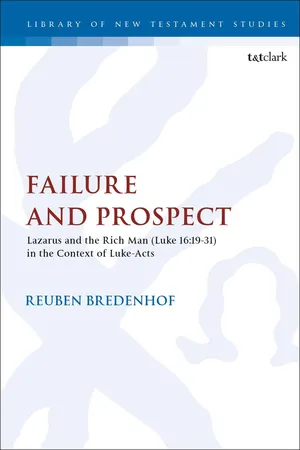
Failure and Prospect
Lazarus and the Rich Man (Luke 16:19-31) in the Context of Luke-Acts
- 264 pages
- English
- ePUB (mobile friendly)
- Available on iOS & Android
eBook - ePub
Failure and Prospect
Lazarus and the Rich Man (Luke 16:19-31) in the Context of Luke-Acts
About this book
Trusted by 375,005 students
Access to over 1.5 million titles for a fair monthly price.
Study more efficiently using our study tools.
Information
Chapter 1
THE CONTINUING STUDY OF LUKE 16:19–31
1. Introduction
Luke 16:19–31 is part of Luke’s Gospel – most readers of the Bible will consider such a remark to be a case of needlessly stating the obvious. Others will be aware that Luke wrote a companion volume to his Gospel, the book of Acts, and that it is within this double literary context that the story of Lazarus and the Rich Man is set.1 This aspect is often overlooked despite the potential of its pronounced impact on interpretation, and it gives rise to the basic purpose and approach of this study. We are investigating the function of this parable in relation to Luke’s two-volume work.2 Having listened to his account so far, how does Luke’s audience hear the story of Lazarus, the rich man, and Abraham? What responses are elicited by the description of the rich man’s affluence, the poor man’s misery, their respective post-mortem reversals, and Abraham’s commentary on their destinies? Through the previous Gospel narratives what evaluation of these three characters is the audience led to form, and what reactions are provoked? Furthermore, as the Lukan audience continues to listen to his account, how do the later narratives of the Third Gospel and Acts shape the reception of the parable and its message? Specifically, how does an awareness of Jesus’s death and resurrection and a familiarity with the activities of the early Christian community in Acts transform how the parable is heard and re-heard? In this study we will advance a narrative, rhetorical and intertextual understanding of Luke 16:19–31 by reading it within this Luke-Acts context. To orient ourselves in this chapter we will consider past scholarship on the parable’s unity, origin, and themes. Then we will review three methods that have been applied to the study of this parable. Finally, we will outline our own approach for this investigation.
2. A Wealth of Scholarship
If Lazarus lying at the rich man’s gate was neglected, the same cannot be said of the story found in Luke 16:19–31. With its memorable characters of Lazarus, the rich man, his five brothers, and Abraham, with its evocative landscape of urban life and afterlife, and with its dramatic reversal of earthly positions, this parable has suffered no neglect at the hands of biblical interpreters. There has been no fewer than five PhD theses written on Luke 16:19–31 in the last ten years,3 as well as a recent volume dedicated largely to methodological, textual, and theological issues pertaining to this passage.4 Yet for all of the scholarly interest there are ongoing debates and discussions about this parable. Some of these questions concern the parable in a general sense: What does the story mean? What is its principal message? Alternately, discussion centres on particular aspects of the parable’s content. For instance, why is the beggar named? Why is the rich man punished? What is the background of the parable’s afterlife topography? The questions multiply, and while some may be considered to have been answered satisfactorily, other questions persist and invite further investigation. Restricting our attention to the history of interpretation since the end of the nineteenth century when there was a burgeoning of parable research, we observe that scholars have investigated numerous elements related to Luke 16:19–31.5
3. The Parable’s Unity
3.1. A Two-Part Parable?
Prompted by an interest in identifying possible sources and reconstructing the history of redaction that lies behind the biblical text, some scholars focus on this parable’s unity and origin.6 As is the case with so many parable studies we must begin with consideration of Jülicher’s seminal work Die Gleichnisreden Jesu.7 He posits that vv. 19–26 comprise the original story of Jesus, albeit one that has origins in popular notions of the afterlife. Verses 27–31 are a secondary, pre-Lukan Christian addition.8 Both sections of the parable are considered to have discrete meanings, with vv. 19–26 about poverty and possessions being the more significant section. In bifurcating the parable, an important consideration for Jülicher is the perceived problem in v. 31 of the five brothers (understood to be representative of the Jewish people) not believing in the resurrection of ‘one from the dead’, who is understood to be emblematic of Jesus. The parable’s notion of resurrection is deemed by Jülicher to be unoriginal, and a later concern for the author of the Third Gospel.9
The story’s bifurcation has been taken for granted in much of subsequent scholarship.10 For instance, after accepting the two-part structure and acknowledging the interpretive assumption that a parable can only have one point, Bultmann considers that the two parts of the parable actually stand in contrast with each other.11 Among more recent scholars, Crossan’s treatment is representative, for he does not consider the parable in its literary context in Luke 16 and he only accepts vv. 19–26 as original.12
3.2. A Cohesive Parable?
Not all are convinced that the parable needs to be read as an intrinsically uneven two-part story. Despite the conventional bifurcation, there are sound reasons to conclude that the parable in its final form constitutes a unity and should be studied as such. In the first place, the proposed division of vv. 19–26 and 27–31 is implausible because it separates the parable in mid-conversation, as the rich man and Abraham dialogue together.13 Schnider and Stenger propose a structuralist argument in support of the unity of the parable, positing a tripartite structure of ‘before’ (vv. 19–21), ‘after’ (vv. 22–23), and a dialogue (vv. 24–31).14 Snodgrass addresses the matter of the parable’s unity and its conventional division, and concludes that the two halves do not conflict but are congruent; indeed, the second portion brings the whole narrative to completion in that the irreversibility and avoidability of the rich man’s torment are made overt through Abraham’s responses.15 Likewise, Snodgrass cautions against overemphasizing the traditional rule of ‘end stress’ in interpreting the parables,16 and suggests that the themes of the use of wealth and the sufficiency of Scripture are equally important to the parable’s message.17 In this study we will consider that vv. 19–31 are a unified illustration of the Lukan perspectives on wealth and poverty, as well as on authoritative revelation. We will also observe that the question of the parable’s internal cohesiveness has interpretive consequences.18
4. The Parable’s Origin
Luke 16:19–31 is patently unique among the other Synoptic parables. While every other parable is set within the socio-economic setting typical of the first-century Palestinian world, Luke 16:19–31 largely takes place in another realm, with the rich man suffering in Hades and Lazarus resting in the bosom of Abraham.19 As a consequence there has been copious scholarly attention to these exceptional elements and their provenance. We will see that suggestions for the origin or background of this narrative about the respective post-mortem destinies of a poor man and a rich man have ranged from an original setting in Jesus’s ministry, to the stories of Egyptian mythology, to the legends of the Greek heroes, Jewish folk tales, and Cynic literature.
4.1. A Teaching of Jesus?
Some assume that Jesus spoke this parable in its entirety during his ministry.20 Luke, having considered the testimony of the ‘eyewitnesses’ (αὐτόπται, 1:2) and having ‘investigated everything from the source’ (παρηκολουθηκότι ἄνωθεν πᾶσιν, 1:3), accurately recorded the parable for posterity with little – if any – editorial modification.21 Bock observes that the parable’s unique character prompts the question of whether the account stems from Jesus, yet in favour of its originality he notes that ‘Jesus’ critique of wealth for its own sake exists in many levels of the tradition’.22 Others...
Table of contents
- Cover
- Half-Title
- Title
- Contents
- Acknowledgments
- Chapter 1 The Continuing Study Of Luke 16:19–31
- Chapter 2 Luke 16:19–31 As Narrative
- Chapter 3 Rhetoric In Luke 16:19–31
- Chapter 4 Intertextuality In Luke 16:19–31
- Chapter 5 Luke 16:19–31 Within Luke-Acts
- Chapter 6 Conclusions And Implications
- Bibliography
- Index of References
- Index of Authors
- Copyright
Frequently asked questions
Yes, you can cancel anytime from the Subscription tab in your account settings on the Perlego website. Your subscription will stay active until the end of your current billing period. Learn how to cancel your subscription
No, books cannot be downloaded as external files, such as PDFs, for use outside of Perlego. However, you can download books within the Perlego app for offline reading on mobile or tablet. Learn how to download books offline
Perlego offers two plans: Essential and Complete
- Essential is ideal for learners and professionals who enjoy exploring a wide range of subjects. Access the Essential Library with 800,000+ trusted titles and best-sellers across business, personal growth, and the humanities. Includes unlimited reading time and Standard Read Aloud voice.
- Complete: Perfect for advanced learners and researchers needing full, unrestricted access. Unlock 1.5M+ books across hundreds of subjects, including academic and specialized titles. The Complete Plan also includes advanced features like Premium Read Aloud and Research Assistant.
We are an online textbook subscription service, where you can get access to an entire online library for less than the price of a single book per month. With over 1.5 million books across 990+ topics, we’ve got you covered! Learn about our mission
Look out for the read-aloud symbol on your next book to see if you can listen to it. The read-aloud tool reads text aloud for you, highlighting the text as it is being read. You can pause it, speed it up and slow it down. Learn more about Read Aloud
Yes! You can use the Perlego app on both iOS and Android devices to read anytime, anywhere — even offline. Perfect for commutes or when you’re on the go.
Please note we cannot support devices running on iOS 13 and Android 7 or earlier. Learn more about using the app
Please note we cannot support devices running on iOS 13 and Android 7 or earlier. Learn more about using the app
Yes, you can access Failure and Prospect by Reuben Bredenhof in PDF and/or ePUB format, as well as other popular books in Theology & Religion & Biblical Studies. We have over 1.5 million books available in our catalogue for you to explore.