J. Andrew Cowan challenges the popular theory that Luke sought to boost the cultural status of the early Christian movement by emphasising its Jewish roots – associating the new church with an ancient and therefore respected heritage. Cowan instead argues that Luke draws upon the traditions of the Old Testament and its supporting texts as a reassurance to Christians, promising that Jesus' life, his works and the church that follow legitimately provide fulfilment of God's salvific plan.
Cowan's argument compares Luke's writings to two near-contemporaries, Dionysius of Halicarnassus and T. Flavius Josephus, both of whom emphasized the ancient heritage of a people with cultural or political aims in view, exploring how the writings of Luke do not reflect the same cultural values or pursue the same ends. Challenging assumptions on Luke's supposed attempts to assuage political concerns, capitalize on antiquity, and present Christianity as an inner-Jewish sect, Cowan counters with arguments for Luke being critical of over-valuing tradition and defining the Jewish people as resistant to God and His messages. Cowan concludes with the argument that the apostle does not strive for legitimisation of the new church by previous cultural standards, but instead provides theological reassurance to Christians that God's plan has been fulfilled, with implications for broader debate.
eBook - ePub
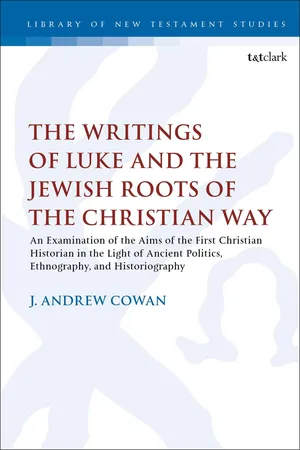
The Writings of Luke and the Jewish Roots of the Christian Way
An Examination of the Aims of the First Christian Historian in the Light of Ancient Politics, Ethnography, and Historiography
- 232 pages
- English
- ePUB (mobile friendly)
- Available on iOS & Android
eBook - ePub
The Writings of Luke and the Jewish Roots of the Christian Way
An Examination of the Aims of the First Christian Historian in the Light of Ancient Politics, Ethnography, and Historiography
About this book
Trusted by 375,005 students
Access to over 1.5 million titles for a fair monthly price.
Study more efficiently using our study tools.
Information
Chapter 1
THE OLD IS GOOD? THE WRITINGS OF LUKE AND THE CHRISTIAN MOVEMENT’S JEWISH ROOTS IN RECENT SCHOLARSHIP
In the midst of his Historiae, the Roman historian Tacitus gives an account of the origins and customs of the Jewish people. To say that Tacitus was no friend of the Jewish people is a gross understatement: he concluded his discussion by declaring, “The customs of the Jews are absurd and foul” (Hist. 5.5).1 Nevertheless, before rendering this final verdict, Tacitus stated regarding some of the customs, “These rites, whatever their origin, are defended by antiquity (antiquitate defendentur)” (Hist 5.5). This latter comment reflects a perspective that was widely shared in the ancient world but no longer holds currency in much of Western civilization: the estimation that antiquity is a key criterion in judging legitimacy and value. This criterion was often applied to ideas and practices, and many groups seeking an elevated status within society sought to demonstrate their ancient pedigree.2
Over the course of the past forty years, an increasing number of New Testament scholars have suggested that the writings of Luke emphasize the Jewish roots of the Christian movement in order to address precisely this issue. They claim that one of the primary motivations behind Luke’s emphasis on the association between Christianity and Judaism was his desire to furnish the Christian movement with a respectable ancient heritage.3 The purpose of this study is to examine and evaluate this claim.
1.1The Origin and Varieties of the Antiquity Proposal
Modern proposals that link Luke’s interest in the Jewish roots of the Christian movement with the issue of antiquity typically develop from and react to a well-known older reading of Luke’s writings: the view that Luke’s writings are intended to function as a political apology.
The reading of Luke’s writings as a political apology is usually traced back to a 1720 study by C. A. Heumann. In this study, Heumann argues that Luke’s writings are an explanation of the Christian movement addressed to a Roman official named Theophilus.4 Although opinions on Theophilus varied over the years, the claim that one of Luke’s primary intentions was to defend Christianity against charges of sedition or to secure the place of the Christian movement within the Roman Empire eventually came to be a majority opinion within Lukan scholarship.5
In 1897, Johannes Weiss proposed what came to be a particularly influential variant of this position, suggesting that the means by which Luke sought to establish the place of the church within the Empire was by arguing that the government should view Christianity as a type of Judaism.6 A similar proposal was set forth in the second volume of the collection of studies on Acts published under the title The Beginnings of Christianity, within which the editors suggest that Luke sought to identify Christianity as the true religion of Israel because Rome only tolerated the religions of recognized races.7 This proposal then came to quintessential expression in Henry J. Cadbury’s seminal work, The Making of Luke-Acts.8 Although Cadbury expresses some qualifying hesitations,9 his work introduced the phrase religio licita into the discussion, and this contribution established his status as a central proponent of this view. He writes:
It may even be conjectured that [Luke’s] political apologetic had as its aim the satisfaction of Rome’s demand that foreign religions must be licensed to be permitted. If Judaism was a religio licita and Christianity was not, it was important to show that Christianity was only a legitimate form of Judaism and could shelter under the Jewish name.10
Cadbury later repudiated both the phrase religio licita and the idea that Rome licensed religions,11 but the influence of his initial proposal was substantial. In the following years, many others endorsed the view that Luke’s aim was to position the church within the legal protections that were afforded to the Jewish religion, often describing Luke’s goal with the phrase religio licita.12
Others continued to argue that Luke’s intention was political apologetic without evoking the relationship between Christianity and Judaism,13 and a few objected to the claim that Luke had a political agenda,14 but the religio licita view remained the majority position until around the 1980s. At this time, however, three main objections to the view that Luke’s writings are political apologetic gained prominence, and construals of Luke’s intentions in the political sphere began to proliferate.
First, there was a growing consensus that Luke’s writings were not addressed to outsiders but to Christians, or, at the very least, to people who were considering converting to Christianity.15 C. K. Barrett’s statement of this objection is frequently cited: “[Acts] was not addressed to the Emperor, with the intention of proving the political harmlessness of Christianity in general and Paul in particular . . . No Roman official would ever have filtered out so much of what to him would be theological and ecclesiastical rubbish in order to reach so tiny a grain of relevant apology.”16
Second, many began to note that Luke’s depiction of the Roman Empire was less decidedly positive than the political apologetic reading assumes. This is the primary objection that Jacob Jervell raises against the political apologetic view,17 but the point is made most forcibly (although with some overstatement) in two monographs by Richard Cassidy.18
Third, the claim that Rome regulated religion and granted Judaism the status of a religio licita was called into question. In a 1982 monograph, Robert Maddox examines the studies of Rome’s dealings with religious groups from the field of Classics, and he finds evidence for Rome’s regulation of religious practice wanting. Consequently, Maddox absolutely rejects the religio licita reading: “The theory of a ‘religio licita’ as explaining the purpose of Luke-Acts may therefore be regarded as unfounded and now discredited.”19 Maddox’s conclusion was then bolstered by Philip Francis Esler, who similarly rejects the claim that Rome licensed religions. Esler also provides a study of the extant evidence for the particular relationship between Rome and the Jewish people, suggesting that the issues that Rome did address were too focused on the particulars of Jewish customs to have relevance for Christian communities.20
Together, these objections brought an end to the dominance of the traditional political apologetic view and the claim that Christianity found shelter within Judaism as a religio licita. In the wake of this dissolution, scholars have set forth a wide variety of interpretations of Luke’s political agenda. The options proposed range from Paul W. Walaskay’s suggestion that Luke’s writings commended the behavior of the Roman Empire to Kazuhiko Yamazaki-Ransom’s argument that Luke presented the Roman Empire as a diabolical institution.21 Within this ongoing discussion, a stream of scholarship has emerged that continues to insist that Luke’s emphasis on the Jewish roots of the Christian movement was (at least partially) motivated by social or political concerns. This stream consists of those who argue that Luke’s interest was in demonstrating that the Christian movement deserves the respect and authority afforded by an ancient heritage.
Proposals along these lines have been set forth by several scholars since the breakup of the older political apologetic reading, but Nils A. Dahl’s 1966 study of Luke’s treatment of Abraham stands as a forerunner to these more recent proposals. Dahl concludes, “[Luke’s] interest in Abraham and his archaizing tendency in general bear the stamp of an age that looked back to classical times and considered antiquity an indication of value.”22 This comment does not appear to have inspired the more recent proposals, but the correspondence is notable.
The recent proposals begin with two studies from the 1984 book Luke-Acts: New Perspectives from the Society of Biblical Literature Seminar. Within this book, the essays by both Robert L. Brawley and Charles H. Talbert promote the claim that Luke appealed to the Christian movement’s Jewish roots in order to associate the Christian movement with antiquity. Brawley’s essay suggests that Luke appealed to antiquity by presenting Paul as a proclaimer of Jewish tradition. Luke did this, Brawley claims, because antiquity was a familiar criterion of legitimation for his Hellenistic audience.23 Talbert, on the other hand, argues that Luke attempted to link the Christian movement with the old and respected Jewish tradition through his extensive use of the motif of prophecy and fulfillment. This connection, Talbert claims, is intended to enhance the cultural profile of the Christian movement. Talbert compares Luke’s strategy to that of the Jewish historian T. Flavius Josephus. He points out that Josephus’s Antiquitates judaicae emphasizes the antiquity of the Jewish tradition in order to enhance the cultural profile of the Jewish people. Talbert also claims that Josephus borrowed this strategy from the Greek historian Dionysius of Halicarnassus, whose similarly titled history of the Romans, Antiquitates romanae, argues that the Romans are legitimate heirs of the ancient Greek tradition.24
Similar claims that Luke’s association of the Christian movement with Judaism is a play for cultural respect via antiquity appear in brief in a number of subsequent studies.25 Among these, three are worth mentioning. First, in Jack T. Sanders’s well-known book arguing that Luke was anti-Semitic, Sanders suggests that the need to provide the Christian movement with ancient roots explains several of the passages with positive references to the Jewish people in Luke’s writings.26 Second, F. Gerald Downing proposes that Luke’s reports of instances of Jewish Christian observance of the Mosaic law serve as a sociocultural apologetic by linking the church with the antiquity of Jewish...
Table of contents
- Cover
- Series Page
- Dedication Page
- Title Page
- Contents
- Acknowledgments
- Note on Translation
- Abbreviations
- Chapter 1 The Old Is Good? The Writings of Luke and the Christian Movement’s Jewish Roots in Recent Scholarship
- Chapter 2 Dionysius of Halicarnassus and the Ancient Greek Roots of the Roman People
- Chapter 3 Josephus and the Antiquity of the Jewish People
- Chapter 4 The Writings of Luke and the Jewish Roots of the Early Christian Movement
- Chapter 5 Conclusion
- Modern Author Index
- Biblical and Other Ancient Sources Index
- Copyright Page
Frequently asked questions
Yes, you can cancel anytime from the Subscription tab in your account settings on the Perlego website. Your subscription will stay active until the end of your current billing period. Learn how to cancel your subscription
No, books cannot be downloaded as external files, such as PDFs, for use outside of Perlego. However, you can download books within the Perlego app for offline reading on mobile or tablet. Learn how to download books offline
Perlego offers two plans: Essential and Complete
- Essential is ideal for learners and professionals who enjoy exploring a wide range of subjects. Access the Essential Library with 800,000+ trusted titles and best-sellers across business, personal growth, and the humanities. Includes unlimited reading time and Standard Read Aloud voice.
- Complete: Perfect for advanced learners and researchers needing full, unrestricted access. Unlock 1.5M+ books across hundreds of subjects, including academic and specialized titles. The Complete Plan also includes advanced features like Premium Read Aloud and Research Assistant.
We are an online textbook subscription service, where you can get access to an entire online library for less than the price of a single book per month. With over 1.5 million books across 990+ topics, we’ve got you covered! Learn about our mission
Look out for the read-aloud symbol on your next book to see if you can listen to it. The read-aloud tool reads text aloud for you, highlighting the text as it is being read. You can pause it, speed it up and slow it down. Learn more about Read Aloud
Yes! You can use the Perlego app on both iOS and Android devices to read anytime, anywhere — even offline. Perfect for commutes or when you’re on the go.
Please note we cannot support devices running on iOS 13 and Android 7 or earlier. Learn more about using the app
Please note we cannot support devices running on iOS 13 and Android 7 or earlier. Learn more about using the app
Yes, you can access The Writings of Luke and the Jewish Roots of the Christian Way by J. Andrew Cowan in PDF and/or ePUB format, as well as other popular books in Theology & Religion & Biblical Studies. We have over 1.5 million books available in our catalogue for you to explore.