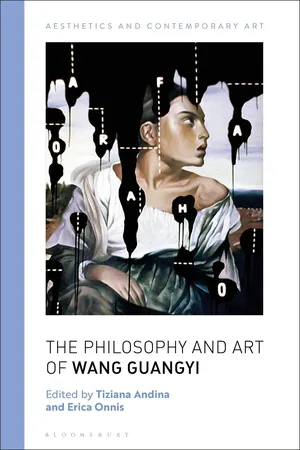
Wang Guangyi, one of the stars of the new wave of Chinese art, has artistically addressed major philosophical trends in Western philosophy while drawing on Taoism, Marxism and Maoism. By bringing together a team of experts in the philosophy of art to discuss his work, The Philosophy and Art of Wang Guangyi presents the first philosophical exploration of Wang's art, his thought and his analysis of Chinese society.
From his use of words in images to his reference to the classics of Western painting, contributors set Wang's work against key questions in contemporary art. As well as answering what makes the language of pop art successful, they examine whether art and its history have come to an end, as Hegel posited, and if it is possible or even necessary to rework a new narrative for the history of contemporary art. The Philosophy and Art of Wang Guangyi marks an important contribution to understanding the background, work and ideas of a 21st-century political artist outside the West.
eBook - ePub
The Philosophy and Art of Wang Guangyi
- 296 pages
- English
- ePUB (mobile friendly)
- Available on iOS & Android
eBook - ePub
The Philosophy and Art of Wang Guangyi
About this book
Trusted by 375,005 students
Access to over 1.5 million titles for a fair monthly price.
Study more efficiently using our study tools.
Information
Part I
Defining the Human and Humanizing the Divine
1
Gratings, Barriers, and Boundaries: Wang Guangyi’s Transcendental Painting
Luca Illetterati 意泐
Gratings and Strikethroughs
In Red Rationality—Revision of Idols (1987) or in the triptych Mao Zedong AO (1988) (see Figure 4.2), the figures and faces painted by Wang Guangyi are covered by a sort of grating: a geometric pattern that in some way hinders a free, full and direct vision of the images underneath. Something similar can also be seen, albeit in a different form, in International Politics—Necessary Documents and in other works of the 1990s (I am thinking for example of Passport No. 2 (see Figure 1.1), where the reticular grating is significantly made up of the words saying who we are, where we were born, the time and place in which we are living).

Figure 1.1 Wang Guangyi, Red Rationality—Revisions of Idols (1987), oil on canvas, 160 × 200 cm.
In reality, what lies behind and underneath the grating is absolutely clear; the pattern does not really hide what exists in that sort of further space, beyond the grid. Whether what lies beyond is the trace of Michelangelo’s Pietà or Mao Zedong’s classic icon, or even the enlarged reinterpretation of a photo card, one that could appear in any kind of document, the object of representation is not really obliterated by the gratings—it is not hidden by the lines that cross it or by the signs placed above it. If anything, it is a bit as the Heideggerian expedient of striking-through the word Sein (Being) to indicate how it is both necessary and unattainable.
The word Sein, according to Heidegger, is at the same time the only object of thought (although the expression “object of thought” is inadequate in relation to Heideggerian philosophy) and its most radical obnubilation. The barred form Sein expresses both what must necessarily be said and the conviction that what is to be said cannot be said in the way we are able to say it. Likewise, in the images of Wang Guangyi, the observer must not make any effort to see what is beyond the grate. And indeed, just as in Heidegger’s struck-through Sein, what lies beyond becomes even more visible thanks to its deferral to this form of pseudo-deletion.
As known, Sein is the word for “being,” which in its verbal form is the all-pervasive and decisive part of any discourse and that, however, in our ordinary communicative practices, we perceive as requiring no explanation or definition of any kind. “Being” is in many ways the source of the meaning of most of our assertions and, yet (perhaps precisely because it is a condition of possibility of meaning), its meaning goes largely unquestioned.1
A separating and distancing sign—such as the Heideggerian strikethrough, but also the different forms of grid that characterize Wang Guangyi’s works—actually clarifies what lies underneath it, submitting it to our gaze while making it both far and close, isolating it from the everyday context it is usually immersed in. The strikethrough, the grating, the lattice establish and bring to the fore the otherness of what lies beyond these forms of barrier.
The Other Dimension
What the observer becomes aware of by experiencing these works, thanks to the barred image, is the fact that the latter exists on the other side, in a dimension other than the observer’s; the image refers, so to speak, to a space of transcendence that is present to the gaze but also exists in a separate dimension with respect to the observer. What lies beyond the grating, what emerges behind the simple geometry that separates the observer from the image represented, are mostly ideal-typical figures, sometimes faceless (as in the case of Pietà), sometimes with a face that is so well known as to be basically a sort of icon (as in the case of Mao), sometimes with a face that is somehow standard, devoid of specific and peculiar characterizations, as in the photo card. In other words, what lies beyond the grating is never the representation of an individual concrete body—it is never really an embodied figure.
The image that lies beyond the grating is in some ways an image out of time, an image that stands out on a background that is radically alien to the concrete space of the world of life. The figures beyond the grating are, in short, overdetermined—so much so that their identification is immediate and does not require any particular effort—and yet abstract; they are individual, recognizable figures (Mao Zedong, the Pietà by Michelangelo, the face of a male on his identity document) and yet universal; they are specific historical figures and yet ideal figures, pure images, supra-historical icons.
The grating therefore establishes two dimensions of space, two experiences that are clearly separate and irreducible to one another, even if, in some way, they are each other’s condition of possibility. On one side there is the observer: a concrete body, a singular body in movement and in becoming, a body forged by nature and history, always immersed in memory and tradition, and necessarily marked by peculiar emotional states. This body is therefore the result of a specific time-space.
On the other hand, there is a reality that is somehow frozen: the similarities between the figures of Red Rationality and those of the Frozen North Pole (Figure 1.2) and Post Classical (see Figure 4.1) series are evident in this sense, showing a universalized reality purged of temporal waste and placed within an ideal dimension, which is in many ways utopian (or perhaps dystopic) and supra-historical. The figure that lies beyond the grid is certainly Mao Zedong, but in such a typified form that it is, so to speak, the idea of Mao Zedong, a concept, an icon, as we have said, and therefore his representation in the form of disembodied universality. The same applies to the figure of Michelangelo’s Pietà: what we see beyond the grating is the image of the Pietà, an almost abstract representation of it, a representation of its concept.

Figure 1.2 Wang Guangyi, Frozen North Pole No. 24 (1984–85), oil on canvas, 68 × 86 cm.
So much so that, in some ways, from the point of view of the content, it could also refer to one of the infinite reproductions of Michelangelo’s sculpture found in the stalls of trinket markets, because those kitsch statuettes embody not so much the specificity of Michelangelo’s work but rather the idea behind it, its symbolic and iconic power. The Pietà beyond Wang Guangyi’s grating is the opaque outline of the Pietà—one would almost call it the “Shroud of the Pietà.” It is not coincidental—on the contrary, it is strictly consistent with Wang Guangyi’s thought and artistic path—that he recently focused his attention on the theme of the Shroud (Sindone). The Shroud is the mark of transcendence, the shadow left in history by what is supra-historical, the footprint in the world of what is other than the world.
In the Catholic imaginary, the Shroud is the trace of eternity in time, the reflection of transcendence in life: it is the concrete, determined, material, and therefore perishable image of what is essential, ideal, and not subject to the laws of time; the image of an original reality that is destined to be experienced and presentified within the historical dimension only through its absence, as a reflection. It is necessary to understand the cult of the Shroud in the light of the great iconoclastic debate that marked so deeply the Western pictorial tradition. The Shroud bears in fact an image of what cannot have an image; it is a figure of what cannot be reduced to any specific or particular portrait; it bears a mark of the body and its negation at the same time. As the image of the Other, which cannot be represented without being radically betrayed and annulled, and therefore as a sign and representation of an absence, the Shroud is in many ways the obsession underlying the history of Western painting.
Vorstellungen
But let us go back to the gratings. There are therefore two sides of the grid: one where we stand, with our bodies, our moods, and our memories; and one beyond, wherein lies the idea, the spirit, the essence. In the artwork, the grating activates a number of movements and passages that depend precisely on the grating and the space it occupies. So, the grid is what separates the dimension of transcendence from the ordinary one of the observer; it is the place that marks the border between time and eternity. However, it is also what leads us to the threshold of this transcendence, allowing us to cast our gaze beyond the place where we are and onto a space that—although through the grating—is open to us. Indeed, the dimension that presents itself as a sort of “beyond” becomes, in a way, what orients and gives meaning to the way we dwell in the world.
In fact, the otherness that lies beyond the grating is, as we have said, something immediately recognizable and identifiable. The otherness that is revealed there is not foreign. Far from it: this otherness presents itself in the form of the ordinary, the usual, the everyday. Everyone knows Mao Zedong’s face; perhaps there is none better known, especially for a Chinese person. Even the most distracted person in the history of art can recognize Michelangelo’s Pietà beyond the grating of Red Rationality: it is almost a universal icon of art, but also of a Christian religious feeling that, in it, becomes a universal and transcultural sentiment. And, again, everyone can recognize a photo card in the face of Passport No. 2: namely a photo that could be showing anyone, that could be anybody’s photo.
Now, because of the deferral produced by the grating, this element of everydayness and familiarity becomes fraught with a symbolic value that radically transforms it and “transfigures” it, to use Danto’s expression.2 This transfiguration is also a disincarnation, a stripping of the historical and conditioned element that is proper to those faces. What lies beyond the grating is more than a face, more than a specific image irreducible in its singularity: once again, it is a Shroud, the trace of an idea, a kind of archetype, an idol. As Wang Guangyi repeatedly emphasizes, it is the representation of a concept.
In the introductory paragraphs of the Encyclopedia of Philosophical Sciences (1830), Hegel wrote that representations (Vorstellungen) “in general can be regarded as metaphors of thoughts and concepts” (§ 3 An.).3 Now, the fact that Hegel describes representation as a metaphor of a concept underlines the idea that representations and concepts do not refer to different things, but rather are different ways to express the same thing. For Hegel, representations are images and generally modalities that are more immediate than conceptual articulation: they express what the concept expresses in the pure form of thought, without resorting to iconic constructs or sensible elements. In other words, representation is an image that is elevated to the form of universality and, yet, at the same time, does not take the form of the concept—that is, has not yet freed itself (in the Hegelian perspective) from the sensible element that is typical ...
Table of contents
- Cover
- Halftitle Page
- Series Page
- Title Page
- Contents
- Figures
- Notes on Contributors
- Introduction
- Part I Defining the Human and Humanizing the Divine
- Part II Duplicating the Scene
- Part III Bridging the Cultural Divide through Pop
- Part IV Words and Images: Two Instruments to Describe the World
- Part V Erasing the Emotions
- Part VI The Circle of Life: Presenting and Representing Food
- Part VII In Dialogue with Wang Guangyi
- Index
- Copyright Page
Frequently asked questions
Yes, you can cancel anytime from the Subscription tab in your account settings on the Perlego website. Your subscription will stay active until the end of your current billing period. Learn how to cancel your subscription
No, books cannot be downloaded as external files, such as PDFs, for use outside of Perlego. However, you can download books within the Perlego app for offline reading on mobile or tablet. Learn how to download books offline
We are an online textbook subscription service, where you can get access to an entire online library for less than the price of a single book per month. With over 1.5 million books across 990+ topics, we’ve got you covered! Learn about our mission
Look out for the read-aloud symbol on your next book to see if you can listen to it. The read-aloud tool reads text aloud for you, highlighting the text as it is being read. You can pause it, speed it up and slow it down. Learn more about Read Aloud
Yes! You can use the Perlego app on both iOS and Android devices to read anytime, anywhere — even offline. Perfect for commutes or when you’re on the go.
Please note we cannot support devices running on iOS 13 and Android 7 or earlier. Learn more about using the app
Please note we cannot support devices running on iOS 13 and Android 7 or earlier. Learn more about using the app
Yes, you can access The Philosophy and Art of Wang Guangyi by Tiziana Andina, Erica Onnis, Tiziana Andina,Erica Onnis in PDF and/or ePUB format, as well as other popular books in Philosophy & Aesthetics in Philosophy. We have over 1.5 million books available in our catalogue for you to explore.