- 168 pages
- English
- ePUB (mobile friendly)
- Available on iOS & Android
eBook - ePub
About this book
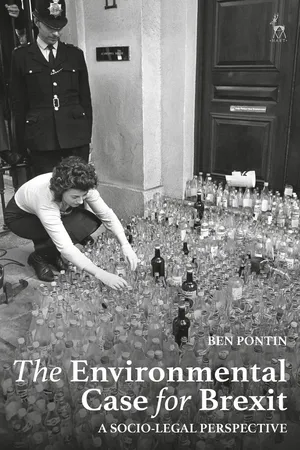
The recent Brexit debates present leaving the European Union largely as a threat to environmental protection, and to environmental law. This exciting and important new work argues that Brexit represents a real opportunity for environmental protection in the United Kingdom, freeing it from a pan-European framework not necessarily fit for UK domestic purposes. Central to the argument is the belief that environmental protection, in the United Kingdom, can most effectively be pursued through established domestic institutions, looking inwards at 'local' challenges and outwards at more global ones, all the while drawing on considerable historical experience. The book is designed to address rather than dismiss those concerns raised by environmental lawyers after the outcome of the referendum. Provocative and compelling, it offers an alternative vision of the UK environmental law framework outside of the European Union.
Trusted by 375,005 students
Access to over 1.5 million titles for a fair monthly price.
Study more efficiently using our study tools.
Information
1
Introduction
This book explores the environmental case for Britain’s withdrawal from the European Union (EU). It does so against the backdrop of widespread concern that environment law and, crucially, the environment itself will suffer as a consequence of Britain’s exiting the EU. The environment has made the ‘journey to the centre stage’ of the EU,1 such that nearly all areas of domestic regulatory law concerning the environment are connected with the EU acquis to a greater or lesser extent.2 What will happen to regulatory law when Britain withdraws from the EU? What will happen to the environment? One worry is that the rigour of EU-derived domestic legislation that is retained (‘retained law’) will be relaxed to boost the economy. Another is ‘zombie law’, where retained law is stripped of the jurisdiction of the European Commission and European Court of Justice, giving only an illusion of environmental protection.3 Mindful of this, commentators lean towards a Brexit that is as ‘soft’ as possible, by which substantive EU law is retained and backed by a system of governance (especially concerning monitoring and enforcement) which replicates that of the EU.4
These concerns are reasonable and sincere, and the purpose of my book is not to impugn them. Rather, the purpose is to situate anxiety about the future of environmental law outside of the EU in a broader socio-legal context, taking into account the historical development of the law (both British and EU) and the practical impact of formal law on the physical environment. The themes of formal law, historical influence and ‘real world impact’ come together particularly well in Karl Llewellyn’s ‘law jobs theory’,5 and it is this that provides the theoretical framework for my study. According to this theory, law is a ‘way’ of facilitating the doing of jobs that are necessary for a society to survive and to flourish, including shaping and reflecting societal values, creating incentives to do things better, channelling behaviour to minimise disputes and resolving disputes that arise. Environmental law cuts across each area of this job description, yet the theory has attracted surprisingly little attention in environmental law scholarship.6 Britain’s withdrawal from the EU is a timely opportunity to begin to make good this gap in the literature. How will Britain’s departure from the EU impact on the doing of ‘environmental law jobs’? Will it really create weaknesses that need addressing? Might it create greater opportunities for these jobs to be done well?
The law jobs theory connects strongly with the present subject matter, because of the narrative of there being a ‘British way’ of doing environmental protection that was dominant when Britain entered the Community.7 This narrative emerged in response to the internationalisation of environmental politics, culminating in the United Nations Conference on the Human Environment, in Stockholm in 1972. It operated (as the saying goes) both as a sword and as a shield: as a sword in the sense that it helped position Britain as a global leader in international environmental policy and law; as a shield in demarcating a territory for exclusive control through domestic institutions. As Nigel Haigh pointed out in his early history of Britain’s relationship with EU environmental law,8 the emphasis on a national way of doing law in this field distinguished Britain from the countries who invented the European Economic Community. The founders (hereafter EU-6) embraced ‘some kind of supra-nationalism’.9 Whilst they too had their own ways of doing environmental law, they were more willing than Britain to treat environmental law (in Ludwig Kramer’s words) as ‘virgin law’.10 Britain, by contrast, emphasised its embeddedness in national heritage. It considered relinquishing of the established crafts of environmental law shaped by centuries of experience to a new jurisdiction as unnecessary and irresponsible. I examine the merits of that stance and its relevance to articulating a positive environmental case for Brexit. Is recourse to a national way in Britain the responsible position to adopt moving forward, as Britain exits the EU? If so, how can that be reconciled with other European countries’ continuing embracing of a greater degree of ‘supra-nationalism’?
A helpful starting point in introducing the British way as a normative tool is provided by the speech of Peter Walker, the British Secretary of State for the Environment, at the Stockholm Conference.11 Britain, he said, had the world’s most established regulatory laws regarding industrial pollution control and nature conservation, the foundations of which were laid by Parliament at Westminster in Victorian times. These laws coexisted alongside medieval-originating common law and Scots law conceptions of property in land, giving expression to the ethics of the ‘good steward’ and the ‘good neighbour’, to constitute a dynamic mix of ‘public law’ and ‘private law’, written and unwritten. The enforcement of this law by executive bodies and individuals brought visible benefits, such as cleaner industrial processes, prevention of waste, conservation of flora and fauna, and the protection of bucolic countryside accessible to all.
Walker was situating the British vision of international environmental policy and law within a Westphalian paradigm geared around mutual recognition of national sovereignty.12 This approach was popular across the British political spectrum, for it appeared to reconcile the established Westminster system of ‘responsible government’ with an internationalism that appealed to emergent environmental activists. Thus few would have objected to the sentiments of Stanley Johnson, who commented that ‘Peter Walker’s speech that afternoon was the culmination of an effort which began with the Alkali Acts of the mid nineteenth century or even, some might say, earlier still’.13 Johnson added that ‘We [Britain] probably knew more about environmental planning and management than anyone else’.14 The ‘we’ in this setting had a broad meaning, referring to the ‘50 million volunteers’ (ie British subjects) on whose efforts the country could count when it came to inspirationally effective ways of protecting the environment.15
This narrative led Britain’s political leaders to be wary of the Community’s assumption of competence in the field of the environment. Aware that the Commission was drafting a programme of environmental action under a Council mandate given to it in 1971,16 Peter Walker instructed civil servants to take ‘a positive part in the discussions as they develop, to influence the Community’s thinking’,17 yet ‘guard against making pollution measures obligatory, in the cause of harmonisation, in circumstances where they are not called for in practical terms’.18
According to Martin Holdgate – the official who headed the Environmental Protection Group within the Department of Environment – the phrase ‘practical terms’ meant dealing with transboundary pollution and trade, but little else; as a general rule, ‘it should be left to countries to protect their own environments’.19 This was the message of the text of the Stockholm Declaration, and the expectation was that pollution would continue to be controlled, and nature conserved, in accordance with the British way.
In what follows I revisit that expectation, with particular reference to literature published on the cusp of the Single European Act 1986, when the Community’s environmental competence received an explicit formal treaty mandate. A key work in this respect is Nigel Haigh’s Essay and Handbook.20 The ‘Essay’ part of the work situates Community law in the context of historic developments in domestic environmental law and emerging international law. The ‘Handbook’ analyses the practical impact on domestic provision of Community interventions in the fields of water, waste, air, nature conservation and others. In this respect Haigh draws on discussions with officials within the Department of Environment, thus adopting an ‘empirical’ approach. This was thought necessary because of the absence of formal signs of Community impact: Britain, when Haigh was writing, was operating within the pre-Community framework of the Environment White Paper of 1970 (as it remained until This Common Inheritance, in 1990).21
The value of Haigh’s approach lies in its attention to detail. Haigh’s chief finding within the empirical (‘Handbook’) part of the analysis is as follows:
With the benefit of hindsight … the passing by the British Parliament of the European Communities Act 1972 was [a] significant step that has changed the way an important part of British environmental policy is now thought about, enunciated and ultimately is even put into practice.22
This sets an agenda for my work. How did the domestic position change as a consequence of Community – and more recently EU – membership? Has change been for the better? Haigh’s Essay and Handbook received a favourable response from Eric Ashby, one of the main critics of Community environmental interventions and the chief advocate of the British way.23 But what significance should be attached to that?
I argue that experience of EU membership has largely vindicated doubts about a novel supranational competence expressed by advocates of the British way on entry to the Community. The fundamentals of the British way paradigm as a sword and shield remain valid today. The responsible approach to environmental policy, law and practice in Britain (and its wider global relationships) is independent of EU institutions.
The structure of the book is as follows. Chapter 2 elaborates on the British way of environmental protection, drawing upon political science as well as law disciplinary literature, and using the law jobs theory as an organising concept for doing so. The law jobs theory is particularly helpful because it is descriptive and normative. It highlights the institutional conditions under which (environmental) law jobs are well done. The chapter anticipates criticisms of the British way and my argument that it is relevant post-Brexit. Some of these involve a more jaundiced (or less rose-tinted) perception of the British way as Britain entered the Community, whilst others address the existential issue that, rightly or wrongly, the British way has not survived membership of the EU and devolution. The chapter also introduces the ‘case studies’ through which the environmental case for Brexit is articulated.
Case study is method by which Llewellyn and Hoebel illuminated the functionality of Cheyenne law-ways, and it is also the approach of political scientists studying European integration noted above.24 My book revisits areas examined by Haigh’s Essay and Handbook, namely, waste, water quality, air quality and nature conservation. These reflect some of the diversity of the challenges tackled by EU environmental law. They are also widely associated with the benefits of EU membership.25 Britain’s environment in these fields, so the argument goes, is ‘getting better’, and that is testimony to the benefits of the EU acquis, and the desirability of mirroring EU law as far as possible after Brexit.
These fields are also selected because of the existence of thorough contemporary records of domestic environmental ‘performance’ when the EU journey began. Thus it is possible to compare with some precision the environment ‘on the ground’ as Britain prepares to leave with that when it entered. Against that backdrop, the ‘getting better’ notion is rather problematic. Per capita production of waste is considerably greater than that on entry, whilst biodiversity has declined. Rivers are broadly of the quality they were half a century ago. Only in the field of air pollution can it be said that Britain is leaving the EU in ruder health than it entered. Britain’s environment thus arguably has not largely got better, but that does not mean that there are not positive achievements to reflect on, in terms of the contribution of EU law (relative to the British way).
This leads on to the issue of apportioning the relative impact on the environment of the British way and EU law. It is notoriously hard to attribute a causal connection between law and practice on the ground in any field.26 In the present field, the causal challenge is asymmetrical vis-à-vis the British way and EU law. By that I mean that it is easier to attribute developments in environmental quality in Britain over recent decades to domestic provision over EU law, for three reasons. First, EU law largely focuses on public law responses to environmental problems, in which competent national executive bodies are required to achieve the objectives of EU law. Thus EU law cannot claim credit for improvements resulting from private law initiatives, which are an integral part of the British way.
Second, the emphasis on formal legal prescription of what a state must do (or achieve) within the EU law means that it cannot claim credit for improvements lying outside law’s requirements – it does not ‘own’ any ‘goodwill’ and ‘voluntarism’ that is responsible for the environment being in the state that it is.27
Third, the British way is an evolutionary process rooted years, decades and even centuries prior to Britain’s entry to the Community. In the...
Table of contents
- Cover
- Title Page
- Preface
- Contents
- 1. Introduction
- 2. The British Way of Environmental Protection
- 3. Waste
- 4. Rivers
- 5. Air Quality
- 6. Habitat Conservation
- 7. Conclusion
- Bibliography
- Index
- Copyright Page
Frequently asked questions
Yes, you can cancel anytime from the Subscription tab in your account settings on the Perlego website. Your subscription will stay active until the end of your current billing period. Learn how to cancel your subscription
No, books cannot be downloaded as external files, such as PDFs, for use outside of Perlego. However, you can download books within the Perlego app for offline reading on mobile or tablet. Learn how to download books offline
Perlego offers two plans: Essential and Complete
- Essential is ideal for learners and professionals who enjoy exploring a wide range of subjects. Access the Essential Library with 800,000+ trusted titles and best-sellers across business, personal growth, and the humanities. Includes unlimited reading time and Standard Read Aloud voice.
- Complete: Perfect for advanced learners and researchers needing full, unrestricted access. Unlock 1.5M+ books across hundreds of subjects, including academic and specialized titles. The Complete Plan also includes advanced features like Premium Read Aloud and Research Assistant.
We are an online textbook subscription service, where you can get access to an entire online library for less than the price of a single book per month. With over 1.5 million books across 990+ topics, we’ve got you covered! Learn about our mission
Look out for the read-aloud symbol on your next book to see if you can listen to it. The read-aloud tool reads text aloud for you, highlighting the text as it is being read. You can pause it, speed it up and slow it down. Learn more about Read Aloud
Yes! You can use the Perlego app on both iOS and Android devices to read anytime, anywhere — even offline. Perfect for commutes or when you’re on the go.
Please note we cannot support devices running on iOS 13 and Android 7 or earlier. Learn more about using the app
Please note we cannot support devices running on iOS 13 and Android 7 or earlier. Learn more about using the app
Yes, you can access The Environmental Case for Brexit by Ben Pontin in PDF and/or ePUB format, as well as other popular books in Law & Environmental Law. We have over 1.5 million books available in our catalogue for you to explore.