Mind-game films and other complex narratives have been a prominent phenomenon of the cinematic landscape during the period 1990-2010, when films like The Sixth Sense, Memento, Fight Club and Source Code became critical and commercial successes, often acquiring a cult status with audiences. With their multiple story lines, unreliable narrators, ambiguous twist endings, and paradoxical worlds, these films challenge traditional ways of narrative comprehension and in many cases require and reward multiple viewings.
But how can me make sense of films that don't always make sense the way we are used to? While most scholarship has treated these complex films as narrative puzzles that audiences solve with their cognitive skills, Making Sense of Mind-Game Films offers a fresh perspective by suggesting that they appeal to the body and the senses in equal measures. Mind-game films tell stories about crises between body, mind and world, and about embodied forms of knowing and subjective ways of being-in-the-world. Through compelling in-depth case studies of popular mind-game films, the book explores how these complex narratives take their (embodied) spectators with them into such crises. The puzzling effect generated by these films stems from a conflict between what we think and what we experience, between what we know and what we feel to be true, and between what we see and what we sense.
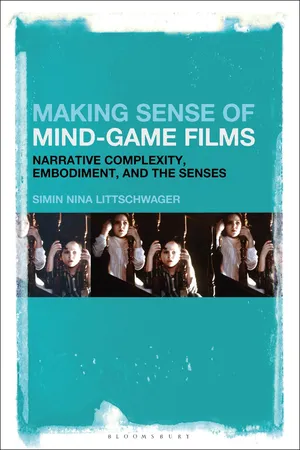
eBook - ePub
Making Sense of Mind-Game Films
Narrative Complexity, Embodiment, and the Senses
- 256 pages
- English
- ePUB (mobile friendly)
- Available on iOS & Android
eBook - ePub
Making Sense of Mind-Game Films
Narrative Complexity, Embodiment, and the Senses
About this book
Trusted by 375,005 students
Access to over 1.5 million titles for a fair monthly price.
Study more efficiently using our study tools.
Information
1
Seeing What Others Cannot See
Epistemological uncertainty and visual complexity in The Sixth Sense and The Others
“I see people. They don’t know they’re dead. They only see what they want to see.” These chill-inducing lines from The Sixth Sense (1999), spoken by a boy named Cole Sear (Haley Joel Osment) while the camera slowly closes in on the face of his child psychiatrist Malcolm Crowe (Bruce Willis), are famous for their double meaning that reveals itself only in hindsight. The uninitiated first-time audience does not know at this point halfway through the film that Malcolm himself is one of these dead people, or ghosts, who “only see what they want to see” and “don’t know they are dead.” Contrary to his initial diagnosis that Cole suffers from childhood schizophrenia and severe hallucinations, Malcolm gradually accepts throughout the second half of the film that the ghosts that Cole sees are real within the fictional world. Once this has been established, they become a visible part of the film’s world, and we learn that they seek Cole for help with some unfinished business. Yet only in the last minutes of the film the truth dawns on Malcolm, along with the unsuspecting first-time viewer, that he too is one of these dead people who needed Cole’s help as much as the boy needed his. Despite the numerous and, in retrospect, more than obvious hints, spectators do not necessarily have reason to suspect that something is wrong with Malcolm until his existential state is disclosed during the film’s notorious twist. Here, Malcolm’s own realization is intercut with three brief flashbacks showing previous scenes in a new light. For example, a reframed part of a restaurant scene makes clear that the dinner had seemed awkward not because Malcolm’s wife was angry at him but because she could not see him. Another flashback brings us back to the film’s prologue, during which Malcolm was shot by a former patient. Initially, the film’s beginning only showed us the act of shooting itself, so that when intertitles introduced the subsequent scene as set in “The next Fall,” the inference was that Malcolm had taken some time to recover. Now, the shooting scene is extended up until the moment Malcolm dies, and we realize that we have been tricked into not doubting Malcolm’s status as a living person through a number of cinematic conventions, such as the elision of narrative time or framing techniques.
A thematically and formally similar film is Alejandro Amenábar’s The Others (2001). While there are a number of significant differences between the two films (which I address in the following section), they have in common that the main protagonists are dead without being aware of it. Grace Stewart (Nicole Kidman) and her children Anne (Alakina Mann) and Nicholas (James Bentley) live with three recently hired servants in an isolated manor around the time of the Second World War. At first, the children’s photosensitivity and the lack of electricity purport to provide a credible explanation for the dark and gothic atmosphere of the mise-en-scène, especially the setting. Yet soon enough strange sounds and occurrences—footsteps, piano music, doors opening and closing at random—foster the impression of a haunted house tale that initially does not seem to stray far from convention. However, during a twist sequence near the end of the film, Grace and the children suddenly find themselves in a room full of strangers holding a séance. It then turns out that these “intruders,” as Grace calls them, are the actual flesh-and-blood inhabitants of the film’s fictional world, who are similarly spooked by inexplicable events in the house, whereas Grace and her children (as well as the servants) are in fact the ghosts that haunt it. A traumatic event that Anne alluded to several times throughout the film is revealed as the moment when a depressed and desperate Grace suffocated her children and subsequently committed suicide. Like in The Sixth Sense, a number of situations in The Others take on a new meaning in hindsight and, besides putting a number of improbable or inexplicable events into context, can be identified as ambiguous narrative hints whose significance is initially elusive. Next to the repeated allusions to “the terrible thing Mommy did that day,” they include Anne’s gasping breathing fits or her description of ghosts wearing white gowns and rattling chains, which matches her own appearance more than anyone else’s. In addition, death and the question of whether dead children go to limbo are topics frequently addressed by Grace in her homeschooling lessons.
On the one hand, the twist endings in these films provide explanations for a number of narrative inconsistencies and improbabilities. In The Sixth Sense one might have questioned Malcolm’s office being located in the dusty basement, his futile attempts to open the basement door, or a funeral party ignoring the presence of an adult stranger. Similar doubts could be raised in The Others about the permanent fog surrounding the Stewarts’s manor, the unexpected emergence of Grace’s missing husband out of nowhere when she loses her way in the fog, followed by his equally inexplicable disappearance only a day later. Yet, on the other hand, the implications of each twist lead to new questions. On the level of fiction, the very revelation itself that Malcolm and the Stewarts did not realize they were dead makes one wonder: How could they possibly stay unaware of their own death? Given that both films feature a number of ambiguous narrative clues that indicate the protagonists’ existential status or point to the volatile nature of vision and the potential unreliability of visual representation, this question also concerns the audience: How could we not suspect that they had been dead all along?
The radical reversal of the ontological premises of the fictional world is distinctive for The Sixth Sense and The Others, as well as for similar twist films that fall under the umbrella category of complex narratives. While more conventional twist films carefully conceal a more or less surprising solution to a central mystery, films like The Sixth Sense and The Others keep out of sight the very existence and true nature of the problem itself (Lavik 2006: 56). For instance, toward the end of The Sixth Sense it is already an established fictional truth that the “dead people” Cole sees are not the fictitious product of a child’s disturbed mind, but that they seek his help because he is the only person who can actually see them. However, while some viewers may already—and as this chapter suggests most literally—sense that Malcolm too is one of these ghosts, only the final minutes explicitly express this hitherto hidden truth. Similarly in The Others, we are carefully guided to be suspicious of the three servants and their intentions. This hunch is proven true when Anne and Nicholas discover tombstones with the servants’ names engraved on them and Grace simultaneously finds a photograph that shows all three servants as corpses and is dated “December 1891,” which is approximately fifty years prior to when the current events are set. From then onward the most pressing narrative questions concern the servants: whether they are dead nor not, and what their intentions might be. Yet these fade into the background when it turns out that the actual issue at stake is Grace’s denial of killing her children and subsequently herself. Thus unlike more traditional twist films, which typically precipitate a surprise along with a eureka moment when causal relationships or characters’ motivations are presented in a new light and a central narrative problem is solved, these complex twist films insinuate that we have missed—in a very direct sense—a vital issue in the first place (Lavik 2006: 56).
George Wilson describes The Sixth Sense and The Others, and similar complex films such as Fight Club (1999) or The Usual Suspects (1995), as “epistemological twist films” because “global aspects of the epistemic structure of their narration are clarified, in a surprising way, only toward the end of the movie” (2006: 89). By “epistemic structure” he refers to the way in which narrative films are commonly structured through a set of cinematic conventions that represent either objective or subjective perspectives within the fictional world. The final turn in epistemological twist films, however, reveals that what had seemed like a clear boundary between subjective and objective is in fact obscured; instead, there is the simultaneous existence of different kinds of truth or different levels of reality that intermingle with each other. As a consequence, narrative transparency itself is called into question and the audience is suddenly confronted with doubts about the cinematic reality that has been presented in these films. While there are a number of mind-game films that undermine narrative transparency in such a manner, Wilson makes a further refinement: The Sixth Sense and The Others belong to a group of films wherein “agents with nonstandard perceptual powers” are able to perceive more than the other characters with standard human vision; by contrast, films like The Usual Suspects or Fight Club conceal that the narrative action represents a character’s mental disposition (2006: 82).
Looking even more closely at the stories told through such complex twist films, Bernd Leiendecker (2013) suggests that they should be categorized according to their narrative content. He differentiates between four significant types: the “unconscious death,” “the retroactive mode of dream representation,” “the lying flashback,” and “the concealed split personality.” While complex twist films from all of these categories can share certain elements, for example, the use of focalization techniques to mislead the audience, or the revelation of narrative truth through flashbacks during a twist sequence, such a thematic refinement allows us to look beyond the mere forms and strategies of complex narration. It turns our attention to the way in which these strategies are not merely used for their own sake but also serves to express certain themes. The Sixth Sense and The Others belong of course to the “unconscious death” type, in which “the character’s death is caused by a trigger event—usually a car crash or a murder—early in the story while the plot twist that reveals this fact usually takes place near the end of the story” (2013: 263), a type of twist that harks back to Herk Harvey’s film Carnival of Souls (1962), which itself is based on Ambrose Pierce’s short story “Occurrence at Owl Creek Bridge.” According to Leiendecker, the “unconscious death” twist in film occurs in three main variations: the character imagines the future internally, in form of a liminal flash-forward; the character continues to exist in some kind of in-between reality that initially cannot be differentiated from the diegetic reality itself; or the character lives on in the diegetic reality as a ghost (2013: 263–64). While The Sixth Sense clearly belongs to the last category, The Others could be considered as an example of the second or third type, depending on whether one considers the film as containing one or two diegetic realities. Examples of the liminal flash-forward are Jacob’s Ladder (1990), a film that is often cited as marking the beginning of the trend to experiment with complex narration in the 1990s and 2000s, as well as Marc Foster’s film Stay (2005), and depending on one’s interpretation, Christian Petzold’s Yella (2007) and David Lynch’s Mulholland Drive (2001).
Characters who are mistaken about their existential status are one of the typical motifs of mind-game films (Elsaesser 2009: 17), though perhaps the notion of the mind-game in the strict sense is misleading here. While much of the dramatic tension during a first viewing of The Sixth Sense or The Others has to do with the question of whether the ghosts that some characters perceive are real or imagined within each film’s respective fictional world, the revelation that the protagonists are dead yet were under the delusion of being alive defies the understanding of hallucinations and seeming misperceptions as mental dysfunctions per se. Neither being alive nor being dead is solely a cognitive process: both states of being also crucially concern our identity as bodily selves, our embodied sense of being in and of this world. Accordingly, those mind-game films that feature characters unaware of their own death, sometimes also referred to as “post-mortem films” (Elsaesser and Hagener 2010: 155), center around a crisis that foregrounds corporeality as a quintessential condition for experience and existence while thematizing its loss as an existential threat.
As this chapter sets out to demonstrate, the uncanny connection between vision and the characters’ disavowal of their own death, which is symptomatic for the disruption of their lived bodies, disturbs our carnal knowledge of what it means to see and perceive and to live an embodied existence. The twist sequences of The Sixth Sense and The Others not only expose the narrative tricks used to mislead spectators but also cast substantial doubt on what we believe to have seen in these films. In doing so, they draw attention to the activity of seeing as an epistemological practice itself, and by extension to its role in cinematic spectatorship. Yet this is not just a play with the conventions of narrative logic and our visual and cognitive attention. The Sixth Sense in particular highlights the embodied nature of seeing, while The Others foregrounds the connection between vision and tactility and the materiality of the seer. On the premise that, unlike Malcolm and Grace, we as spectators are fully alive embodied human beings, and are moreover what Sobchack refers to as “cinesthetic subjects,” our viewing experience is informed by our embodied vision throughout the film (2004e: 67). While the twists in these films undermine vision as the most directly addressed sense and primary means of cinematic signification, both films perform an epistemological shift that revalues the significance of other senses, in particular hearing and touch, in cinematic spectatorship.
Complex twist films and the disavowal of death
The misleading nature of The Sixth Sense and The Others is inextricably interwoven with the credibility and plausibility of the fictitious scenarios they present. Much research has focused on the films’ narrative form and to what extent they allow for a consistent reconstruction of the story, once the premises of their fictional worlds are turned upside down as a consequence of the twist (Barratt 2009: 66; Lavik 2006: 57, 59). In this regard The Sixth Sense has attracted greater critical attention than The Others, which, given the audacious cleverness of its plot, is hardly surprising. Despite letting us witness how Malcolm gets shot in the opening sequence, the film tricks us into believing—or rather never doubting—that he is perfectly alive and well, albeit giving us the impression that he still needs to come to terms with the traumatic event. Here lies an important difference to The Others, which commences after Grace killed her children and committed suicide, an event that is conveyed only indirectly and in retrospect. Thus as audience we are not deceived into believing that Grace and her children are (still) alive to the same extent that the temporal gap between the prologue and the beginning of the main story effects it in The Sixth Sense.
Another key difference between The Sixth Sense and The Others is that the latter does not switch indistinguishably between living and dead characters throughout the film. Malcolm moves and acts among the living, oblivious to the fact that they are unaware of his presence, and yet simultaneously unable to see any of the other dead people himself. By contrast, The Others stays exclusively on the side of Grace and her children until the twist sequence. Apart from very few exceptions, the Stewarts do not interact with the living human beings with whom they, unbeknown to each oth...
Table of contents
- Cover
- Half-Title
- Dedication
- Title
- Contents
- Acknowledgements
- Introduction
- 1 Seeing What Others Cannot See
- 2 Solving Things Differently
- 3 Getting Lost, Sensing the Way
- Conclusion: Play It Again – Games with the Mind or with the Body and the Senses?
- Notes
- References
- Films
- Television
- Index
- Copyright
Frequently asked questions
Yes, you can cancel anytime from the Subscription tab in your account settings on the Perlego website. Your subscription will stay active until the end of your current billing period. Learn how to cancel your subscription
No, books cannot be downloaded as external files, such as PDFs, for use outside of Perlego. However, you can download books within the Perlego app for offline reading on mobile or tablet. Learn how to download books offline
Perlego offers two plans: Essential and Complete
- Essential is ideal for learners and professionals who enjoy exploring a wide range of subjects. Access the Essential Library with 800,000+ trusted titles and best-sellers across business, personal growth, and the humanities. Includes unlimited reading time and Standard Read Aloud voice.
- Complete: Perfect for advanced learners and researchers needing full, unrestricted access. Unlock 1.5M+ books across hundreds of subjects, including academic and specialized titles. The Complete Plan also includes advanced features like Premium Read Aloud and Research Assistant.
We are an online textbook subscription service, where you can get access to an entire online library for less than the price of a single book per month. With over 1.5 million books across 990+ topics, we’ve got you covered! Learn about our mission
Look out for the read-aloud symbol on your next book to see if you can listen to it. The read-aloud tool reads text aloud for you, highlighting the text as it is being read. You can pause it, speed it up and slow it down. Learn more about Read Aloud
Yes! You can use the Perlego app on both iOS and Android devices to read anytime, anywhere — even offline. Perfect for commutes or when you’re on the go.
Please note we cannot support devices running on iOS 13 and Android 7 or earlier. Learn more about using the app
Please note we cannot support devices running on iOS 13 and Android 7 or earlier. Learn more about using the app
Yes, you can access Making Sense of Mind-Game Films by Simin Nina Littschwager in PDF and/or ePUB format, as well as other popular books in Media & Performing Arts & Film & Video. We have over 1.5 million books available in our catalogue for you to explore.