A comprehensive look at four of the most famous problems in mathematics
Tales of Impossibility recounts the intriguing story of the renowned problems of antiquity, four of the most famous and studied questions in the history of mathematics. First posed by the ancient Greeks, these compass and straightedge problems—squaring the circle, trisecting an angle, doubling the cube, and inscribing regular polygons in a circle—have served as ever-present muses for mathematicians for more than two millennia. David Richeson follows the trail of these problems to show that ultimately their proofs—which demonstrated the impossibility of solving them using only a compass and straightedge—depended on and resulted in the growth of mathematics.
Richeson investigates how celebrated luminaries, including Euclid, Archimedes, Viète, Descartes, Newton, and Gauss, labored to understand these problems and how many major mathematical discoveries were related to their explorations. Although the problems were based in geometry, their resolutions were not, and had to wait until the nineteenth century, when mathematicians had developed the theory of real and complex numbers, analytic geometry, algebra, and calculus. Pierre Wantzel, a little-known mathematician, and Ferdinand von Lindemann, through his work on pi, finally determined the problems were impossible to solve. Along the way, Richeson provides entertaining anecdotes connected to the problems, such as how the Indiana state legislature passed a bill setting an incorrect value for pi and how Leonardo da Vinci made elegant contributions in his own study of these problems.
Taking readers from the classical period to the present, Tales of Impossibility chronicles how four unsolvable problems have captivated mathematical thinking for centuries.
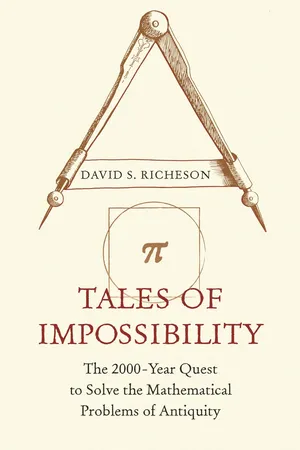
eBook - PDF
Tales of Impossibility
The 2000-Year Quest to Solve the Mathematical Problems of Antiquity
- 451 pages
- English
- PDF
- Available on iOS & Android
eBook - PDF
Tales of Impossibility
The 2000-Year Quest to Solve the Mathematical Problems of Antiquity
About this book
Information
Publisher
Princeton University PressYear
2019Print ISBN
9780691218724
9780691192963
eBook ISBN
9780691194233
Table of contents
- Cover
- Contents
- Preface
- Introduction
- CHAPTER 1. The Four Problems
- Tangent: Cranks
- CHAPTER 2. Proving the Impossible
- Tangent: Nine Impossibility Theorems
- CHAPTER 3. Compass-and-Straightedge Constructions
- Tangent: The Tomahawk
- CHAPTER 4. The First Mathematical Crisis
- Tangent: Toothpick Constructions
- CHAPTER 5. Doubling the Cube
- Tangent: Eratosthenes’s Mesolabe
- CHAPTER 6. The Early History of π
- Tangent: The Great Pyramid
- CHAPTER 7. Quadratures
- Tangent: Leonardo da Vinci’s Lunes
- CHAPTER 8. Archimedes’s Number
- Tangent: Computing π at Home
- CHAPTER 9. The Heptagon, the Nonagon, and the Other Regular Polygons
- Tangent: It Takes Time to Trisect an Angle
- CHAPTER 10. Neusis Constructions
- Tangent: Crockett Johnson’s Heptagon
- CHAPTER 11. Curves
- Tangent: Carpenter’s Squares
- CHAPTER 12. Getting By with Less
- Tangent: Origami
- CHAPTER 13. The Dawn of Algebra
- Tangent: Nicholas of Cusa
- CHAPTER 14. Viète’s Analytic Art
- Tangent: Galileo’s Compass
- CHAPTER 15. Descartes’s Compass-and-Straightedge Arithmetic
- Tangent: Legislating π
- CHAPTER 16. Descartes and the Problems of Antiquity
- Tangent: Hobbes,Wallis, and the New Algebra
- CHAPTER 17. Seventeenth-Century Quadratures of the Circle
- Tangent: Digit Hunters
- CHAPTER 18. Complex Numbers
- Tangent: The τ Revolution
- CHAPTER 19. Gauss’s 17-gon
- Tangent: Mirrors
- CHAPTER 20. PierreWantzel
- Tangent: What Can We Construct with Other Tools?
- CHAPTER 21. Irrational and Transcendental Numbers
- Tangent: Top 10 Transcendental Numbers
- Epilogue: Sirens or Muses?
- Notes
- References
- Index
- Blank Page
Trusted by 375,005 students
Access to over 1.5 million titles for a fair monthly price.
Study more efficiently using our study tools.
Frequently asked questions
Yes, you can cancel anytime from the Subscription tab in your account settings on the Perlego website. Your subscription will stay active until the end of your current billing period. Learn how to cancel your subscription
No, books cannot be downloaded as external files, such as PDFs, for use outside of Perlego. However, you can download books within the Perlego app for offline reading on mobile or tablet. Learn how to download books offline
Perlego offers two plans: Essential and Complete
- Essential is ideal for learners and professionals who enjoy exploring a wide range of subjects. Access the Essential Library with 800,000+ trusted titles and best-sellers across business, personal growth, and the humanities. Includes unlimited reading time and Standard Read Aloud voice.
- Complete: Perfect for advanced learners and researchers needing full, unrestricted access. Unlock 1.5M+ books across hundreds of subjects, including academic and specialized titles. The Complete Plan also includes advanced features like Premium Read Aloud and Research Assistant.
We are an online textbook subscription service, where you can get access to an entire online library for less than the price of a single book per month. With over 1.5 million books across 990+ topics, we’ve got you covered! Learn about our mission
Look out for the read-aloud symbol on your next book to see if you can listen to it. The read-aloud tool reads text aloud for you, highlighting the text as it is being read. You can pause it, speed it up and slow it down. Learn more about Read Aloud
Yes! You can use the Perlego app on both iOS and Android devices to read anytime, anywhere — even offline. Perfect for commutes or when you’re on the go.
Please note we cannot support devices running on iOS 13 and Android 7 or earlier. Learn more about using the app
Please note we cannot support devices running on iOS 13 and Android 7 or earlier. Learn more about using the app
Yes, you can access Tales of Impossibility by David S. Richeson in PDF and/or ePUB format, as well as other popular books in Mathematics & Games in Mathematics. We have over 1.5 million books available in our catalogue for you to explore.