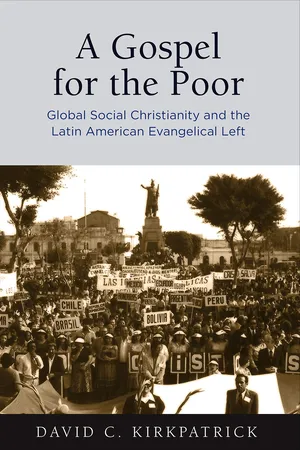
In 1974, the International Congress on World Evangelization met in Lausanne, Switzerland. Gathering together nearly 2, 500 Protestant evangelical leaders from more than 150 countries and 135 denominations, it rivaled Vatican II in terms of its influence. But as David C. Kirkpatrick argues in A Gospel for the Poor, the Lausanne Congress was most influential because, for the first time, theologians from the Global South gained a place at the table of the world's evangelical leadership—bringing their nascent brand of social Christianity with them.Leading up to this momentous occasion, after World War II, there emerged in various parts of the world an embryonic yet discernible progressive coalition of thinkers who were embedded in global evangelical organizations and educational institutions such as the InterVarsity Christian Fellowship, the International Fellowship of Evangelical Students, and the International Fellowship of Evangelical Mission Theologians. Within these groups, Latin Americans had an especially strong voice, for they had honed their theology as a religious minority, having defined it against two perceived ideological excesses: Marxist-inflected Catholic liberation theology and the conservative political loyalties of the U.S. Religious Right.In this context, transnational conversations provoked the rise of progressive evangelical politics, the explosion of Christian mission and relief organizations, and the infusion of social justice into the very mission of evangelicals around the world and across a broad spectrum of denominations. Drawing upon bilingual interviews and archives and personal papers from three continents, Kirkpatrick adopts a transnational perspective to tell the story of how a Cold War generation of progressive Latin Americans, including seminal figures such as Ecuadorian René Padilla and Peruvian Samuel Escobar, developed, named, and exported their version of social Christianity to an evolving coalition of global evangelicals.
eBook - ePub
A Gospel for the Poor
Global Social Christianity and the Latin American Evangelical Left
- 288 pages
- English
- ePUB (mobile friendly)
- Available on iOS & Android
eBook - ePub
A Gospel for the Poor
Global Social Christianity and the Latin American Evangelical Left
About this book
Trusted by 375,005 students
Access to over 1.5 million titles for a fair monthly price.
Study more efficiently using our study tools.
Information
Publisher
University of Pennsylvania PressYear
2019Print ISBN
9780812250947
9780812250947
eBook ISBN
9780812296051
Topic
Theology & ReligionSubtopic
Religion, Politics & StateCHAPTER 1

A New Style of Evangelicalism from Latin America
“American culture Christianity infuses racial and class segregation into its strategy for world evangelization.”1 After René Padilla’s fiery plenary speech at the Lausanne Congress of 1974, one American leader arose—visibly unnerved—to confront him on the platform: “How can you say that when you graduated from Wheaton [College]?”2 In Padilla’s recollection, the astonished leader was struck by the discordance of his thoroughly evangelical education and critical diagnosis of world missions, that the “American way of life” had poisoned the gospel message around the world. In a 2013 interview in Buenos Aires, Padilla declined to name the “very important leader”—someone “very, very related with Wheaton College.”3 The most probable leader given his presence on the platform would be Wheaton president Hudson Armerding (1965–1982). Yet, one might also speculate none other than Billy Graham, given his prominence as a Wheaton alumnus and presence on the platform at Lausanne, as well.4 Regardless, Padilla recalled responding, “Precisely there [at Wheaton] I learned to do critical thinking.”5 American managerial control was placed on watch.
This brief anecdote sheds light on three key historical details. First, it reveals that many Western leaders were unaware of the revolutionary ferment brewing to the South. At the time, many Americans were unaware of, or simply chose to ignore, the growing voices and discourse from “Third World” thinkers. These voices, however, became harder to ignore, especially for mission leaders in international organizations such the InterVarsity Christian Fellowship–USA and the Billy Graham Evangelistic Association (BGEA). Few could deny these increasingly influential voices after the First International Congress on World Evangelization (Lausanne 1974), due to the prominence of African, Asian, and Latin American leaders at the congress and on its platform, as well.

Figure 2. René Padilla giving a plenary speech at the Lausanne Congress, July 1974. Courtesy of the Billy Graham Evangelistic Association. Used with permission. All rights reserved.
This conflict, second, was a window into the future of evangelicalism—one filled with tension, disagreement, and negotiation on the place of social Christianity in evangelical discourse. But third, it reveals an organizational reality for many evangelicals in the postwar period: the close proximity of liberal and conservative leaders and corresponding negotiation over the boundaries of evangelicalism. Indeed, the nascent Latin American Evangelical Left often negotiated the acceptance of social Christianity while many conservatives guarded the boundaries of traditional evangelical theological and political loyalties. This negotiation took place not outside the gate of global evangelicalism but within its very structures. The growing awareness and acceptance of diverse voices inadvertently opened the door to a wider understanding of Christian mission particularly from Latin Americans.
The Latin American evangelical language of a “gospel for the poor”—and not simply the American middle class—was forged within the heat of liberal versus conservative battles that erupted in the late 1960s and 1970s. Minority voices became amplified in the West as emerging postcolonial discourse called for greater attention to the social location of knowledge. In the field of religion, postcolonialists called for the acknowledgment of the contextuality of all knowledge—that every idea is tied to its local context. For theologians, this meant there was no longer “theology” but rather “theologies”: North American theology, Latino/a theology, African theology, and European theology, for example. Armed with these ideas, theologians from the developing world began to challenge traditionally held assumptions regarding propositional truth and rote formulae for the evangelization and discipleship of Christians.6 They also decried imported or prepackaged answers to their local questions, challenging long-held evangelical Protestant traditions.7
Thus, the presence of Samuel Escobar and René Padilla on the platform at the Lausanne Congress of 1974 was simultaneously a symbol of emerging evangelical leadership from the Global South and a symbol of protest. Their controversial plenary speeches marked the emergence of a generation of young evangelicals who brought their experience in contexts of oppression, violence, and sociopolitical unrest into discussions of the contemporary problems of the day. In doing so, they helped usher in the evangelical rediscovery of social Christianity. In the coming decades, progressive Latin American evangelicals insisted on the noninterference of Western missionary leaders and the relentless independence of theology from the Global South. Lausanne is simply one example of many where Latin Americans dictated the terms upon which this theological independence took place. As Latin American evangelical theologians shifted to postcolonial ideological sympathies, they pulled many global evangelicals with them.
Early Opposition and Latin American Inclusion
In July 1974, Catharine Feser Padilla gathered her children around a world atlas in their home in the barrio of Florida Este, Buenos Aires. Her daughter, Ruth Padilla DeBorst, recalled, “The tone of her voice had a certain unaccustomed urgency: ‘Today, when he gives his talk here, in Lausanne, Switzerland’—pointing to the city on the map—‘Papi will say some things that not everyone is going to want to hear. Let’s pray for him and for the people listening to him.’”8 Neither Samuel Escobar nor René Padilla entered the Lausanne Congress with naive optimism. At the time, both were staff members with global evangelical parachurch ministries—Escobar as general director of the InterVarsity Christian Fellowship in Canada (1972–1975) and Padilla as general secretary of the International Fellowship of Evangelical Students (IFES) in Latin America. IFES is the worldwide representative body that arose out of the InterVarsity Fellowship (IVF), later known as the Universities and Colleges Christian Fellowship (UCCF) in Britain and InterVarsity Christian Fellowship–USA (IVCF). Behind the inception of IFES was the Australian evangelical leader C. Stacey Woods, the founding general secretary of IVCF in the United States (which would quickly become its largest and primary source of financial backing) and the first general secretary of IFES.9 Woods was uniquely positioned as an Australian to mediate the growing tension between British, American, and Scandinavian approaches to ministry and organizational leadership.10 Yet, previously unstudied personal correspondence reveals that Woods opposed Escobar and Padilla participating in the Lausanne Congress. Woods destroyed most of his personal papers, but many documents are preserved in those of Latin Americans. Ultimately, both Padilla and Escobar accepted their speaking nominations in opposition to Woods’s advice.11
In an August 1972 letter, Woods outlined his primary concerns regarding the Lausanne Congress: the presence of Roman Catholic observers and Billy Graham’s personal ambition.12 Regarding the former, Woods wrote sharply, “Just because Roman Catholics in many cases are open to the Gospel, this should not blind us to the unchanging deviltry of the Vatican of its murder, licentiousness and cruelty . . . let us welcome Roman Catholics unreservedly, with open arms, but let us not welcome an implacable curia which has never changed.”13 To this pointed critique, he added the persistent violence of Catholics against Protestants in Latin America. Months earlier, Woods had sent a memo to his entire staff warning of Catholic inclusion and clarifying his position on Lausanne 1974.14 Escobar appeared unconcerned by Catholic inclusion and avoided the topic altogether in his response letters. This was perhaps surprising given the vehement anti-Catholicism among many Latin American evangelical communities.
Stacey Woods worried that Billy Graham would build a metaphorical monument to himself in Lausanne: “Billy Graham always wants that which is official which will have worldly, organizational, institutional recognition and will give him status, I am afraid.”15 As Escobar and Padilla persisted in their desire to participate, Woods expressed optimism at working with Lausanne convener and British Anglican evangelical A. Jack Dain, who was the assistant bishop of the Sydney Anglican diocese (a particularly evangelical diocese).16 At the same time, Woods warned the young Peruvian Escobar to stand up to American influence: “You will need to stand against the manoeuvres of the Billy Graham Committee members, who more or less tend to ride rough-shod over everybody else. I think you and [IFES staff member Chua] Wee Hian ought to form a team of two as a kind of a spearhead, cutting through the nonsense to something really worthwhile.”17
In his reply on August 2, 1972, Escobar braced himself for conflict with “evangelical tycoons” and pondered accepting Billy Graham’s invitation to join the planning committee.18 In one final letter, Woods gave the young Peruvian a strong warning: “God has a great future ministry for you although, and remember this, if you are true to this message I’m afraid almost inevitably it will end, or at least involve, suffering.”19 In the end, Escobar accepted Graham’s invitation and soon reported back to Woods on the first planning meeting in September 1972: “In my personal talk with Billy Graham, I expressed my concern about a mutilated gospel and the need to clearly distinguish the Christian message from western and eastern ideologies. He expressed his agreement, although I realize he cannot avoid being influenced by the fact that he is a United States citizen with definite political preferences about which some of the people on his team are very vocal.”20 Escobar worried that Lausanne would cheer a “mutilated Gospel,” an American middle-class gospel tainted by the “American way of life” and loyalties to conservative politics. Similarly, for Latin American progressive evangelicals, the issue was not simply agreement with facts but the origin of those ideas—the social location of that knowledge.21 In many cases, the reality of being American was enough to taint belief and render one suspect.
Escobar concluded his letter to Woods by persisting in his inclusion in the congress: “All in all, Stacey, I think that our presence and our contribution in this committee for the next Congress on Evangelism is worth the time, work and patience involved in it.”22 While Escobar was particularly prescient in predicting Lausanne’s influence, ironically, Escobar’s inclusion in the planning committee blunted his influence on later progressive evangelical development. When the congress opened two years later, Escobar would be largely sidelined by organizational detail. In his absence, René Padilla took a leading role as organizer, agitator, and exponent of misión integral themes among a growing and restless sector of global evangelicalism—including many in the emerging American Evangelical Left.
It is tempting to view Padilla’s plenary speech as shocking to all involved. Yet, careful attention to unstudied correspondence reveals that Padilla had already registered on the radar of conservative evangelicals due to his battles with American missionaries and his controversial affinity for leftist politics. This raises a critical question: why would Graham and his associates invite Padilla when many viewed him as suspicious, at best, and dangerous, at worst? Later, we will see that the Billy Graham Evangelistic Association had learned its lesson on paternalism and inclusion throu...
Table of contents
- Cover
- Half title
- Title
- Copyright
- Dedication
- Contents
- List of Abbreviations
- Introduction. Toward a Gospel for the Poor
- Chapter 1. A New Style of Evangelicalism from Latin America
- Chapter 2. Revolutionary Ferment
- Chapter 3. Cold War Christianity
- Chapter 4. Deporting American Evangelicalism
- Chapter 5. Marketing Social Christianity
- Chapter 6. Crossing Boundaries
- Chapter 7. The Reshaping of Global Evangelicalism
- Conclusion. A Global Reach
- Notes
- Bibliography
- Index
- Acknowledgments
Frequently asked questions
Yes, you can cancel anytime from the Subscription tab in your account settings on the Perlego website. Your subscription will stay active until the end of your current billing period. Learn how to cancel your subscription
No, books cannot be downloaded as external files, such as PDFs, for use outside of Perlego. However, you can download books within the Perlego app for offline reading on mobile or tablet. Learn how to download books offline
Perlego offers two plans: Essential and Complete
- Essential is ideal for learners and professionals who enjoy exploring a wide range of subjects. Access the Essential Library with 800,000+ trusted titles and best-sellers across business, personal growth, and the humanities. Includes unlimited reading time and Standard Read Aloud voice.
- Complete: Perfect for advanced learners and researchers needing full, unrestricted access. Unlock 1.5M+ books across hundreds of subjects, including academic and specialized titles. The Complete Plan also includes advanced features like Premium Read Aloud and Research Assistant.
We are an online textbook subscription service, where you can get access to an entire online library for less than the price of a single book per month. With over 1.5 million books across 990+ topics, we’ve got you covered! Learn about our mission
Look out for the read-aloud symbol on your next book to see if you can listen to it. The read-aloud tool reads text aloud for you, highlighting the text as it is being read. You can pause it, speed it up and slow it down. Learn more about Read Aloud
Yes! You can use the Perlego app on both iOS and Android devices to read anytime, anywhere — even offline. Perfect for commutes or when you’re on the go.
Please note we cannot support devices running on iOS 13 and Android 7 or earlier. Learn more about using the app
Please note we cannot support devices running on iOS 13 and Android 7 or earlier. Learn more about using the app
Yes, you can access A Gospel for the Poor by David C. Kirkpatrick in PDF and/or ePUB format, as well as other popular books in Theology & Religion & Religion, Politics & State. We have over 1.5 million books available in our catalogue for you to explore.