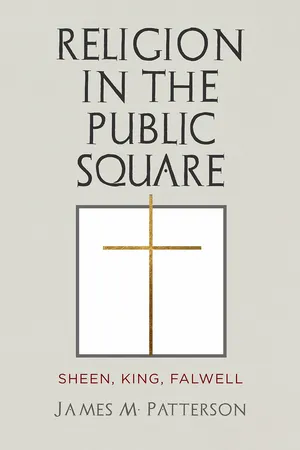
Ven. Fulton J. Sheen, Dr. Martin Luther King Jr., and Rev. Jerry Falwell—religious leaders who popularized theology through media campaigns designed to persuade the public In Religion in the Public Square, James M. Patterson considers religious leaders who popularized theology through media campaigns designed to persuade the public. Ven. Fulton J. Sheen, Dr. Martin Luther King Jr., and Rev. Jerry Falwell differed profoundly on issues of theology and politics, but they shared an approach to public ministry that aimed directly at changing how Americans understood the nature and purpose of their country. From the 1930s through the 1950s, Sheen was an early adopter of paperbacks, radio, and television to condemn totalitarian ideologies and to defend American Catholicism against Protestant accusations of divided loyalty. During the 1950s and 1960s, King staged demonstrations and boycotts that drew the mass media to him. The attention provided him the platform to preach Christian love as a political foundation in direct opposition to white supremacy. Falwell started his own church, which he developed into a mass media empire. He then leveraged it during the late 1970s through the 1980s to influence the Republican Party by exhorting his audience to not only ally with religious conservatives around issues of abortion and the traditional family but also to vote accordingly.Sheen, King, and Falwell were so successful in popularizing their theological ideas that they won prestigious awards, had access to presidents, and witnessed the results of their labors. However, Patterson argues that Falwell's efforts broke with the longstanding refusal of religious public figures to participate directly in partisan affairs and thereby catalyzed the process of politicizing religion that undermined the Judeo-Christian consensus that formed the foundation of American politics.
- 248 pages
- English
- ePUB (mobile friendly)
- Available on iOS & Android
eBook - ePub
About this book
Trusted by 375,005 students
Access to over 1.5 million titles for a fair monthly price.
Study more efficiently using our study tools.
Information
Publisher
University of Pennsylvania PressYear
2019Print ISBN
9780812250985
9780812250985
eBook ISBN
9780812296112
Topic
StoriaSubtopic
Storia nordamericanaCHAPTER 1

Americanism
The tempter approached and said to him, “If you are the Son of God, command that these stones become loaves of bread.”
[Jesus] said in reply, “It is written: ‘One does not live by bread alone, but by every word that comes forth from the mouth of God.’ ”
—Matthew 4:2–3
In one of his many sermons against totalitarianism, Ven. Fulton J. Sheen offered his audience a choice, pronouncing, “There is no such thing as living without a cross. We are free only to choose between crosses. Will it be the Cross of Christ which redeems us from our sins, or will it be the Double-Cross, the Swastika, the hammer and sickle, the fasces?”1 The “Double-Cross” referred to more than the images on totalitarian flags. Sheen believed totalitarian ideologies promised an earthly paradise, which every Fascist, Nazi, and Communist party would inevitably betray. However, the only other choice—the cross—was a hard one. The cross dispelled totalitarian dreams in favor of the reality of human fallenness, its need for redemption, and religious liberty to pursue that redemption. For America to choose the cross was only hard at first, he preached, since upon choosing the cross the nation and its citizens would experience the blessing of fulfilling its role in defending religious liberty at home and extending it to repressed nations abroad. According to Sheen, Catholics in the US chose the cross and, by choosing it, affirmed the defense of American religious liberty and their commitment to restoring it to the rest of the world double-crossed by totalitarian ideology. By choosing the cross, Americans also chose their country.
For the first half of the twentieth century, Sheen was one of America’s most famous and beloved Catholic priests. Most American Catholics today remember him for his theological instruction, consoling sermons, and his thoughts on the priesthood—as well as for his penetrating stare into the television camera. However, Sheen also had a political mission to persuade America of the dangers posed by totalitarian regimes, as well as to demonstrate American Catholic patriotism in opposing them. He argued that the Catholic Church was the spiritual authority that provided the moral education necessary for guiding Americans of all faiths away from totalitarianism. For this reason, he rejected American exceptionalism, regarding the Church as the “city on the hill” rather than America.
These positions are striking considering American religious history. Since the colonial period, anti-Catholicism was a mainstay of American politics. After the anti-Catholicism provoked by the 1928 candidacy of Democratic presidential candidate Al Smith—a “wet” on Prohibition and a Catholic—Catholic leaders sought to exploit new mass media technologies to improve public opinion of the faith. One of those enlisted was Sheen, who demonstrated Catholic patriotism by appropriating traditionally Protestant anti-Catholic narratives and repurposing them to combat totalitarianism instead. Just as Samuel Morse and Lyman Beecher had warned nineteenth-century Americans about Rome, Sheen railed against an aggressive, tyrannical, foreign power. For Sheen, the threat was not the foreign prince in Rome. On the contrary, the Church was America’s best ally against totalitarian ideologies of Fascism, Nazism, and, with the end of the Second World War, Communism in particular. Sheen thereby sought to prove the Catholic commitment to religious liberty in America and abroad by condemning repression of religious liberty in totalitarian nations.
To make this case, Sheen grounded his Catholic patriotism and antitotalitarianism in what he called “Americanism.” Americanism defined citizenship in terms of membership in a religious congregation or as people of conscience. Sheen’s version began with the observation that America was a liberal democracy, which depended on the people for its legitimacy. For Sheen, no people unaided by religious instruction were sufficiently moral to establish good government, defined above all as one protecting religious liberty. An irreligious people would create a government that they hoped would feed them, no matter the cost to their personal liberties. This kind of government inevitably tyrannized the people. Therefore, the Church preceded the people in importance to found a government. While in the old days, the Church crowned kings, now, as Sheen preached, the Church placed the crown on the people by providing religious education about the priority of spiritual ends to material means as well as the necessary limits and moral obligations of the state.
Americanism Redefined
Peter “Fulton” John Sheen was born in 1895 to an Irish Catholic family in El Paso, Illinois, as the oldest of four boys. He had an older half-sister, Eva Natalie Sheen, born in 1886 to his father, Newton Sheen, a lapsed Catholic, and his first wife, Ida Clara von Buttear, a descendent of German Protestants. Von Buttear died suddenly a few years into the marriage. When Newton Sheen married Fulton’s mother, the devout Catholic Delia Fulton, he returned to the Church—at which point the Von Buttear family had Eva removed from the Sheen family to be raised according to her late mother’s faith. Early in life, Sheen wanted to become a priest and entered the seminary at St. Viator’s College and Seminary, from which he graduated in 1919. He was then ordained a priest and sent to Catholic University of America (CUA), where he received a canon law degree in 1921. With strong backing from some American bishops, Sheen then attended the Catholic University of Louvain, Belgium, where he received a doctorate in 1922 and, in 1925, received the highest academic honor granted at the university: a “Very High Distinction” in the elite “agrégé in philosophy.” After Louvain, Sheen became an assistant professor of theology and, after a spate of clashes with colleagues, moved into the Philosophy Department in 1931 and then the School of Scholastic Philosophy in 1936.2 Though Sheen remained a faculty member at CUA until 1950, he spent much of his time away from the university, giving lectures and retreats, and penning both academic and popular publications.
In 1930, the National Council of Catholic Men started Catholic Hour, a nationally syndicated radio program, to combat anti-Catholicism stirred up during Al Smith’s presidential campaign. Sheen was invited to be one of its chief contributors. Over the next two decades, Sheen also gave public sermons, led mass rallies of American Catholics, and published numerous bestselling books, including Communism and the Conscience of the West in 1948 and Peace of Soul in 1949.3 After Sheen’s mass media success, Pope Pius XII consecrated him a bishop in 1951 and appointed him to lead the Society for the Propagation of the Faith in the United States. While serving in this capacity, Sheen would also serve as an auxiliary bishop to Cardinal Francis Joseph Spellman of the Archdiocese of New York, the most powerful Church prelate in the United States. Sheen then became the official public face of the Catholic Church in America and led fundraising efforts for missions. The following year, the Dumont Television Network began airing Sheen’s program Life Is Worth Living (it moved to the American Broadcasting Company in 1955). A surprise hit, the show earned Sheen the Emmy for Best Television Personality in 1953. His national renown and tenacious anti-Communism led to an appearance detailing the “ideological defects of communism” for the House Committee on Un-American Activities and several gatherings with top state and federal officials, including meetings—public and private—with President Dwight D. Eisenhower to discuss the role of American faith in defeating the Soviets and saving the Russian people.4
When Sheen first began his career as a priest, he faced populist anti-Catholicism found in the Ku Klux Klan and periodicals such as The Menace.5 Significant parts of the American population regarded American Catholics as moral, physical, and racial inferiors with a slavish devotion to an absolute, arbitrary, and foreign dictator—the pope.6 They feared the pope would, if he could, tyrannize Americans with forced conversions to Catholicism.7 Much of this hysteria was grounded in anxiety over the rapidly changing ethnic and economic conditions, but much of it was also grounded in long-held, common beliefs that had once united disparate American Protestant denominations together when little else could. As already discussed, the “Protestant hegemony” treated American democracy as dependent on a consensus of Protestant confessions united in defense of republican liberty.8 Sheen made efforts to redefine the Protestant consensus to include Catholics and Jews, what became the new “Judeo-Christian consensus.” For the old Protestant hegemony, a chief threat to republican liberty was the Holy See, which rejected liberty of conscience with a policy of establishing the Catholic Church as the faith of all sovereign states. With the rise of the Judeo-Christian consensus, however, Sheen preached that Jews and Catholics wanted religious liberty as much as their Protestant neighbors, especially considering the totalitarian repression of the faithful in Europe. Sheen wrote in 1948, “Jews, Protestants, and Catholics alike, and all men of good will are realizing that the world is serving their souls an awful summons” in the fight against Communism. Jews, Protestants, and Catholics “may not be able to meet in the same pew—would to God we could—but we can meet on our knees.”9
Sheen referred to this refounding of religious consensus as “Americanism,” which he defined in the following way:
Americanism, as understood by our Founding Fathers, is the political expression of the Catholic doctrine concerning man. Firstly, his rights come from God, and therefore cannot be taken away; secondly, the State exists to preserve them. . . . The recognition of the inalienable rights of the human person is Americanism, or, to put it another way, an affirmation of the inherent dignity and worth of man. . . . As a political document, [the Declaration of Independence] affirms what the Gospel affirms as religion: the worth of man. Christ died on a cross for him, and governments are founded on account of him. He is the object of love theologically and politically—the source of rights, inalienable and sacred because when duly protected and safeguarded, he helps in the creation of a kingdom of Caesar which is the stepping-stone to the Kingdom of God.10
This definition, offered the year before the United States entered the Second World War, was part of a long tradition of American Catholics finding their place in the American founding.11 Sheen’s position was, like American Catholics before and after him, to find a kind of “accidental Thomism” among the Protestants and Deists who fought the War for Independence. If persuasive, Sheen could credibly claim that American anti-Catholicism was not merely bigoted but contrary to the nation’s founding. American Protestants had fought the wrong enemy in the Catholic Church, and now the mutual enemy of American religious peoples was rising in the east. As he said in a 1939 address:
True Americanism means two things—positively, the recognition of the sovereign, inalienable rights of man, and negatively, unqualified opposition to all totalitarian forms—whether they be NAZI, FASCIST, or COMMUNIST—which deny these rights. There is irreconcilable opposition between the regimes of Russia, Germany, and Italy.
Over there, the state is the source of rights; here man is the source of rights. Over there, freedom resides in the collectivity: in the race as in Germany, in the nation as in Italy, and in the class as in Russia; over here, freedom resides in man.12
Sheen replaced Protestant hegemony with the Judeo-Christian consensus, and he replaced the old enemy in the Vatican with the new one in totalitarianism; in short, Sheen appropriated old anti-Catholic discourse for Catholic ends.
Two factors enabled Sheen’s appropriation of anti-Catholic discourse to argue for its reinterpretation as Americanism. First, many moderate Protestants experienced genuine alarm at the paranoid, illiberal rhetoric among hardline Protestant preachers and Klansmen. In response, they began an interfaith dialogue that introduced a new concept to Americans: the “Judeo-Christian heritage” that supported the “American way of life.”13 The central idea was an extension of the logic that had once defended disparate Protestants in the nineteenth century—that the differences across denominations mattered less than the similarities. Sheen by no means invented this idea, but he certainly expanded upon it as a rhetorical strategy for legitimating American Catholic citizens and political representatives, as well as making Catholic appeals against totalitarianism. The second factor was the difference between the anti-Catholic fears of “Romish” tyranny and Catholic-led fears of totalitarian tyranny. The difference was that, unlike the anti-Catholic Thomas Nast’s fever dreams of alligator-mitered bishops crossing the Atlantic, the fears of Communist suppression of religious liberty were well-grounded in recent events.
One should note that Sheen chose an embattled term for his description of church-state relations. “Americanism” had, at the time, two directly contradictory meanings. For Catholics at the time, “Americanism” referred to the attempt, first made by American priest and founder of the Paulists, Isaac Hecker, to reconcile American liberalism with the Church. One of Hecker’s principal admirers in Europe was the French priest Felix Klein, who popularized Hecker’s ideas in a controversial effort to reconcile French Ca...
Table of contents
- Cover
- Half title
- Title
- Copyright
- Dedication
- Contents
- Introduction
- Chapter 1. Americanism: Fulton J. Sheen, Catholic Patriotism, and the Fight Against Totalitarianism
- Chapter 2. The Beloved Community: Martin Luther King Jr., Civil Disobedience, and the Second Great Emancipation
- Chapter 3. The American Dispensation: Jerry Falwell, the Nehemiad, and the Signs of the Times
- Conclusion. American Religious Foundations After the Judeo-Christian Consensus
- Notes
- Bibliography
- Index
- Acknowledgments
Frequently asked questions
Yes, you can cancel anytime from the Subscription tab in your account settings on the Perlego website. Your subscription will stay active until the end of your current billing period. Learn how to cancel your subscription
No, books cannot be downloaded as external files, such as PDFs, for use outside of Perlego. However, you can download books within the Perlego app for offline reading on mobile or tablet. Learn how to download books offline
We are an online textbook subscription service, where you can get access to an entire online library for less than the price of a single book per month. With over 1.5 million books across 990+ topics, we’ve got you covered! Learn about our mission
Look out for the read-aloud symbol on your next book to see if you can listen to it. The read-aloud tool reads text aloud for you, highlighting the text as it is being read. You can pause it, speed it up and slow it down. Learn more about Read Aloud
Yes! You can use the Perlego app on both iOS and Android devices to read anytime, anywhere — even offline. Perfect for commutes or when you’re on the go.
Please note we cannot support devices running on iOS 13 and Android 7 or earlier. Learn more about using the app
Please note we cannot support devices running on iOS 13 and Android 7 or earlier. Learn more about using the app
Yes, you can access Religion in the Public Square by James M. Patterson in PDF and/or ePUB format, as well as other popular books in Storia & Storia nordamericana. We have over 1.5 million books available in our catalogue for you to explore.