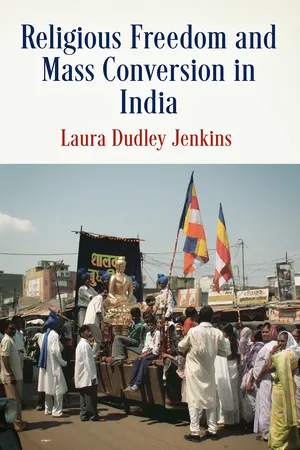
Hinduism is the largest religion in India, encompassing roughly 80 percent of the population, while 14 percent of the population practices Islam and the remaining 6 percent adheres to other religions. The right to "freely profess, practice, and propagate religion" in India's constitution is one of the most comprehensive articulations of the right to religious freedom. Yet from the late colonial era to the present, mass conversions to minority religions have inflamed majority-minority relations in India and complicated the exercise of this right.In Religious Freedom and Mass Conversion in India, Laura Dudley Jenkins examines three mass conversion movements in India: among Christians in the 1930s, Dalit Buddhists in the 1950s, and Mizo Jews in the 2000s. Critics of these movements claimed mass converts were victims of overzealous proselytizers promising material benefits, but defenders insisted the converts were individuals choosing to convert for spiritual reasons. Jenkins traces the origins of these opposing arguments to the 1930s and 1940s, when emerging human rights frameworks and early social scientific studies of religion posited an ideal convert: an individual making a purely spiritual choice. However, she observes that India's mass conversions did not adhere to this model and therefore sparked scrutiny of mass converts' individual agency and spiritual sincerity.Jenkins demonstrates that the preoccupation with converts' agency and sincerity has resulted in significant challenges to religious freedom. One is the proliferation of legislation limiting induced conversions. Another is the restriction of affirmative action rights of low caste people who choose to practice Islam or Christianity. Last, incendiary rumors are intentionally spread of women being converted to Islam via seduction. Religious Freedom and Mass Conversion in India illuminates the ways in which these tactics immobilize potential converts, reinforce damaging assumptions about women, lower castes, and religious minorities, and continue to restrict religious freedom in India today.
- 320 pages
- English
- ePUB (mobile friendly)
- Available on iOS & Android
eBook - ePub
Religious Freedom and Mass Conversion in India
About this book
Trusted by 375,005 students
Access to over 1.5 million titles for a fair monthly price.
Study more efficiently using our study tools.
Information
Publisher
University of Pennsylvania PressYear
2019Print ISBN
9780812250923
9780812250923
eBook ISBN
9780812296006
PART I

MOBILITY
CHAPTER 1
Mass Movement Christians: Religious and Social Mobility
Fear that lower-caste and Adivasi people will convert en masse has provoked political backlashes against conversions.1 Such anxieties extend back to large-scale conversions of lower castes to Christianity in the late colonial era.2 Mass conversions to Christianity started in South India by the 1700s and, from the 1830s, spread north into virtually every province of British India and some princely states.3 Protestant missionaries in the 1880s began to use the term “mass movement” to describe these large, interconnected conversions, often by lower-caste groups, and the term spread widely by the early 1900s.4 Mohandas Gandhi increasingly criticized the mass movements as a threat to poor and uneducated groups and to anti-colonial unity.
Missionaries tried to prove the sincerity and agency of mass converts to several audiences, including nationalist critics like Gandhi, international funders of missionaries, and potential future converts. To do so they drew on “evidence” such as conversion narratives or images documenting the converts’ transformations.5 In the early 1930s, one of the most influential defenders of mass movement conversions used a novel technique: a social scientific survey of converts. To prove that mass converts were sincere, or “valid,” converts, J. Waskom Pickett (1890–1981), a Wesleyan Methodist missionary from the United States, directed a survey of nearly four thousand converts from ten areas in India to document the preponderance of spiritual motives. Many converts surveyed were from Dalit communities, known at the time as untouchables or Depressed Classes. Pickett’s Christian Mass Movements in India: A Study with Recommendations, published in 1933, stood out because he pioneered “scientific” and statistical conversion narratives when most missionary accounts were either spiritual reflections or amateur ethnographies.6 Pickett imbued his text with faith in both science and religion.

Figure 3. From the Wesleyan missionary F. Coyler Sackett’s book, Vision and Venture: A Record of Fifty Years in Hyderabad. This is an example of visual evidence of conversion in the context of the Christian mass movements, from a chapter entitled, “The Units That Went to Make up the Mass.” Photograph from F. Coyler Sackett, Vision and Venture: Fifty Years in India (London: Cargate Press, 1931).
Pickett’s survey measuring the spiritual motives of mass movement Christians in the 1930s popularized the increasingly predominant narrative that true converts were individual agents choosing spiritually sincere beliefs. Rooted in Protestantism and early psychological scholarship on religion, this emphasis on individual belief extended beyond Protestants. As discussed in the introduction, in the 1940s individual belief became central to articulations of religious freedom in the Indian Constitution and the Universal Declaration of Human Rights. Although he is not single-handedly responsible for spreading notions of sincerity and agency, Pickett’s conceptualization of a valid convert popularized this prototype within India.
To this day, critics of conversion in India routinely question the spiritual sincerity or agency of converts to undermine the rights of those who do not fit this norm. Pickett’s study and personal papers demonstrate that Pickett himself found motives of converts to be multifaceted and group-conversion dynamics to be complex. Nevertheless, in his analysis and conclusions he crammed unruly data about mass movement converts into the idealized model of the sincere individual convert, contributing to the persistence and popularity of this predominant narrative.
Mass Movement Christians and Their Legacies
The mass movement conversions of untouchables to Christianity in the late colonial era challenged both nationalist and missionary assumptions about the lower strata of Indian society. Mass conversions particularly worried Mohandas Gandhi. He hoped to keep the lowest castes, which he called Harijans, meaning “people of (a Hindu) god,” within the Hindu fold.7Meanwhile, missionaries had envisioned initially converting individual elites, who would help convert other sections of society.8 Lower-caste communities requesting conversions as a group surprised them. Dubbed “rice Christians” by some journalists and competing missionaries, mass converts elicited skepticism among many church leaders and donors, who had a more individualized conversion ideal in mind.9
Through his survey, J. Waskom Pickett tried to show that the new Christians were valid converts, document their motives, assess the opinions of their neighbors, and make recommendations for future missionary work. Pickett’s Christian Mass Movements in India, published by American and Indian publishers in 1933, was an early application of scientific survey methodology to the study of religion. Based on this and his other books, as well as book advertisements, book reviews, personal writings, drafts, and correspondence, I will examine Pickett’s varied mass movement conversion narratives for three divergent audiences: nationalist critics, especially Gandhi; Christian skeptics (in India and abroad); and the low castes known at the time as Depressed Classes, especially their leader, Dr. B. R. Ambedkar.10 Ambedkar announced in 1935, just two years after Pickett’s study was published, that he would not die a Hindu, leading to a frenzy of speculation among leaders of various religious communities: would Ambedkar and his followers join their religion? With the Depressed Classes up for grabs, Pickett’s research gained new attention, as he and others drew on it to try to woo Ambedkar and the lowest castes to Christianity.
The Christian mass movements have several contemporary legacies. One is Hindu nationalist fears, perennially revived by politicians and activists, that Hindu majority status will be lost due to growing minority populations, despite the fact that the national census consistently records Hindus as a sizeable majority of India’s population. The latest official percentages (from the 2011 census) are 79.80 percent Hindus and 2.30 percent Christians.11 This “fear of small numbers” is prevalent in India but certainly not unique to this country.12 Demographic fears and suspicion of missionary tactics vis-à-vis the so-called weaker sections of society set the stage for periodic attacks on Christian churches and Christians, including missionaries, and a range of state laws monitoring or limiting forcible and induced religious conversions, the focus on Chapter 4.13
A second legacy of the mass movement conversions is the large number of Christians of lower-caste heritage, many still facing caste discrimination both within and outside of Christian communities.14 Separate congregations, communion cups, and cemeteries demonstrate the existence of caste hierarchies regardless of religion in many communities. Facing ongoing discrimination, Dalit Christians have pressed for affirmative action benefits, known as reservations, that other Dalits (administratively known as Scheduled Castes) receive.15 Currently, Dalit Christians and Dalit Muslims are not recognized as Scheduled Castes. Their ongoing campaign to be included among the Scheduled Castes, on the basis of religious freedom, is discussed in Chapter 5.
A third legacy is subsequent mass conversions, particularly among lower-status groups. Although he ultimately decided against Christianity and chose Buddhism, the leader of the Depressed Classes, B. R. Ambedkar (see Chapter 2), made his public decision to leave Hinduism after many of the Christian mass movements had already occurred. As we will see in this chapter, his declaration that he would not die a Hindu sparked a flurry of missionary speculation about a potential influx of converts into Christianity. Mass conversions of lower-caste groups to various religions continue, such as the conversion of Dalits to Islam in Meenakshipuram in 1981 and, more recently, conversions of Dalits to Buddhism in Patapar, Gujarat, in October 2013, as well as other annual conversions on October 14, the anniversary of the day Ambedkar and his followers became Buddhists.16 Mass conversions to Hinduism are currently still sparking political debates in India.17
A fourth legacy, and the focus of this chapter, is a predominant narrative that spiritual sincerity and individual agency are litmus tests for authentic conversion. This religious and political narrative is better understood against the background of the mass movements of the past and an analysis of the preoccupations and arguments of their critics and their defenders. J. Waskom Pickett’s defense of these converts is peppered with complications of the paradigmatic individual, spiritual convert, but his public conclusions ultimately reinforced this paradigm.
Who Is Eligible for Freedom? Sincerity and Agency Narratives
The sincerity narrative has two interlinked emphases: belief, or conversion as primarily a change of mind rather than practices, and spirituality, a premise that conversion motives can and should be purely spiritual as opposed to material or political. Both elements stress interior rather than exterior change. The sincerity narrative is linked to the agency narrative in that a convert is supposed to be an individual with the agency, or autonomy and capability, to make that personal decision to convert to new spiritual beliefs. These normative narratives about converts were not unique to India. Webb Keane suggests that the “sincere belief model” was “at the heart of a moral narrative of modernity” that accompanied the global spread of Christianity, especially Protestantism.18 For Talal Asad, the principle of “moral autonomy” spread with the project of modernity, along with, in Keane’s view, a “vision of self that must be abstracted from material and social entanglements.”19 Saba Mahmood, Nathaniel Roberts, and Gauri Viswanathan critique liberal presumptions about autonomous agency in the context of religion or conversion:20 Is anyone entirely autonomous? Is any decision or belief purely spiritual? No, but Viswanathan traces “the fictionalization of religious experience as self-engendered and separable from the authority of law and other institutions,” demonstrating the reach and sway of this narrative.21 Thus, as discussed in the introduction, international and constitutional lawmakers embedded a spiritual, belief-centric conception of religion and a choice-centric conception of freedom into religious freedom clauses.
This chapter focuses on narratives promulgated by an American missionary in India in the early 1900s. The sincere agent model of conversion was gaining traction in both America and India at this time. In the United States, William James’s influential “Christian psychology” approach to conversion focused on the “intense religious experiences of individuals” through written first-person accounts.22 James’s Varieties of Religious Experience, originally published in 1902, included his attempts to empirically study the interior experiences of converts. One of his students, Edwin Starbuck, pioneered the use of questionnaires as a way to study conversions (to Protestant Christianity).23 Gauri Viswanathan, in her literary analysis of conversion, reads James as an exemplar of the “myth of autonomous religious experience.” To Viswanathan, “the pressure of . . . social and political constraints upon the presumed autonomy of religious experience is precisely what is absent in a work like James’ Varieties of Religious Experience.”24 American psychological approaches accentuated existing Protestant emphases on sincere belief and individual agency, reinforcing a predominant narrative that a convert is an autonomous individual choosing a new belief.
Meanwhile in India, “authenticity talk” about Christian converts emerged by about 1895, according to the historian Rupa Viswanath. Discussions of converts’ authenticity included themes of sincerity and agency but had a distinct genealogy in India. This narrative followed a large number of mass conversions by lower-caste communities in colonial South India and proposals for Pariah agricultural settlements managed by missionaries. (Pariahs are a Dalit caste.) Such Pariah settlements undermined the system of slavery predicated on Pariah landlessness.25 Challenges to the authenticity of converts became a tool in the arsenal of upper caste critics of the land scheme in the regional press. The Madras-based newspaper the Hindu in 1895 critiqued the use of the land proposals as “bait to draw Pariahs into the Christian fold.”26 Such arguments initiated “the adoption and dissemination by Tamil publicists of the Christian idea that religion should be rooted in an ...
Table of contents
- Cover
- Half title
- Title
- Copyright
- Contents
- Introduction. Religious Freedom and the Right to Convert
- Part I. Mobility
- Part II. Immobility
- Conclusion. A More Equal Freedom
- Notes
- Bibliography
- Index
- Acknowledgments
Frequently asked questions
Yes, you can cancel anytime from the Subscription tab in your account settings on the Perlego website. Your subscription will stay active until the end of your current billing period. Learn how to cancel your subscription
No, books cannot be downloaded as external files, such as PDFs, for use outside of Perlego. However, you can download books within the Perlego app for offline reading on mobile or tablet. Learn how to download books offline
Perlego offers two plans: Essential and Complete
- Essential is ideal for learners and professionals who enjoy exploring a wide range of subjects. Access the Essential Library with 800,000+ trusted titles and best-sellers across business, personal growth, and the humanities. Includes unlimited reading time and Standard Read Aloud voice.
- Complete: Perfect for advanced learners and researchers needing full, unrestricted access. Unlock 1.5M+ books across hundreds of subjects, including academic and specialized titles. The Complete Plan also includes advanced features like Premium Read Aloud and Research Assistant.
We are an online textbook subscription service, where you can get access to an entire online library for less than the price of a single book per month. With over 1.5 million books across 990+ topics, we’ve got you covered! Learn about our mission
Look out for the read-aloud symbol on your next book to see if you can listen to it. The read-aloud tool reads text aloud for you, highlighting the text as it is being read. You can pause it, speed it up and slow it down. Learn more about Read Aloud
Yes! You can use the Perlego app on both iOS and Android devices to read anytime, anywhere — even offline. Perfect for commutes or when you’re on the go.
Please note we cannot support devices running on iOS 13 and Android 7 or earlier. Learn more about using the app
Please note we cannot support devices running on iOS 13 and Android 7 or earlier. Learn more about using the app
Yes, you can access Religious Freedom and Mass Conversion in India by Laura Dudley Jenkins in PDF and/or ePUB format, as well as other popular books in Politics & International Relations & Human Rights. We have over 1.5 million books available in our catalogue for you to explore.