- 328 pages
- English
- ePUB (mobile friendly)
- Available on iOS & Android
eBook - ePub
About this book
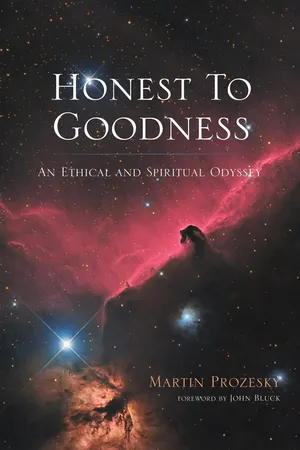
Honest to Goodness proposes a new Christian presence that is free of dogmatism, exclusivism, and biblicism. It charts a way back to the spiritual and ethical revolution begun by Jesus of Nazareth, one that can make a vital difference to needless evils such as bigotry, environmental destruction, poverty, and violence. The book reveals the author's experience of living under, against, and after apartheid, insisting that a faith that does not confront this world's evils is no faith at all, but a dangerous betrayal of all that is good, beautiful, and true.
Honest to Goodness unflinchingly identifies the grave moral shortcomings that are embedded in traditional Christian beliefs and practices, and proposes ways of transforming them into harmony with the divine goodness that the author discerns everywhere.
Embracing a world of religious diversity, science, and creative philosophy, the book describes a new way of experiencing and expressing the divine. It defends faith by moving beyond both theism and atheism.
Trusted by 375,005 students
Access to over 1.5 million titles for a fair monthly price.
Study more efficiently using our study tools.
Information
Topic
Theology & ReligionSubtopic
Christian TheologyPart I
Formative Factors
Chapter 1
Goodness
Celebrating goodness
In a powerful book written more than a generation ago, England’s Bishop John Austin Baker wrote a memorable passage about goodness. With his and his publisher’s permission it is reproduced here, very slightly edited to fit the present context.
“Sorrow is at most only one half of reality. In a thousand, often surprising ways our humanness is matched to its environment, and enabled to find it good; indeed, the ways in which humankind finds or makes its pleasures are far more varied than its pains.
“There is the relish of food and drink; the satisfaction of hard, tiring work alternating with rest, leisure, sleep; the precious sense of physical health. There are the joys of love, of friendship, and of family life, the pride and excitement stirred by the achievements of one’s children, fellow-workers, and neighbours, one’s nation or others, be it in football or philosophy, outrigger racing or space exploration. Almost every nation takes pleasure in music and dance, in making things that are beautiful or useful, in solving problems. There are the delights of the senses. Visual beauty—not only present in the people and the works of art or Nature generally agreed to be beautiful, but liable to descend with a sudden nuance of the light, even if only for a short while, on the most unlikely objects; and the more acutely or wholeheartedly we look, the less bored or sated we are with what we see. Beauty of touch—the feel of polished wood, of water through the fingers or swilling all over you, of the solid earth under you, of the sheets of muscle in a horse’s neck. Beauty of hearing—an old song worn to a perfect line by centuries, ripples against a running boat, a bird, a drum, a smooth powerful motor. Beauty of smell—wine, the first frost, green things after rain, the fur of a healthy animal . . .
“The pleasures already mentioned are of the kinds open to all societies, poor or rich, simple or sophisticated, in every continent. Once we start investigating those peculiar to each culture or sub-culture—pop music and pigeon-racing, bullfighting and beer, Stravinsky and stamp-collecting—there are more than enough entries for a large encyclopaedia. And that in itself tells us something of enormous importance about our experience of the world. Are we to count only the hate, never the love, only the ugliness, never the loveliness, only the misery, never the joy?”1
Goodness explained
As the governing value of this book, goodness must now be more carefully explained. According to philosopher Richard Robinson, to deem anything good is “to reach an attitude towards it, an evaluation of it, and a decision how to behave with regard to it. It is to choose it,” adding the important insight that the “beginning of wisdom is to value something for itself.”2 Goodness is valued for itself in the experiences underlying this book because it is like a many-faceted diamond, precious for itself, and for the many beautiful forms that are its facets.
The living heart of goodness for us as human beings is well-being, which stands, subjectively, for the many profoundly fulfilling, meaningful and happy experiences that matter most to us, and objectively for the surrounding contexts that make them possible. The three main facets of goodness, in the judgment of this book, are love, which entails active concern, compassion and a dedication to justice for all; truth, which requires honesty, attested evidence and reason; and freedom, understood as both creativity and as a willingness to seek fulfilment in new ways that do no harm. Experiencing any of these and embracing them leads to behavior that expresses and extends them to others, and also receives them from others. These values are ones that Christianity itself teaches; they are also taught by other ethical traditions, as earlier research of mine demonstrated.3
A book called Honest to Goodness clearly sets very great store by the pursuit of truth, so something needs to be said now about truth, a value that the Bible itself centralizes, in John 8:32 and in numerous other passages. The standpoint of this book is that there is an ethical duty for everybody to seek the fullest possible truth, understood as beliefs that can be confirmed by evidence and logical reasoning of the kind that are open to everybody. This is what it means to love God with all your mind and not just all your heart and strength, and its clear implication is that deference to authority cannot be the primary method of truth-seeking. Here again Richard Robinson provides a helpful insight with these words: “Complete submission to authority is a grave irresponsibility” and when he adds that truth “is something like the accumulation of acceptable statements, the pursuit, formation and possession, of as many acceptable statements as possible.”4
As a philosopher Robinson not surprisingly regards reason as the greatest virtue, whereas in Christianity love is deemed the greatest virtue, but his definition of reason, which plays a decisive part in this book, is nonetheless fully compatible with the love that Christianity and other faiths require. He defines it as love of truth, respect for reasons, consistency, deductiveness (meaning acceptance of the logical implications of our beliefs), preference for probability, tentativeness (as opposed to dogmatism), respect for evidence, submission to criticism, impartiality (meaning balanced objectivity), and the lessening of misery.5
The goodness of which Bishop Baker wrote so eloquently is within us, among us and beyond us. We experience it daily, hourly and even continuously when we put our minds to it, in the wondrous ways that give us well-being. Life itself and all living things are good, as is the existence of the cosmos in its stunning grandeur. Love is a very great good, in the Christian faith the greatest of all. Good also is our ability to be aware of our worlds and to recognize and create beauty; and, for our own good and of others, also the ability to recognize and transform ugliness and evil. The ability to know and value truth is another very great good, both in itself and because without it other goods diminish and even perish. The ability to find ways of facing and handling adversity, alone and with others, is yet another good, as is the joy of sharing whatever makes life very precious.
Goodness is present in the people who enrich our lives all the time and in the structures of society that give it stability, order and justice. We experience it in all the unearned and unexpected blessings that come to us, like a seemingly miraculous deliverance from deadly peril, a welcome job offer, a chance meeting that leads to love, marriage and a family, rains that end a long drought, the breath-taking beauty of the universe and a tiny flower that catches the eye next to a path in the mountains, and in so many other ways which touch us all, unbidden, throughout our lives. And most wondrous of all is the ability to recognize and value goodness itself, a supreme blessing that gives us our bearings and direction, underlying the countless specific ways we experience it throughout our lives. Encountering these realities evokes gratitude and at times amazement; it offers us opportunities to enhance goodness around us and in ourselves, and it invites us to ponder its ultimate source.
From, or perhaps through, a handful of rare individuals over the past few thousand years there have flowed powerful rivers of goodness that have changed the world and still do, mostly as an inherent part of their spiritual influence. Moses on Mount Sinai, according to the Hebrew Scriptures, received the moral guidance of the Ten Commandments. I once heard a Hasidic rabbi explain that on the holy mountain he received a vision of an inexhaustible compassion, a vision that not only shaped Judaism but also Christianity. As the eminent New Testament scholar John Dominic Crossan has said, the entire prophetic tradition involves an “insistent divine demand for distributive justice” for all and not just for Israel.6 In India there was Gautama Siddharta’s experience of enlightenment about the way to overcome suffering, which made him the Buddha and gave rise to yet another great river of goodness, best known today in the person of the Dalai Lama.
Some five centuries after the Buddha, Judaism gave birth to a great new river of goodness with a message and practice of divine love as a world-changing ethic, given to the world in and by Jesus of Nazareth, who fed the hungry and healed the sick, and whose earliest followers experienced the life-giving Easter truth that his spirit, message and example had not been defeated by the horror of his crucifixion. Still later came a further great stream from Prophet Muhammad’s hearing and reciting of the words of the Qur’an, receiving them as from the very heart of Allah himself.
Nearer our own time came the moral outrage felt by Karl Marx at the pitiless exploitation of workers by their employers in the mines and factories of nineteenth-century Europe; the women and men of conscience who started and led the movement to end slavery; also Gandhi’s great experiment with truth and the power of the soul known as satyagraha to overcome injustice.7 At much the same time brave women began the demand for equal treatment with men, launching another great stream of goodness in the world. Then we saw the dramatic force of Martin Luther King’s courage and his great speech of a dream for a better world which so inspired all who struggled against racism, like Nelson Mandela and Desmond Tutu. For me personally, lis...
Table of contents
- Title Page
- Acknowledgements
- Foreword
- Preface
- Apologia for an Odyssey
- Part I: Formative Factors
- Part II: Conservative and Liberal Christianity in the Light of Great Goodness
- Part III: Progressive Christianity as an Ethical Faith and Practice
- Epilogue
- Bibliography
Frequently asked questions
Yes, you can cancel anytime from the Subscription tab in your account settings on the Perlego website. Your subscription will stay active until the end of your current billing period. Learn how to cancel your subscription
No, books cannot be downloaded as external files, such as PDFs, for use outside of Perlego. However, you can download books within the Perlego app for offline reading on mobile or tablet. Learn how to download books offline
Perlego offers two plans: Essential and Complete
- Essential is ideal for learners and professionals who enjoy exploring a wide range of subjects. Access the Essential Library with 800,000+ trusted titles and best-sellers across business, personal growth, and the humanities. Includes unlimited reading time and Standard Read Aloud voice.
- Complete: Perfect for advanced learners and researchers needing full, unrestricted access. Unlock 1.5M+ books across hundreds of subjects, including academic and specialized titles. The Complete Plan also includes advanced features like Premium Read Aloud and Research Assistant.
We are an online textbook subscription service, where you can get access to an entire online library for less than the price of a single book per month. With over 1.5 million books across 990+ topics, we’ve got you covered! Learn about our mission
Look out for the read-aloud symbol on your next book to see if you can listen to it. The read-aloud tool reads text aloud for you, highlighting the text as it is being read. You can pause it, speed it up and slow it down. Learn more about Read Aloud
Yes! You can use the Perlego app on both iOS and Android devices to read anytime, anywhere — even offline. Perfect for commutes or when you’re on the go.
Please note we cannot support devices running on iOS 13 and Android 7 or earlier. Learn more about using the app
Please note we cannot support devices running on iOS 13 and Android 7 or earlier. Learn more about using the app
Yes, you can access Honest To Goodness by Martin Prozesky in PDF and/or ePUB format, as well as other popular books in Theology & Religion & Christian Theology. We have over 1.5 million books available in our catalogue for you to explore.