eBook - ePub
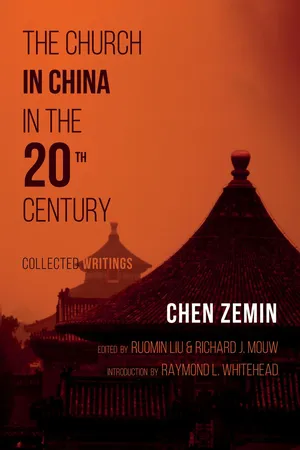
The Church in China in the 20th Century
Collected Writings
- 228 pages
- English
- ePUB (mobile friendly)
- Available on iOS & Android
eBook - ePub
The Church in China in the 20th Century
Collected Writings
About this book
While the Peoples Republic of China is officially an atheist country, Christianity continues to experience rapid growth on the Chinese mainland. Many observers see the country as on the way to becoming "the world's most Christian nation." Yet there is widespread ignorance in the English speaking world about how the Chinese Christian community fared during the decades prior to China's "opening up to the West" in the aftermath of the historic visit of Richard Nixon to Beijing in 1972. This collection of essays, the first of them published in 1939, provides an invaluable record of developments in mainland Chinese Christianity during that period and for the remaining decades of the twentieth century. The fact that the essays were all authored by a key participant in the Protestant churches in China provides significant added value. Professor Chen discusses a wide range of important topics: various stages of rural and urban development, the "Three Self" principles for structuring officially sanctioned worshiping communities, Bishop K.H. Ting's advocacy of a genuinely indigenous Chinese theology, patterns of international cooperation, worship, seminary education, and much more. These essays make a unique and significant contribution to the Western understanding of Asian religious life in the twentieth century.
Trusted by 375,005 students
Access to over 1.5 million titles for a fair monthly price.
Study more efficiently using our study tools.
Information
Topic
Teologia e religioneSubtopic
CristianesimoChrist And Culture in China
A Sino-American Dialogue
(Columbia Theological Seminary, October, 1992)
As part of a more general discussion of the relationship between Christ and culture, Prof. Chen focuses on the Chinese experience, discussing the attempts at contextualization and inculturation which have been made since Christianity first came to China. He points out the difficulties which resulted from the historical identification of evangelization with cultural invasion, a history which continues to complicate the long process of transforming Christianity from a foreign religion into one which is essentially Chinese.
I. The Perennial Problem
The problem of how Christianity is related to culture has nowadays become a hotly debated issue on a worldwide scale. In China, especially during the last decade, it has attracted the attention and interest of many scholars, historians, sociologists, philosophers, political theoreticians and theologians, and is being pushed to the forefront of academic debates, overshadowing the once dominant religion as opium question. However, most Christians, who are deeply engrossed in the urgent and heavy task of building the church anew and trying to implement the newly regained freedom of religion in the best possible way, have only recently come to realize the significance of this “theoretical issue.”
In fact, the problem is as old as Christianity. Jesus himself tackled it in the context of Jewish culture and Judaism. Paul and the early church fathers wrestled with this problem amid the dominant Greco Roman secular or pagan cultural environment. Up till then Christianity had been a minority religion suppressed and persecuted, and swamped by an overwhelmingly “pagan” cultural ocean. In order to survive and develop it had to take this problem seriously and find some kind of solution. From the fourth century onward, Christianity, on becoming a state religion, with all the political, military and material support of the Roman Empire, itself became an encroaching and aggressive cultural force. The problem gradually became less acute. By the tenth century all “civilized” Europe had been Christianized. To be Christian and to be civilized had become synonymous. Cultural assimilation seemed to be the natural outcome of Christianization. But even at the height of Christian hegemony in the twelfth century, with the challenges of encroaching Islam and Arabic civilization, the Schoolmen had to struggle with this problem again. Thomas Aquinas took up the challenge, and successfully worked out the Great Synthesis which laid the foundation for another long period of ecclesial and theological development. In the East Christianity had engaged in an encounter with Byzantine culture, and through a certain amount of accommodation had grown into several powerful Eastern Orthodox Churches, which culturally dominated Eastern Europe and the Russian part of Asia for almost a millennium.
In Western Europe, during the periods of the Renaissance, the Reformation and the Enlightenment, Christianity had to grapple with this problem in a new cultural milieu amid the rising tides of secular humanism, nationalism, rationalism and natural sciences. Generally speaking, however, Christianity remained the dominant cultural power while also undergoing significant changes and developments itself. Christianity has always been a missionary religion. Committed to the Great Commission (Mt. 28:19–20), and firmly affirming that Christ is the only Saviour of humanity (Acts 4:12; Jn. 14:6), from the Apostolic Age on through all the centuries Christians have made it their first priority to make Christian converts of people of all nations. In so doing they came to encounter peoples and nations of many different religious and cultural traditions. Such encounters became sharper and on ever larger scales when missionary activities were carried on with evangelical zeal beyond Europe and America, often accompanied and backed up by colonial expansion. This reached its height in the nineteenth century, when Christianity reached practically all corners of the earth. In most of the “mission fields,” Christian missionaries found themselves in the minority amidst great oceans of “heathen” or “pagan” religions and cultures, some of which had much longer histories of development than Christianity. Most of these “missionary target” peoples had been quite happy with and proud of their own cultural heritages, and did not welcome interference from the new religion. This was especially obvious in Asia, such as in the Arabic countries in the Near East (Islamic), the subcontinent (Hindu), Southeast Asian countries (Buddhist or Islamic), Japan (Shinto), and China. The not-so-successful missionary enterprises in such countries have set the sending countries and churches to “rethinking mission,” leading to revolutionary mission reforms in the last half century.
II. Some Solutions
All this may seem too simplistic. But it brings us back to the enduring problem of Christ (or Christianity) in relation to the multifarious non-Christian cultures. An avalanche of books and monographs have been poured out on the subject and many answers put forward. Here I can only select a few examples for comparison and as a foil for my presentation. Let me begin with H. Richard Niebuhr, whose classic work Christ and Culture40, (the fortieth anniversary of whose publication we now have the happy occasion to commemorate) gives a splendid summary and classification of responses. They are:
1. Christ against culture, exclusivism (Tertullian, Tolstoy).
2. Christ of (or in) culture, accommodation and inclusivism (Gnosticism, Abelard and A. Ritschl).
3. Christ above culture, synthesis, (Thomas Aquinas).
4. Christ and culture in paradox, dualism (Luther).
5. Christ the transformer of culture, conversion, (Augustine and F. D. Maurice).
But almost all the illustrations in this book are taken from the West, and Niebuhr does not seem to have the encounters of Christ with great cultures in the East much in mind. In his last chapter “A Concluding Unscientific Postscript” (a phrase borrowed from Kierkegaard) he gives a long list of books and essays on the topic but leaves us in a state of bewilderment, although he himself seems to lean towards a not very well-defined “social existentialism,” a specified model of Christ as the transformer of culture.
A more recent scholar of the evangelical wing, Charles H. Kraft of Fuller Seminary, follows Niebuhr’s classification in the main but with some modifications:41
1. God against culture (Niebuhr’s 1)
2. God in culture (Niebuhr’s 2)
3. Christ above culture:
a. Above and unconcerned (Deism);
b. Synthetic (Niebuhr’s 3, Thomas Aquinas);
c. Dualistic (Niebuhr’s 4, Luther);
d. Conversion (Niebuhr’s 5, Augustine, Calvin, Wesley);
e. God-above-but-through culture
Kraft seems to opt for the last answer. “Though God exists totally outside of culture while humans exist totally within culture, God chooses the cultural milieu in which humans are immersed as the arena of his interaction with people.”“God is absolute and infinite. Yet he has freely chosen to employ human culture and at major points to limit himself to the capacities of culture in his interaction with people.”42 I would heartily recommend his book to the evangelical majority of our fellow Chinese Christians, most of whom take a rather rigid exclusivist view.
Let me give two more examples from the Catholic side, not exactly on Christ and culture, but on Christ and non-Christian religions, (which may be seen as components of culture, just as Christianity is taken as a cultural phenomenon by most Chinese scholars). First, I have in mind Paul Knitter.43 Knitter has the merit of reducing all theological reflections on this subject to four patterns:
1. Christ against religions (culture), hostility towards “paganism,” dominating in nearly all the history of Christianity, “extra ecclesiamnullasalus”;
2. Christ within religions, possibility of salvation also for non-Christians within religions, (Karl Rahner and Edward Schillebeeckx);
3. Christ above religions (culture). Other religions have an independent validity: “Even if Christ is not the exclusive cause of saving grace, yet He remains above all religions and all peoples.” (Hans Kung, Claude Geffre);
4. Unitive pluralism or “the coincidence of opposites.” “Each religion is unique and decisive for its followers; but it is also of universal importance.” It is neither exclusive (against) or inclusive (within or above), but is “essentially related to other religions,” so “perhaps . . . other revealers and saviours are as important as Jesus of Nazareth.”
Another Catholic theologian, RaimundoPannikar, reaches the same conclusion by making a distinction between the Christ-Logos and the historical Jesus. There is more in the Christ-Logos than there is in the historical Jesus, so that the Logos can appear in different but real ways in other religions and historical figures outside of Jesus of Nazareth.44
Perhaps I may add here that Bishop K.H. Ting’s essay “The Cosmic Christ”45 hints at the same thing. His “Cosmic Christ” is synonymous with “the Christ-Logos.” The theological implication of the Cosmic Christ in respect to our present issue is being slowly but gradually understood and accepted by an increasing number of Christians and theological workers in China now.
This much is enough as a background of theological reflections concerning this enduring problem. Perhaps the two Catholic theologians’ views cited above are too radical for most Protestant Thinkers in China to endorse.
III.In China—Historical Retrospect
In the first part of this paper I have tried to compare two different circumstances: first, Christianity as a dominant cultural factor in the building up of a Christendom of so-called “Christian civilization” (as in Europe and North America from the fourth century to the present); with secondly, Christianity’s encounter with older highly developed indigenous cultures in non-Christi...
Table of contents
- Title Page
- Preface
- Introductory Essay
- An Overview of the Theoretical Foundation and Practical Tasks of Building New China
- Protestant Church in China Today
- The Post-denominational Unity of the Chinese Protestant Church
- Living as Christians Today
- On Nanjing Theological Seminary
- Remarks at the Close of the Fortieth Anniversary Celebrations of Nanjing Union Theological Seminary
- Speech Given at Commencement Ceremony of Central Philippine University Iloilo City, Philippines
- The Heavenly Vision
- Pastor and Priest
- Convocation Address
- Living is Christ and Dying is Gain
- Sermon
- Montreat Conference Bible Study (in Outline)
- Intensify Theological Reconstruction in the Chinese Church
- Outline of Presentation
- Inculturation of the Gospel and Hymn Singing in China
- Reconciliation with the People
- Theological Construction in the Chinese Church
- Christ And Culture in China
- Self-Propagation in the Light of the History of Christian Thought
- Y. T. Wu
- Protestant Christianity in China
- Faith’s Journey
- Address on the “Celebration of the First Publication of ‘God is Love’”
Frequently asked questions
Yes, you can cancel anytime from the Subscription tab in your account settings on the Perlego website. Your subscription will stay active until the end of your current billing period. Learn how to cancel your subscription
No, books cannot be downloaded as external files, such as PDFs, for use outside of Perlego. However, you can download books within the Perlego app for offline reading on mobile or tablet. Learn how to download books offline
Perlego offers two plans: Essential and Complete
- Essential is ideal for learners and professionals who enjoy exploring a wide range of subjects. Access the Essential Library with 800,000+ trusted titles and best-sellers across business, personal growth, and the humanities. Includes unlimited reading time and Standard Read Aloud voice.
- Complete: Perfect for advanced learners and researchers needing full, unrestricted access. Unlock 1.5M+ books across hundreds of subjects, including academic and specialized titles. The Complete Plan also includes advanced features like Premium Read Aloud and Research Assistant.
We are an online textbook subscription service, where you can get access to an entire online library for less than the price of a single book per month. With over 1.5 million books across 990+ topics, we’ve got you covered! Learn about our mission
Look out for the read-aloud symbol on your next book to see if you can listen to it. The read-aloud tool reads text aloud for you, highlighting the text as it is being read. You can pause it, speed it up and slow it down. Learn more about Read Aloud
Yes! You can use the Perlego app on both iOS and Android devices to read anytime, anywhere — even offline. Perfect for commutes or when you’re on the go.
Please note we cannot support devices running on iOS 13 and Android 7 or earlier. Learn more about using the app
Please note we cannot support devices running on iOS 13 and Android 7 or earlier. Learn more about using the app
Yes, you can access The Church in China in the 20th Century by Chen Zemin, Ruomin Liu,Richard J. Mouw, Ruomin Liu in PDF and/or ePUB format, as well as other popular books in Teologia e religione & Cristianesimo. We have over 1.5 million books available in our catalogue for you to explore.