- 146 pages
- English
- ePUB (mobile friendly)
- Available on iOS & Android
eBook - ePub
About this book
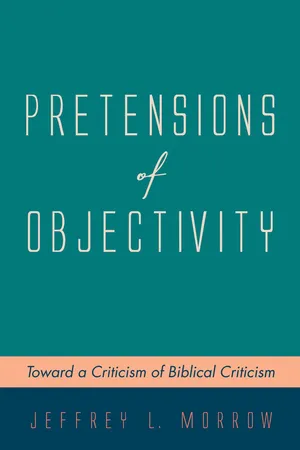
Modern historical biblical criticism, while having many strengths, often operates under the pretensions of objectivity, as if such scholarship were neutral and disinterested. Examining the history and roots of modern biblical scholarship shows that such objectivity is elusive, and was never intended by the method's earliest practitioners. Building upon his earlier work in Three Skeptics and the Bible and Theology, Politics, and Exegesis, Morrow continues this historical investigation into the political and philosophical roots of modern biblical criticism in Pretensions of Objectivity, in the hope of developing a criticism of biblical criticism and of making space for theological exegesis.
Trusted by 375,005 students
Access to over 1.5 million titles for a fair monthly price.
Study more efficiently using our study tools.
Information
1
Back to the Source
Biblical Criticism in the Renaissance and Reformation
The task of this first chapter is to provide an overview of the political and philosophical background to the history of modern biblical criticism from the fourteenth century through the Reformation. The chapter expands upon the first chapter in my previous book, Theology, Politics, and Exegesis.19 In particular, it elaborates upon the role of Marsilus of Padua (1275–1342) and William of Ockham (1285–1347) through the period of the Protestant Reformation.20 As with that volume, this book follows the basic outline Scott Hahn and Benjamin Wiker constructed in their Politicizing the Bible: The Roots of Historical Criticism and the Secularization of Scripture 1300–1700, with which I am in substantial agreement.21 Their introductory chapter helpfully sets the stage for the history that follows, and this is a valuable contribution.
As their subtitle—“The Secularization of Scripture”—indicates, these authors underscore some of the ways in which the interpretation and study of Scripture has been secularized over the course of centuries. Far too rarely in brief surveys of biblical scholarship has the role of politics and philosophy been addressed, let alone addressed adequately. Hahn and Wiker demonstrate how various political concerns and undergirding philosophies shaped and guided the long process which led to the historical critical method of biblical interpretation. They situate this process within the broader historical, political, philosophical, and theological contexts in which historical criticism was formed. Moreover, they situate the contributions of the major figures involved in this process within the context of their biographies, which proves to be so necessary for understanding this history. Hahn and Wiker consider an expansive and often neglected period within the history of modern biblical criticism.22 I have tried to contribute to this project through my Three Skeptics and the Bible,23 my sequel to that volume, Theology, Politics, and Exegesis, and now, with the present, third installment in that series.
Following Hahn and Wiker’s outline, as well as the initial sketch I made at the beginning of Theology, Politics, and Exegesis, I begin this chapter by showing how Marsilius of Padua’s and William of Ockham’s arguments justify the subordination of the church to the state. Hahn and Wiker suggested this had to do with Marsilius’s Averroist philosophical underpinnings and Ockham’s nominalism. As we shall see, however, it is not certain that Marsilius was an Averroist. Regardless, such Averroist and nominalist philosophies continued to undergird much of the future of historical critical exegesis, even if these may not have been the sole or primary driving forces with Marsilius and Ockham.
After this, I turn to Wycliffe’s attack upon nominalism and how it inadvertently supported the same sort of exegesis and subordination of the church to the state as had Marsilius and Ockham. Thus, for theological reasons (and for philosophical reasons, directly opposed to Ockham) Wycliffe brought to English and—through his followers—to German soil the subordination of the church to the state, as Marsilius and Ockham had argued. Thus, the foundation was set for the German and English Reformations which would soon follow. Next, I turn to Machiavelli, showing how Machiavelli created a hermeneutic of suspicion, where, much like Averroës, he saw religion as a veil for more crafty political machinations of hypocritical rulers.
From Machiavelli, I turn to Luther and the Protestant Reformation, where we find Luther and his co-Reformers inspired in part by the widespread corruption among clerical leaders within the Catholic hierarchy. Luther was a nominalist and self-identified as a follower of Ockham. Luther built upon the groundwork laid by Marsilius and Wycliffe, and he inadvertently aided in the transformation of the public civic realm into a secular realm, wherein the state controlled the church. After Luther, I conclude with the English Reformation of King Henry VIII, showing how his reforming policy built upon all the influential figures whom I have previously discussed: Marsilius, directly through Henry’s advisors; Ockham, implied through the German Protestant influence; Wycliffe, through the influence of English Lollardy, which had so shaped English nationalist aspirations as well as prepare the groundwork in Germany for the Reformation; Machiavelli, directly through Henry’s advisors; and Luther, through embracing the Protestant Reforming agenda in England.
In Hahn and Wiker’s volume, their overarching argument is that “the development of the historical-critical method in biblical studies is only fully intelligible as part of the more comprehensive project of secularization that occurred in the West over the last seven hundred years, and that the politicizing of the Bible was, in one way or another, essential to this project.”24 In roughly the first half of their volume, Hahn and Wiker show how the stage is set for the drama of historical criticism’s evolution. In the second half of the text, the authors illustrate how specific exegetes operated within the intellectual and political world created by the figures discussed in the first half.
I would modify Hahn and Wiker’s claim only slightly, in order to accommodate an important insight found in Andrew Jones’s important work, Before Church and State. Jones has shown how problematic it is to read church and state conflicts back into the medieval period; this is an anachronistic viewpoint influenced by our own contemporary experience of church and state.25 In the medieval period, the secular was not what we take it to mean today (more on this in chapter five). Church and state were not vying for political authority, contrary to the many studies by revered historians of the past more than a century. In fact, church and state, as two completely separable institutions, did not exist in the world of medieval Christendom. Instead, lay and ecclesiastical rulers saw themselves as enmeshed in the same sacramental world—fulfilling different roles, but working together for a common goal, both earthly and heavenly, directed at temporal peace and eternal beatitude.
I would thus rephrase Hahn and Wiker’s quotation to something like this: “the development of the historical-critical method in biblical studies is only fully intelligible as part of” a more complicated, seven-hundred-year history of developments in biblical exegesis. In the latter part of this history, historical biblical criticism formed “a part of the more comprehensive project of secularization that occurred in the West.” “The politicizing of the Bible was, in one way or another, essential to this project.”
Pretensions of Historical Criticism
We can begin by calling into question the objective neutrality of the historical critical method; it has never been disinterested and neutral, nor was it always articulated as such.26 Although it is commonplace in textbook accounts of historical-criticism to see the method as a product of the nineteenth century, increasingly, scholars identify the roots of historical criticism in the eighteenth and seventeenth centurie...
Table of contents
- Title Page
- Acknowledgments
- Introduction
- Chapter 1: Back to the Source
- Chapter 2: Corrosive History
- Chapter 3: The Brave New World of Seventeenth-Century Biblical Interpretation
- Chapter 4: A Genealogy of Catholic Notions of Inspiration
- Chapter 5: Secularization and the Elusive Quest for Objective Biblical Interpretation
- Conclusion
- Bibliography
Frequently asked questions
Yes, you can cancel anytime from the Subscription tab in your account settings on the Perlego website. Your subscription will stay active until the end of your current billing period. Learn how to cancel your subscription
No, books cannot be downloaded as external files, such as PDFs, for use outside of Perlego. However, you can download books within the Perlego app for offline reading on mobile or tablet. Learn how to download books offline
Perlego offers two plans: Essential and Complete
- Essential is ideal for learners and professionals who enjoy exploring a wide range of subjects. Access the Essential Library with 800,000+ trusted titles and best-sellers across business, personal growth, and the humanities. Includes unlimited reading time and Standard Read Aloud voice.
- Complete: Perfect for advanced learners and researchers needing full, unrestricted access. Unlock 1.5M+ books across hundreds of subjects, including academic and specialized titles. The Complete Plan also includes advanced features like Premium Read Aloud and Research Assistant.
We are an online textbook subscription service, where you can get access to an entire online library for less than the price of a single book per month. With over 1.5 million books across 990+ topics, we’ve got you covered! Learn about our mission
Look out for the read-aloud symbol on your next book to see if you can listen to it. The read-aloud tool reads text aloud for you, highlighting the text as it is being read. You can pause it, speed it up and slow it down. Learn more about Read Aloud
Yes! You can use the Perlego app on both iOS and Android devices to read anytime, anywhere — even offline. Perfect for commutes or when you’re on the go.
Please note we cannot support devices running on iOS 13 and Android 7 or earlier. Learn more about using the app
Please note we cannot support devices running on iOS 13 and Android 7 or earlier. Learn more about using the app
Yes, you can access Pretensions of Objectivity by Jeffrey L. Morrow in PDF and/or ePUB format, as well as other popular books in Theology & Religion & Biblical Criticism & Interpretation. We have over 1.5 million books available in our catalogue for you to explore.