eBook - ePub
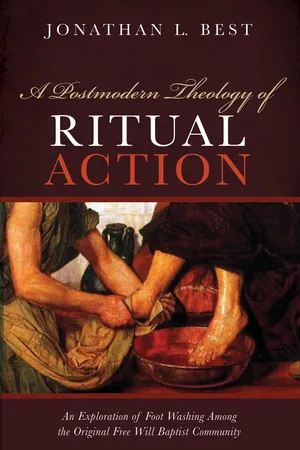
A Postmodern Theology of Ritual Action
An Exploration of Foot Washing among the Original Free Will Baptist Community
- 250 pages
- English
- ePUB (mobile friendly)
- Available on iOS & Android
eBook - ePub
A Postmodern Theology of Ritual Action
An Exploration of Foot Washing among the Original Free Will Baptist Community
About this book
A Postmodern Theology of Ritual Action is a unique work that seeks to explore where we find meaning within ritual and actions within the church. Bridging hermeneutics, philosophy, and postmodern thought, this work seeks to explore how to do theology with the community through conversation. Beginning with the mindset that meaning is already present within ritual action rather than outside it, Best engages the practice of foot washing among the Original Free Will Baptist denomination of eastern North Carolina. Foot washing suggests a new future for theology, a future that models love, service, and acceptance. Incorporating insights gained from conversing with philosophy, theology, and the Original Free Will Baptists, foot washing points toward a future relational practical theology. A Postmodern Theology of Ritual Action is a captivating work that draws from both philosophers and theologians to show that we can learn much by listening to the voices of religious practitioners.
Trusted by 375,005 students
Access to over 1.5 million titles for a fair monthly price.
Study more efficiently using our study tools.
Information
Topic
Theology & ReligionSubtopic
Christian DenominationsChapter One
Hermeneutics and Ritual Action
The Difficulty of Interpretation
Interpretation is never an easy task. It is a complex process of exploring people and their actions. Meaning is not self-evident. Instead, meaning may appear as self-contradictory or completely absent in certain situations. The complexities of human action and behavior do not always lend themselves to clear and apparent meanings. This is especially so for religious meaning. It is a truism to say that religious texts and actions are difficult to discern. There is a need for interpretation that delves into the heart of practice and respects the integrity of such practices. Interpretation that seriously considers the interpreted, without recourse to something outside action itself.
All narrative or literary objects are estranged from their author and context. It is futile to attempt a reconstruction of the original world or its author.45 Consequently, this estrangement functions on many levels and is a major barrier in interpretation. Historical distancing is an ongoing process that makes the job of interpretation ongoing.46 Once born, history affects all objects of interpretation. The written word, the delivered speech, and the enacted ritual are immediately subjected to distanciation.47
As interpreters, we are not immune to this distancing effect. History affects us all, and separation with our historical situation is impossible.48 The interpretative situation is much like standing on the precipice of an ever-growing chasm. The ability to accurately interpret the original work, and the author behind that work, retreats further in the distance with each passing generation. Interpretation becomes guesswork. Moreover, it becomes difficult to determine the meaning of the original situation and its application to the present. Recognition of our situation and horizon are thus immensely important in interpretation. Finitude is a continual barrier in interpretation. No one has the luxury of seeing all the factors involved in interpretation.49 The act of interpretation is one of continually coming up short. This limit is what is what Hans-Georg Gadamer meant by the situation.50 Varying factors limits how we can interpret and view our world. These include obvious factors such as race, gender, culture, and creed. The situation is also comprised of less obvious elements such as stories, life decisions, and the experiences that make each of us unique. Personal history limits our own vision.51
Interpretation and Horizon
Interpretation connects to our situations and experiences. Situation sets the limits of interpretation, while the horizon has the potential for opening that interpretation. Thus, the horizon encompasses the whole scope of our vision. This vision includes its possible expansion into the future. Though bound by a situation, our horizon is the element of potential in interpretation. The horizon opens new paths of interpretative engagement. Thus, horizon is a position of remaining open to the object of interpretation.52 General openness requires us to be attentive to important claims texts, objects, and actions place on our lives. Things such as texts, musical performances, and rituals possess powerful ways of garnering our attention. They challenge and redefine what was previously known, but on the condition that we remain open to its claims. Furthermore, the horizon is not a blank slate, rather it represents an anthology of experiences that all of us bring into conversation.53 Texts, performances, and rituals are conversation starters. They make claims that we as interpreters can adopt, argue, or reject.54 In fact, argument is important in interpretation. Arguments and conflicting viewpoints can be important for expanding and moving the conversation forward. To interpret is to make a claim, therefore argument and defense offer the possibility to go deeper into conversation. When conflicts arise, interpretation uses that as an opportunity to go further.55 Interpreting ritual action may bring conflicts when encountering unfamiliar, and even familiar, rituals. Arguments are a chance for going beyond the superficial
All interpretation begins from an initial situation and possible horizon. The limit and scope of that horizon depends on our openness in interpretation. The horizon can be narrow or even completely absent if we remain closed in the interpretative task. As such, the horizon lies in our own hands. The goal is not to escape from the horizon, but to embrace our own situation as necessary for interpretation.56 Estrangement is thus beneficial in the interpretative process. Acknowledging estrangement avoids the illusion of objectivity, which allows us to go further in interpretation. A closed interpretation, one that seeks an objective path to knowledge and understanding, attempts interpretation from the outside. It escapes real engagement with the object, text, or action in interpretation.
Further Problems in Interpretation: Action as a Text
The problems of interpretation are vast, especially for texts. Texts provide an excellent example of the problems we face in interpretation. For example, texts suffer a semantic distancing between the author and the contemporary reader. As time goes by, understanding the author’s mind becomes an arduous and increasingly difficult task. The author is no longer available for questioning once the text is written down. There is no longer a direct one-to-one correspondence between the author’s meaning and the interpreted meaning. The text no longer depends on the author. Consequently, the text acquires semantic autonomy.57 The text leaves the author and his or her world behind. Interpretation is not an attempt to decipher a single fixed meaning. The text expands its public to a potentially unlimited number of interpreters. Meaning is open to an infinite array of readers across various times and spaces.58 The interpretive focus does not center on the author and his or her world. As such, understanding is a process of questioning the things in themselves. All the while, we remain open to surprises in interpretation.
Problems of interpretation go beyond texts. These problems move into other aspects of action and behavior. Textual interpretation is but one example of a larger problem of meaning. Consider the action of speaking. There are considerable problems of interpretation present in speaking. Like a text, speaking creates a semantic distance between what was said and the speaker. Semantic distance is a continual problem since the experience of the speaker is not directly transferable to the listener.59 There is a distance between the discourse, the situation of speaking, and the audience. The experience of the speaker, like the writer, is a private experience. However, the meaning is a public event of interpretation.60
Ritual action brings problems like interpreting text or speech. The principles of textual interpretation provide important first steps toward encountering ritual action’s meanings. Thinking of action as a text suggests ways that we can encounter and interpret ritual action. In Paul Ricoeur’s words, “the not...
Table of contents
- Title Page
- Acknowledgments
- Introduction
- Chapter 1: Hermeneutics and Ritual Action
- Chapter 2: Learning to Listen
- Chapter 3: A Conversation with the Original Free Will Baptists
- Chapter 4: Relation, Space, Story, and Action
- Chapter 5: Love and Community
- Chapter 6: Toward a Relational Practical Theology
- Bibliography
Frequently asked questions
Yes, you can cancel anytime from the Subscription tab in your account settings on the Perlego website. Your subscription will stay active until the end of your current billing period. Learn how to cancel your subscription
No, books cannot be downloaded as external files, such as PDFs, for use outside of Perlego. However, you can download books within the Perlego app for offline reading on mobile or tablet. Learn how to download books offline
Perlego offers two plans: Essential and Complete
- Essential is ideal for learners and professionals who enjoy exploring a wide range of subjects. Access the Essential Library with 800,000+ trusted titles and best-sellers across business, personal growth, and the humanities. Includes unlimited reading time and Standard Read Aloud voice.
- Complete: Perfect for advanced learners and researchers needing full, unrestricted access. Unlock 1.5M+ books across hundreds of subjects, including academic and specialized titles. The Complete Plan also includes advanced features like Premium Read Aloud and Research Assistant.
We are an online textbook subscription service, where you can get access to an entire online library for less than the price of a single book per month. With over 1.5 million books across 990+ topics, we’ve got you covered! Learn about our mission
Look out for the read-aloud symbol on your next book to see if you can listen to it. The read-aloud tool reads text aloud for you, highlighting the text as it is being read. You can pause it, speed it up and slow it down. Learn more about Read Aloud
Yes! You can use the Perlego app on both iOS and Android devices to read anytime, anywhere — even offline. Perfect for commutes or when you’re on the go.
Please note we cannot support devices running on iOS 13 and Android 7 or earlier. Learn more about using the app
Please note we cannot support devices running on iOS 13 and Android 7 or earlier. Learn more about using the app
Yes, you can access A Postmodern Theology of Ritual Action by Jonathan L. Best in PDF and/or ePUB format, as well as other popular books in Theology & Religion & Christian Denominations. We have over 1.5 million books available in our catalogue for you to explore.