eBook - ePub
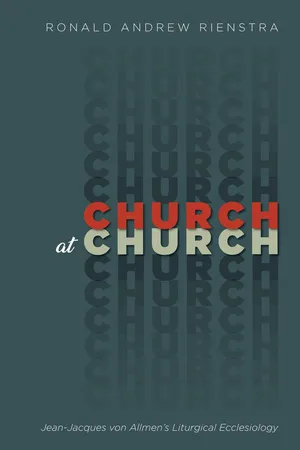
Church at Church
Jean-Jacques von Allmen’s Liturgical Ecclesiology
- 176 pages
- English
- ePUB (mobile friendly)
- Available on iOS & Android
eBook - ePub
About this book
Consider:
-The church both learns and becomes what it truly is when it gathers to worship.
-Worship tells the story of God's salvation history and invites God's people into it.
-By doing so, the church offers the world both a stern warning and a hopeful promise.
These are three of the key insights that animated the work of Jean-Jacques von Allmen, a Swiss Reformed pastor and professor who is among the most admired liturgical theologians of the twentieth century. Yet his work is largely and lamentably unknown to most worship leaders. In this book, Ron Rienstra provides an introduction to this important thinker. He offers methodological and biographical context and then explores von Allmen's most generative insights concerning the church as it engages in its most foundational activity: worship. Viewed through the lens of the Nicene marks, Rienstra's exploration yields the outlines of a "liturgical ecclesiology": a way to help the church think more deeply about its identity and to help its leaders shape the worship they prepare and lead today.
Trusted by 375,005 students
Access to over 1.5 million titles for a fair monthly price.
Study more efficiently using our study tools.
Information
Topic
Theology & ReligionSubtopic
Christian Rituals & PracticeChapter 1
Liturgical Ecclesiology
The Church is first and foremost a worshipping community. Worship comes first, doctrine and discipline second.
—George Florovsky1
What is Liturgical Ecclesiology? A part of what this present project aims to do is to identify an emerging field at the intersection of two fairly new theological disciplines: ecclesiology and liturgical theology. It will first be necessary to provide some context—thematic, historical, and methodological—in order to locate the present project within those larger disciplinary conversations.
Pioneers and Subsequent Settlers
On the border between ecclesiology and liturgical theology is a relatively undeveloped theological subdivision. In what follows, my intention is to take some of the materials from the one neighborhood (liturgical theology) along with the best plans from what we might consider to be well-constructed houses in the neighborhood of ecclesiology, to see what kind of structure von Allmen, as a pioneer, built there. Or to use another metaphor, I want to put on a pair of ecclesiological spectacles—in particular (though not exclusively), the Nicene marks of the church—and read von Allmen’s liturgical theology through them. What we see there will be a new thing: a liturgical ecclesiology.2 We will begin with a brief examination of a few theologians who, consciously or not, followed in von Allmen’s footsteps, whose work and methodologies echo those von Allmen used decades earlier, and who, self-consciously or not, were also doing liturgical ecclesiology. Our goal is to be particularly attentive to their methodological moves. We will then be in a position to articulate the approach that will guide the rest of this study.
The connection between liturgy and ecclesiology is an obvious one, but not a clear one. That is to say, while it is plain to see that there is a connection, it is more difficult to define precisely what that connection is. Recent interest in both fields of study has led a few scholars—especially liturgical theologians—to try to do so. For example, as the Orthodox theologian Alexander Schmemann writes in his Introduction to Liturgical Theology: “The purpose of worship is to constitute the Church.”3 Hence, his methodological approach is to start with the church at worship, its liturgical life, and its fundamental ordo, and to discern in them the material for theological—and thus ecclesiological—reflection. In contrast, Lutheran scholar Frank Senn suggests a mirror image of this relationship between the two: liturgy and the study of it is encompassed by ecclesiological questions and concerns. He writes that liturgiology (a cousin of liturgical theology) is really “a subdivision of ecclesiology.”4
The recovery of the doctrine of the Mystical Body of Christ was central to the emergence of the Liturgical Renewal Movement, and to liturgical theology as its own discipline. The fundamental conviction arising from this recovery is that the church is most explicitly itself when it gathers on the Lord’s Day for worship. This is the starting point and returning touchstone for nearly all of the scholars who, like von Allmen, undertake to do liturgical theology from an ecclesiological viewpoint. Hearing, in the pages that follow, from later settlers in this territory (or, to use the other metaphor, those who wore ecclesiological glasses while writing their liturgical theology) will give us some guidelines to discern the method and assess the prototypical liturgical ecclesiology we see in von Allmen.
Nathan Mitchell
In 1999, Nathan Mitchell published an article entitled Liturgy and Ecclesiology. His is an interpretation of Vatican II as a reform of both worship and church—or perhaps, church through worship: “The challenge of Vatican II, therefore, was not simply to find a new way of worshipping, but to find a new way of being church in and for the world.”5 For Mitchell, as for Schmemann and Kavanagh, doctrine arises from doxology—ecclesiology from liturgy:
Patterned on Christ, led by the Spirit, embodied in the Gospels, and enacted in the liturgy. . . . Through them the Christian assembly rehearses—practices—the presence of God’s kingdom in and for the world. For this reason, liturgy is the privileged place where the Church discovers and actualizes its own deepest identity.6
Mitchell hastens to note that liturgy is not just a set of institutional rituals or body of beliefs, but a way of life.
For Mitchell, the presence of God’s kingdom is characterized by radical renunciation of money, glory, and power. It is a community in which economic, racial, and sexual barriers have fallen. It is a community where people own things in common, willingly and quickly offer forgiveness, where they shoulder each other’s burdens, etc.7 “This,” says Mitchell, “is the ecclesiology that the liturgy rehearses and promotes.” Then, he places that ecclesiology in God’s salvation history: “It offers not only an ideal icon of who and what the Church should be but a lively sacrament of the whole world’s future.”8 Ecclesiology, eschatology, and ethics all intersect, as the church calls itself and the world into a destiny of justice, peace, and charity—a destiny that must simultaneously be sought after and rested in.
The method for a liturgical ecclesiology that Mitchell outlines, then, is one characterized “not only by an emphasis on the Church’s cultic activity but also—and more importantly—by its emphasis on the Church as a body of disciples who enflesh Jesus’ vision of a new human community based on justice, mercy, and compassion.”9 In other words, the worshipping church is important, but important because it is there that the Christian community’s values for life in the world are shaped and expressed. It is there that the body of Christ is formed. Mitchell identifies two specific consequences. First, that Eucharistic hospitality is the hallmark of any community that is called church. This puts the Lord’s Supper at the center not only of liturgical celebrations, but also of Christian life. Second, there is a humility vis-à-vis the world, an acknowledgment of a “liturgy in the world,” a grace that God gives the cosmos at its depths, which is signaled but not exhausted in the Eucharist. Thus, the supper is not an invitation to abandonment of the “secular,” but an offering the church makes, an offering of Christ, and itself, as sacrament for the world.
Mitchell’s article, while suggestive, has neither the length nor the focus to clearly articulate either a method for liturgical ecclesiology or a constructive project of liturgical ecclesiology. But it is significant in its use of the term and the centrality of eccle...
Table of contents
- Title Page
- Acknowledgments
- Introduction
- Chapter 1: Liturgical Ecclesiology
- Chapter 2: Jean-Jacques von Allmen, Biography
- Chapter 3: Persistent Themes
- Chapter 4: Ecclesial Identity
- Chapter 5: Liturgical & Homiletical Implications
- Bibliography
Frequently asked questions
Yes, you can cancel anytime from the Subscription tab in your account settings on the Perlego website. Your subscription will stay active until the end of your current billing period. Learn how to cancel your subscription
No, books cannot be downloaded as external files, such as PDFs, for use outside of Perlego. However, you can download books within the Perlego app for offline reading on mobile or tablet. Learn how to download books offline
Perlego offers two plans: Essential and Complete
- Essential is ideal for learners and professionals who enjoy exploring a wide range of subjects. Access the Essential Library with 800,000+ trusted titles and best-sellers across business, personal growth, and the humanities. Includes unlimited reading time and Standard Read Aloud voice.
- Complete: Perfect for advanced learners and researchers needing full, unrestricted access. Unlock 1.5M+ books across hundreds of subjects, including academic and specialized titles. The Complete Plan also includes advanced features like Premium Read Aloud and Research Assistant.
We are an online textbook subscription service, where you can get access to an entire online library for less than the price of a single book per month. With over 1.5 million books across 990+ topics, we’ve got you covered! Learn about our mission
Look out for the read-aloud symbol on your next book to see if you can listen to it. The read-aloud tool reads text aloud for you, highlighting the text as it is being read. You can pause it, speed it up and slow it down. Learn more about Read Aloud
Yes! You can use the Perlego app on both iOS and Android devices to read anytime, anywhere — even offline. Perfect for commutes or when you’re on the go.
Please note we cannot support devices running on iOS 13 and Android 7 or earlier. Learn more about using the app
Please note we cannot support devices running on iOS 13 and Android 7 or earlier. Learn more about using the app
Yes, you can access Church at Church by Ronald Andrew Rienstra in PDF and/or ePUB format, as well as other popular books in Theology & Religion & Christian Rituals & Practice. We have over 1.5 million books available in our catalogue for you to explore.