- 148 pages
- English
- ePUB (mobile friendly)
- Available on iOS & Android
eBook - ePub
About this book
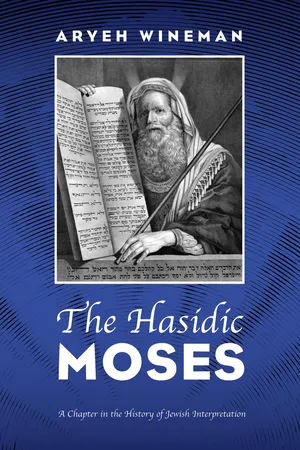
In The Hasidic Moses, Aryeh Wineman invites readers to join him on a journey through various eighteenth- and nineteenth-century Hasidic texts that interpret the life of Moses. Such texts read their own accent on spirituality and innerness along with their conceptions of community and spiritual leadership into the biblical account of Moses. Wineman reveals the ways in which historical Hasidic voices interpreted both the Exodus from Egypt and the scene of Revelation at Sinai as statements concerning what occurs constantly in our lives at all times. In addition, Wineman shows how Hasidic readers embraced the idea that Moses had to die in order that his soul might return to the world in the righteous and holy ones of every generation, and that the presence of Moses actually transcends time and is present in spiritual understanding as it unfolds at any moment in any period.
Trusted by 375,005 students
Access to over 1.5 million titles for a fair monthly price.
Study more efficiently using our study tools.
Information
Topic
Teologia e religioneSubtopic
Commento della Bibbia1
Prelude
An Itinerary
An account of any person, from any point-in-time, is never a finished product. Rather such a story continues and grows from one generation to another and from one era to another. It comes to mirror new sensitivities which come to the fore along the path of time.
In Jewish tradition, the meaning of the scriptural text is not bounded by the text itself. The past is retold in a way to serve as a source and treasure of later insight. A narrative set in the past takes on new life from generation to generation. This is, perhaps, the broadest definition of the phenomenon of midrash as a later generation’s reading an older text in light of its own experience, values, and sensitivities. The initial account, even when set down in a written text, is never the last and final word, and a personage of the past is re-conceived over time as that person becomes the subject of re-telling.
In the Torah, Moses is associated with the Exodus from slavery in ancient Egypt and also with the Revelation at Sinai as well as with the trials of his leadership both leading up to the departure from Egypt and the years of wandering in the desert. He is given a considerable life-span but dies before being allowed to complete his task. In rabbinic lore, intensifying the sense of the biblical text, Moses pleads to live on and experience a sense of fulfillment of his life’s endeavor, but that privilege and satisfaction is denied him. Though he argues and pleads to live on, employing every means and argument at his command and imagination, his pleading is nevertheless rejected and he dies.
As he is viewed through various universes of discourse, the narrative concerning Moses is ceaselessly expanded and deepened through time along with the very conception of who and what Moses was. His life comes to mirror concepts and values of later eras, and he outgrows even the limitations of his biblical life-span. He is given the highest praise, and he is also the recipient of profound criticism.
In the chapters that follow, we will note how the Eastern European commentators and preachers of Hasidic teaching, primarily in the eighteenth and early nineteenth centuries, recast the account of Moses in the light of their own image and emphases and world-view. We will begin with an introduction to the terrain and landscape of the subject by a discussion of the very character of Hasidic interpretation of the Torah. This will be followed by viewing various excerpts and examples in which the Hasidic Masters, in quite diverse ways, creatively elaborated upon what is told about the life of Moses in the Torah-text in a way to express themes and values basic to Hasidism’s message and self-image. While pointing in various directions, each of these excerpts from a range of homily-texts re-creates the biblical account of Moses in some noteworthy and interesting respects.
Then we will explore how the Hasidic preachers creatively re-conceived the two major themes so central in the biblical account of Moses—the Exodus from Egypt and the Revelation-scene at Mount Sinai—and will become acquainted with a significant Hasidic statement of the role of interpretation through time. Our journey will bring us to a surprising explanation of Moses’ death in a way that both envisions his soul’s return to the world throughout the generations, along with statements of criticism of what some Hasidic thinkers understood as Moses’ own intentions had he been able to enter the Land with his people. Then, turning to Moses’ role as a lawgiver—or, more precisely, as an agent of Divine Revelation of a body of law—we will examine how the Hasidic homilists related to the laws involving the biblical priestly cult centered around the sacrificial altar. And journeying still further, we will explore the various ways that the Hasidic thinkers conceived of Moses himself in terms of who and what he was—or is—stretching from grasping Moses as a person bounded by time and a human life-span to his more essential metaphorical role which transcends time itself.
Every age shares in an innate tendency to grasp the past in terms of its own hour of history and its own mentality, values, and experience, and the Hasidic stream that emerged in eighteenth-century Eastern Europe was no exception.
An acquaintance with the basic literary expressions of Hasidic teaching in its earlier period, the classic homily-texts, point to the presence of a highly creative process of interpretation of traditional and sacred texts. The revered texts of Jewish tradition are largely read on a metaphorical level colored by a mode of spirituality that often radically re-created or added to their earlier meaning. In fact, what stands out from an acquaintance with these homily-texts might precisely be their remarkable creativity. The reader is invited to participate in a journey that recasts both the biblical Moses and the central themes associated with Moses in Jewish tradition to comprise an inexhaustible source of ongoing spiritual insight.
The late Jewish literary scholar, Shalom Spiegel, would refer to the “afterlife of the Bible,” by which he meant that its narratives, concepts, and laws, and even the wording of the text continued to have a life of their own, which reflects the growing wisdom, experience, and insight of many later generations. In Jewish tradition the words of the Hebrew Bible were explored and analyzed in a way to serve as a source of ever-new ideas and interpretations, and its stories gave birth to new stories and narrative variations that spoke to a later time-period, serving as a garment for significant insights making their appearance over time.
The role and scenario of the biblical Moses was, in various degrees, re-created in many different eras, and the re-creation of the biblical Moses at the hands of Hasidic preachers and commentators contributed to the ongoing re-telling of his life and the re-shaping of his very identity in a way that spoke meaningfully to them, to their own following, and their own time, and which might relate to the deeper spiritual quest of our own hour of history as well.
Welcome to the journey!
2
How the Hasidic Masters Read the Torah1
The nature of the Hasidic homily
To understand a plant, it is necessary to consider the soil in which it is situated. The plant—or trans-plant—in this analogy is Moses himself, the figure Moses as understood in biblical and also rabbinic texts. The soil in our analogy is the very character of classical Hasidic interpretation, which casts light on how the early teachers and preachers of the Hasidic stream re-created, in some significant and highly interesting ways, not only the figure and life-story of Moses, which they received from earlier generations, but virtually every element of the sacred texts and the tradition they inherited.
The collections of homilies from Hasidism’s classical period—from the latter decades of the eighteenth through the early decades of the nineteenth century—have been mined and continue to be mined as a source of Hasidic teaching, in fact, as the major source of Hasidic thought in that early period. With rare exception, the Hasidic world-view and its ideas were not presented at all systematically as an organized body of concepts. They were communicated rather in the form of sermonic discussions on the weekly Torah-portions, a highly traditional form and medium, even when the content of those same homilies might comprise a radically innovative understanding of the traditional texts themselves.
This same body of sermonic notes can be approached as a highly creative reading of the Torah, the basic Jewish sacred text. Doing so calls for focusing not solely on the idea-content of the homilies, but also on how any particular Hasidic master and homilist made the journey from A to B, the sometimes seemingly galactic journey from the plain meaning (p’shat) of the hallowed Torah-text to his own interpretation significantly removed from the more conventional and evident understanding of the same text. Beyond its role as a vehicle of communication, the Hasidic homily reveals how the Torah-text lived within the consciousness of the Hasidic masters and what they heard or overheard in it. The meanings derived from biblical verses go much beyond the earlier, more systematic and formal medieval conception of four levels of meaning in their addressing primarily the inner life. Certain traits, qualities, and premises account for the pronounced transformation of the meaning and even of the texture of the Torah-text as grasped in the Hasidic homily in a way that might have a very contemporary appeal.
A focus on the inner dimension
While inheriting traditions of interpretation from earlier periods, the Hasidic Masters also interpreted a passage or verse from the Torah in the context of their own specific value-complex. And perhaps the single core-value around which that complex revolved is p’nimi’ut—innerness itself, the inner being and depth-dimension of the self, of the Torah, of existence, and even of God. Whatever the actual or more evident nature of the Torah-text that he expounded, the Hasidic preacher grasped the ultimate setting of the specific passage to be the Jew’s inner life as it confronts both the complexity of the human make-up and the unique soulfulness found at the deepest level of a person’s psyche.
In this light, a number of Hasidic Masters read God’s initial command to Avram, leikh l’kha (“Go forth,” Gen 12:2) in light of the idiom’s two words read literally and separately as “Go/to you.” Kalonymus Kalman Epstein of Krakow, for example, read that expression as a call addressed to every person to penetrate beyond the more external aspects of the self to one’s truer, deeper, and innermost self, which he identified as an aspect and expression of the Divine.2 The same is true of the identification, in some Has...
Table of contents
- Title Page
- Abbreviations
- Chapter 1: Prelude
- Chapter 2: How the Hasidic Masters Read the Torah
- Chapter 3: Hasidic Re-creation of the Biblical Account of Moses
- Chapter 4: The “World of History” and the Hasidic Homily
- Chapter 5: The “World of History” and the Hasidic Homily
- Chapter 6: Degel Maḥaneh Efrayim
- Chapter 7: A Hasidic Myth on the Death of Moses and Its Metamorphoses
- Chapter 8: Cult and Homily
- Chapter 9: Moses—Between Person and Metaphor
- Bibliography
Frequently asked questions
Yes, you can cancel anytime from the Subscription tab in your account settings on the Perlego website. Your subscription will stay active until the end of your current billing period. Learn how to cancel your subscription
No, books cannot be downloaded as external files, such as PDFs, for use outside of Perlego. However, you can download books within the Perlego app for offline reading on mobile or tablet. Learn how to download books offline
Perlego offers two plans: Essential and Complete
- Essential is ideal for learners and professionals who enjoy exploring a wide range of subjects. Access the Essential Library with 800,000+ trusted titles and best-sellers across business, personal growth, and the humanities. Includes unlimited reading time and Standard Read Aloud voice.
- Complete: Perfect for advanced learners and researchers needing full, unrestricted access. Unlock 1.5M+ books across hundreds of subjects, including academic and specialized titles. The Complete Plan also includes advanced features like Premium Read Aloud and Research Assistant.
We are an online textbook subscription service, where you can get access to an entire online library for less than the price of a single book per month. With over 1.5 million books across 990+ topics, we’ve got you covered! Learn about our mission
Look out for the read-aloud symbol on your next book to see if you can listen to it. The read-aloud tool reads text aloud for you, highlighting the text as it is being read. You can pause it, speed it up and slow it down. Learn more about Read Aloud
Yes! You can use the Perlego app on both iOS and Android devices to read anytime, anywhere — even offline. Perfect for commutes or when you’re on the go.
Please note we cannot support devices running on iOS 13 and Android 7 or earlier. Learn more about using the app
Please note we cannot support devices running on iOS 13 and Android 7 or earlier. Learn more about using the app
Yes, you can access The Hasidic Moses by Aryeh Wineman in PDF and/or ePUB format, as well as other popular books in Teologia e religione & Commento della Bibbia. We have over 1.5 million books available in our catalogue for you to explore.