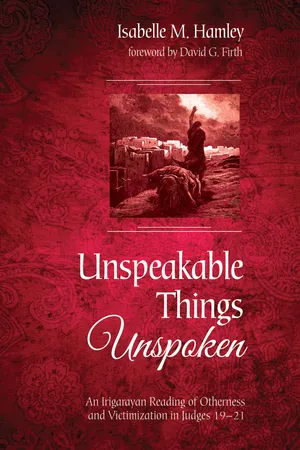
eBook - ePub
Unspeakable Things Unspoken
An Irigarayan Reading of Otherness and Victimization in Judges 19–21
- 264 pages
- English
- ePUB (mobile friendly)
- Available on iOS & Android
eBook - ePub
Unspeakable Things Unspoken
An Irigarayan Reading of Otherness and Victimization in Judges 19–21
About this book
The story of the raped and murdered woman of Judges 19 and the civil war and mass marriage that ensue in chapters 20-21 are hardly favorite tales of the Hebrew Bible. The chapters have often been dismissed as little more than an anachronistic epilogue, an awkward amalgamation of earlier stories or a "text of terror," proof of patriarchal oppression. This book argues that, far from being a clumsy collage, Judges 19-21 is a carefully narrated tale that chronicles the descent of a nation into extreme individualism and fragmentation. In dialogue with continental philosopher Luce Irigaray, it will uncover the dynamics of identity formation and how differential constructions of identity of the One and the Other yield patterns of victimization and justification of violence. This literary-philosophical reading will bring out silences and missed possibilities for the subjectivity of women, whilst also shedding light on the victimization of men within the logic of totalitarian identity constructions. The end of Judges therefore offers a theological conclusion to the book as a whole and opens up avenues for thought on theological anthropology, understandings of identity and gender, and a theological commentary on violence.
Information
1
Encountering Irigaray
Speculum: De l’Autre Femme. Irigaray’s often mistranslated, misunderstood title encapsulates the depths and dilemmas of her philosophy. She is a difficult philosopher, wielding language in witty, unusual, and poetic ways that make her writing at times hermetic. Her interest in gender and constructing feminine identity (“l’autre, femme”), has seen her associated with Cixous and Kristeva—the so-called Holy Trinity of French Feminism—despite Irigaray’s own reservations about the feminist enterprise.1 Speculum (mirrors and signs) points to her interest in semiotics and training as a linguist, while her concern for the Other situates her firmly within contemporary, postmodern philosophies of otherness, in dialogue with Sartre, Merleau-Ponty, Derrida, and Lévinas. Her interest in otherness is not merely philosophical but also steeped in Lacanian psychoanalysis. Encountering Irigaray and bringing her to bear on the Book of Judges will involve careful listening to the different strands of her thought and its complex interweaving of disciplines, influences, and dialogue partners. First, however, Irigaray insists that any work needs to be listened to on its own; therefore, this chapter will chart a course through her primary work. After an initial overview, we will explore the three main methodological strands of her approach (philosophy, psychoanalysis, and linguistics) before turning to thematic concerns of relevance to Judges.
1. Irigaray: an overview
The publication of Speculum in 1974 marked the beginning of Irigaray’s main research interest: deconstructing phallocentrism in language and culture and mapping out a different way of being for both genders. Her work divides into roughly three periods. Initially, she concentrated on deconstructing Western philosophical models, a “critique addressed to a monosubjective, monosexual, patriarchal, and phallocratic philosophy and culture.”2 Having made a space for woman to emerge, she then attempted to map out female subjectivity and the conditions necessary for its sustainability. Finally, she addresses the very possibility of intersubjective, inter-gender relationships.
Irigaray’s initial concern was to expose how the dominance of a universal single principle in Western culture has precluded the emergence of and dialogue with a true Other. She tackled the main figures of classical philosophy, starting with Freud, as he embodies and makes explicit the outcome of centuries of phallocentric culture. She then works her way back to Marx, Nietzsche, Kant, Descartes, Socrates, and Plato. Over her next few books, she explores issues of religion, truth, and appearance in dialogue with Nietzsche.3 There we see the seeds of her dual approach, simultaneously seeking deconstruction and retrieval. She then deepens her focus on language, with its definition of reality and its role in identity construction and relationships.4 Critiquing Heidegger leads her to reflect on mediations, liminality, and the need for in-between spaces to distinguish between the One and the Other and make true communication possible.5
Irigaray then shifts from deconstruction toward the emergence of a feminine subject. Linguistics becomes more prominent, together with social and political issues. She pays attention to the silences of past cultures so as to hear forgotten voices. An early concern is the retrieval of female genealogies, the mother-daughter relationship, and the necessity of women-to-women relationships to construct a female generic identity.6 Other work in that period focuses on linguistics and empirical study of the sexuation of language.7 Irigaray’s key linguistic principles center careful, precise speech analysis and a challenge to the idea of ‘neutral/neuter’ speech and of scientific methods as objective.8 At the same time, Irigaray develops embryonic reflections on methodology: the importance of the situatedness of both text and reader, their history and context, and the need to understand texts and the person speaking behind them on their own terms. There, she parts company with other postmodern philosophers and reader-focused approaches to literary criticism.
Je, Tu, Nous marks the start of Irigaray’s third period, a more constructive and speculative period. Having brought out underlying philosophical, psychological, and linguistic schemas and made a contribution toward elaborating a distinct female subjectivity, she turns her attention to the possibility of true communication with the Other, across genders—and, to a lesser degree, cultures and ethnicities—and the political conditions needed for change.
The first phase of her work is of most interest to a study of Judges, both thematically (in its emphasis on otherness and the constitution of subjectivity) and methodologically. Irigaray self-consciously applies deconstructive techniques to both philosophical and mythological texts, combining psychoanalytic, philosophical, and linguistic tools for her study. Her second and third phases are more constructive and speculative in nature, though her themes and methods still offer much scope for application.
2. A three-pronged approach
Irigaray draws equally on philosophy, psychoanalysis, and linguistics. While the three interweave and feed off of each other, it is possible to trace differences in emphasis in her approach to various themes. Her discussion of otherness and the “logic of the same” is deeply philosophical, despite the Lacanian influence, and a marker of her early period; her psychoanalytic roots are most evident in her discussion of the constitution of subjectivity and how this must temper purely philosophical or ethical reflections, a growing interest from her middle period that tapers off into a more political stance; and finally, her linguist’s training shapes her analysis of texts and discourse. Separating these three threads is somewhat artificial, yet it can enable us to grasp essential aspects and nuances of her arguments.
2.1. Philosophy: toward a theory of sexual/sexuate difference
2.1.1. The “logic of the same”
Philosophy shapes Irigaray’s content and method. She takes a reverse look at philosophy, patiently disentangling layers of successive reversals—Marx inverses Hegel, Nietzsche inverses Platonism.9 She copies this reversal, but ...
Table of contents
- Title Page
- Foreword
- Introduction
- Chapter 1: Encountering Irigaray
- Chapter 2: Toward an Irigarayan Method
- Chapter 3: Translation and textual notes
- Chapter 4: Dissecting the dismembered text
- Chapter 5: The Politics of Identity in Judges 19–21
- Conclusion: Where now? Reading Judges 19–21 today
- Bibliography
Trusted by 375,005 students
Access to over 1.5 million titles for a fair monthly price.
Study more efficiently using our study tools.
Frequently asked questions
Yes, you can cancel anytime from the Subscription tab in your account settings on the Perlego website. Your subscription will stay active until the end of your current billing period. Learn how to cancel your subscription
No, books cannot be downloaded as external files, such as PDFs, for use outside of Perlego. However, you can download books within the Perlego app for offline reading on mobile or tablet. Learn how to download books offline
Perlego offers two plans: Essential and Complete
- Essential is ideal for learners and professionals who enjoy exploring a wide range of subjects. Access the Essential Library with 800,000+ trusted titles and best-sellers across business, personal growth, and the humanities. Includes unlimited reading time and Standard Read Aloud voice.
- Complete: Perfect for advanced learners and researchers needing full, unrestricted access. Unlock 1.5M+ books across hundreds of subjects, including academic and specialized titles. The Complete Plan also includes advanced features like Premium Read Aloud and Research Assistant.
We are an online textbook subscription service, where you can get access to an entire online library for less than the price of a single book per month. With over 1.5 million books across 990+ topics, we’ve got you covered! Learn about our mission
Look out for the read-aloud symbol on your next book to see if you can listen to it. The read-aloud tool reads text aloud for you, highlighting the text as it is being read. You can pause it, speed it up and slow it down. Learn more about Read Aloud
Yes! You can use the Perlego app on both iOS and Android devices to read anytime, anywhere — even offline. Perfect for commutes or when you’re on the go.
Please note we cannot support devices running on iOS 13 and Android 7 or earlier. Learn more about using the app
Please note we cannot support devices running on iOS 13 and Android 7 or earlier. Learn more about using the app
Yes, you can access Unspeakable Things Unspoken by Isabelle M. Hamley in PDF and/or ePUB format, as well as other popular books in Theology & Religion & Biblical Criticism & Interpretation. We have over 1.5 million books available in our catalogue for you to explore.