eBook - PDF
Dobler: Traders and Trade in Colonial Ovamboland
Elite Formation and the Politics of Consumption under Indirect Rule and
- 282 pages
- English
- PDF
- Available on iOS & Android
eBook - PDF
Dobler: Traders and Trade in Colonial Ovamboland
Elite Formation and the Politics of Consumption under Indirect Rule and
About this book
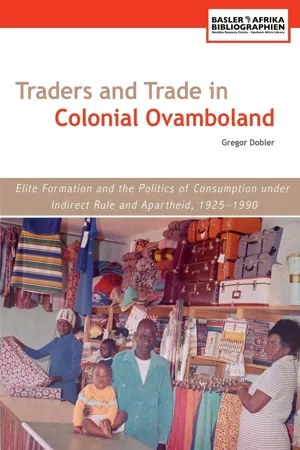
Taking the history of trade and of traders as its subject matter, this book offers the first economic history of northern Namibia during the twentieth century. It traces Namibia?s way from a rural, largely self-relying society into a globalised economy of consumption. This transformation built on colonial economic activities, but it was crucially shaped by local traders, a new social elite emerging during the 1950s and 1960s. Becoming a trader was one of the few possibilities for black Namibians to gain monetary income at home. It was a pathway out of migrant labour, to new status in the local society and often to prosperity. Politically, most traders occupied a middle ground: content of their own social position, but intent on political emancipation from colonial rule. Economically, their energy and business acumen transformed northern Namibia into an increasingly urban consumer society. The development path they chose, however, depended too much on the colonial reserve economy to remain sustainable after 1990. Their legacy still shapes spatial and social structures in northern Namibia, but most traders? businesses have today closed down. By telling the history of the rise and decline of traders and trade in northern Namibia, this book is thus also a reflection on the conundrums of economic development under conditions of structural inequality.
Information
Table of contents
- Cover
- Title page
- Copyright page
- Contents
- Acknowledgment
- Introduction
- 1. The early years: from itinerant traders to monopoly stores
- 2. The monopoly stores, 1925–1952
- 3. The first locally owned stores, 1937–1955
- 4. From indirect rule to liberation war: Ovamboland 1948–1978
- 5. Traders in a modernizing society
- 6. Stores and spatial organization after 1950
- 7. Taking sides? Traders and politics during the liberation war
- Conclusion
- Annex: Price List Ondjodjo and Omafo 1941
- List of Illustrations
- References
- Index
- Back cover
Trusted by 375,005 students
Access to over 1.5 million titles for a fair monthly price.
Study more efficiently using our study tools.
Frequently asked questions
Yes, you can cancel anytime from the Subscription tab in your account settings on the Perlego website. Your subscription will stay active until the end of your current billing period. Learn how to cancel your subscription
No, books cannot be downloaded as external files, such as PDFs, for use outside of Perlego. However, you can download books within the Perlego app for offline reading on mobile or tablet. Learn how to download books offline
Perlego offers two plans: Essential and Complete
- Essential is ideal for learners and professionals who enjoy exploring a wide range of subjects. Access the Essential Library with 800,000+ trusted titles and best-sellers across business, personal growth, and the humanities. Includes unlimited reading time and Standard Read Aloud voice.
- Complete: Perfect for advanced learners and researchers needing full, unrestricted access. Unlock 1.5M+ books across hundreds of subjects, including academic and specialized titles. The Complete Plan also includes advanced features like Premium Read Aloud and Research Assistant.
We are an online textbook subscription service, where you can get access to an entire online library for less than the price of a single book per month. With over 1.5 million books across 990+ topics, we’ve got you covered! Learn about our mission
Look out for the read-aloud symbol on your next book to see if you can listen to it. The read-aloud tool reads text aloud for you, highlighting the text as it is being read. You can pause it, speed it up and slow it down. Learn more about Read Aloud
Yes! You can use the Perlego app on both iOS and Android devices to read anytime, anywhere — even offline. Perfect for commutes or when you’re on the go.
Please note we cannot support devices running on iOS 13 and Android 7 or earlier. Learn more about using the app
Please note we cannot support devices running on iOS 13 and Android 7 or earlier. Learn more about using the app
Yes, you can access Dobler: Traders and Trade in Colonial Ovamboland by Gregor Dobler in PDF and/or ePUB format, as well as other popular books in Storia & Economia dello sviluppo. We have over 1.5 million books available in our catalogue for you to explore.