How To Invest in Debt
eBook - ePub

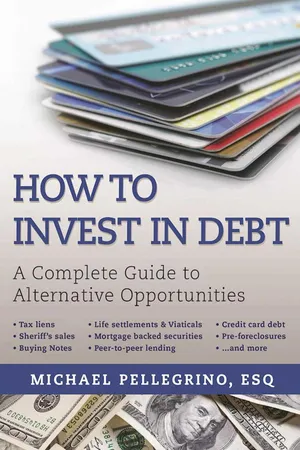
How To Invest in Debt

A Complete Guide to Alternative Opportunities

  1. 184 pages
  2. English
  3. ePUB (mobile friendly)
  4. Available on iOS & Android
eBook - ePub

How To Invest in Debt

A Complete Guide to Alternative Opportunities

About this book

With this nuts-and-bolts guide, both savvy and novice investors can discover the secrets to profiting from personal and corporate debt, including municipal tax liens, defaulted credit card debt, discount promissory notes, mortgage foreclosures, and micro loans. Anyone can participate in these investments, but not all of these options are as easy as calling a broker – they require some legwork and research – so many of these opportunities often go untapped. While there are many books on alternative investment ideas, none provide this level of practical information and advice. How To Invest in Debt provides everything readers need to capitalize on these investments. Readers will discover:

  • How to find and purchase debt at a deep discount
  • How to do effective due diligence and pick the ones that are most likely to pay off
  • How to collect debt, and the secrets to making short-term high interest loans
  • Buying future streams of cash flow
  • Overcoming what could go wrong before it happens
  • And much more.

Dozens of charts, table, forms, spreadsheets, and diagrams empower readers to get started right away, with all the tools they will need to collect and analyze data and pursue the most profitable opportunities. How To Invest in Debt shows that if you're willing to do the work, you can profit from debt.
Frequently asked questions

Yes, you can cancel anytime from the Subscription tab in your account settings on the Perlego website. Your subscription will stay active until the end of your current billing period. Learn how to cancel your subscription.
No, books cannot be downloaded as external files, such as PDFs, for use outside of Perlego. However, you can download books within the Perlego app for offline reading on mobile or tablet. Learn more here.
Perlego offers two plans: Essential and Complete
  • Essential is ideal for learners and professionals who enjoy exploring a wide range of subjects. Access the Essential Library with 800,000+ trusted titles and best-sellers across business, personal growth, and the humanities. Includes unlimited reading time and Standard Read Aloud voice.
  • Complete: Perfect for advanced learners and researchers needing full, unrestricted access. Unlock 1.4M+ books across hundreds of subjects, including academic and specialized titles. The Complete Plan also includes advanced features like Premium Read Aloud and Research Assistant.
Both plans are available with monthly, semester, or annual billing cycles.
We are an online textbook subscription service, where you can get access to an entire online library for less than the price of a single book per month. With over 1 million books across 1000+ topics, we’ve got you covered! Learn more here.
Look out for the read-aloud symbol on your next book to see if you can listen to it. The read-aloud tool reads text aloud for you, highlighting the text as it is being read. You can pause it, speed it up and slow it down. Learn more here.
Yes! You can use the Perlego app on both iOS or Android devices to read anytime, anywhere — even offline. Perfect for commutes or when you’re on the go.
Please note we cannot support devices running on iOS 13 and Android 7 or earlier. Learn more about using the app.
Yes, you can access How To Invest in Debt by Michael Pellegrino in PDF and/or ePUB format, as well as other popular books in Personal Development & Bonds. We have over one million books available in our catalogue for you to explore.

Information

Publisher
Skyhorse
Year
2017
Print ISBN
9781510715196
1
Tax Liens & Tax Deeds
Make Money by Paying Other People’s Taxes
Income tax, sales tax, real estate tax … everyone hates to pay taxes, but most people don’t know that there is a way to make great profit from paying taxes. This chapter will tell you how to invest in high-yield property tax liens that are secured by first- priority liens on real estate.
High interest and low risk are very attractive terms these days. With interest rates near historic lows and the high volatility of the stock market, many people have been drawn to alternative investments. Tax liens accrue interest at 21 percent or higher, they’re secured by a first-priority lien on property chosen by the investor, and they offer the added bonus of possibly of obtaining ownership of the property at a big discount.
Summary Points
1. Specialized Knowledge: Real estate valuation & rehab
2. Minimum Capital Requirement: $5,000
3. Scalability: Yes
4. Liquidity: Limited; resale of tax liens is not well organized
5. Priority over other forms of debt: Highest
6. Barriers to Entry: None
My law practice has been focused on representing tax lien investors in New Jersey for over twenty years. I’ve written a law review article and a book on New Jersey tax liens, and I have been a speaker at the New Jersey Bar Association’s continuing legal education annual seminar for over ten years. I’d say that I know more about tax liens than any other subject. I’ll outline the positive and negative aspects, and I’ll leave it to you to decide whether this unique investment vehicle is right for you.
Unfortunately, each state has a different statutory scheme covering how tax liens are to be sold and foreclosed. This chapter will provide an overview of the various jurisdictions. There are a lot of details, and it would not be possible to cover each state in this chapter. Like all of the other chapters, I have included a list of some books on investing in tax liens. This subject is far more complex than what can be covered in this chapter, so you will find these books to provide a more detailed and complete review. There is no substitute for good old-fashioned personal experience and one-on-one communication. If any questions remain, call your local tax lien attorney!
How Does This Work?
Like most things in life, there is a short, simple story and a long, detailed story. Property tax liens can be summarized in a very simple paragraph, or it could take years of experience and an entire book. The short and simple version is as follows:
Tax liens are sold by tax collectors to make up for unpaid property taxes. Local governments (like counties and municipalities) depend on the collection of property taxes and other assessments to pay for services provided to residents. Local governments could not operate without the consistent collection of these funds, so it creates a problem when property owners fail to pay their property taxes. In exchange for the payment of overdue property taxes, an investor is issued a tax lien that generates interest until redeemed (paid off) by the property owner or another interested person. The tax certificate represents a high-priority lien on a delinquent tax payer’s property. If the lien is not redeemed within a period of time, the lien holder may foreclose and obtain clean title to the underlying property. Tax lien investors make money by collecting interest on liens that are redeemed, and by foreclosing on properties and reselling them.
That’s the short version. For the long version, you will have to read the rest of this chapter.
Who Should Invest in Tax Liens?
Tax liens offer a compelling investment vehicle. Investors get a high priority lien at a high interest rate on real property selected by the investor. To top it off, the investor may gain ownership of the underlying real estate for a cost far less than the property is worth. That’s the attractive side of this investment. That’s why there are so many people interested in buying tax liens, and it’s probably why you are reading this.
Before we get into details, let’s address specifically what a tax lien is. A “lien” is a legal restriction on property rights to secure repayment of debt. A tax lien is represented by a piece of paper known as a Tax Sale Certificate, which is recorded in the county records along with other liens on real property such as mortgages. The lien stays on the property until it is “redeemed” or paid off. The owner of the property still maintains control over, and responsibility for, the property, but the property generally cannot be sold or refinanced without paying off the lien. If the lien is not redeemed, it can be foreclosed, and the tax lien holder may become the new owner of the property, free and clear of any other liens.
That phrase “free and clear of any other liens” is very important. This means that if you foreclose on a tax lien, you can wipe out any mortgage, judgments, or any other liens, and you will become the owner of the property with clean title—with a few exceptions as determined by State laws (for example, newer—“subsequent”—tax liens) that generally have priority over older (“prior”) tax liens, so they are an exception to the priority rule. In some states, you will obtain free and clear title at the conclusion of the tax lien foreclosure, but in other states, you must file an additional “quiet title” suit to obtain clean title.
Why This Works
Tax liens are an option for adding diversity to a balanced investment portfolio. Unlike other investments, the value of a tax lien is not affected by the economy, the stock market, or interest rate fluctuations. A tax lien’s value is based solely on the taxes that have been paid by the investor and the applicable interest rate. No outside economic factors can change that. Of course, if a tax lien is foreclosed, then the real estate market will determine the value of the investment, but most tax liens are eventually redeemed, and the real estate market generally does not fluctuate greatly.
Most investments are judged by six common factors: income, growth potential, safety of investment capital, liquidity, diversification, and simplicity. Tax liens compare well under the standard benchmarks:
1. Income …. …. …. …. … … Very Good
Tax liens accrue an exceptionally high interest rate.
2. Growth potential …. …. … … Fair
Tax liens provide an opportunity to obtain property for less than its value, but such opportunities are rare.
3. Safety of investment capital … … Very Good
Tax liens are secured by a first priority lien on real estate, so it is very likely that your investment will be returned.
4. Liquidity …. …. …. …. …. Bad
There is no organized secondary market, so it can be difficult to cash out of a tax lien.
5. Diversification …. …. …. …. Very Good
There is no correlation to other investment markets.
6. Simplicity …. …. …. …. …. Bad
Investing in tax liens requires more time and experience than most other investments.
Of course, everything has its downside. Investing in tax liens is certainly not without risk and hard work. Unlike passive investments such as stocks, bonds, and certificates of deposit, buying tax liens is closer to a business than an investment. This takes time and some knowledge. To be successful, investors need to develop an ability to evaluate the condition of properties and assess their value. Many people just don’t have the time or energy to devote to this type of undertaking. For them, publicly traded securities are the extent of their investment portfolio, and there is certainly nothing wrong with that. If you do not have extra time to devote to this venture, don’t buy tax liens.
Another important consideration before you buy your first tax lien is the long-term commitment that is required. There is no efficient secondary market for tax liens, so there is no simple and efficient way to trade out of a lien if the need arises. With stocks and bonds, on the other hand, the investor can call a broker at any time and simply sell the investment for its current value less the cost of the broker’s commission. Even bank CDs can be cashed in either at the end of the term or at any time with the payment of a penalty. The holder of a tax lien must go out and find someone willing to buy the lien, and then negotiate a price—which of course may be more or less than the redemption value of the lien.
Aside from the term of this commitment, investors must also make further financial commitments to a lien after it is purchased. Unlike most other investments that require only one, up-front payment, purchasing a tax lien is a long-term commitment requiring additional payments each year for at least three years. One of my friends who has been investing in tax liens for a long time likens the initial purchase of a tax lien to the initial ante in a poker game. Buying the tax lien just gets you started, like tossing that first chip onto the poker table. In order to maintain the priority of the lien, and to accrue more interest, lien holders must continue to pay subsequent taxes each year. If the lien is not paid off after a few years, the tax lien holder will also have to fund the costs and fees involved in foreclosure proceedings.
Another unusual negative aspect of this investment vehicle is that investors do not have control over what liens they can buy. If someone wants to invest in a particular stock or bond, there is no question that he or she will succeed with a simple phone call to a broker. Tax liens are different in that each is unique. Each tax lien is a legal interest in a unique piece of real estate, so each lien is as unique as the underlying property.
For the last several years, there has been fierce competition among bidders at tax lien auctions. Many investors often get shut out at the auction, having been outbid by more aggressive investors. Sometimes all of the time spent looking at properties and reviewing public records can be for nothing.
Finally, as addressed in more detail later in this chapter, tax lien investors will eventually face the morality issues connected with foreclosing on a family’s home or evicting elderly widows! Before you buy your first tax lien, you should be aware of the emotional and moral aspects of this investment.
The purpose of addressing these negative aspects of tax lien investing is not to discourage people from buying tax liens. (I make my living representing tax lien investors!) I simply want investors to be aware of what they are getting into. I’ve had far too many inexperienced investors come to my law offices with problems that could have been avoided had they simply known all of the risks, or if they had at least known which questions to ask. Most other sources of information about tax lien investing either completely ignore these negative aspects or gloss over them.
Despite the negatives, I know of no other investment vehicle that can generate such a high rate of interest secured by real estate at a low lien-to-value ratio. This high security and rate of return, coupled with the possibility of acquiring real estate worth far more than you invested, makes tax liens a valuable addition to an investment portfolio.
Now that we have gotten most of the negative aspects out of the way, we can get into the details about how to buy tax liens.
Tax Liens vs Tax Deeds
Some states sell “tax deeds” instead of tax liens. Tax deeds (like tax liens) are sold to the public to convert tax delinquencies into cash flow for the local government. The basic concepts are similar, but the key difference is whether the investor acquires a tax lien or a tax deed. In most states, the property owner has a period of time to pay off the tax delinquency and retain the property.
Tax Lien States
Alabama, Arizona, Colorado, Connecticut, Florida, Illinois, Indiana, Iowa, Kentucky, Louisiana, Maryland, Massachusetts, Mississippi, Missouri, Montana, Nebraska, New Jersey, New York, Ohio, Rhode Island, South Dakota, Vermont, West Virginia, Wyoming.
In my home state of New Jersey, and other tax lien states, investors bid on and purchase “tax lien certificates.” You are not acquiring an ownership interest in the property; rather, you are paying the taxes and acquiring a lien on the property. The owner of the property must pay off the amount of the lien plus interest and penalties in order to have the lien removed. If the lien is not “redeemed” (paid) within a specified “redemption period,” the purchaser of the tax lien certificate may foreclose on the property. Each state has different rules and laws controlling when and how tax liens may be foreclosed. In some states, the tax lien will expire if it is not foreclosed within the time allowed.
How Tax Liens Are Purchased
Each state has different laws that specify interest rates, redemption periods, and bidding procedures. Tax liens are not sold like other, more common investments. There are no listings in the financial pages of your newspaper, and you cannot just call your broker as you would to buy a stock, bond, or commodity. There are no sales commissions, no monthly statements in the mailbox, and generally no salesmen or advisors. This takes a little more work, but it can be worth the effort.
Auction Process
Tax lien auctions are the primary way that tax liens are purchased. They are usually well attended and can get very exciting. The auction process is always confusing to newcomers, so it is advisable to attend a few auctions before you begin bidding. This will give you a feel for the process, and you may get pointers from some of the more experienced bidders. Tax lien auctions are generally held once per year in each municipality or county, so it may be impossible to personally attend every auction that you’d like. This is becoming less of an issue, because more and more auctions are being held online through services such as “RealAuction” and “Grant Street.” This change to online bidding is rapidly gaining popularity and is more efficient than live, in-person auctions, but the ease and efficiency of the online auctions creates even more competition for investors.
Prior to a tax sale auction, the tax collector is req...

Table of contents

  1. Cover
  2. Title Page
  3. Copyright
  4. Dedication & Acknowledgment
  5. Contents
  6. Introduction: Debt Is Rampant—Let’s Make Money
  7. 1. Tax Liens & Tax Deeds: Make Money by Paying Other People’s Taxes
  8. 2. Peer-to-Peer Lending: Making Small Unsecured Loans
  9. 3. Credit Card Debt: Buying and Collecting Defaulted Credit Card Debt
  10. 4. Defaulted Notes: Buying Defaulted Mortgage Notes
  11. 5. Performing Notes: Buying Mortgage Notes at a Discount
  12. 6. Sheriff’s Sales: Buying Properties at Foreclosure Sales
  13. 7. “White Knight” Rescues & Short Sales: Buying Preforeclosure Properties
  14. 8. REO & Seized Assets: Buying Foreclosed Property from Banks
  15. 9. Life Settlements and Viaticals: Buying Life Insurance Benefits
  16. 10. Mortgage-Backed Securities: Ginnie Mae, Fannie Mae, & Freddie Mac
  17. 11. Morality of Investing in Debt
  18. 12. True Story!
  19. In Conclusion …
  20. Appendix: Due Diligence Checklists
  21. About the Author