War Is a Racket
eBook - ePub

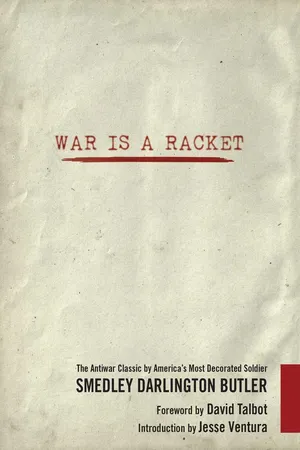
War Is a Racket

The Antiwar Classic by America's Most Decorated Soldier

  1. 232 pages
  2. English
  3. ePUB (mobile friendly)
  4. Available on iOS & Android
eBook - ePub

War Is a Racket

The Antiwar Classic by America's Most Decorated Soldier

About this book

US Marine Corps Major General Smedley Butler collected an award cabinet full of medals for his battlefield bravery. But perhaps his bravest act of all was to declare, after his retirement in the early 1930s, who was really winning (and losing) during the bloody clashes.It was business interests, he revealed, who commercially benefited from warfare. War Is a Racket is the title of the influential speech Butler delivered on a tour across the United States, as well the expanded version of the talk that was later published in 1935—and is now reprinted here. This seminal piece of writing rings as true today as it did during Butler's lifetime.In his introduction, Jesse Ventura reviews Butler's original writings and relates them to our current political climate—explaining how right he was, and how wrong our current system is. With an insightful new foreword by Salon.com founder David Talbot, this portable reference will appeal to anyone interested in the state of our country and the entire world.Skyhorse Publishing, as well as our Arcade imprint, are proud to publish a broad range of books for readers interested in history--books about World War II, the Third Reich, Hitler and his henchmen, the JFK assassination, conspiracies, the American Civil War, the American Revolution, gladiators, Vikings, ancient Rome, medieval times, the old West, and much more. While not every title we publish becomes a New York Times bestseller or a national bestseller, we are committed to books on subjects that are sometimes overlooked and to authors whose work might not otherwise find a home.
Frequently asked questions

Yes, you can cancel anytime from the Subscription tab in your account settings on the Perlego website. Your subscription will stay active until the end of your current billing period. Learn how to cancel your subscription.
At the moment all of our mobile-responsive ePub books are available to download via the app. Most of our PDFs are also available to download and we're working on making the final remaining ones downloadable now. Learn more here.
Perlego offers two plans: Essential and Complete
  • Essential is ideal for learners and professionals who enjoy exploring a wide range of subjects. Access the Essential Library with 800,000+ trusted titles and best-sellers across business, personal growth, and the humanities. Includes unlimited reading time and Standard Read Aloud voice.
  • Complete: Perfect for advanced learners and researchers needing full, unrestricted access. Unlock 1.4M+ books across hundreds of subjects, including academic and specialized titles. The Complete Plan also includes advanced features like Premium Read Aloud and Research Assistant.
Both plans are available with monthly, semester, or annual billing cycles.
We are an online textbook subscription service, where you can get access to an entire online library for less than the price of a single book per month. With over 1 million books across 1000+ topics, we’ve got you covered! Learn more here.
Look out for the read-aloud symbol on your next book to see if you can listen to it. The read-aloud tool reads text aloud for you, highlighting the text as it is being read. You can pause it, speed it up and slow it down. Learn more here.
Yes! You can use the Perlego app on both iOS or Android devices to read anytime, anywhere — even offline. Perfect for commutes or when you’re on the go.
Please note we cannot support devices running on iOS 13 and Android 7 or earlier. Learn more about using the app.
Yes, you can access War Is a Racket by Smedley Darlington Butler in PDF and/or ePUB format, as well as other popular books in History & Military & Maritime History. We have over one million books available in our catalogue for you to explore.

Information

ARTICLES
My Services with the Marines (Undated)
image
image
image
image
image
image
image
image
image
image
image
image
image
image
image
image
image
image
image
image
image
image
image
image
Dictatorship? (Undated)
image
image
Editor’s note: Page two of this document was unavailable and is not included.
image
image
image
image
image
image
image
image
The Peace Racket (Undated)
Having devoted most of the years of my life to the study of legalized murder, by which I mean the so-called science of war, I find it impossible to accept the theories of those idealists who are innocent enough to believe that the attainment of world peace is merely a question of joining the World Court, the league of Nations or some other international association for the promotion of brotherly love.
I have said in the past, and I still repeat, that war is a racket. I made this charge long before the Nye Committee of the United States Senate exposed the munitions industry and proved that—for a respectable profit—any manufacturer of armaments will sell his guns to an enemy of his own country. The Nye Committee uncovered some astounding information about the munitions industry, including a confession to profits as high as 800 percent.
But just as the business of war has been an age-old racket, in this country and in Europe, so is the cause of peace becoming a racket. There are at least one hundred or more, known and unknown, national and international, peace societies operating in America and most of them have their headquarters in Washington, D.C. There are probably several hundred minor groups that also believe they are destined to bring about world peace. Many of these are designated by fanciful titles built around the word “peace,” while others disguise their aims and purposes with some other name to avoid the charge of being pacifists.
I say the cause of peace is becoming a racket in this country today because every one of these so-called peace committees and organizations must have money with which to function. Salaries have to be paid to executive secretaries and office staffs. Printers must be paid for the publication of pamphlets and brochures. Landlords must have their rent. Lecturers must have expense accounts as well as remuneration. Where are they getting all this money, these millions of dollars that are being spent annually? The answer is simple. We gullible Americans who are philanthropically inclined, dig down in our pockets for generous donations and contributions. We buy memberships on national committees. We are flattered when our names are printed on their stationary, in company with a long list of America’s most distinguished philanthropists and world peace advocates. Every penny that these peace societies are spending can come only from the pockets of the American people. Professional pacifists have discovered that they can work upon the emotions of some of our wealthy citizens with encouraging financial results.
I don’t mean that all of these organizations are promoted by personal profit seeking individuals. Some of them are headed by sincere but misguided people who have adopted the cause of world peace as a hobby. World peace is a hobby that a lot of people like to indulge because it represents a popular cause, and they enjoy the spotlight of prominence. Naturally, everybody is in favor of world peace. No one who talks or gets emotional about the prospects of world peace is going to afford his neighbor of a different religion, or political creed, or hurt the feelings of a prospective business customer. In fact, the peace racket is harmless hobby in every respect except one. In most instances, the peace racket of today is purely a commercial endeavor that is extracting millions of dollars from soft-headed people by imposing upon their humanitarian impulse with flattery, false hopes and impossible schemes. If these professional pacifists would dare to use the same tactics in nearly any other field of effort, they could be convicted of fraud.
One particular peace seeking group is planned as a thoroughly businesslike, non-profit organization, basing its campaigns on economically sound theories. Its sponsors have apparently accepted the idea that world peace can be accomplished through the education of the masses on the evils of war. They are employing the strategy of a nationwide publicity campaign with full page magazine insertions, outdoor advertising, newspaper columns, radio addresses and the publication of special volumes on war and munitions.
The names of college presidents, editors, authors, professors in theological seminaries, executives of religious organizations and nationally known preachers and rabbis can be found in abundance on stationary that goes out from Washington bearing plaintive appeals for moral support—and frequently for funds. If the funds are not forthcoming in actual cash, the equivalent in free newspaper or magazine space is always acceptable. And when I glance over these names, I think of a little ditty that was popular with a Maryland outfit of negro engineers in the A. E. F., back in 1918. The theme of this little chant was well expressed in the following:
“Oh de states is full o’ people tellin’ how de war is fit,
But when hit comes to fightin’, never fit a single bit.”
That pretty well expresses my personal views on the futility of the peace racket. Don’t misunderstand me. I am not saying that world peace is an empty dream. I am not predicting that just because we always have had wars in the past, that we must have wars in the future. Once upon a time, in the enthusiasm of my militaristic environment, I really used to think that way. The professional patriots had me, as well as millions of others, convinced that the instinct for war is a human impulse that can never be restrained or refined. Up until my retirement, after more than thirty years active service in the United States Marine Corps. I was absolutely sure that the people of every either country in the world were just a bunch of cut-throats ready to spring Uncle Sam the moment he dared to drop his guard.
But I have learned to think differently, I have spent the past few years meeting and mingling with people all over the country. I have a new conception of the American mind and today I am convinced that we can look forward with some hope to eventual world peace. I admit this condition may not arrive for the next fifty or a hundred years. But in the meantime we can make some headway toward that goal by increasing the normal cycle of years between wars. However, the more I see and learn about the activities of those back of the present peace racket, the more I am convinced that one thing is certain. There is only one element in our American citizenship that can keep us from having another war, at least for the next few generations. That element is composed of the men who stopped the last war. I mean the men who actually did the stopping—the real overseas veterans, the men who went to France and actually lived in the muck and the poison and the blood of war as it was fought on the field of battle, rather than the way it is pictured in history or on the screen.
Don’t get me wrong. I am not thinking of the professional veteran—the fellow who spent thirty to sixty days in some nearby camp and then came home posing as one of the “strong, silent men” who helped save the world for democracy. I am not speaking of the chap who by political pull, or through a generous campaign contribution was able to get himself a set of gleaming spurs and the bars of a second lieutenant. Too many of these chaps are active in our veteran organizations today. That explains why in some sections the veteran organizations have thus far failed to reach their peak strength. Too many of these pseudo veterans have taken it upon themselves to speak for the real veteran. And when you hear them on the radio, or the public platform, they will “bleed on the battlefield” more profusely and “pay the supreme sacrifice” more frequently than a thousand other veterans who really know what the hell of war is all about.
The revelations of the Nye committee have demonstrated that the business of making profits out of war is a practical profession. It is not conducted by idealists and visionaries but by men who are politically showed and commercially smart. They use practical methods to gain their ends and they are smart enough to use cold logic in preference to fanciful theories. If that is how people start wars, than that’s how we will have to stop them. By being practical, cold and calculating. Most of all, we can be politically intelligent
The overseas veterans of this country are the only ones who can really guarantee the peaceful security of this nation in the future. First, because the overseas veteran is the only man who can speak sincerely and from personal experience on the horrors of war and its futility as a means of setting international disputes. In the second place, the overseas veterans of this country are held together by a common bond of comradeship that can never be dissolved by religious or political differences. This tie of comradeship will always exist between the men who composed the A.E.F. It provides the foundation for an organization nationwide in scope, that can really do something practical in the desire for peace. With the passing of the years, as these men become older, this bond becomes more firmly cemented and the results of their efforts can be preserved.
You ask the question, “How can the overseas veterans of this country constitute a constructive force toward world peace?” Here is my answer. During the years that have elapsed since the World War, the average overseas veteran has acquired many hard knocks, common sense and considerable experience. He represents the one large group of American citizens that is thoroughly disillusioned about the glories of war. He can no longer be fooled by the fanfare and the panoply of marching troops, and the oratorical pap of the flag wavers. In the intervening years since the Armistice, he has had sufficient time to analyze the emotions that drove him forward while in the service. He knows now that he was merely a poem in a game that was being played by others and that all his patriotic emotions were the result of artificial stimulation. Today he recognizes the motive in the propaganda that once nearly made his uniformed breast burst with pride. He realize that most of the people who patted him on the back, when he went away, and told him to “Give the Kaiser hell for me!” never really cared a tinker’s darn whether he came back, or how will he might fare should he to lucky enough to return. He has had too many doors slammed in his face when looking for a job. He has heard himself and his buddies, on too many occasions described as “treasury raiders.” He has seen too many politicians, and their patrons, benefit from the profits they made cut of the war. He has witnessed too much graft, and waste of government funds, while ready veterans were told by Presidents that they had done nothing to deserve special consideration.
Sad experience has made the overseas veteran practical and that’s why these men have reached the very definite conclusion that the only way to stop war is to take the profits out of war. Proof of this trend of thinking in the minds of American’s ex-service men was plainly evident when the American Legion held its last convention in Miami. And the veterans of foreign wars of the United States assembled in Louisville. The American Legion took a very decisive step in this direction, with a resolution urging the federal government on the same basis of the wages we pay our troops. In time of war, the veterans want to see the workers in every factory paid proportionately the same as the doughboy in uniform receives. They would let every foremen have a salary equivalent to the salary of a corporal and every superintendent the pay of a lieutenant. Others higher up in the scale of our industrial structure would receive the same money that we pay for the use of brains and intelligence in the Army, Navy and Marine Corps. They are entitled to no more. As far as wealth and properties are concerned, the government should have the same right to take over a building or a manufacturing plant as it has to draft a human being. As a direct result of this universal draft plan being fostered and promoted by veterans, I am predicting that legislation of this character will actually be approved by this or the next session of Congress.
But these veterans will not be content with merely a wartime blow at profiteering. They recognize, in the existing methods and means being employed by the manufacturers of munitions, a constant menace to the peace and security of America. They demand that the threat of war be destroyed before it becomes too late. These veterans ask immediate federal control of all munitions plants. They would put these wholesalers of death and destruction out of business without waiting until the belligerents get a chance to arm themselves for war. They would prevent the promotion and instigation of wars and choke them off before their inception. They would stop the sale of arms and arrangements, in this country, in peace times, to nations that may later declare war upon the United States and use these same guns to annihilate armies of American young men.
Among the ex-service men of American we have a group of citizens whose loyalty and patriotism can never be questioned. Nobody can accuse them of being pacifists or conscientious objectors. No one can accuse them of being internationalists. No one can charge that these men, who have already demonstrated their respect for American’s traditions, will deliver this country into the hands of its enemies. As leaders of the movement for world peace, this is the only group of citizens that can hope to inspire and attract the moral support and the confidence of the people as a whole.
Unfortunately, the problem of veteran welfare legislation in this country has been a political football from the very beginning. The need to overcome the injustices the truly deserving disabled veteran has suffered, as a result of this situation, has made the ex-service men of this country politically smart. And each succeeding election shows that they are rapidly becoming smarter. To hold their own, they have learned they must resort to the same political tricks, and the same organized pressure, that other groups employ to accomplish their objectives. More than one million veterans are today affiliated with the five major veteran groups. Within the not far distant future, the great majority of America’s approximately four and one-half million ex-service men will be banded together as members of these various associations.
Peace will come to this country when we make it impossible for anyone to profit through the promotion of wars. We can never hope to remove the profits of war until Congress passes the necessary legislation. Congress will never adopt such legislation until the individual members of that body are told that they have to vote accordingly or sacrifice their places on the government payroll. The only one who can speak to a politician, and get any degree of attention, is the voter in his home bailiwick. If a sufficient number of these voters make their demands simultaneously. Mr. Congressman will vote to keep his job. After all, the average congress member comes from a district where are no munitions plants and he need not worry about treading on tender toes.
The five major veteran organizat...

Table of contents

  1. Cover
  2. Halftitle
  3. Title Page
  4. Copyright
  5. Front
  6. Contents
  7. Editor’s Note
  8. Foreword by David Talbot
  9. Introduction by Jesse Ventura
  10. War Is a Racket
  11. Speeches:
  12. Radio Addresses:
  13. Articles:
  14. War Is a Racket (Draft)
  15. Afterword by Cindy Sheehan