The Education of a Graphic Designer
eBook - ePub

The Education of a Graphic Designer

  1. 380 pages
  2. English
  3. ePUB (mobile friendly)
  4. Available on iOS & Android
eBook - ePub

The Education of a Graphic Designer

About this book

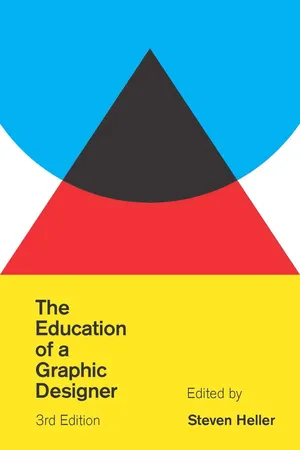
Revised and updated, this compelling collection of essays, interviews, and course syllabi is the ideal tool to help teachers and students keep up in the rapidly changing field of graphic design. Top designers and educators talk theory, offer proposals, discuss a wide range of educational concerns—such as theory versus practice, art versus commerce, and classicism versus postmodernism—and consider topics such as emerging markets, shifts in conventions, global impact, and social innovation. Building on the foundation of the original book, the new essays address how graphic design has changed into an information-presenting, data-visualization, and storytelling field rooted in art and technology. The forward-thinking course syllabi are designed for the increasingly specialized needs of undergraduate and graduate students. Personal anecdotes from these designers about their own educations, their mentors, and their students make this an entertaining and illuminating idea book.The book features writing from: Lama Ajeenah, Roy R. Behrens, Andrew Blauvelt, Max Bruinsma, Chuck Byrne, Moira Cullen, Paula J. Curran, Louis Danziger, Liz Danzico, Meredith Davis, Sheila de Bretteville, Carla Diana, Johanna Drucker, Milton Glaser, Rob Giampietro, April Greiman, Sagi Haviv, Lorraine Justice, Jeffery Keedy, Julie Lasky, Warren Lehrer, Ellen Lupton, Victor Margolin, Andrea Marks, Katherine McCoy, Ellen McMahon, J. Abbott Miller, Sharyn O'Mara, Rick Poynor, Chris Pullman, Michael Rock, Katie Salen, Douglass Scott, Steven Skaggs, Virginia Smith, Kerri Steinberg, Gunnar Swanson, Ellen Mazur Thomson, Michael Vanderbyl, Veronique Vienne, Lorraine Wild, Richard Wilde, Judith Wilde, and Michael Worthington.Allworth Press, an imprint of Skyhorse Publishing, publishes a broad range of books on the visual and performing arts, with emphasis on the business of art. Our titles cover subjects such as graphic design, theater, branding, fine art, photography, interior design, writing, acting, film, how to start careers, business and legal forms, business practices, and more. While we don't aspire to publish a New York Times bestseller or a national bestseller, we are deeply committed to quality books that help creative professionals succeed and thrive. We often publish in areas overlooked by other publishers and welcome the author whose expertise can help our audience of readers.
Frequently asked questions

Yes, you can cancel anytime from the Subscription tab in your account settings on the Perlego website. Your subscription will stay active until the end of your current billing period. Learn how to cancel your subscription.
At the moment all of our mobile-responsive ePub books are available to download via the app. Most of our PDFs are also available to download and we're working on making the final remaining ones downloadable now. Learn more here.
Perlego offers two plans: Essential and Complete
  • Essential is ideal for learners and professionals who enjoy exploring a wide range of subjects. Access the Essential Library with 800,000+ trusted titles and best-sellers across business, personal growth, and the humanities. Includes unlimited reading time and Standard Read Aloud voice.
  • Complete: Perfect for advanced learners and researchers needing full, unrestricted access. Unlock 1.4M+ books across hundreds of subjects, including academic and specialized titles. The Complete Plan also includes advanced features like Premium Read Aloud and Research Assistant.
Both plans are available with monthly, semester, or annual billing cycles.
We are an online textbook subscription service, where you can get access to an entire online library for less than the price of a single book per month. With over 1 million books across 1000+ topics, we’ve got you covered! Learn more here.
Look out for the read-aloud symbol on your next book to see if you can listen to it. The read-aloud tool reads text aloud for you, highlighting the text as it is being read. You can pause it, speed it up and slow it down. Learn more here.
Yes! You can use the Perlego app on both iOS or Android devices to read anytime, anywhere — even offline. Perfect for commutes or when you’re on the go.
Please note we cannot support devices running on iOS 13 and Android 7 or earlier. Learn more about using the app.
Yes, you can access The Education of a Graphic Designer by Steven Heller in PDF and/or ePUB format, as well as other popular books in Design & Design History & Criticism. We have over one million books available in our catalogue for you to explore.

Information

Part
1
Designing Design Knowledge
01
A Design Core for the Twenty-First Century
Andrea Marks
When I began teaching graphic design at Oregon State University in 1992, the required freshmen foundation courses included 2-D and 3-D design and basic drawing. It was a core of classes very similar to the ones I took upon entering college in the late 1970s. Many graphic design programs today still rely on a set of outdated design foundation classes that are offered throughout the freshman year as prerequisites to entering graphic design programs. These are often watered down courses modeled from the Bauhaus Foundation courses. Though a basic understanding of design principles and vocabulary is necessary, the freshman year introductory model needs to be replaced by a broader, more relevant set of core classes. A revamped design core, developed as a set of classes taken across three years by students from multiple design disciplines, can strengthen student understanding of the connections between disciplines, research and practice.
It may be helpful to look at history for the context of our current foundation classes. The great European designers and artists, who came to the United States in the early to mid-twentieth century, brought new ideas and theories about Modernism. They influenced a generation of Americans, who in turn became teachers and practitioners, and the cycle of influence continued throughout the decades. Many of the Bauhaus faculty were among this group of ĂŠmigrĂŠs and continued teaching in the States; Moholy Nagy and Gyorgy Kepes taught at the New Bauhaus in Chicago (now the Illinois Institute of Design), and Walter Gropius and Marcel Breuer in the Department of Architecture at Harvard University.
Josef Albers immigrated to the United States in 1933 to teach at Black Mountain College, a new type of experimental and interdisciplinary college in North Carolina. At Black Mountain, Albers taught a basic design course called Werklehre (workteaching), a course similar to the preliminary course he taught at the Bauhaus. In 1950, he left Black Mountain to become head of the department of design at Yale University and spent his eight years at Yale, developing what would become known as the Yale Graphic Design Program.
In the United States, the 1960s and ’70s saw commercial art programs give way to four-year college and university graphic design programs, most located within art departments. Coursework in 2-D and 3-D design and drawing were mandatory before moving into a more defined discipline, and many of the projects and investigations done in these courses were reflective of the Bauhaus model.
First year foundation curricula at many institutions have changed to include courses in design thinking, collaboration, visual culture and theory, yet many freshmen still take foundation classes within a more traditional, fine arts—oriented model. Some may argue that freshmen typically have no idea what particular discipline they want to pursue, so letting them take a combination of fine art, design and art history courses can help them with their future decisions. Though this argument may be true, there is also a critical need for contemporary graphic design programs to develop a new type of core, one that includes a set of design foundation courses coupled with a more multidisciplinary set of classes that better prepare design students for the 21st century. Why not a drawing course and a course in entrepreneurship?
Today the scale and impact of design is much greater than during the Bauhaus era due to many factors including technology and complexity of information. As a result, graphic design has become a richly diverse field that continues to evolve. Today’s graphic designers work as creative strategists alongside business leaders, engineers, computer programmers, and other disciplines. Graphic design education needs to keep pace with this acceleration of change to ensure students understand the importance of design research and human behavior in relation to a designed experience. Rethinking both what a contemporary graphic design curriculum looks like and where a graphic design program resides is necessary.
In the fall of 2012, the graphic design program at Oregon State University migrated from the art department in the College of Liberal Arts, where it had been housed for over three decades, and joined three other disciplines on campus to form a School of Design. This new school, comprised of graphic design, apparel design, interior design, and merchandise management, is housed within the College of Business. The first goal of the school was to create a cross-disciplinary set of core classes for all students to take over their four years of college. These classes are in addition to the individual program requirements for each of the four majors and will roll out in the fall of 2015. A new set of freshmen design foundation courses (Design Perspectives and Design Explorations) replaced the previous 2-D and 3-D courses. The eight new “core” classes will allow for students from graphic design, apparel design, interior design, and merchandise management to take classes together with students from the College of Business. The collaboration is intended to give students a more holistic understanding of how they will work when they graduate. The courses include:
• Human-Centered Research for Design and Merchandising
• Human-Centered Design Theory and Strategies
• Collaborative Studio
• Sustainable Engineering
• Introduction to Microeconomics
• Fundamentals of Accounting
• Introduction to Entrepreneurship
• Introduction to Marketing
When the Bauhaus began in 1919, its structure and curriculum was progressive. Walter Gropius and his colleagues understood the need for change in how art and design were taught in response to the cultural, social, and economic context of the time. Today’s design programs need to also respond to significant changes. With the need for more collaborative, multidisciplinary curriculum models, a specific core that is comprised of a diverse group of cross-disciplinary classes can build stronger connections and ultimately better prepare design students to solve today’s complex problems.
02
Interdisciplinarity and the Education of the Design Generalist
Meredith Davis
There is little disagreement that the context for design practice has changed over the last decades and that design education is long overdue for rethinking curricular and pedagogical strategies. The expanding scale of contemporary design problems, quickly evolving technology, increasing participation of users in the design process, and accelerating demands for research call into question the traditional priorities for educating design professionals. What now characterizes work in an environment of complexity, rapid change, and accountability is deep collaboration among people from a variety of disciplines. Problems are too big, too diverse, and too consequential to be solved by individuals or single fields of practice. They require teamwork and many kinds of expertise.
Disciplines have tools, methods, concepts, and theories that provide coherent ways for dealing with problems under an organized worldview. They allow experts to decide what constitutes “good work from bad” within the scope of their domains,1 which are subject to different patterns of growth and changes in perspectives brought about by new knowledge. Experts have deep and sustained experience within a discipline that distinguishes them from novices. Some disciplines remain tightly defined from their origins, while others are open, borrowing freely from other fields and shifting paradigms as the basis for practice.
The terminology that describes disciplines coming together is as varied as the nature of the practice itself. Multidisciplinary, cross-disciplinary, trans-disciplinary, and interdisciplinary are often used interchangeably to describe collaborative practices, however, there are variations in their application. In some cases, disciplinary specialists take on individual tasks through a division of problem-solving labor. A social scientist may conduct an ethnographic study of users to inform later work by designers. The study enhances the quality of a solution, but the role of the social scientist is limited to the analytical part of the design process. In other instances, teams work under flat hierarchies with all members contributing equally and simultaneously to the design solution. IDEO’s “Deep Dive”2 features team members forgoing their disciplinary status when redesigning a supermarket shopping cart. Other investigations transfer the methods or theories from one field to problem solving in another, as in the current interest of business in design thinking as a management strategy.
In all of these examples, the intent is to work beyond the traditional boundaries of disciplines on problems that are somewhat ambiguous regarding the skills and knowledge required for their solution. In doing so, it is possible for new fields to emerge that are interdisciplinary from inception or for traditional fields to transform into something that bears little resemblance to their origins.
A Little History on Interdisciplinarity in the Academy
Interdisciplinary aspirations are not new; we can find them in the writings of Aristotle and Plato. On the other hand, how universities organize curricula with the intent of integrating knowledge across disciplines has changed over the centuries. Advances in nineteenth-century knowledge—brought about by the industrial revolution, developments in modern science, and technological innovation—exerted external pressures on colleges and universities to specialize undergraduate education.3 In response, institutions compartmentalized scholarship, transforming a broad liberal arts education into an academic landscape of concentrated majors and departments.4
By the beginning of the twentieth century, academics feared that institutions no longer reflected concern for the education of the whole person and introduced the concept of “general education” as a curricular remedy to perceived over-specialization. Designed to expose students to the foundations of Western thought, the content of general education arose from the humanities and social sciences and often involved reading “great books” that best expressed the values of the educated world.
In the last half of the twentieth century, funding incentives grew for universities to address the practical, project-based interests of government and industry. Multidisciplinary “think tanks” and hyphenated sciences emerged to solve large-scale problems that were not being addressed by traditional areas of scholarship.5 In today’s undergraduate programs, general education and focused study in majors sit side-by-side as an academic compromise in which a well-rounded education and preparation for future employment compete for curricular superiority. Therefore, the growth of interest in interdisciplinarity since the latter half of the twentieth century has both philosophical and practical motives.6
Most communication design programs in the United States entered universities through a variety of contexts during this late twentieth-century progression of interdisciplinary perspectives. Many institutions viewed communication design as a subspecialty of fine art. Although there has been recent migration of communication design programs to schools of architecture, business, and communications, most of today’s programs still reside in art departments and schools.
Interdisciplinary work between communication designers and artists in the 1970s often took the form of artists’ books, exhibition catalogs, and posters. Restricted in their professional practice by geographic location or schedule, many communication design faculty met their scholarly obligations through self-published work and exhibitions, although often outside the established criteria for evaluating fine artists. While for decades this institutional context supported the common concerns of artists and designers for form and the construction of meaning, the practical problem solving of design always created slightly uneasy relationships with fine art. For example, Nina de Angeli Walls’s book on the founding of Moore College of Art in 1848 (Art, Industry, and Women’s Education in Philadelphia) documents early philosophical disagreements between programs in art and design, the latter of which trained middle class women for respectable employment in advertising and the decorative arts. Shared foundation coursework—about which fine art and design faculty must agree—is still the most contested curricular territory in schools of art and design. And although today’s sponsored projects occasionally seek participation of both fine art and design, the more typical model of collaboration with industry favors one or the other and few communication designers would identify the most pressing issues facing their practice as those shared with artists.
A second institutional context, more common in Europe than the US, framed communication design as a skill set within the mother discipline of architecture or within a more general curriculum on design. At NC State University, for example, founding dean and architect Henry Kamphoefner described the future evolution of the college’s modernist design curriculum as a tree with branches in architecture, landscape architecture, and industrial design. He envisioned visual communication as a common skill that cut across the 1948 curriculum, and in fact, the discipline first emerged in the college as a collection of courses in a product design major before becoming its own graphic design degree program in 1990. This perspective shaped interdisciplinary collaboration in many colleges of design and still accounts for architects undertaking signage and exhibition design as extensions of their environmental practices.
In the 1970s, interdisciplinary projects in colleges of design often stratified design responsibility for students from various majors: architecture students designed the buildings; industrial designers designed the furnishings and fixtures; and communication designers handled signage and final presentation boards. Rarely, however, did communication concepts constitute the organizing principles for these projects, nor were collaborations significantly informed by participants from outside the design majors.
Another stream of interdisciplinary activity in the 1970s involved studies of methods and thinking in design. William Pena’s Problem Seeking, Chris Jones’s Design Methods, Christopher Alexander’s Pattern Language, Don Koberg’s Universal Traveler, K...

Table of contents

  1. Cover
  2. Title Page
  3. Copyright
  4. Table of Contents
  5. Acknowledgments
  6. Introduction: Much Left to Learn
  7. Part 1 Designing Design Knowledge
  8. Part 2 Coming of Age
  9. Part 3 Teaching and Learning
  10. Part 4 Theory and Practice
  11. Part 5 Stasis and Change
  12. Part 6 Special Ed
  13. Part 7 Designing Disciplines
  14. Part 8 What to Teach
  15. Part 9 Questions and Answers
  16. Part 10 Merging Cultures
  17. Contributors
  18. Index
  19. Ad Card