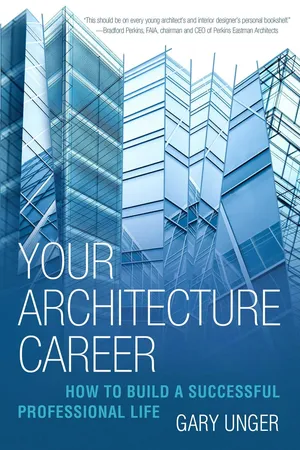
Your Architecture Career
eBook - ePub

Your Architecture Career

How to Build a Successful Professional Life

  1. 272 pages
  2. English
  3. ePUB (mobile friendly)
  4. Available on iOS & Android
eBook - ePub

Your Architecture Career

How to Build a Successful Professional Life

About this book

Master the business side of architecture with advice from an expert.
In Your Architecture Career, Gary Unger provides tips and guidance to students, interns, architects, and firm owners to help them understand and master the business side of architecture and interior design. Students in school are not taught to manage process, projects, and clients—the emphasis is on design. However, most graduates will not finish their careers as designers. Rather, their focus will be on marketing, programming, project management, cost estimating, rendering, virtual reality, drawing documentation, specifications, workplace strategy, and construction administration. Gary Unger expertly describes the creative aspects of these disciplines and the considerable value they bring to a firm.
In order to accurately represent how an architecture firm successfully operates, Gary stresses the importance of teamwork. With project teams made up of architects, engineers, realtors, building owners, contractors, furniture dealers, and more, it is important to note that a project's success is measured by how well handoffs of information are executed both inside a firm as well as from firm to firm. Spanning a wide variety of topics, chapters include:

  • Completing architectural school
  • Deciding on a career path
  • Landing your first job
  • Building your reputation
  • Managing handoffs
  • RFPs and proposals
  • Reassessing your career
  • Starting your own firm

  • Whether you're a student about to graduate or a seasoned professional, Your Architecture Career is an invaluable resource for the business side of architecture.

Frequently asked questions

Yes, you can cancel anytime from the Subscription tab in your account settings on the Perlego website. Your subscription will stay active until the end of your current billing period. Learn how to cancel your subscription.
At the moment all of our mobile-responsive ePub books are available to download via the app. Most of our PDFs are also available to download and we're working on making the final remaining ones downloadable now. Learn more here.
Perlego offers two plans: Essential and Complete
  • Essential is ideal for learners and professionals who enjoy exploring a wide range of subjects. Access the Essential Library with 800,000+ trusted titles and best-sellers across business, personal growth, and the humanities. Includes unlimited reading time and Standard Read Aloud voice.
  • Complete: Perfect for advanced learners and researchers needing full, unrestricted access. Unlock 1.4M+ books across hundreds of subjects, including academic and specialized titles. The Complete Plan also includes advanced features like Premium Read Aloud and Research Assistant.
Both plans are available with monthly, semester, or annual billing cycles.
We are an online textbook subscription service, where you can get access to an entire online library for less than the price of a single book per month. With over 1 million books across 1000+ topics, we’ve got you covered! Learn more here.
Look out for the read-aloud symbol on your next book to see if you can listen to it. The read-aloud tool reads text aloud for you, highlighting the text as it is being read. You can pause it, speed it up and slow it down. Learn more here.
Yes! You can use the Perlego app on both iOS or Android devices to read anytime, anywhere — even offline. Perfect for commutes or when you’re on the go.
Please note we cannot support devices running on iOS 13 and Android 7 or earlier. Learn more about using the app.
Yes, you can access Your Architecture Career by Gary Unger in PDF and/or ePUB format, as well as other popular books in Arquitectura & Arquitectura general. We have over one million books available in our catalogue for you to explore.

Information

PART I
Finishing School and Getting a Job
CHAPTER 1
Completing Architecture School
WHAT TO FOCUS ON DURING YOUR LAST TWO YEARS
Most course curricula become very specific in the last two years of an architectural or interior design program—without a lot of room for electives. Here are three things I encourage all students to focus on during their years in school:
Additional Elective Courses
Despite the rigors of the required design/thesis lab courses, I recommend taking as many professional practice or business administration courses as you can fit in. This will be your last and probably only time to be exposed to the foundation of the business of architecture. Not all of you will become primary designers in the firm you choose to work for, so having more than a basic understanding of the specifics of the business will be useful. For example, it is necessary to learn all you can about finance, marketing concepts, proposal writing, presentation techniques, time management, and project management.
Courses on Creative Writing
Architects need to write more than they think they will. It is imperative that architects take as many courses on creative writing as they can fit into their schedule. If there is a course on email writing, I encourage you to take it because the state of email communication in business today is pathetic. It is one thing if you are writing an email to a friend asking to get together for lunch and it is not worded properly, but it is another when you send a client an email about a schedule slippage, budget overrun, or other detail. Emails should be written like letters with a beginning, middle, and end. Most important of all, do not forget emails are legal documents.
Creating a Contact ā€œJob Searchā€ Database
Start while you are in school to create a contact list of professors, students, school administration staff, visiting professors, potential companies you may send rƩsumƩs to, vendors, and speakers.
One of the most important tasks you will learn in Part 1 is how to get organized for an effective job search.
The list will be valuable to you in school and for many years to come as you begin your professional career.
image
My recommendation is to keep your job search references and information separate from your personal phone contact list.
There are many templates available for tracking this information using Excel or Google Docs. There are also free and inexpensive database apps that will keep you organized.
Important information to track
• Contact Name
• Title
• Business Affiliation
• Business Phone
• Cell Phone
• Email
• Type of Contact
• Company Name
• Additional Contact
• Address
• Main Phone #
• Website
• Date RĆ©sumĆ© Submitted
• How RĆ©sumĆ© Submitted
• What Was Submitted
• Letter
• RĆ©sumĆ©
• References
• Follow-Up Date
• Result
• Job Description
• Personal Notes
• Interview Notes
IMPRESSING YOUR PROFESSORS SO THEY WILL REMEMBER AND RECOMMEND YOU
Many of the professors at Washington University School of Architecture, which I attended, were very successful architects in their home countries. It was fashionable for schools during the ’60s to use visiting professors. Many had both professional and personal reasons for coming, beyond their contracted teaching assignments. Teaching was a way for them to take a year and travel through the United States. Many also had special design projects they needed to complete, or were doing research for future books, so having access to loads of students they did not have to pay was very positive. This was both a plus and a minus to me. The plus was that I was able to help them with those tasks, and it was a great way to learn about real projects. The minus was that they were super busy and did not have extra time to meet for discussion and advice beyond the assigned lab period. If you find yourself in this position, volunteer in order to get an opportunity to develop the relationship and hopefully a recommendation.
Professors are excellent references once they know your capabilities. In order to make that happen, go out of your way to volunteer to help and chat with them about their firms. Take the time to look them up online so you can better understand their practice. Without being too pushy, ask for their advice and support.
NETWORKING WITH CLASSMATES, ALUMNI, AND PROFESSORS
Coordinate your job search research with classmates and share information with one another about firms in various cities. When you start looking for your first job, there is a lot of information to gather, and the ā€œdivide and conquerā€ approach makes a lot of sense, especially with the more mundane tasks of gathering contact information about firms in each city.
By the middle of your next-to-last year, you need to be making contacts for summer jobs. Your professors should be able to be a big help to you in the search. If you have a placement office or guidance office, sometimes they get calls from local firms or associations like the AIA and ASID and know who is looking for summer interns. I have always considered alumni to be the best resource because there should be an immediate bond with them and, hopefully, willingness to help. At least a good letter should get you in the door for an interview with one or more of the alumni from your school.
CHAPTER 2
Deciding on a Career Path
A SUMMER INTERNSHIP BEFORE YOUR LAST YEAR
The summer of your next-to-last year in architecture school is one of the most important for your future career as an architect. If you are able to land a summer internship, it will significantly enhance your ability to find a job after graduation. Employers reviewing rƩsumƩs for a full-time job like to know that you have had some related work experience. I recommend starting to look for that summer job in February or March. Use your connections to help you find out about potential summer jobs. You need to learn how to leverage your relationships with:
• Professors, school counselors, and alumni coordinators
• Family friends and students
• Architectural alumni
• Local AIA contacts—get to know the staff in local AIA offices
image
I am not big on following or responding to job boards, want ads, or online recruiters. In my experience, summer jobs are rarely listed that way. You need to be looking for the job that is not posted. It is to your advantage that summertime is the biggest period for employee vacations. In many cases, your job may be filling in for employees who are on vacation. Your cover letter or email should trigger ideas in the mind of the reader that it would be a good idea to have you f...

Table of contents

  1. Front Cover
  2. Title Page
  3. Copyright Page
  4. Dedication
  5. Table of Contents
  6. Foreword
  7. Introduction
  8. Debunking Three Myths about Architecture and Architects
  9. Part I. Finishing School and Getting a Job
  10. Part II. Starting and Excelling at Your Job
  11. Part III. Architecture Is a Team Sport
  12. Part IV. Moving On Up—From Intern to Architect
  13. Part V. Reassessing Your Career
  14. Part VI. Time, Money, and Luck
  15. Part VII. Closing Thoughts
  16. List of Terms
  17. Bibliography
  18. Suggested Readings
  19. Resources
  20. About the Author
  21. Index