
eBook - ePub
My Life as an Indian
The Story of a Red Woman and a White Man in the Lodges of the Blackfeet
- 480 pages
- English
- ePUB (mobile friendly)
- Available on iOS & Android
eBook - ePub
My Life as an Indian
The Story of a Red Woman and a White Man in the Lodges of the Blackfeet
About this book
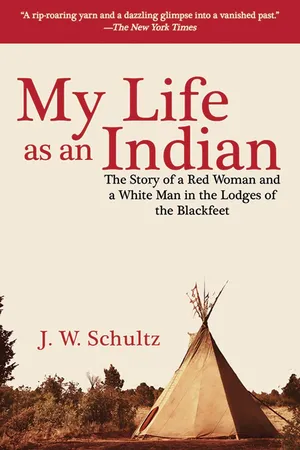
First published in 1907, My Life as an Indian is the memoir of J. W. Schultz's life as a young white man among the Piegan Blackfeet in the Montana Territory. Out of curiosity and in search of adventure, Schultz went west and became a trapper and trader. He was inspired by the journals of Lewis and Clark and George Catlin's Oregon Trail, but found a wholly different source of inspiration when he met the Blackfeet and quickly settled into their lifestyle, even taking a Blackfoot woman for his wife and riding along with the men on buffalo hunts and wars with neighboring tribes.
Frequently asked questions
Yes, you can cancel anytime from the Subscription tab in your account settings on the Perlego website. Your subscription will stay active until the end of your current billing period. Learn how to cancel your subscription.
At the moment all of our mobile-responsive ePub books are available to download via the app. Most of our PDFs are also available to download and we're working on making the final remaining ones downloadable now. Learn more here.
Perlego offers two plans: Essential and Complete
- Essential is ideal for learners and professionals who enjoy exploring a wide range of subjects. Access the Essential Library with 800,000+ trusted titles and best-sellers across business, personal growth, and the humanities. Includes unlimited reading time and Standard Read Aloud voice.
- Complete: Perfect for advanced learners and researchers needing full, unrestricted access. Unlock 1.4M+ books across hundreds of subjects, including academic and specialized titles. The Complete Plan also includes advanced features like Premium Read Aloud and Research Assistant.
We are an online textbook subscription service, where you can get access to an entire online library for less than the price of a single book per month. With over 1 million books across 1000+ topics, weâve got you covered! Learn more here.
Look out for the read-aloud symbol on your next book to see if you can listen to it. The read-aloud tool reads text aloud for you, highlighting the text as it is being read. You can pause it, speed it up and slow it down. Learn more here.
Yes! You can use the Perlego app on both iOS or Android devices to read anytime, anywhere â even offline. Perfect for commutes or when youâre on the go.
Please note we cannot support devices running on iOS 13 and Android 7 or earlier. Learn more about using the app.
Yes, you can access My Life as an Indian by J. W. Schultz in PDF and/or ePUB format, as well as other popular books in History & North American History. We have over one million books available in our catalogue for you to explore.
Information
CHAPTER I
FORT BENTON
WIDE, brown plains, distant, slender, flat-topped buttes; still more distant giant mountains, blue-sided, sharp-peaked, snow-capped; odour of sage and smoke of camp fire; thunder of ten thousand buffalo hoofs over the hard, dry ground; long-drawn, melancholy howl of wolves breaking the silence of night, how I loved you all!
I am in the sere and yellow leaf, dried and shrivelled, about to fall and become one with my millions of predecessors. Here I sit, by the fireplace in winter, and out on the veranda when the days are warm, unable to do anything except live over in memory the stirring years I passed upon the frontier. My thoughts are always of those days; days before the accursed railroads and the hordes of settlers they brought swept us all, Indians and frontiersmen and buffalo, from the face of the earth, so to speak.
The love of wild life and adventure was born in me, yet I must have inherited it from some remote ancestor, for all my near ones were staid, devout people. How I hated the amenities and conventions of society; from my earliest youth I was happy only when out in the great forest which lay to the north of my home, far 3 beyond the sound of church and school bell, and the whistling locomotives. My visits to those grand old woods were necessarily brief, only during summer and winter vacations. But a day came when I could go where and when I chose, and one warm April morning long ago I left St. Louis on a Missouri River steamboat, bound for the Far West.
The Far West! Land of my dreams and aspirations! I had read and re-read Lewis and Clarkâs âJournal,â Catlinâs âEight Years,â âThe Oregon Trail,â Fremontâs expeditions; at last I was to see some of the land and the tribes of which they told. The sturdy flat-bottom, shallow-draft, stern-wheel boat was tied to the shore every evening at dusk, resuming her way at daylight in the morning, so I saw every foot of the Missouriâs shores, 2,600 miles, which lay between the Mississippi and our destination, Fort Benton, at the head of navigation. I saw the beautiful groves and rolling green slopes of the lower river, the weird âbad landsâ above them, and the picturesque cliffs and walls of sandstone, carved into all sorts of fantastic shapes and form by wind and storm, which are the features of the upper portion of the navigable part of the river. Also I saw various tribes of Indians encamped upon the banks of the stream, and I saw more game than I had thought ever existed. Great herds of buffalo swimming the river often impeded the progress of the boat. Numberless elk and deer inhabited the groves and slopes of the valley. On the open bottoms grazed bands of antelope, and there were bighorn on nearly every butte and cliff of the upper river. We saw many grizzly bears, and wolves, and coyotes; and in the evenings, when all was still aboard, the beavers played and splashed alongside the boat. What seemed to me most remarkable of all, was the vast number of buffalo we passed. All through Dakota, and through Montana clear to Fort Benton, they were daily in evidence on the hills, in the bottoms, swimming the river. Hundreds and hundreds of them, drowned, swollen, in all stages of decomposition, lay on the shallow bars where the current had cast them, or drifted by us down the stream. I believe that the treacherous river, its quicksands, and its unevenly frozen surface in winter, played as great havoc with the herds as did the Indian tribes living along its course. We passed many and many a luckless animal, sometimes a dozen or more in a place, standing under some steep bluff which they had vainly endeavoured to climb, and there they were, slowly but surely sinking down, down into the tenacious black mud or sands, until finally the turbid water would flow smoothly on over their lifeless forms. One would naturally think that animals crossing a stream and finding themselves under a high cut bank would turn out again into the stream and swim down until they found a good landing place; but this is just what the buffalo, in many cases, did not do. Having once determined to go to a certain place, they made a bee-line for it; and, as in the case of those we saw dead and dying under the cut banks, it seemed as if they chose to die rather than to make a detour in order to reach their destination.
After we entered the buffalo country there were many places which I passed with regret; I wanted to stop off and explore them. But the captain of the boat would say: âDonât get impatient; you must keep on to Fort Benton; thatâs the place for you, for there youâll meet traders and trappers from all over the Northwest, men you can rely upon and travel with, and be reasonably safe. Good God, boy, suppose I should set you ashore here? Why, in all likelihood you wouldnât keep your scalp two days. These here breaks and groves shelter many a prowlinâ war party. Oh, of course, you donât see âem, but theyâre here all the same.â
Foolish âtenderfoot,â innocent âpilgrimâ that I was, I could not bring myself to believe that I, I who thought so much of the Indians, would live with them, would learn their ways, would be a friend to them, could possibly receive any harm at their hands. But one day, somewhere between the Round Butte and the mouth of the Musselshell River, we came upon a ghastly sight. On a shelving, sandy slope of shore, by a still smouldering fire of which their half-burned skiff formed a part, lay the remains of three white men. I say remains advisedly, for they had been scalped and literally cut to pieces, their heads crushed and frightfully battered, hands and feet severed and thrown promiscuously about. We stopped and buried them, and it is needless to say that I did not again ask to be set ashore.
Ours was the first boat to arrive at Fort Benton that spring. Long before we came in sight of the place the inhabitants had seen the smoke of our craft and made preparations to receive us. When we turned the bend and neared the levee, cannon boomed, flags waved, and the entire population assembled on the shore to greet us. Foremost in the throng were the two traders who had sometime before bought out the American Fur Company, fort and all. They wore suits of blue broadcloth, their long-tailed, high-collared coats bright with brass buttons; they wore white shirts and stocks, and black cravats; their long hair, neatly combed, hung down to their shoulders. Beside them were their skilled employeesâclerks, tailor, carpenterâand they wore suits of black fustian, also brass-buttoned, and their hair was likewise long, and they wore parileche-soled moccasins, gay with intricate and flowery designs of cut beads. Behind these prominent personages the group was most picturesque; here were the French employees, mostly Creoles from St. Louis and the lower Mississippi, men who had passed their lives in the employ of the American Fur Company, and had cordelled many a boat up the vast distances of the winding Missouri. These men wore the black fustian capotes, or hooded coats, fustian or buckskin trousers held in place by a bright-hued sash. Then there were bull-whackers, and mule-skinners, and independent traders and trappers, most of them attired in suits of plain or fringed and beaded buckskin, and nearly all of them had knives and Coltâs powder and ball six-shooters stuck in their belts; and their headgear, especially that of the traders and trappers, was homemade, being generally the skin of a kit fox roughly sewn in circular form, head in front and tail hanging down behind. Back of the whites were a number of Indians, men and youths from a near by camp, and women married to the resident and visiting whites, I had already learned from what I had seen of the various tribes on our way up the river, that the everyday Indian of the plains is not the gorgeously attired, eagle plume bedecked creature various prints and written descriptions had led me to believe he was. Of course, all of them possessed such fancy attire, but it was worn only on state occasions. Those I now saw wore blanket or cow (buffalo) leather leggings, plain or beaded moccasins, calico shirts, and either blanket or cow-leather toga. Most of them were bareheaded, their hair neatly braided, and their faces were painted with reddish-brown ochre or Chinese vermilion. Some carried a bow and quiver of arrows; some had flint-lock fukes, a few the more modern cap-lock rifle. The women wore dresses of calico; a few âwivesâ of the traders and clerks and skilled labourers even wore silk, and gold chains and watches, and all had the inevitable gorgeously hued and fringed shawl thrown over their shoulders.
At one glance the eye could take in the whole town, as it was at that time. There was the great rectangular adobe fort, with bastions mounting cannon at each corner. A short distance above it were a few cabins, built of logs or adobe. Back of these, scattered out in the long, wide flat-bottom, was camp after camp of trader and trapper, string after string of canvas-covered freightersâ wagons, and down at the lower end of the flat were several hundred lodges of Piegans. All this motley crowd had been assembling for days and weeks, impatiently awaiting the arrival of the steamboats. The supply of provisions and things brought up by the boats the previous year had fallen far short of the demand. There was no tobacco to be had at any price. Keno Bill, who ran a saloon and gambling house, was the only one who had any liquor, and that was alcohol diluted with water, four to one. He sold it for a dollar a drink. There was no flour, no sugar, no bacon in the town, but that did not matter, for there was plenty of buffalo and antelope meat. What all craved, Indians and whites, was the fragrant weed and the flowing bowl. And here it was, a whole steamboat load, together with a certain amount of groceries; no wonder cannon boomed and flags waved, and the population cheered when the boat hove in sight.
I went ashore and put up at the Overland Hotel, which was a fair-sized log cabin with a number of log-walled additions. For dinner we had boiled buffalo boss ribs, bacon and beans, âyeast powderâ biscuit. coffee with sugar, molasses, and stewed dried apples. The regular guests scarcely touched the meat, but the quantities of bread, syrup, and dried apples they stowed away was surprising.
That was a day to me, a pilgrim fresh from the East, from the âStates,â as these frontiersmen called it, full of interest. After dinner I went back to the boat to see about my luggage. There was a gray-bearded, long-haired old trapper standing on the shore looking absently out over the water. His buckskin trousers were so bagged at the knees that he seemed to be in the attitude of one about to jump out into the stream. To him approached a fellow passenger, a hair-brained, windy, conceited young fellow bound for the mining country, and said, looking intently at the aforesaid baggy knees, âWell, old man, if youâre going to jump, why donât you jump, instead of meditating over it so long?â
He of the buckskins did not at first comprehend, but following the questionerâs intent stare he quickly saw what was meant. âWhy, you pilgrim,â he replied, âjump yourself.â And instantly grasping the youth by the legs below the knees he heaved him out into about three feet of water. What a shout of laughter and derision arose from the bystanders when the ducked one reappeared and came gasping, spluttering, dripping ashore. He looked neither to the right nor the left, but hurried on board to the seclusion of his cabin, and we saw him no more until he pulled out on the stage the next morning.
I had letters of introduction to the firm which had bought out the American Fur Company. They received me kindly and one of them took me around introducing me to the various employees, residents of the town, and to several visiting traders and trappers. Of the latter I met one, a man only a few years older than myself, who I was told was the most successful and daring of all the traders of the plains. He spoke a number of Indian languages perfectly, and was at home in the camps of any of the surrounding tribes. We somehow took to each other at once, and I passed the balance of the afternoon in his company. Eventually we became great friends. He still lives; and as I may in the course of this story tell some of the things we did together, for which we are now both truly sorry, I will not give his right name. The Indians called him the Berry; and as Berry he shall be known in these chronicles of the old plains life. Tall, lean, long-armed and slightly sto op-shouldered, he was not a fine looking man, but what splendidly clear, fearless dark brown eyes he had; eyes that could beam with the kindly good nature of those of a child, or fairly flash fire when he was aroused to anger.
It was not half an hour after the arrival of the steamboat, before whisky dropped to the normal price of âtwo bitsâ per drink, and tobacco to $2 per pound. The white men, with few exceptions, hied to the saloons to drink, and smoke, and gamble. Some hurried to load their wagons with sundry kegs and make for the Indian camp at the lower end of the bottom, and others after loading ran out on the Teton as fast as their horses could go. The Indians had hundreds and hundreds of prime buffalo robes, and they wanted whisky. They got it. By the time night closed in, the single street was full of them charging up and down on their pinto ponies, singing, yelling, recklessly firing their guns, and vociferously calling, so I was told, for more liquor. There was a brisk trade that night at the rear doors of the saloons. An Indian would pass in a good head and tail buffalo robe and receive for it two and even three bottles of liquor. He might just as well have walked boldly in at the front door and traded for it over the bar, I thought, but I learned that there was a United States marshal somewhere in the Territory, and that there was no telling when he would turn up.
In the brightly lighted saloons the tables were crowded by the resident and temporary population, playing stud and draw poker, and the more popular game of faro. I will say for the games as played in those wide open and lawless days that they were perfectly fair. Many and many a time I have seen the faro bank broken, cleaned out of its last dollar by lucky players. You never hear of that being done in the âclubs,â the exclusive gambling dens of to-day. The men who ran games on the frontier were satisfied with their legitimate percentage, and they did well. The professionals of to-day, be it in any town or city where gambling is prohibited, with marked cards, false-bottom faro boxes, and various other devices take the playersâ all.
I never gambled; not that I was too good to do so, but somehow I never could see any fun in games of chance. Fairly as they were conducted there was always more or less quarreling over them. Men a half or two-thirds full of liquor are prone to imagine things and do what they would recoil from when sober; and, if you take notice, you will find that, as a rule, those who gamble are generally pretty heavy drinkers. Somehow the two run together. The professional may drink also, but seldom when he is playing. That is why he wears broadcloth and diamonds and massive gold watch chains; he keeps cool and rakes in the drunken plungerâs coin. In Keno Billâs place that evening I was looking on at a game of faro. One of those bucking it was a tall, rough, bewhiskered bull-whacker, full of whisky and quarrelsome, and he was steadily losing. He placed a blue chip, $2.50, on the nine spot, and coppered it; that is, he placed a small marker upon it to signify that it would lose; but when the card came it won, and the dealer flicked off the marker and took in the chip.
âHere, you,â cried the bull-whacker. âWhat you doinâ? Give me back that chip and another one with it. Donât you see that the nine won?â
âOf course it won,â the dealer replied, âbut you had your bet coppered.â
âYouâre a liar!â shouted the bull-whacker, reaching for his revolver and starting to rise from his seat.
I saw the dealer raising his weapon, and at the same instant Berry, crying out, âDown! Down!â dragged me with him to the floor; everyone else in the room who could not immediately get out of the door also dropped prone to the floor. There were some shots, fired so quickly that one could not count them; then there was a short dense silence, broken by a gasping, gurgling groan. Men shuffled to their feet and hurried over to the smoke-enveloped corner. The bull-whacker, with three bullet holes in his bosom, lay back in the chair from which he had attempted to arise, quite dead; the faro dealer, white, but apparently calm, stood on the opposite side of the table stanching with his handkerchief the blood from the nasty furrow a bullet had ploughed in his right cheek.
âClose call for you, Tom,â said some one.
âHe sure branded me,â the dealer grimly replied.
âWho was he? What outfit was he with?â was asked.
âDonât know what his name was,â said Keno Bill âbut I believe he rolled in with Missouri Jeffâs bull-train Letâs pack him into the back room, boys, and Iâll get word to his friends to come anâ plant him.â
This was done; the blood-stained chair was also removed, ashes were scattered on some dark spots staining the floor, and after all hands had taken a drink on the house the games were resumed. Berry and I strolled out of the place. I felt queer; rather shaky in the legs and sick at the stomach. I had never before seen a man killed; for that matter, I had never even seen two men in a fist fight. I could not forget that terrible death gurgle, nor the sight of the dead manâs distorted face and staring eyes.
âAwful, wasnât it?â I remarked.
âOh, I donât know,â Berry replied, âthe fish got what he was looking for; these bad men always do, sooner or later. He started first xo pull his gun, but he was a little too slow.â
âAnd what next?â I asked. âWill not the dealer be arrested? Will not we be subpcenaed as witnesses in the case?â
âWho will arrest him?â my friend queried in turn. âThere are no police, nor officers of the law here of any description.â
âWhyâwhy, how, then, with so many desperate characters as you evidently have here, how do you manage to preserve any form of law and order?â
âSevenâelevenâseventy-seven,â Berry sententiously replied.
âSevenâelevenâseventy-seven,â I mechanically repeated. â...
Table of contents
- Cover
- Halftitle
- Titlepage
- Copyright
- Publisherâs Note
- Editorâs Note
- Contents
- Principal Characters
- illustrations
- Chapter I Fort Benton
- Chapter II The Ruse of a Savage Lover
- Chapter III The Tragedy of the Marias
- Chapter IV A War trip for Horses
- Chapter V Days With the Game
- Chapter VI The Story of the Crow Woman
- Chapter VII A White Buffalo
- Chapter VIII A Winter on the Marias
- Chapter IX I have a Lodge Of My Own
- Chapter X The Killing of a Bear
- Chapter XI The Kutenaiâs Story
- Chapter XII The Great Race
- Chapter XIII The Snake Woman
- Chapter XIV The Snake Womanâs Quest
- Chapter XV I Return To My People
- Chapter XVI The Story of Rising Wolf
- Chapter XVII A Friendly Visit from the Crows
- Chapter XVIII A Raid By the Crows
- Chapter XIX Nät-ahâ-Kiâs Wedding
- Chapter XX The Attack on the Hunters
- Chapter XXI Never-Laughs Goes East
- Chapter XXII The War Trip of Queer Person
- Chapter XXIII The Piegans Move In
- Chapter XXIV A Wolverineâs Medicine
- Chapter XXV Little Deerâs End
- Chapter XXVI The Ways of the Northland
- Chapter XXVII The Story of Ancient Sleeper
- Chapter XXVIII Dianaâs Marriage
- Chapter XXIX A Game Of Fate
- Chapter XXX Trade, Hunt, and War Party
- Chapter XXXI Nät-ahâ-Kiâs Rids
- Chapter XXXII Curbing The Wanderers
- Chapter XXXIII Crees and Red Rivers
- Chapter XXXIV The Last of the Buffalo
- Chapter XXXV The âWinter of Deathâ
- Chapter XXXVI The âBlack Robeâs Helpâ
- Chapter XXXVII Later Years