Prevail
eBook - ePub

Prevail

The Inspiring Story of Ethiopia's Victory over Mussolini's Invasion, 1935-1941

  1. 640 pages
  2. English
  3. ePUB (mobile friendly)
  4. Available on iOS & Android
eBook - ePub

Prevail

The Inspiring Story of Ethiopia's Victory over Mussolini's Invasion, 1935-1941

About this book

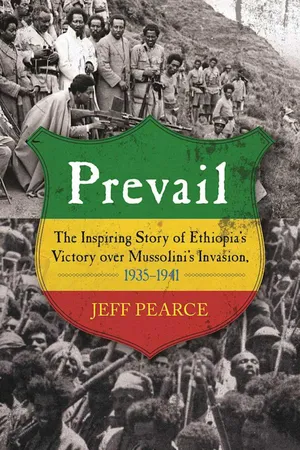
It was the war that changed everything, and yet it's been mostly forgotten: in 1935, Italy invaded Ethiopia. It dominated newspaper headlines and newsreels. It inspired mass marches in Harlem, a play on Broadway, and independence movements in Africa. As the British Navy sailed into the Mediterranean for a white-knuckle showdown with Italian ships, riots broke out in major cities all over the United States.Italian planes dropped poison gas on Ethiopian troops, bombed Red Cross hospitals, and committed atrocities that were never deemed worthy of a war crimes tribunal. But unlike the many other depressing tales of Africa that crowd book shelves, this is a gripping thriller, a rousing tale of real-life heroism in which the Ethiopians come back from near destruction and win.Tunnelling through archive records, tracking down survivors still alive today, and uncovering never-before-seen photos, Jeff Pearce recreates a remarkable era and reveals astonishing new findings. He shows how the British Foreign Office abandoned the Ethiopians to their fate, while Franklin Roosevelt had an ambitious peace plan that could have changed the course of world history—had Chamberlain not blocked him with his policy on Ethiopia. And Pearce shows how modern propaganda techniques, the post-war African world, and modern peace movements all were influenced by this crucial conflict—a war in Africa that truly changed the world.Skyhorse Publishing, as well as our Arcade imprint, are proud to publish a broad range of books for readers interested in history--books about World War II, the Third Reich, Hitler and his henchmen, the JFK assassination, conspiracies, the American Civil War, the American Revolution, gladiators, Vikings, ancient Rome, medieval times, the old West, and much more. While not every title we publish becomes a New York Times bestseller or a national bestseller, we are committed to books on subjects that are sometimes overlooked and to authors whose work might not otherwise find a home.
Frequently asked questions

Yes, you can cancel anytime from the Subscription tab in your account settings on the Perlego website. Your subscription will stay active until the end of your current billing period. Learn how to cancel your subscription.
No, books cannot be downloaded as external files, such as PDFs, for use outside of Perlego. However, you can download books within the Perlego app for offline reading on mobile or tablet. Learn more here.
Perlego offers two plans: Essential and Complete
  • Essential is ideal for learners and professionals who enjoy exploring a wide range of subjects. Access the Essential Library with 800,000+ trusted titles and best-sellers across business, personal growth, and the humanities. Includes unlimited reading time and Standard Read Aloud voice.
  • Complete: Perfect for advanced learners and researchers needing full, unrestricted access. Unlock 1.4M+ books across hundreds of subjects, including academic and specialized titles. The Complete Plan also includes advanced features like Premium Read Aloud and Research Assistant.
Both plans are available with monthly, semester, or annual billing cycles.
We are an online textbook subscription service, where you can get access to an entire online library for less than the price of a single book per month. With over 1 million books across 1000+ topics, we’ve got you covered! Learn more here.
Look out for the read-aloud symbol on your next book to see if you can listen to it. The read-aloud tool reads text aloud for you, highlighting the text as it is being read. You can pause it, speed it up and slow it down. Learn more here.
Yes! You can use the Perlego app on both iOS or Android devices to read anytime, anywhere — even offline. Perfect for commutes or when you’re on the go.
Please note we cannot support devices running on iOS 13 and Android 7 or earlier. Learn more about using the app.
Yes, you can access Prevail by Jeff Pearce in PDF and/or ePUB format, as well as other popular books in History & 20th Century History. We have over one million books available in our catalogue for you to explore.

Information

Publisher
Skyhorse
Year
2017
Print ISBN
9781510718654
eBook ISBN
9781510718746
PART ONE
RESIST
INTRODUCTION
“The Lion of Judah has prevailed.”
—Slogan associated with Haile Selassie and with Ethiopia
They scrambled down into the pass, their thickly-callused bare feet ignoring the bite of the rocks and stones, their swords and spears held high. If they didn’t have swords or spears to carry, they would wield sticks and clubs. Some were armed with rifles, but these were often old, practically relics—their saving grace was the fact that they took a variety of cartridges. The buffalo-hide shields would do nothing to stop bullets, but they would block the bayonets slammed forward by the fierce askaris—native soldiers brown like themselves, born like themselves in the Horn of Africa, but now serving a colonial master. Unlike the askaris, most of the Ethiopians wore the traditional shamma, a toga-like garment that their ancestors had donned for generations. You could have painted the whole scene in oils like a war mural hung in London’s National Gallery, or preserved it in a sepia photograph …
Until the tanks rolled in.
And then it was no longer a vintage scene of colonial warfare; it was a grotesque tableau of anachronism. This was not a page out of the Book of Empire from the eighteenth or nineteenth centuries. This was December 1935.
At first, the more ignorant warriors took these strange, lumbering metal things for monsters and ran. But one of them, fearless and proud, circled around and jumped onto a tank, pounding on its tin shell casing. Machine guns were blazing away and slicing men in half, and still the Ethiopians swarmed and flooded their numbers into the narrow gorge of what is called Dembeguina Pass, overwhelming the enemy. When it was finally dusk, the men and their brilliant commander, Imru, would slip away with fifty captured machine guns.
Miles away—beyond the frontier with Sudan, beyond Egypt and Libya and across the Mediterranean—the original Strongman of Europe sat behind the desk in his cavernous office in Rome and fumed, his eyebrows knit in frustration below his stolid dome. Benito Mussolini was furious. This was not how his grand campaign was supposed to go. It wasn’t so much that the Ethiopians were winning—so far, overall, they weren’t. But they were not clearly losing. And the world watched and was amazed at the defiant courage of “savages.”
Hadn’t his armies practically strolled into enemy territory, easily taking towns in the north? And when his general in charge had vacillated, hadn’t he moved to act, replacing the old codger with his army’s chief of staff? But still the war was not the continuous triumph he longed for. A month before, a skirmish at a place called Ende Giorgis had made headlines around the world because the Ethiopians had gotten the upper hand there, too. They were not supposed to do well! They were only supposed to fight and bleed and die, and let the glorious new Roman Empire be born.
But a tiny man of five foot four—as self-contained as Mussolini was wildly expansive—said no. Haile Selassie, the Emperor of Ethiopia, the Lion of Judah, insisted that the age of white colonialism was past. His warriors were only fighting now because it was a last resort, and he would not break his faith in God and the assertion that men of noble stature should keep their word and play by the rules. African monarchs had said no before—and been ignored—but this king had such presence of dignity, such gentle eloquence, that he could not be so easily dismissed. He said no.
But more importantly, most of the world was listening and, for the very first time, was also saying no.
In London, outraged liberals tangled with Oswald Mosley’s Blackshirts, who naturally supported the invasion. Demonstrators in Toulouse, France, attacked a group of Italian sailors who wanted to go home to serve. Down in Accra, the capital of the British-held Gold Coast, about five hundred black citizens wanted to sign up to go fight for Ethiopia; in Cape Town, South Africa, six thousand black citizens turned up at a government office, wanting the same, to fight for distant comrades. Muslim Arabs in French and Spanish Morocco put together a small mercenary army, intent on crossing the Sahara and winding their way along the Upper Nile to go fight. Sympathetic Communists wreaked havoc in Mexico City, brawling with police armed with rifles. The Ethiopia Crisis could be felt as far away as South America and even touched Asia. The news was everywhere, inescapable, and the word was going out that Haile Selassie’s soldiers would not simply roll over and accept the inevitable.
In America, support was arguably at its highest. On a hot afternoon back in August, an estimated twenty thousand people had poured into the streets of New York’s Harlem neighborhood for the cause. Many of those in the throng had taken to calling themselves “African” in a remarkable show of black power before the term had even been coined. Here were African Americans marching in an age of barefoot children going to school, a time of “Whites Only” drinking fountains and back entrances at hotels, long before Black Panthers and the pride of Roots, before Marley and Mandela.
“This is no time to eat ice cream or peel bananas!” a speaker had shouted from the huge wooden platform. People were told to “listen to the speeches and donate as much money as possible.” Cheers went up as the Ethiopian tricolor of green, yellow, and red was waved in the crowd. Then came the shouting, the chanting: “Death to Fascism!” and “Down with Mussolini!” At the height of the Depression, it was no surprise that one poster read: SIXTEEN MILLION UNEMPLOYED WANT BREAD, NOT BULLETS. The founder of the organization Pioneers of Ethiopia, F. A. Cowan, told the sea of faces that as far as Mussolini was concerned, “We will show him that the American Negro is going right over into his backyard!”
It was a good line, a line that would make the papers. And many African Americans in the crowd would surely have believed it. They could picture themselves on Ethiopian soil, each with a rifle in his hands, fighting for their distant brothers. This same hope was shared by many in West Africa, and a collection of earnest radical expatriates in London and Paris. All of them, whether American or British, Jamaican or Kenyan, could not possibly have a clue what forces would be brought to bear to prevent them or anyone else from coming to Ethiopia’s aid.
* * *
For more than a year, the crisis would dominate Western headlines. Ethiopia was a member of the League of Nations, and under the League’s Covenant, members were supposed to defend the African country if it was attacked. The United States, however, was not a member of the League. Still, Franklin Roosevelt was finding it increasingly difficult to stay neutral, as riots broke out between blacks and Italians in New York. As diplomatic overtures would fail and tensions escalate, Great Britain would send its fleet into the Mediterranean, and Mussolini would respond by sending two army divisions to Libya to threaten Egypt.
It would prompt comment from great political leaders of the day, from Winston Churchill to Mahatma Gandhi to Leon Trotsky. Celebrities would weigh in, from George Bernard Shaw to Josephine Baker. It inspired poets, motivated a world-famous inventor, and was turned into a Broadway play that provoked controversy and US government censorship. The war would become business news when secret negotiations were uncovered between Ethiopia and Standard Oil. It would spill into the sports pages with a prize fight between Detroit’s Joe Louis and Italy’s Primo Carnera, becoming a symbolic showdown between black and white. For, in the end, this was how many blacks in America, as well as other parts of Africa—along with some whites in the United States and Europe—chose to see the conflict. For them, this would be the race war. It was a war that would change the world.
Across the Atlantic, more than a month before the mass protest in Harlem, the League of Nations Union had published its survey of more than eleven million people in Great Britain, a poll that eventually became famously known as the “Peace Ballot.” Among its five questions, it had asked if nations should use economic means to compel an aggressor nation from attacking another. Today, our shorthand for this is “sanctions.” More than ten million people had answered yes, and more than six million were willing to back up the economics with military measures. Every respondent had to know what example was being implied by a question of one nation attacking another: Italy versus Ethiopia. The results of the Peace Ballot clearly indicated that yes, the British public wanted peace, but not at any price. British citizens were willing to defend an ally.
But their government would eventually allow Mussolini to have his war. So would France. Roosevelt, anxious about the coming election in 1936, would refuse to involve the United States. Alone, Ethiopia would fight to defend itself, and against all odds, it would hold its own—for a while. Italian planes would drop poison gas on its soldiers and bomb Red Cross hospitals. Italian soldiers would commit atrocities that would never be deemed worthy of a war crimes tribunal. After 1945, the conflict was considered “another war,” distinct from World War Two, and not worth going back to investigate.
And the world would forget.
* * *
The war once mattered. To cite a superficial but interesting measure of its impact, consider Casablanca. In the film, both the French police captain, Renault, and the freedom fighter, Victor Laszlo, remind Bogart’s hero, Rick Blaine: “You ran guns to Ethiopia.” Everyone in the audience at the time knew what they were talking about. Laszlo asks rhetorically, “Isn’t it strange that you always happen to be fighting on the side of the underdog?” Ethiopia is mentioned in the same breath as the fight against the Fascists in Spain, raising it to the status of a romantic crusade.
The war did indeed once matter. For a brief time, it captured the world’s attention, stirring feelings of rebellion in Egypt and worrying the colonial masters of South Africa. The conflict would be the real beginning of the decline of the League of Nations that led to World War Two. Some people know this or were given fleeting references to the war in history classes. It’s presumed that the war’s only relevance is to the League of Nations. What many people don’t know is that an arguably far more significant development involving Roosevelt and America also affected events—and it, too, hinged on Ethiopia.
So the war is an important turning point in world history. It is African history, and not just because Ethiopia is in Africa. The war shaped the political mind of a continent in ways that so many of us have hardly noticed but that are crucial to understanding our events today. “I was seventeen when Mussolini attacked Ethiopia, an invasion that spurred not only my hatred of that despot but of fascism in general.”
Those words belong to Nelson Mandela.
In his autobiography, Long Walk to Freedom, he wrote: “Ethiopia has always held a special place in my own imagination and the prospect of visiting Ethiopia attracted me more strongly than a trip to France, England, and America combined. I felt I would be visiting my own genesis, unearthing the roots of what made me an African. Meeting the Emperor himself would be like shaking hands with history.”1
Africans elsewhere felt the same way. They quite deliberately called the nation “Ethiopia,” using the Greek word, and not “Abyssinia,” a Latin corruption of an Arabic label, “Habesha.” Whites—Europeans and European-descent Americans—used that term more often. Ethiopia was a fountainhead of legendary culture, where the obelisks and monasteries of Aksum rose in the same era as the Romans and ancient India. As a leading professor of Ghana would later put it, “If Ethiopians were the brothers of all black people then their historical achievements could be represented as the achievements of all.”2
It’s little wonder then that thousands of African Americans felt the same, and so the war is a crucial chapter in their history as well. For New York, Chicago, Pittsburgh, and Detroit, the capitals of black consciousness in 1935, Ethiopia indeed mattered. It held a spiritual significance for black Americans as an African kingdom where Christianity had flourished since the fourth century. And it was defiantly independent, smack in the middle of the colonial map. The great black historian, John Hope Franklin, wrote in his landmark work, From Slavery to Freedom: “Almost overnight, even the most provincial among American Negroes became international-minded. Ethiopia was a black nation, and its destruction would symbolize the final victory of whites over blacks.”3 Thousands of African Americans signed up with ad hoc militias to try to keep it that way.
Above all, this war is the story of a courageous people who, despite antiquated weapons and overwhelming odds, held their own against the Italians for as long as they could and came close to invading the Italian-held frontier of Eritrea. They were cheated out of the inheritance of a generation. Mussolini’s generals ruthlessly exterminated men trained to lead the country into the twentieth century, and the history of Ethiopia might have been quite different had they lived.
Which brings us to Haile Selassie, still held in far more esteem sometimes by foreigners than by his own people, and even the foreign view is often harsh in its judgment. He is overdue for a reappraisal, a task that is for the most part beyond the scope of this narrative. Still, some points regarding him will need to be made, because the war had far-reaching effects into the modern age and how the West treated Africa after the Second World War. Western opinion of Haile Selassie today is often based on now-discredited news reports and on the aftermath of a brutal Derg regime, while the reality of his character at the time was far more complex.
We are no better served by some historians today. In an aggrandizing chronicle ...

Table of contents

  1. Cover
  2. Title Page
  3. Copyright
  4. Contents
  5. Dedication
  6. List of Illustrations and Photo Credits
  7. Foreword by Richard Pankhurst
  8. Preface to the Paperback Edition
  9. Note on Names
  10. Maps
  11. Part One: Resist
  12. Part Two: Endure
  13. Part Three: Prevail
  14. Notes
  15. Acknowledgments
  16. Select Bibliography
  17. Index