The must-read summary of Carter Pate and Harlan Platt's book: "The Phoenix Effect: 9 Revitalizing Strategies No Business Can Do Without".
This complete summary of the ideas from Carter Pate and Harlan Platt's book "The Phoenix Effect" answers one of the biggest questions in the business environment: why do so many successful companies fail? In their book, the authors present their research and conclude that these failures are the result of managers that refuse to accept that they are losing and fail to take action. This summary provides a detailed insight into the reasons behind business failures, meaning you can keep an eye on your own strategies and know when it's time to act.
Added-value of this summary:
• Save time
• Understand key concepts
• Expand your business knowledge
To learn more, read "The Phoenix Effect" and discover how you can ensure that failures in your company are spotted in time and turned around.
eBook - ePub
Summary: The Phoenix Effect
Review and Analysis of Pate and Platt's Book
- English
- ePUB (mobile friendly)
- Available on iOS & Android
eBook - ePub
About this book
Information
Subtopic
Business StrategyIndex
BusinessSummary of The Phoenix Effect (Carter Pate and Harlan Platt)
Before Beginning: Get to the point of all the pain
Main Idea
Before starting on the corporate renewal process, decide whether the problems facing the company call for a tune-up, a turnaround or crisis management. Get to the point of why the pain will be worth enduring.
Supporting Ideas
Before being able to write a prescription, a physician has to diagnose the patient’s condition. Similarly, before deciding on the best path to pursue for any corporation, it is essential for a turnaround manager to begin by having an accurate idea of what the true current situation is.
Thus, the first questions a turnaround manager should ask are:
- “Have any laws been broken?”
- “Has there been any embezzlement or corporate fraud?”
- “Have any taxes which are due not been paid or withheld?”
- “Are there any lawsuits pending which threaten the company’s future viability?”
- “Has there been an offer to acquire the company from someone else?”
- “What exactly is the company’s current cash position?”
Armed with the answers to those (and other equally probing) questions, a decision can then be made on which of the three courses to corporate renewal will be most appropriate:
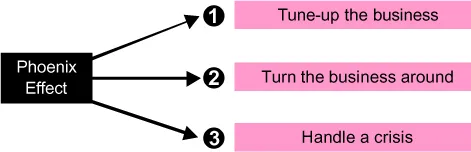
Generally speaking:
- A corporate tune-up will focus on strategic solutions and revisions or upgrades of the company’s financial and operational policies.
- A turnaround will introduce dramatic financial and operational adjustments, usually accompanied by modifications in strategy as well.
- Crisis resolution usually demands immediate changes in financial policy and changes in operations (if time permits).
Before heading down the path of corporate renewal and revitalization, decide what the advantages will be at the end of the process. That will provide a sense of why the pain will be worth enduring along the way.
Key Thoughts
“The key insight of our profession is that companies are seldom what they think they are. The strong overlook their flaws; the weak overlook their possibilities. The abyss yawns for both, but it need not. By constantly examining real-time data, using our simple methodology, the leaders of both strong and weak companies can set realistic goals and achieve them year after year.”
– Carter Pate and Harlan Platt
Strategy #1: Decide on the firm’s optimum scope
Main Idea
Over time, many corporations lose focus. They start trying to run too many lines of business or operating in too many or too few locations. Thus, the first step in a Phoenix program is to get the scope of the business exactly right.
Supporting Ideas
The scope of an organization is its direction, range of ambitions, opportunities and markets. There are five external factors which will affect decisions about scope:
- Whether the economy is expanding or contracting.
- New developments in the competitive landscape.
- Social changes and changes in consumer buying habits.
- The availability of new technology.
- Government actions, regulations or law changes.
Once those factors are taken into account, a business leader can make one of three basic decisions about the scope of his or her organization:
- Enter a new business and broaden the scope. The potential advantages and pay-offs of broadening the scope of a company are:
- New revenue streams will be established, adding to profits.
- Gaps in your product range can be filled.
- You will discourage competitors from entering your field.
- Fixed costs can be spread across more products.
- The corporation’s brand and identity can be strengthened.
- Exit a business and narrow the scope. It will make good sense to narrow the scope of the business (by selling or liquidating existing assets or perhaps by completely exiting a line of business) when:
- There are insufficient resources to go around.
- The company lacks the know-how or experience required.
- It’s too difficult to manage and run far flung business units.
- There is insufficient management commitment.
- Maintain the enterprise’s current scope. Many companies forgo expansion opportunities and focus instead on becoming exceptionally good (hopefully world-class) at what they already do. For these organizations, their focus is on becoming better, not necessarily bigger.
Key Thoughts
“Among your most important business decisions is what scope is best for your organization. Once you settle that, execute that decision and do so quickly. Don’t let your present scope determine the size of your...
Table of contents
- Book Presentation: The Phoenix Effect by Carter Pate and Harlan Platt
Trusted by 375,005 students
Access to over 1.5 million titles for a fair monthly price.
Study more efficiently using our study tools.
Frequently asked questions
Yes, you can cancel anytime from the Subscription tab in your account settings on the Perlego website. Your subscription will stay active until the end of your current billing period. Learn how to cancel your subscription
No, books cannot be downloaded as external files, such as PDFs, for use outside of Perlego. However, you can download books within the Perlego app for offline reading on mobile or tablet. Learn how to download books offline
We are an online textbook subscription service, where you can get access to an entire online library for less than the price of a single book per month. With over 1.5 million books across 990+ topics, we’ve got you covered! Learn about our mission
Look out for the read-aloud symbol on your next book to see if you can listen to it. The read-aloud tool reads text aloud for you, highlighting the text as it is being read. You can pause it, speed it up and slow it down. Learn more about Read Aloud
Yes! You can use the Perlego app on both iOS and Android devices to read anytime, anywhere — even offline. Perfect for commutes or when you’re on the go.
Please note we cannot support devices running on iOS 13 and Android 7 or earlier. Learn more about using the app
Please note we cannot support devices running on iOS 13 and Android 7 or earlier. Learn more about using the app
Yes, you can access Summary: The Phoenix Effect by BusinessNews Publishing in PDF and/or ePUB format, as well as other popular books in Business & Business Strategy. We have over 1.5 million books available in our catalogue for you to explore.