eBook - ePub
Dietary Guidelines for Americans 2015-2020
- 146 pages
- English
- ePUB (mobile friendly)
- Available on iOS & Android
eBook - ePub
Dietary Guidelines for Americans 2015-2020
About this book
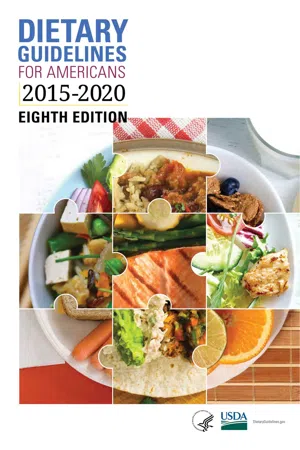
Dietary Guidelines for Americans 2015-2020 provides the government's must up-to-date information on diet and health in order to help all children and their families consume a healthy, nutritionally adequate diet.
Previous editions of the Dietary Guidelines
- focused primarily on individual dietary components of the food pyramid, such as dairy, meats, fruits, and vegetables. However, a growing body of new research has examined the relationship between overall eating patterns, health, and risk of chronic disease, and findings on these relationships are sufficiently well established to support dietary guidance. As a result, eating patterns and their food and nutrient characteristics are a focus of the recommendations in the
- 2015-2020 Dietary Guidelines
- . This edition provides guidelines for the seven million Americans who follow vegetarian dietsāa number that has tripled in the last ten years. The information in the
- Dietary Guidelines
- is used in developing Federal food, nutrition, and health policies, educational materials, and programs. These guidelines are a necessary reference for policymakers and nutrition and health professionals, and a great resource for parents who strive to create a healthy lifestyle for their families. Additional audiences who may use
- Dietary Guidelines
- information to develop programs, policies, and communication for the general public include businesses, schools, community groups, media, the food industry, and State and local governments.
Frequently asked questions
Yes, you can cancel anytime from the Subscription tab in your account settings on the Perlego website. Your subscription will stay active until the end of your current billing period. Learn how to cancel your subscription.
No, books cannot be downloaded as external files, such as PDFs, for use outside of Perlego. However, you can download books within the Perlego app for offline reading on mobile or tablet. Learn more here.
Perlego offers two plans: Essential and Complete
- Essential is ideal for learners and professionals who enjoy exploring a wide range of subjects. Access the Essential Library with 800,000+ trusted titles and best-sellers across business, personal growth, and the humanities. Includes unlimited reading time and Standard Read Aloud voice.
- Complete: Perfect for advanced learners and researchers needing full, unrestricted access. Unlock 1.4M+ books across hundreds of subjects, including academic and specialized titles. The Complete Plan also includes advanced features like Premium Read Aloud and Research Assistant.
We are an online textbook subscription service, where you can get access to an entire online library for less than the price of a single book per month. With over 1 million books across 1000+ topics, weāve got you covered! Learn more here.
Look out for the read-aloud symbol on your next book to see if you can listen to it. The read-aloud tool reads text aloud for you, highlighting the text as it is being read. You can pause it, speed it up and slow it down. Learn more here.
Yes! You can use the Perlego app on both iOS or Android devices to read anytime, anywhere ā even offline. Perfect for commutes or when youāre on the go.
Please note we cannot support devices running on iOS 13 and Android 7 or earlier. Learn more about using the app.
Yes, you can access Dietary Guidelines for Americans 2015-2020 by Department of Health and Human Services, U.S. Department of Agriculture in PDF and/or ePUB format, as well as other popular books in Medicine & Nutrition, Dietics & Bariatrics. We have over one million books available in our catalogue for you to explore.
Information
CHAPTER 1 | Key Elements of Healthy Eating Patterns |

Introduction
Over the course of any given day, week, or year, individuals consume foods and beverages[1] in combinationāan eating pattern. An eating pattern is more than the sum of its parts; it represents the totality of what individuals habitually eat and drink, and these dietary components act synergistically in relation to health. As a result, the eating pattern may be more predictive of overall health status and disease risk than individual foods or nutrients. Thus, eating patterns, and their food and nutrient components, are at the core of the 2015-2020 Dietary Guidelines for Americans. The goal of the Dietary Guidelines is for individuals throughout all stages of the lifespan to have eating patterns that promote overall health and help prevent chronic disease.
About This Chapter
This chapter defines the core concepts of healthy eating and physical activity patterns and focuses on the first three Guidelines:
1. Follow a healthy eating pattern across the lifespan. All food and beverage choices matter. Choose a healthy eating pattern at an appropriate calorie level to help achieve and maintain a healthy body weight, support nutrient adequacy, and reduce the risk of chronic disease.
2. Focus on variety, nutrient density, and amount. To meet nutrient needs within calorie limits, choose a variety of nutrient-dense foods across and within all food groups in recommended amounts.
3. Limit calories from added sugars and saturated fats and reduce sodium intake. Consume an eating pattern low in added sugars, saturated fats, and sodium. Cut back on foods and beverages higher in these components to amounts that fit within healthy eating patterns.
4. Shift to healthier food and beverage choices. Choose nutrient-dense foods and beverages across and within all food groups in place of less healthy choices. Consider cultural and personal preferences to make these shifts easier to accomplish and maintain.
5. Support healthy eating patterns for all. Everyone has a role in helping to create and support healthy eating patterns in multiple settings nationwide, from home to school to work to communities.
The chapter first presents Key Recommendations, which describe the elements of a healthy eating pattern and provide detail on how individuals can follow the Guidelines, followed by a description of the science supporting healthy eating patterns. Then, the Healthy U.S.-Style Eating Pattern at the 2,000-calorie level is provided as an example. A Closer Look Inside a Healthy Eating Pattern provides details on each of the food groups and other dietary components of public health importance in the United States. In addition, the chapter provides two variations of the Healthy U.S.-Style Eating Pattern as examples of additional healthy eating patternsāthe Healthy Mediterranean-Style Eating Pattern and the Healthy Vegetarian Eating Pattern. Both of these patterns align with the Guidelines. Finally, this chapter provides an overview of healthy physical activity patterns.

Key Recommendations: Components of Healthy Eating Patterns
The Dietary Guidelinesā Key Recommendations for healthy eating patterns should be applied in their entirety, given the interconnected relationship that each dietary component can have with others. As illustrated later in this chapter, there is more than one way to put these Key Recommendations into action; this is exemplified by the three eating patterns that translate and integrate the Key Recommendations into an overall healthy way to eat.

Consume a healthy eating pattern that accounts for all foods and beverages within an appropriate calorie level.
A healthy eating pattern includes:[2]
⢠A variety of vegetables from all of the subgroupsādark green, red and orange, legumes (beans and peas), starchy, and other
⢠Fruits, especially whole fruits
⢠Grains, at least half of which are whole grains
⢠Fat-free or low-fat dairy, including milk, yogurt, cheese, and/or fortified soy beverages
⢠A variety of protein foods, including seafood, lean meats and poultry, eggs, legumes (beans and peas), and nuts, seeds, and soy products
⢠Oils
A healthy eating pattern limits:
⢠Saturated fats and trans fats, added sugars, and sodium
Key Recommendations that are quantitative are provided for several components of the diet that should be limited. These components are of particular public health concern in the United States, and the specified limits can help individuals achieve healthy eating patterns within calorie limits:
⢠Consume less than 10 percent of calories per day from added sugars[3]
⢠Consume less than 10 percent of calories per day from saturated fats[4]
⢠Consume less than 2,300 milligrams (mg) per day of sodium[5]
⢠If alcohol is consumed, it should be consumed in moderationāup to one drink per day for women and up to two drinks per day for menāand only by adults of legal drinking age.[6]
Healthy Eating Patterns: Dietary Principles
Healthy eating patterns support a healthy body weight and can help prevent and reduce the risk of chronic disease throughout periods of growth, development, and aging as well as during pregnancy. The following principles apply to meeting the Key Recommendations:
An eating pattern represents the totality of all foods and beverages consumed. All foods consumed as part of a healthy eating pattern fit together like a puzzle to meet nutritional needs without exceeding limits, such as those for saturated fats, added sugars, sodium, and total calories. All forms of foods, including fresh, canned, dried, and frozen, can be included in healthy eating patterns.
Nutritional needs should be met primarily from foods. Individuals should aim to meet their nutrient needs through healthy eating patterns that include nutrient-dense foods. Foods in nutrient-dense forms contain essential vitamins and minerals and also dietary fiber and other naturally occurring substances that may have positive health effects. In some cases, fortified foods and dietary supplements may be useful in providing one or more nutrients that otherwise may be consumed in less than recommended amounts (see Chapter 2. Shifts Needed To Align With Healthy Eating Patterns).
Healthy eating patterns are adaptable. Individuals have more than one way to achieve a healthy eating pattern. Any eating pattern can be tailored to the individualās socio-cultural and personal preferences.
Healthy Physical Activity Patterns

Meet the Physical Activity Guidelines for Americans
In addition to consuming a healthy eating pattern, individuals in the United States should meet the Physical Activity Guidelines for Americans.[7] Regular physical activity is one of the most important things individuals can do to improve their health. The Physical Activity Guidelines, released by the U.S. Department of Health and Human Services, provides a comprehensive set of recommendations for Americans on the amounts and types of physical activity needed each day (see Appendix 1. Physical Activity Guidelines for Americans). Adults need at least 150 minutes of moderate intensity physical activity and should perform muscle-strengthening exercises on 2 or more days each week. Youth ages 6 to 17 years need at least 60 minutes of physical activity per day, including aerobic, muscle-strengthening, and bone-strengthening activities. Establishing and maintaining a regular physical activity pattern can provide many health benefits. Strong evidence shows that regular physical activity helps people maintain a healthy weight, prevent excessive weight gain, and lose weight when combined with a healthy eating pattern lower in calories. Strong evidence also demonstrates that regular physical activity lowers the risk of early death, coronary heart disease, stroke, high blood pressure, adverse blood lipid profile, type 2 diabetes, breast and colon cancer, and metabolic syndrome; it also reduces depression and prevents falls. People can engage in regular physical activity in a variety of ways throughout the day and by choosing activities they enjoy. The Physical Activity Guidelines provides additional details on the benefits of physical activity and strategies to incorporate regular physical activity into a healthy lifestyle.
The Science Behind Healthy Eating Patterns
The components of healthy eating patterns recommended in this edition of the Dietary Guidelines were developed by integrating findings from systematic reviews of scientific research, food pattern modeling, and analyses of current intake of the U.S. population:
⢠Systematic reviews of scientific research examine relationships between the overall diet, including its constituent foods, beverages, and nutrients, and health outcomes.
⢠Food pattern modeling assesses how well various combinations and amounts of foods from all food groups would result in healthy eating patterns that meet nutrient needs and accommodate limits, such as those for saturated fats, added sugars, and sodium.
⢠Analyses of current intakes identify areas of potential public health concern.
Together, these complementary approaches provide a robust evidence base for healthy eating patterns that both reduce risk of diet-related chronic disease and ensure nutrient adequacy.
Scientific evidence supporting dietary guidance has grown and evolved over the decades. Previous editions of the Dietary Guidelines relied on the evidence of relationships between individual nutrients, foods, and food groups and health outcomes. Although this evidence base continues to be substantial, foods are not consumed in isolation, but rather in various combinations over timeāan āeating pattern.ā As previously noted, dietary components of an eating pattern can have interactive, synergistic, and potentially cumulative relationships, such that the eating pattern may be more predictive of overall health status and disease risk than individual foods or nutrients. However, each identified component of an eating pattern does not necessarily have the same independent relationship to health outcomes as the total eating pattern, and each identified component may not equally contribute (or may be a marker for other factors) to the associated health outcome. An evidence base is now available that evaluates overall eating patterns and various health outcomes.
Associations Between Eating Patterns & Health
Evidence shows that healthy eating patterns, as outlined in the Guidelines and Key Recommendations, are associated with positive health outcomes. The evidence base for associations between eating patterns and specific health outcomes continues to grow. Strong evidence shows that healthy eating patterns are associated with a reduced risk of cardiovascular disease (CVD). Moderate evidence indicates that healthy eating patterns also are associated with a reduced risk of type 2 diabetes, certain types of cancers (such as colorectal and postmenopausal breast canc...
Table of contents
- Cover
- Title Page
- Copyright
- Table of Contents
- Message From the Secretaries
- Acknowledgments
- Executive Summary
- Introduction
- Chapter 1. Key Elements of Healthy Eating Patterns
- Chapter 2. Shifts Needed To Align With Healthy Eating Patterns
- Chapter 3. Everyone Has a Role in Supporting Healthy Eating Patterns
- Appendixes