Troll Nation
eBook - ePub

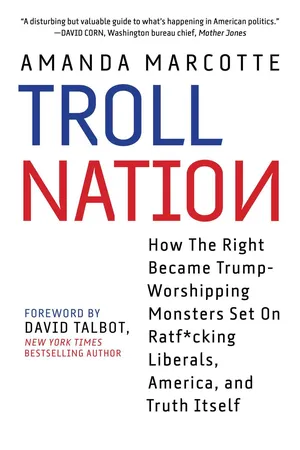
Troll Nation

How The Right Became Trump-Worshipping Monsters Set On Rat-F*cking Liberals, America, and Truth Itself

  1. 216 pages
  2. English
  3. ePUB (mobile friendly)
  4. Available on iOS & Android
eBook - ePub

Troll Nation

How The Right Became Trump-Worshipping Monsters Set On Rat-F*cking Liberals, America, and Truth Itself

About this book

"Amanda Marcotte drains the swamp and reveals a Republican Party hijacked by grifters and frauds."?David DaleyThe election of Donald Trump in 2016, like most of his campaign, came as a shock to many Americans. How could a man so lacking in capacity, so void of any intellectual heft, become the president of the United States? How did Trump, a man with no detectable personal qualities outside of resentment and the will to dominate, appeal to millions of Americans and win the highest office in the land? The American right has spent decades turning away from reasoned discourse toward a rhetoric of pure resentment—it's this shift that laid the groundwork for Trump's ascendency. In Troll Nation, journalist Amanda Marcotte outlines how Trump was the inevitable result of American conservatism's degradation into an ideology of blind resentment. For years now, the purpose of right wing media, particularly Fox News, has not been to argue for traditional conservative ideals, such as small government or even family values, so much as to stoke bitterness and paranoia in its audience. Traditionalist white people have lost control over the culture, and they know it, and the only option they feel they have left is to rage at a broad swath of supposed enemies? journalists, activists, feminists, city dwellers, college professors? that they blame for stealing "their" country from them. Conservative pundits, politicians, and activists have abandoned any hope of winning the argument through reasoned discourse, and instead have adopted a series of bad faith claims, conspiracy theories, and culture war hysterics. Decades of these antics created a conservative voting base that was ready to elect a mindless bully like Donald Trump.
Frequently asked questions

Yes, you can cancel anytime from the Subscription tab in your account settings on the Perlego website. Your subscription will stay active until the end of your current billing period. Learn how to cancel your subscription.
No, books cannot be downloaded as external files, such as PDFs, for use outside of Perlego. However, you can download books within the Perlego app for offline reading on mobile or tablet. Learn more here.
Perlego offers two plans: Essential and Complete
  • Essential is ideal for learners and professionals who enjoy exploring a wide range of subjects. Access the Essential Library with 800,000+ trusted titles and best-sellers across business, personal growth, and the humanities. Includes unlimited reading time and Standard Read Aloud voice.
  • Complete: Perfect for advanced learners and researchers needing full, unrestricted access. Unlock 1.4M+ books across hundreds of subjects, including academic and specialized titles. The Complete Plan also includes advanced features like Premium Read Aloud and Research Assistant.
Both plans are available with monthly, semester, or annual billing cycles.
We are an online textbook subscription service, where you can get access to an entire online library for less than the price of a single book per month. With over 1 million books across 1000+ topics, we’ve got you covered! Learn more here.
Look out for the read-aloud symbol on your next book to see if you can listen to it. The read-aloud tool reads text aloud for you, highlighting the text as it is being read. You can pause it, speed it up and slow it down. Learn more here.
Yes! You can use the Perlego app on both iOS or Android devices to read anytime, anywhere — even offline. Perfect for commutes or when you’re on the go.
Please note we cannot support devices running on iOS 13 and Android 7 or earlier. Learn more about using the app.
Yes, you can access Troll Nation by Amanda Marcotte in PDF and/or ePUB format, as well as other popular books in Politics & International Relations & American Government. We have over one million books available in our catalogue for you to explore.
Chapter 1
Political Correctness
Almost no other concept has been as great a gift to the American right as the myth of “political correctness,” this widespread contention in right wing circles that a censorious left has somehow disallowed conservatives nationwide to enjoy their First Amendment–guaranteed right to be an asshole. This belief, that right wing mouths have all been sewn shut by a Stalinist left, played an enormous role in the election of Trump.
“I am so tired of this politically correct crap,” Politico reported Trump saying to the biggest cheers of the night at a South Carolina rally during the campaign.
“They have put political correctness above common sense, above your safety, and above all else,” he said in a speech in June 2016.
“I think the big problem this country has is being politically correct. I’ve been challenged by so many people and I don’t, frankly, have time for total political correctness,” Trump said during a Republican debate.
There are many other examples, but I’ll end on that one, because it encapsulates the rhetorical sleight-of-hand so many on the right use to establish the myth of “political correctness.” They conflate being challenged with being censored.
It’s an argument that really should be self-refuting. If the conservative right to free speech depends on not being challenged, then, by logic, it requires ending the liberal right to free speech. After all, what are liberals doing when they challenge Trump, if not using their free speech to counter his?
Even setting aside the legal definition of free speech, the problem with the term “political correctness” is, in itself, a form of political correctness. What is political correctness, if not the use of shame and social repercussions to discourage certain forms of expression? But labeling someone “politically correct” is using shame and the threat social repercussions to discourage any expression the conservative deems overly progressive.
It’s a very snake-eating-its-tail problem, but the illogic doesn’t seem to register with the members of troll nation. As with most things in troll nation, the free speech posturing and claims to desire a rough-and-tumble public discourse are feints. The behavior of the right suggests that the real goal here is not free speech at all. If anything, it’s an effort to escape engaging in real discourse, which always brings with it the threat of proving the intellectual emptiness of so many right wing ideas.
There’s an evil genius to conservatives painting themselves as champions of free speech chafing against the censorious forces of political correctness. As long as people are arguing about free speech and whether or not it’s being taken from the right, they aren’t actually arguing about the ideas that conservatives are touting. The “political correctness” gambit allows right wingers to imply their ideas are just so scintillating that the scared lefties have to censor them, without ever having to prove the validity of those ideas. It’s a damn good way to make bad ideas seem rebellious and compelling.
Nowhere has this become more obvious than in the growing community of overt white supremacists, angry “men’s rights activists,” would-be brownshirts and other assorted jackasses that Hillary Clinton memorably labeled the “deplorables” that have been empowered by Trump’s campaign and election.
Spend five minutes reading some alt-right blogger expounding on the supposed threats to “Western civilization” or how men are the gender that’s really oppressed or, god forbid, how the popularity of rap music is leading to “white genocide,” and it quickly becomes apparent how, just on the basis of their arguments alone, they aren’t going to make inroads with the public at large. And the alt-right knows this, which is why their public-facing events have been packaged not as showcases for their rancid political beliefs, but as “free speech” rallies.
Instead of trying to defend their actual arguments, the alt-right prefers to be seen defending their right to make those arguments. That very few people are actually trying to shut them down hardly seems to matter. If they can’t get actual leftists with actual power, they will pull stunts to create the illusion of censorship where none exists.
This was how the violence in Charlottesville, Virginia—which ended in the murder of a woman named Heather Heyer when a white supremacist plowed his car into a crowd of progressive demonstraters—began.
A group of white supremacists and other fringe right figures descended on the city for a two-day protest, claiming, as they always do, that they are the victims of leftist oppression. In this case, the complaint was over efforts to tear down statues honoring Confederate leaders, including the one of Robert E. Lee in Charlottesville. Fringe right figures love Confederate statues, because, obviously, these statues are tributes to white supremacy. It’s not just that the men depicted literally committed treason to defend slavery, though that certainly should be reason enough to tear the statues down. The statues were largely built expressly as a way to assert white supremacy.
As many historians repeatedly pointed out, most Confederate statues were built during times of heightened racial tensions—usually when black Americans were pushing for more rights or gaining economically, and getting lynched or terrorized in return. Most were built in the early 20th century, when the KKK was reforming and lynchings were on the rise, and there was another spate of statue-building in response to the civil rights movement of the ’50s and ’60s.
The Robert E. Lee statue in Charlottesville was built in 1924, at the edge of a prosperous black neighborhood, Vinegar Hill. It was less about memorializing anything special Lee had done, and more to send a threat to black residents who were seen as uppity for having economic success. Eventually, white Virginians made good on the implicit threat, and Vinegar Hill was razed and taken over.
It’s quite clear that the reason that the alt-right feels protective of these statues is they continue to admire and honor the values these statues stand for, which are white supremacy and the terrorizing of black people. But those are hard values to defend publicly, so instead, the right tries to make the discussion one of censorship and free speech, by accusing progressives of trying to hide history.
This is a nonsense argument, of course. Europeans, for instance, do a fine job of remembering the history of WWII without littering the landscape with statues portraying Hitler as a noble Christian warrior. But as a rhetorical tactic, it works fairly well. As long as they’re forcing an argument about speech and memory and censorship, the alt-right doesn’t have to defend what it is about slavery and white supremacy they find so honorable anyway.
The one problem, however, was that the protesters that showed up in Charlottesville did a piss-poor job of keeping up the pretense that this was an anti-censorship rally. The torch-wielding mob chanted racist slogans, waved Nazi flags, and made it quite clear what these folks are really about.
But even after the mask slipped that far, Trump clearly thought he could get away with rolling out the script about how it’s just a bunch of free speech activists sticking it to the politically correct.
“You had people in that group that were there to protest the taking down of, to them, a very, very important statue and the renaming of a park from Robert E. Lee to another name,” Trump whined during a post-Charlottesville press conference. “You’re changing history. You’re changing culture.”
Trump and the alt-right organizers’ attempt to establish a narrative where oppressed white supremacists are enduring censorship at the hands of leftists failed him that time, due to the murder and the general inability of the alt-right crowds to keep a lid on their enthusiasm for fascism that day. But the strategy of framing their issue in terms of “free speech” and opposition to “political correctness”—instead of as simply naked enthusiasm for racism and misogyny—has made more headway elsewhere.
The strategy, in Charlottesville and elsewhere, has been simple: Hold alt-right rallies in liberal-leaning cities with large college populations, pretending that the rallies are in the name of “free speech,” but which are in fact an attempt to recruit more people to a toxic ideology built around bigotry and fascist sympathies. Act in incredibly provocative ways, including starting fights, and then pose as victims of violent leftist thugs who use their fists in the name of censorship. Ideally, they also get universities or the city police departments to shut it all down, so they can then claim they are victims of liberal censorship.
It’s a disturbingly effective strategy because, to be blunt, there are a small minority on the left who are willing to play their assigned roles in this little bit of fascist drama, as the censors and the violent thugs. Antifas, the name for a loose coalition of anti-fascist activists who believe in direct action like outing fascists and confronting them on the street, have been known to get into fistfights with the “deplorables.” This is especially true in college towns, where there are a lot more young, idealistic people ready to do this sort of thing. And there are a number of people on the left who demand that universities shut down right wing speakers.
I fully confess that I belonged, to a degree, to that latter group. Not all right wing speakers on campus could legally be shut down, or should be, but it did seem reasonable to me to point out that “free speech” doesn’t guarantee one a stipend or a speaking engagement at a prestigious university. Most of us don’t get those things, and no one is taking our free speech, after all.
But I’ve come around to the view that the right benefits far more than the left when some right wing speaker is denied a speaking opportunity, even in the case where these speakers are touting racist or misogynist views. It’s arguable that the only real reason conservative student groups bring speakers like Charles Murray, Ann Coulter, or Ben Shapiro to campus is to troll the left. Even conservatives aren’t really that interested in these people’s views. Their value exists only as objects of left wing ire.
Not to say that people shouldn’t counter-protest or speak out. These folks have dreadful views, which should occasion resistance, and ideally mockery. By all means, people should turn out and raise awareness about their terrible views, and argue and debate those that have such terrible views. What they shouldn’t do, however, is try to censor, much less resist, with violence.
In other words, the left should deny the alt-right what they want, which is to play the victim of the censorious left. Instead, the left should give them what they don’t want, which is an actual discussion and debate about alt-right views, a debate the right knows they cannot win.
The propaganda value of playing the victim of the censorious left was most cleanly illustrated by the saga of (who else?) Milo Yiannopoulos and the University of California at Berkeley, a school whose reputation for left wing politics has made it an object of fascination and hatred for the American right—especially now that trolling and nihilism have become the dominant features of the right under Trump.
Milo’s built most of his fan base by appealing to very young men—think high school and college age—who frequently mistake the bumps and bruises of adolescence for persecution. It’s not hard to understand why pimply-faced awkward teenagers would rather hear that feminism is to blame for their dating woes than their own inexperience. It’s easy to see how normal adolescent insecurity, when confronted by young, empowered women who are speaking their minds and hustling for good grades and good jobs, could feel alienating. They don’t know that those young women also have fears, failures, and face dating rejection. All they see is “girl power” and they get mad.
Milo’s bullying persona makes his young male fans seem powerful, and his sexual orientation makes them feel hip—they’re not like those homophobic, sex-hating conservatives of old. They’re practically liberals, right? They just think feminists and progressives have taken it too far and need punishment.
All of which means that Yiannopoulos has created for himself a robust college circuit speaking career. The appeal of bringing Milo to your campus lies not in anything he has to say, which is mostly a bunch of reactionary vitriol that Rush Limbaugh perfected decades earlier, but in the way he really angers those campus liberals. He draws out protesters and angry comments online and allows his fans to believe that they have somehow gotten the upper hand on those earnest young liberals and feminists.
It’s a phenomenon that would cause sympathetic embarrassment for these young fools, if they weren’t being so awful. These young alt-righters have universally confused getting a rise with taking the piss out of someone, and don’t seem to understand how badly they’ve missed the mark.
Due to the alt-right strategy of going to liberal college towns in hopes of maximum provocation, Yiannopoulos had scheduled his Inauguration Day talk at the University of Washington in Seattle. Tensions were high, due to the national trauma—or sadistic glee, if you’re alt-right—of watching Trump sworn in as president. The scene outside of Kane Hall got violent as pro-Trump forces and leftists clashed. In the melee, a woman named Elizabeth Hokoana, aided by her pepper spray–wielding husband, Marc Hokoana, shot a socialist protester named Joshua Dukes.
The Hokoanas claimed self-defense, but one witness—David Neiwert, a reporter for the Southern Poverty Law Center, who was at the protest as a journalist—told me that Dukes had been trying to use his large frame to break up fights, not engage them. The Seattle prosecutors agree, citing social media posts made by Marc Hokoana about how he couldn’t wait to “start cracking skulls.”
The College Republicans hosted the event. “The point, club members say, was to promote free speech,” the Seattle Times reported.
Once again, “free speech” and “political correctness” create excellent distractions to avoid talking about the actual content of the speech in question. Reports indicate that the speech inside was rambling, but was heavily focused on calling progressive protesters “fat dykes” and arguing “girls are retards.”
After that near-killing, the University of California at Berkeley decided to cancel Yiannopoulos’s scheduled appearance in February. The school could not have given Yiannopoulos, who had generally been treated like an unfortunate fart by more mainstream right wing publications and venues, a bigger gift. Fox News gave him glowing coverage. The Conservative Political Action Conference booked him next to their usual crew of gay-bashers and abortion obsessives. Bill Maher brought him onto his HBO show. Even mainstream liberal publications ran chin-scratching articles about the value of free speech, largely ignoring the context that suggested they were being taken in by right wing propaganda.
All that immediately came crashing down, as recounted in this book’s introduction, when a video surfaced of him speaking favorably of grown men having sex with young teenage boys. Conservatives were ready to declare themselves fans of the rough-and-tumble, anything-goes world of political rhetoric when minorities and women were the targets—but nasty words towards boys was another story altogether.
Still, Yiannopoulos believed, for good reason, that a white man is never down for long in American society. He managed to get millions of dollars from secret investors (reportedly the billionaire Mercer family, according to Buzzfeed) and got back to his job of trolling college campuses. Berkeley, where the bona fide free speech movement began in the ’60s, was the golden goose.
Milo announced in August of 2016 that, the very next month, there would be a four-day, conservative celebrity-studded extravaganza at Berkeley called “Free Speech Week.” Mysteriously, it was being hosted by a tiny—with no more than 5 or 10 members—student group called the Berkeley Patriot that had no existence before July of that year and only started its web pages after the announcement of this suspiciously large event.
As I documented for an investigation at Salon, there was a significant amount of evidence that Yiannopoulos and his student group never intended to have this event. The students kept missing deadlines for registering event space, and when prodded by the school, they kept coming up with obtuse objections to signing the paperwork. There also seemed to be no interest in actually booking speakers. A dazzling (by right wing standards) list of speakers did get released, but many of them, including Charles Murray, told reporters they weren’t coming and others said they had never even been invited. A few who...

Table of contents

  1. Front Cover
  2. Title Page
  3. Copyright
  4. Contents
  5. Foreword
  6. Introduction
  7. CHAPTER 1: Political Correctness
  8. CHAPTER 2: Whose Political Correctness?
  9. CHAPTER 3: Women
  10. CHAPTER 4: The Environment
  11. CHAPTER 5: Health Care
  12. CHAPTER 6: Guns
  13. CHAPTER 7: Race
  14. CHAPTER 8: Conspiracy Theories
  15. CHAPTER 9: The Media
  16. CONCLUSION: Will There Be an End to the Trolling?