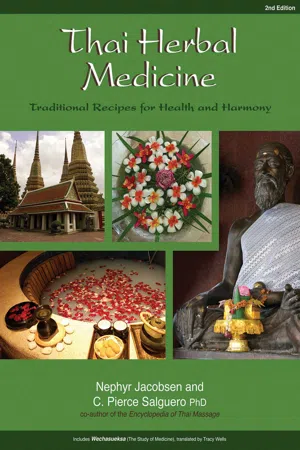
Thai Herbal Medicine
eBook - ePub

Thai Herbal Medicine

Traditional Recipes for Health and Harmony

  1. 160 pages
  2. English
  3. ePUB (mobile friendly)
  4. Available on iOS & Android
eBook - ePub

Thai Herbal Medicine

Traditional Recipes for Health and Harmony

About this book

Thai herbs are part of a vibrant culture of healing that has been practiced and preserved over the centuries in traditional medicine schools, Buddhist monasteries, and village homes all over Thailand. Many quite ancient herbal traditions continue to be practiced throughout Thailand to this day, and some of these have now been recognized by the Ministry of Public Health as an important facet of the country's national healthcare system. This revised and updated edition provides an overview of traditional Thai medicine--including both the theory and the practical application of Thai cuisine, bodywork, and herbal medicine. Of interest to herbalist, massage therapists, and practitioners of other alternative healthcare systems, the book introduces the basic principles of Thai herbal healing in simple and clear terms, and it includes a detailed compendium of individual herbs. Best of all, this book is fun, offering easy recipes for home remedies, healthcare products, and cuisine that will make the world of Thai tradition come alive in your home.

Frequently asked questions

Yes, you can cancel anytime from the Subscription tab in your account settings on the Perlego website. Your subscription will stay active until the end of your current billing period. Learn how to cancel your subscription.
No, books cannot be downloaded as external files, such as PDFs, for use outside of Perlego. However, you can download books within the Perlego app for offline reading on mobile or tablet. Learn more here.
Perlego offers two plans: Essential and Complete
  • Essential is ideal for learners and professionals who enjoy exploring a wide range of subjects. Access the Essential Library with 800,000+ trusted titles and best-sellers across business, personal growth, and the humanities. Includes unlimited reading time and Standard Read Aloud voice.
  • Complete: Perfect for advanced learners and researchers needing full, unrestricted access. Unlock 1.4M+ books across hundreds of subjects, including academic and specialized titles. The Complete Plan also includes advanced features like Premium Read Aloud and Research Assistant.
Both plans are available with monthly, semester, or annual billing cycles.
We are an online textbook subscription service, where you can get access to an entire online library for less than the price of a single book per month. With over 1 million books across 1000+ topics, we’ve got you covered! Learn more here.
Look out for the read-aloud symbol on your next book to see if you can listen to it. The read-aloud tool reads text aloud for you, highlighting the text as it is being read. You can pause it, speed it up and slow it down. Learn more here.
Yes! You can use the Perlego app on both iOS or Android devices to read anytime, anywhere — even offline. Perfect for commutes or when you’re on the go.
Please note we cannot support devices running on iOS 13 and Android 7 or earlier. Learn more about using the app.
Yes, you can access Thai Herbal Medicine by Nephyr Jacobsen,C. Pierce Salguero in PDF and/or ePUB format, as well as other popular books in Medicine & Alternative & Complementary Medicine. We have over one million books available in our catalogue for you to explore.

Information

CHAPTER 1
Introduction to Traditional Thai Medicine
History of Medicine in Thailand
Known as the Kingdom of Siam until 1939, and thereafter as the Kingdom of Thailand, for simplicity, in this book we refer to the region as “Thailand,” regardless of which era we are discussing. Although historical records of the practice of medicine in Thailand begin only in the Ayutthaya period (1351–1767), common belief says that traditional Thai medicine preserves knowledge that has been handed down orally for over two thousand years by lineages of teachers and students. The ancient history of Thai medicine remains beyond the ability of historians to reconstruct conclusively. However, it is likely that at least some of the herbal knowledge that is still practiced in Thailand today has indeed been in existence for millennia, given that people have inhabited Southeast Asia for an estimated 1–2 million years and that people have always reached out to the natural world to heal their ailments and improve their health.
Much speculation exists about the primary influencing factors in the historical development of Thai medicine, and we will discuss these below. However, it must be noted that, despite the influx of knowledge from multiple cultures, traditional medicine always develops in close relationship with the geographical region in which it is practiced. The reason for this is that climate, soil, water, flora, and fauna affect the nature of diseases and injuries existent in any given region, as well as the natural medicinal options available. Hence, regardless of the many cultural influences that have gone into the tradition, Thai medicine can be said to be a product of the geographical region currently known as Thailand.
Thailand is bordered to the west by Burma, which exposed the territory to many influences from the Mon culture; to the east by Cambodia, bringing Khmer influence; and to the north by Laos and China, allowing exchange of ideas with these groups as well. Mon and Khmer peoples inhabited the land that is now Thailand long before the arrival of the Tai/Dai peoples, the ethnic group that today makes up the majority population in Thailand. Influences from these neighboring peoples continue to be reflected in many aspects of Thai culture. They are the source of many of Thailand’s traditions of spirit-religion and folk belief, and, following the Indianization of Burma and Cambodia, the route by which Indian theories and beliefs entered Thailand as well. The modern nation of Thailand is also home to a wide range of people that have been given the umbrella term “Hill Tribes.” The Hill Tribes living in Thailand represent a variety of separate ethnic groups with ancestral homelands in Tibet, China, and all over Southeast Asia. The migrations of the Tai peoples into the area about AD 800−1000, primarily from southern China via northern Vietnam, marked the beginning of a change in the dominant ethnic demo-graphics. The Tais brought their own indigenous knowledge and beliefs into the mix of medical doctrines prevalent in the area.
Local legends attribute much of traditional Thai medicine to the ancient reusi (a Thai word derived from the Sanskrit ṛṣior rishi), who are revered ascetics and seers. Known to study the natural sciences, such as astronomy, mathematics, and medicine, the reusi are credited with introducing many traditional herbal formulas, as well as with creating a system of self-care known as reusi da ton. Reusi da ton includes meditation, self-massage, range-of-motion exercises for the joints, and yoga-like postures. It has aspects that are similar to Indian yoga, and is one of the ingredients in the genesis of Thai massage.
While the reusi are said to have contributed specific herbal lore, medical techniques, and bodywork, the primary figurehead in traditional Thai medicine is the Buddha. As Thailand is 95–98 percent Buddhist, a substantial portion of the population considers the Buddha to be the ultimate physician and Buddhism to be the ultimate source of healing. Another Buddhist figure that is important is Jīvaka Komārabacha (known colloquially as “Jīvaka,” “Shivago,” or “Mor Chewok” หมอชีวก). Jīvaka is a doctor whose story is recorded in the sacred Buddhist text called the Vinaya, which is written in the ancient Pāli language. In this text, he is said to have been the physician to the Buddha and the original order of monks, and he therefore holds a role of great prominence in Thailand. In the north of the country, he is commonly called the “Father Doctor” (pôrmŏr พ่อหมอ). Many Thais embellish the stories about Jīvaka from the Buddhist scripture, saying that he traveled to Thailand and directly contributed medical knowledge to the area’s healers. Today, medical practitioners in Thailand, from herbalists, dentists and midwives to biomedical surgeons, give homage to Doctor Jīvaka as a part of daily life. However, strictly speaking, there is no historical record of him traveling to Thailand, or even that he was a real person.
Aside from the legends of Jīvaka, many other Indian medical doctrines, stories, and lore arrived in Thailand in several waves throughout the first millennium AD. Thailand sits at the crossroads of an extensive trade network, and a constant flow of new information came into Thailand as Indian, Chinese, and Arab merchants plied their trade in the region. European explorers arrived as early as 1504. Thai medical traditions picked up something from each of these groups as they came through. With a length of 1,648 kilometers and a width of 780 kilometers, Thailand encompasses many different terrains, and different cultural groupings. At the bottom of the isthmus one finds Malay and Muslim people, while central Thailand has a strong Chinese population. In Northern Thailand, the “Lanna region” preserves many indigenous traditions of the Tai as well as Hill Tribe peoples.
As a result of this diverse mix of peoples and cultures, traditional Thai medicine varies significantly from practitioner to practitioner. Depending on heritage, training, and geographical location within Thailand, one person may incorporate more Chinese practices, another more Indian theory, and another more indigenous ideas. By about 1600, however, Thai temples and hospitals under royal patronage began codifying a system of medical theory and practice. What some scholars have called the “royal tradition” was based on the same ideas as the rural medical lore but became organized and systematized with an overlay of Ayurvedic and Western concepts. In 1836, King Rama III ordered an extensive renovation of the grounds of Wat Phra Chettuphon Wimon Mangklaram (commonly referred to as “Wat Pho” or “Wat Po”), which had been established as the royal temple in the new capital of Bangkok in the late 1700s. At that time, 60 inscribed stone tablets bearing Thai acupressure charts and 1,100 herbal recipes were placed in the walls of a temple to preserve medical knowledge for future generations. Over 80 statues depicting massage techniques and reusi da ton postures were erected throughout the grounds as well. These statues and stone tablets can still be seen by visitors to the temple today.
From 1895 to 1907, Wat Pho’s traditional medical school published several important herbal manuals to disseminate the information collected at the temple throughout Thailand. These represent the main sources of historical information about medical practice in Thailand and are often cited as the definitive word on traditional Thai medicine. But it is important to remember that the codification of medicine sponsored by kings and preserved at Wat Pho represents a relatively small sample of the vast scope of traditional medicine in Thailand. Tellingly, a small handful of older texts have been preserved from the Bangkok and Ayutthaya periods (one famous example is the medical manuscripts of King Narai), and these frequently have little to do with the medical systematization at Wat Pho. Traditional doctors throughout Thailand to this day still keep hand-written notes and manuscripts handed down through generations, but these are fiercely guarded and not likely to become publicly available any time soon. Thus, it is perhaps inevitable that the true history of medicine in Thailand will always be more diverse and complex than the existing written sources lead us to believe.
Traditional Medicine Today
Today, multiple systems of traditional medicine coexist in Thailand. Below, we have mentioned four major and widely recognized traditions:
TRADITIONAL THAI MEDICINE (TTM) (Pâet păen tai แพทย์แผนไทย)
The standardized system promoted by the Ministry of Public Health and taught in colleges all over Thailand. It is based on certain ancient texts, was first standardized during the reign of the Fifth King in the late 19th century, and has been modified as recently as the late 1990s. This system is primarily derived from royal traditions of medicine, with considerable Western influence.
TRADITIONAL MEDICINE OF THAILAND (Pâet păen boh-raan แพทย์แผนโบราณ)
Non-standardized practices that are based on ancient texts written in Thai and Khmer script from the 19th century and before. Methods vary from practitioner to practitioner, depending on which texts they follow. Mr păen boh-raan translates to “traditional doctor.”
LOCAL MEDICINE OR INDIGENOUS MEDICINE (Pâet péun bâan แพทย์พื้นบ้าน)
Local practices that vary from area to area and are based on local texts and teachings. Also known as “village medicine” (Mŏr péun bâan translates to “village doctor”).
LANNA MEDICINE (Pâet láan-naa แพทย์ล้านนา)
Peoples of northern Thailand consider themselves to be Lanna, culturally distinct from Thais in other parts of the country. Lanna medicine is based on northern texts written in the Lanna script, and is a particularly well preserved tradition of local medicine. Mŏr láan-naa translates to “Lanna doctor.” While in one sense, Lanna medicine is a specific local tradition of medicine, it is also an important source of knowledge for TTM. As Chiang Mai has emerged as an important center for health-related tourism in recent decades, Lanna medicine has been particularly influential in recent years, both among Western tourists and Thais themselves.
All of the above systems have mutually influenced one another, and they subsequently share many theories and practices. In practice, herbalists do not necessarily stick to only one category, but instead draw from multiple systems in their treatment of patients. While the compendium of herbs and formulas included in this book incorporates teachings from all four systems, the theoretical systems of Elements and Flavors introduced here are TTM.
There are five primary branches of TTM, with further specialization possible within each branch. The five primary branches are as follows (with an explanation of the literal meaning of the Thai name):
INTERNAL/HERBAL MEDICINE (Pâet-sàat แพทยศาสตร์)
Pâet = medicine, doctor, drugs
Sàat = knowledge, study, science
This branch includes the methods of using plants, animals, and minerals as medicine for both internal and external application, the use of food as medicine, dietary counseling, and the administration of medicine.
EXTERNAL THERAPIES OR ORTHOPEDIC MEDICINE (Gaai-yá-pâap bam-bàt กายภาพบำบัด)
Gaai-yá-pâap = body
Bam-bàt = therapy
This branch includes Thai massage. However, it is inclusive of many more therapies, including bone-setting, cupping, scraping, blood letting, point therapy, sên เส้น (channel) therapy, and much more.
DIVINATION OR ORACULAR SCIENCES (Hŏh-raa-sàat โหราศาสตร์)
Hŏh-raa = an astrological chart
Sàat = knowledge, study, science
This branch primarily uses Vedic astrology in order to ascertain a patient’s Elemental constitution, disease predisposition, current illnesses, planetary influence, and remedial measures for afflictions caused by the planets. Palm reading, numerology, tarot, geomancy, and various other methods can also be employed in this branch of medicine.
SPIRIT MEDICINE (Săi-yá-sàat ไสยศาสตร์)
Săi-yá = magic
Sàat = knowledge, study, science
This branch of TTM involves demons, deities, and ghosts, and employs the use of invocations, mantras, amulets, and spiritual tattooing. A wide range of practices fall under this umbrella, which are often collectively referred to as “animism” or “shamanism.”
BUDDHISM (Pút-tá-sàat พุทธศาสตร์)
Pút-tá = the Thai pronunciation of the word Buddha
Sàat = knowledge, study, science
Buddhist wisdom, practices, and beliefs are central to virtually all forms of traditional medicine in Thailand, and can be seen even in the most secular institutions of TTM. Buddhism is thought of as a system to alleviate all suffering, but this branch of medicine might be thought of as traditional Thai psychology as it is used predominantly to promote mental health and treat mental disorders.
Note that while TTM is officially divided into these five branches, there is also one more, less frequently mentioned branch: midwifery (pà-dung kan ผดุงครรภ์). Most likely, this branch is often forgotten because it is highly specialized and only practiced by women.
Practitioners of TTM rarely practice all five branches, but rather specialize in one branch, or perhaps even one aspect of one branch. At the same time, they know enough about all of the other branches to augmen...

Table of contents

  1. Cover
  2. Half Title
  3. Title Page
  4. Contents
  5. Preface by C. Pierce Salguero
  6. Preface by Nephyr Jacobsen
  7. How To Use This Book
  8. 1. Introduction to Traditional Thai Medicine
  9. 2. Thai Herbal Theory
  10. 3. Everyday Herbs
  11. 4. Herbs in Traditional Thai Bodywork and Sauna
  12. 5. Internal Thai Herbal Medicine Therapies
  13. 6. A Compendium of Traditional Thai Herbal Medicine
  14. Appendix