Aromatherapy Workbook
eBook - ePub

Aromatherapy Workbook

  1. 192 pages
  2. English
  3. ePUB (mobile friendly)
  4. Available on iOS & Android
eBook - ePub

Aromatherapy Workbook

About this book

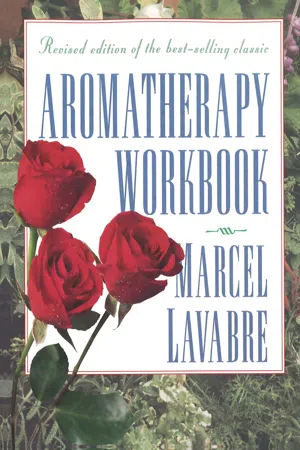
Aromatherapy Workbook, first published in 1990, is an essential guide to the history, folklore, science, and practice of aromatherapy. It features more than seventy essential oils classified by botanical family with detailed discussions of their specific actions, along with unique insights into their energetic and spiritual properties. This revised edition incorporates the latest biochemical research with the spiritual and psychological understanding of essential oils. Author Marcel Lavabre, a founder of the American Aromatherapy Association, explains the mysterious and powerful influence of scent on our mental state, emotion, and sexuality. He discusses the various methods of extraction, devotes a special section to the art of blending, and presents specific formulas for disorders such as digestive and circulatory ailments, headaches, insomnia, and menstrual problems. Aromatherapy Workbook is an ideal guide for beginners as well as a reference for practitioners. • More than 90, 000 copies sold. • Easy-to-follow illustrated reference for beginners. • A desk resource and teaching tool for practicing aromatherapists.
Frequently asked questions

Yes, you can cancel anytime from the Subscription tab in your account settings on the Perlego website. Your subscription will stay active until the end of your current billing period. Learn how to cancel your subscription.
No, books cannot be downloaded as external files, such as PDFs, for use outside of Perlego. However, you can download books within the Perlego app for offline reading on mobile or tablet. Learn more here.
Perlego offers two plans: Essential and Complete
  • Essential is ideal for learners and professionals who enjoy exploring a wide range of subjects. Access the Essential Library with 800,000+ trusted titles and best-sellers across business, personal growth, and the humanities. Includes unlimited reading time and Standard Read Aloud voice.
  • Complete: Perfect for advanced learners and researchers needing full, unrestricted access. Unlock 1.4M+ books across hundreds of subjects, including academic and specialized titles. The Complete Plan also includes advanced features like Premium Read Aloud and Research Assistant.
Both plans are available with monthly, semester, or annual billing cycles.
We are an online textbook subscription service, where you can get access to an entire online library for less than the price of a single book per month. With over 1 million books across 1000+ topics, we’ve got you covered! Learn more here.
Look out for the read-aloud symbol on your next book to see if you can listen to it. The read-aloud tool reads text aloud for you, highlighting the text as it is being read. You can pause it, speed it up and slow it down. Learn more here.
Yes! You can use the Perlego app on both iOS or Android devices to read anytime, anywhere — even offline. Perfect for commutes or when you’re on the go.
Please note we cannot support devices running on iOS 13 and Android 7 or earlier. Learn more about using the app.
Yes, you can access Aromatherapy Workbook by Marcel Lavabre in PDF and/or ePUB format, as well as other popular books in Medicine & Alternative & Complementary Medicine. We have over one million books available in our catalogue for you to explore.
ONE
image
Aromatics and Perfumes in History
image
Since the earliest ages of humanity, aromatic fumigations have been used in daily rituals and during religious ceremonies as an expression and a reminder of an all-pervasive sacredness. Fragrance has been seen as a manifestation of divinity on the earth, a connection between human beings and the gods, medium and mediator, emanation of matter and manifestation of spirit.
In a sense, the origins of aromatherapy can be traced back to the origins of humanity. Some anthropologists believe that the appearance of some form of rituals is the defining moment in the emergence of human culture. Since their origins, rituals have always involved fumigations and the burning of aromatic herbs and woods. Rituals were used mostly in healing ceremonies. What a great intuition! By burning aromatic substances, fumigations diffuse essential oils, which have an antiseptic effect, into the air, bringing about physical healing. At the same time, the fragrance acts on a subtle level for psychic and spiritual healing.
AROMATIC MEDICINE IN EGYPT
The origin of aromatherapy is usually attributed to Ancient Egypt and India. I would date it back to the fabulous and mysterious Kingdom of Sheba, located in the part of the world now called Ethiopia. Ethiopia is considered the cradle of humanity, where the most ancient remains of our distant ancestors have been found.
The Kingdom of Sheba, the “land of milk and honey,” was a very prosperous country of the high antiquity. In particular, it controlled the production of the very precious frankincense and myrrh and the trade in spices coming by caravan from India and then by boat through the Red Sea. Sheba is the land from where the three magi came to greet the infant Christ with gifts of gold, frankincense, and myrrh, the three most precious substances of the time.
There is also the fabulous story of the Queen of Sheba. While the Kingdom of Sheba controlled the trade in frankincense and myrrh, the Queen of Sheba was doing a very hefty business with a tiny kingdom called Israel. Located at the outskirts of the known world, Israel was ruled by a king by the name of Solomon, whose fame had reached all the way to Sheba. The Queen was known to be immensely rich and Solomon had promised his God Yahweh to build a temple the like of which had never been seen on the face of the earth. But the tiny kingdom was broke. Solomon sent emissaries to the Queen, trying to borrow some gold from her. The Queen was intrigued. She decided to undertake the perilous journey across the unforgiving desert to meet her client and potential debtor.
The Queen was young and courageous, and her beauty was stunning. Solomon fell desperately in love with her at first sight. Under the spell of the Queen's magnificent beauty, he neglected his wives and concubines, and even the governing of his kingdom. The Queen eventually decided to return to her kingdom, bearing Solomon’s child. Solomon never recovered from his lost love and tried to lose himself in debauchery. He also composed the very famous “Song of Songs,” one of the most beautiful love poems and erotic poems in human literature.
There is evidence that the Egyptians borrowed some of their religious and political system from the land of Sheba. In Egypt, medicine was inseparable from religion, and healing always took place in both body and mind. The use of perfumes and aromatics was originally a privilege of the Pharaohs and the high priests. The priests developed a very sophisticated pharmacy, using large quantities of aromatics, which were also used for the preparation and preservation of mummies. The Egyptians made extensive use of substances such as myrrh and frankincense, as well as rose and jasmine. These products were so precious that they were traded as currency.
The Egyptians are considered the inventors of western medicine, pharmacy, and cosmetology. Parallel with the development of medicine and pharmacy, they also developed very refined techniques for skin care, creating beauty recipes that have endured to the present day. Aromatics were the major active ingredients in their skin care preparations. Cleopatra, of course, is legendary for her use of cosmetic preparations and perfumes to enhance her beauty and her powers of seduction. When she sailed to greet the Roman Emperor Marc Anthony, the sails of her ship were soaked in jasmine, one of the most aphrodisiac fragrances. Marc Anthony fell so deeply in love with Cleopatra that he gave up his empire to follow her.
Aromatic medicine emerged from the shade of smoky temples in Egypt—the birthplace of medicine, perfumery, and pharmacy—more than six thousand years ago. The precious substances came from all parts of the world, carried by caravan or by boat: cedar from Lebanon; roses from Syria; spikenard, myrrh, frankincense, labdanum, and cinnamon from Babylon, Ethiopia, Somalia, and even Persia and India.
The priest supervised the preparations in the temples, reading the formulas and chanting incantations, while the students mixed the ingredients. Pulverization, maceration, and other operations could continue for months until the right subtle fragrance was obtained for ceremonial use.
But spiritual matters were not the only concern of the Egyptians. They attached the greatest importance to health and hygiene and were thoroughly familiar with the effect of perfumes and aromatic substances on the body and the psyche. Many preparations were used for both their fragrant quality and their healing power. Kephi, for example, a perfume of universal fame, was an antiseptic, a balsamic, and a tranquilizer that could be taken internally.
The Egyptians also practiced the art of massage and were famous specialists in skin care and cosmetology. Their products were renowned all over the civilized world. The Phoenician merchants exported Egyptian unguents, scented oils, creams, and aromatic wines all over the Mediterranean world and the Arabic peninsula and thereby enhanced the fame and wealth of Egypt.
Embalming was one of the main uses of aromatics. Bodies were filled with perfumes, resins, and fragrant preparations after removal of the internal organs. So strong is the antiseptic power of essential oils that the tissues are still well preserved thousands of years later. In the seventeenth century, mummies were sold in Europe, and doctors distilled them and used them as ingredients in numerous medicines. The use of aromatics spread from Egypt to Israel, Greece, Rome, and the whole Mediterranean world. Every culture and civilization, from the most primitive to the most sophisticated, developed its own practice of perfumery and cosmetics.
India is probably the only place in the world where this tradition was never lost. With over ten thousand years of continuous practice, Ayurvedic medicine is the oldest continuous form of medical practice. The Vedas, the most sacred book of India and one of the oldest known books, mentions over seven hundred different products, such as cinnamon, spikenard, coriander, ginger, myrrh, and sandalwood. The Vedas codifies the uses of perfumes and aromatics for liturgical and therapeutic purpose.
DISTILLATION AND ALCHEMY
In Europe, the advent of Christianity and the fall of the Roman Empire marked the beginning of a long period of barbarism and a general decline of all knowledge. Revival came from the Arabic countries with the birth of Islam. Intellectual and cultural activity flourished, as did the arts. Arabic civilization attained an unequaled degree of refinement. The philosophers devoted themselves to the old hermetic art of alchemy, whose origin was attributed to the Egyptian god Tehuti. They renewed the use of aromatics in medicine and perfumery and perfected the techniques. The great philosopher Avicenna invented the refrigerated coil, a real breakthrough in the art of distillation.
Alchemy, which was probably introduced to Europe by the crusaders on their way back from the Holy Land, was primarily a spiritual quest, and the different operations performed by the adept were symbolic of the processes taking place within the alchemist. Distillation was the symbol of purification and the concentration of spiritual forces.
In the alchemist’s vision, everything, from sand and stones to plants and people, was made up of a physical body, a soul, and a spirit. In accordance with the basic principle solve and coagula (dissolve and coagulate), the art of spagyrie consisted of dissolving the physical body and condensing the soul and spirit, which had all the curative power, into the quintessences. The material was distilled over and over to remove all impurities, and the final products were highly potent medicines.
With the expansion of this mysterious art, more and more substances were treated for the extraction of essences. These quintessences were the basis of most medicines, and for centuries essential oils remained the only remedies for epidemic diseases.
THE RENAISSANCE, DECLINE, AND REBIRTH
During the Renaissance, the use of essential oils expanded into perfumery and cosmetics. With further progress in the arts of chemistry and distillation, the production of elixirs, balms, scented waters, fragrant oils, and unguents for medicine and skin care flourished. Nicholas Lemery, the personal physician of Louis XIV, described many such preparations in the Dictionnaire des drogues simples. Some have survived until now: Melissa water, Arquebuse water, and the famous Cologne water, for instance, are still produced.
The arrival of modern science in the nineteenth century marked the decline of all forms of herbal therapy. The early scientists had a simplistic and somewhat naive vision of the world. When the first alkaloids were discovered, scientists thought it better to keep only the main active principals of the plants and then reproduce them in laboratories. Thus they discovered and reproduced penicillin (from a natural mold growing on bread), aspirin (naturally present in birch, wintergreen, and meadowsweet), antibiotics, and so on.
Without denying the obvious value of many scientific discoveries, we must acknowledge that the narrow vision of the allopathic medical profession has led to some abuses. Microorganisms adapt to antibiotics much faster than does the human body, making antibiotics inefficient as well as dangerous to the body. Corticosteroids have dreadful side effects; hypnotics, antidepressants, and amphetamines are highly addictive; and so on.
THE BIRTH OF MODERN AROMATHERAPY: AROMATHERAPY IN FRANCE
Aromatherapy per se was formally developed in France in the late 1920s and grew into a mainstream movement in Europe. The term itself was coined by a French chemist by the name of René-Maurice Gattefosse. As the story goes, Mr. Gattefosse, who was a chemist working for the perfume industry, burned his hand in an explosion in his laboratory. A vat full of lavender oil was nearby, and he plunged his hand into it. The pain disappeared instantly, and he recovered so fast that he decided to investigate further the healing power of essential oils. Thus was born modern aromatherapy.
I personally experienced the quasi-miraculous effect of lavender oil on burns on several occasions. A few years ago, while cooking asparagus in a pressure cooker, I spilled more than half a gallon of boiling water on my feet and legs. I removed my socks promptly and applied lavender neat on the whole area and continued applying it every ten to fifteen minutes for a few hours. Not only did the pain disappear, but I never blistered or lost skin! Likewise, when my daughter was twelve years old, she fell asleep on the beach on a very hot summer day, with no prior tan to protect her. She had forgotten to use any sunscreen and the Southern California sun was implacable. She came home redder than a lobster. I instantly applied to her face and body an oil that contains lavender, marjoram, and neroli in a base of sweet almond, hazelnut, and vitamin E. I continued applying it every hour for the first evening and then twice a day for a few days. Again, my daughter didn’t blister or peel.
Back to the 1920s, the curative power of essential oils was well known at that time, and many essential oils belonged to the European pharmacopoeia (and still do), which means that they are classified as active medical ingredients.
The French emphasized the medical uses of aromatherapy and conducted extensive research on the antiseptic and antibiotic use of essential oils. Aromatherapy is taught in medical schools and is practiced by medical doctors and naturopaths. Dr. Jean Valnet widely contributed to the popularity of aromatherapy in the sixties and seventies. The major figures today are the conservative Drs. Lappraz, Belaiche, and Duraffour on the one hand, who are the defenders of medical orthodoxy, and Pierre Franchomme, a creative but controversial pioneer, who recently struck gold when he was hired by EstĂ©e Lauder to create the “Origins” line. A former Franchomme associate, Dr. Daniel Penoel, recently started working on his own to develop his special techniques on the basis of “live embalming,” a massage of the body with pure essential oils.
The French have developed the skin care uses of aromatherapy in only the last ten to fifteen years. French estheticians have grown increasingly attracted to aromatherapy, thanks mostly to lines like Decleor. The French in general, even in the skin care area, tend to use much higher dosages and concentrations than do other European practitioners. Preparations with 10 percent essential oils are not unheard of for professional products, resulting in products that must be used with extreme caution by highly trained professionals. Essential oils and aromatherapy products can be found in all health food stores and many pharmacies and have a stable following. Still, aromatherapy in France has never made headlines the way it has in the United States or the United Kingdom.
The European aromatherapy market evolved in various countries along quite different lines, with each country developing one specific area of application. Only now do we see some overlapping of the various approaches.
British aromatherapy began in the 1950s with Marguerite Maury, a French cosmetologist who lived in London and emphasized uses in skin care and massage, with esoteric undertones. She gave British aromatherapy the spiritualist undertones that it still retains.
Today the major figures in the United Kingdom are Robert Tisserand, Patricia Davis, Shirley Price, and Valerie Worwood. Aromatherapy has become extremely popular in the United Kingdom since the late eighties, when it was known that its adepts included Ms. Thatcher and the royal family, from Princess Diana and Fergie to Prince Charles. Aromatherapy is now a well-developed movement in the United Kingdom, expanding in the health fields through nurses; a group of dedicated nurses gives aromatherapy massage to patients in British hospitals.
Aromatherapy is also gaining scientific credentials, especially in the field of psycho-aromatherapy. Warwick University in particular has been investigating the psychological effects of fragrances for quite some time now.
If the French can be somewhat reckless, the British tend to be overly cautious. Dosages rarely exceed a few drops per ounce. Their list of contra-indications seems to be growing by the day, with no scientific or anecdotal evidence to sustain it. As pointed out by a frustrated aromatherapist in a recent debate on the subject, there is still not one single reported accident involving essential oils in the United Kingdom.
Curiously, the Europeans have yet to really discover the effect of essential oils as fragrances. Americans, on the other hand, tend to see aromatherapy as the use of fragrances for their mood-enhancing effects, which after all is the most obvious effect of essential oils.
AROMATHERAPY IN THE UNITED STATES
Aromatherapy did not exist in any significant way in the United States until the early 1980s. In fact, when I first moved here in 1981, aromatherapy was still virtually unknown. Aroma Véra, Inc., the company that I founded and still head, has been instrumental in popularizing the concept in the United States and is considered the leader as well as the largest genuine aromatherapy company.
The aromatherapy movement in the United States can be separated into two very different approaches: a genuine approach and a mass-market approach. Genuine aromatherapy is education driven and aims at achieving a synthesis of the various approaches of aromatherapy, which have flourished primarily in Europe. This approach is based on the study of essential oils as chemical substances as well as fragranc...

Table of contents

  1. Cover Image
  2. Title Page
  3. Dedication
  4. Acknowledgments
  5. Table of Contents
  6. Introduction
  7. Chapter One. Aromatics and Perfumes in History
  8. Chapter Two. Aromatherapy: A Multilevel Therapy
  9. Chapter Three. Essential Oils: Extraction and Adulteration
  10. Chapter Four. The Chemistry of Essential Oils
  11. Chapter Five. Principles of Aromatherapy: How Essential Oils Work
  12. Chapter Six. The Use of Essential Oils for Health, Beauty, and Well-Being
  13. Chapter Seven. The Essential Oils
  14. Chapter Eight. Essential Oils in Botanical Families
  15. Chapter Nine. The Art of Blending
  16. Appendix I. Essential Oils Reference Table
  17. Appendix II. Aromatherapy Therapeutic Index
  18. Appendix III. Resource Guide
  19. Footnotes
  20. Selected Bibliography
  21. About the Author
  22. About Inner Traditions ‱ Bear & Company
  23. Copyright & Permissions