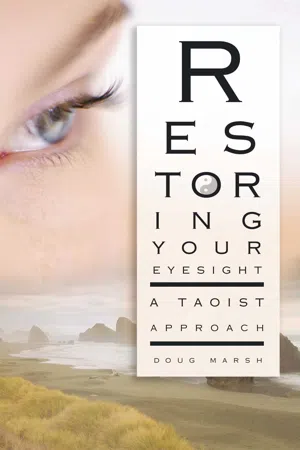
Restoring Your Eyesight
eBook - ePub

Restoring Your Eyesight

A Taoist Approach

  1. 240 pages
  2. English
  3. ePUB (mobile friendly)
  4. Available on iOS & Android
eBook - ePub

Restoring Your Eyesight

A Taoist Approach

About this book

A holistic guide to improving one's vision both physically and spiritually • Explains how blurred vision is a reflection of other imbalances in the body, mind, and spirit • Offers natural methods for improvement of poor eyesight and stress-related difficulties, including dyslexia and ADHD • Combines the core values of the Bates method of natural vision improvement and Taoism Fewer than three percent of children in North America are born with visual defects, yet as they become adults nearly two thirds will become reliant on prescription lenses to see clearly. Virtually nonexistent in pre-industrialized cultures, this epidemic of blurred vision can be traced to mental, physical, and spiritual imbalances in modern society. The traditional "quick fixes" of eyeglasses and contact lenses only serve to cover the true cause of blurred vision while increasing eye-strain, and often progressively worsen eyesight as the eyes become trained to work within the confines of the corrective lenses. The advent of refractive surgery carries even more serious risks. In Restoring Your Eyesight, Doug Marsh offers a natural alternative that shows readers how to improve their eyesight by taking conscious control of their vision health. He combines proven methods pioneered a century ago by eye doctor William Bates with the ancient Chinese wisdom of Taoism. Marsh describes how vision goes deeper than the eyes and optic nerves, extending well into the layers of the mind, emotions, and spirit. Eyesight difficulties are often connected to behavioral and stress-related syndromes, such as dyslexia, ADHD, stuttering, TMJ, and anxiety disorders. He draws upon the core values of the Bates method and Taoism--rhythm, softness, return, balance, and wholeness--to provide guidelines for a holistic healing of outer and inner vision.
Frequently asked questions

Yes, you can cancel anytime from the Subscription tab in your account settings on the Perlego website. Your subscription will stay active until the end of your current billing period. Learn how to cancel your subscription.
No, books cannot be downloaded as external files, such as PDFs, for use outside of Perlego. However, you can download books within the Perlego app for offline reading on mobile or tablet. Learn more here.
Perlego offers two plans: Essential and Complete
  • Essential is ideal for learners and professionals who enjoy exploring a wide range of subjects. Access the Essential Library with 800,000+ trusted titles and best-sellers across business, personal growth, and the humanities. Includes unlimited reading time and Standard Read Aloud voice.
  • Complete: Perfect for advanced learners and researchers needing full, unrestricted access. Unlock 1.4M+ books across hundreds of subjects, including academic and specialized titles. The Complete Plan also includes advanced features like Premium Read Aloud and Research Assistant.
Both plans are available with monthly, semester, or annual billing cycles.
We are an online textbook subscription service, where you can get access to an entire online library for less than the price of a single book per month. With over 1 million books across 1000+ topics, we’ve got you covered! Learn more here.
Look out for the read-aloud symbol on your next book to see if you can listen to it. The read-aloud tool reads text aloud for you, highlighting the text as it is being read. You can pause it, speed it up and slow it down. Learn more here.
Yes! You can use the Perlego app on both iOS or Android devices to read anytime, anywhere — even offline. Perfect for commutes or when you’re on the go.
Please note we cannot support devices running on iOS 13 and Android 7 or earlier. Learn more about using the app.
Yes, you can access Restoring Your Eyesight by Doug Marsh in PDF and/or ePUB format, as well as other popular books in Medicine & Alternative & Complementary Medicine. We have over one million books available in our catalogue for you to explore.
PART ONE
EXCESS
The Way of heaven
reduces excess and fills need,
but the way of humans is not so.
LAO TZU
1
THE CHASE
Colors blind people’s eyes,
sounds deafen their ears;
flavors spoil people’s palates,
the chase and the hunt
craze people’s minds.
LAO TZU1
Spring is an especially welcome season in Canada, marking the renewal phase after a long winter. That’s why gardening is very popular; people are eager to begin their annual green-thumbed rituals. They sow seeds in neat rows and then anxiously wait for the first sprouts to pop through the soil. They continue to nurture and tend their gardens to reap the succulent fruits of their labors. Patience and care are needed, for the gardeners would never think to interfere with nature’s miracle of plant life.
Ellen Chen relates the “tragic consequences of human intervention” in the story of a farmer who was concerned his rice plants were not growing quickly enough. When he returned home one day, he told his family, “I am worn out … I have been helping the rice plants grow.” His wife, realizing what her husband had done, rushed out to the field only to find the plants all shriveled up. He’d been pulling on the plants to help them grow faster.2
Western civilization is “modeled on animal life and characterized by struggle, conquest, and the survival of the fittest,” says Chen.3 The excessive use of technological force in the name of progress is exacting a price on our ecology and our society. Are we losing as much as we are gaining in overall health?
RAT RACE
Progress. Industrialization. Machines. Technology. Imagine how intoxicating it was two or three centuries ago to those on the frontier of the changes to come in society. The possibilities must have seemed endless; they dreamed humans would conquer and control the earth and create a mechanistic utopia—heaven on earth—with no disease, no poverty, no famine, no wars.
Most of us living today in Western-style society were raised among machines and systems. There’s virtually no escaping them; the few who try are considered Luddites and romantic freaks. The notions of evolution and progress are drilled into us almost from the time we learn to walk and talk. Once fully indoctrinated, many eventually become disillusioned with progress and accept the routine of progress as a rat race. Thomas Cleary explains the opening Lao Tzu quote:
Colors, sounds, and flavors all have legitimate functions in art, music, and diet, but they are perverted into superficial sensuous diversions. The chase and the hunt represent livelihood from the point of view of effort and struggle, which originally have a function in human life but become diverted into ambition… . Livelihood becomes a rat race. People degenerate under these conditions: no longer do they use the energies of sense and feeling to propel themselves into greater understanding and attunement with subtler phenomena such as principles, balances, and harmonies; on the contrary, degenerating humans diffuse energies through the habit of dwelling on the senses and feelings themselves.4
Time is money, we’re told. With our Western concept of linear time as a fixed commodity, there just doesn’t seem to be enough to go around. The hurried, dog-eat-dog pace is given as necessary to get ahead in the world. We have to compete not just with the clock but also with everyone else. Building a better mousetrap is the American dream of rags to riches. Fame and fortune will reward all who work hard enough to achieve it.
Bates had noted in his day, “The various forms of artificial lighting … tempt most of us to prolong our vocations and avocations into hours when primitive man was forced to rest.”5 But it’s no longer a matter of choice or temptation; industrial society expects and demands that people dutifully push themselves to the limit to succeed. The aberration of punching the clock in mechanical synchronicity has evolved into tossing it aside completely; “nine-to-five” has morphed into “twenty-four/seven,” obliterating traditional lines between work and rest. Transcontinental airline pilots, whose schedules drastically flip-flop between opposite global time zones, fight to stay awake in the cockpit. Hospital interns drive themselves close to a delirious stupor while working shifts up to thirty hours straight. The once-sacred work ethic has become so distorted that worker burnout has created a huge and growing industry in legal gambling and lotteries. People are desperate to instantly hit the jackpot to break free from it all.
The Great Depression of the 1930s forced two professionals living in New York to ask fundamental questions about the rat race. Helen and Scott Nearing sought the elusive “good life” by rejecting regimented dependence on the industrial and consumer complex. Theirs was a “personal search for a simple, satisfying life on the land, to be devoted to mutual aid and harmlessness, with an ample margin of leisure in which to do personally constructive and creative work.” They weren’t seeking an escape from work: “Quite the contrary, we wanted to find a way in which we could put more into life and get more out of it. We were not shirking obligations but looking for an opportunity to take on more worthwhile responsibilities.”6
The Nearings valued the work ethic in its purest sense—work-onyour-own-terms ethic. Their subsistence homesteading, not only largely freed them from the labor commodity markets, it also greatly freed their time for partaking of enriching pursuits and interests. “We were able to organize our work time so that six months of bread labor each year gave us six months of leisure, for research, traveling, writing, speaking and teaching.”7
Their back-to-the-land and conservationist experiment was by no means easy, and the majority would likely find such self-sufficient living to be overly radical, harsh, and austere. For the Nearings, it turned out to be a highly satisfying and healthy way of life. For five decades they never had the need to visit a doctor, and both lived long lives; Scott died at age one hundred, and Helen might have lived as long had she not died in a car accident at age ninety-one.
The Nearings discovered for themselves a rewarding and autonomous formula for living that was similar to that adopted by hunter-gatherers and traditional indigenous subsistence cultures. Marshall Sahlins referred to such people as the “original affluent society,” shattering common misconceptions about “primitive” living in his in-depth study of their economics.8 At the most, adult workers in such cultures spent three to five hours per day in food production, a far cry from the hours punched in by workers earning their dough on modern civilization’s treadmill. “Huntergatherers consume less energy per capita per year than any other group of human beings,” Sahlins wrote. “Yet when you come to examine it the original affluent society was none other than the hunter’s—in which all the people’s material wants were easily satisfied. To accept that hunters are affluent is therefore to recognize that the present human condition of man slaving to bridge the gap between his unlimited wants and his insufficient means is a tragedy of modern times.”9
There’s no question that progress has improved our lives in many ways. Where I live in Canada, we have a climate of extremes; the temperature can rise to 40° Celsius (104° F) in the summer and dip to a very frosty minus 40° Celsius (minus 40° F) in the winter. During the depths of January, when a blizzard could be raging outside, I have a great appreciation for how progress makes my life a whole lot easier. It’s very reassuring to have a furnace with natural gas piped in to keep our house warm at night. There are wonderful comforts when rising in the morning: a flush toilet, hot running water for a shower, electricity for lights and appliances, a refrigerator stocked full of food purchased at the nearby supermarket where the goods never run out. The comforts go on and on when you really stop to think of them. The Y2K scare a few years ago jarred many Canadians, because the thought of trying to survive in the winter without modern amenities was a frightening proposition.
Unfortunately, what was largely ignored when industrial progress was in its infancy was that, for every benefit or improvement, there would be a corresponding downside. Not everyone in the era of the industrial revolution was enthralled with the idea of mechanized progress. Some skeptics and dissenters were gravely concerned about losses amid the gains. Mary Shelley’s classic novel, Frankenstein, warned in 1818 of the dangers of unleashing an industrialized monster that could turn against us. Our current ecological crisis, together with the amount of human slaughter every year in industry and transportation, are just two examples of her amazing foresight. Of course, those are unintentional forms of destruction—what have been either traditionally brushed aside or euphemistically called accidents.a
The road to hell was indeed paved with good intentions. The rat race isn’t an evolutionary concept whereby getting ahead at all costs is in the cards. Even Charles Darwin was apparently bitter about his theory of evolution being distorted as “the law of the jungle” or “survival of the fittest” and then misused to justify all sorts of self-serving aggression.10 Lewis Mumford noted how utopian dreams of a mechanized power system degraded into “poisonous effluents” among an affluent society.11 Taoism warned of this danger many centuries before:
Do you think you can take over the universe and improve it?
I do not believe it can be done.
The universe is sacred.
You cannot improve it.
If you try to change it, you will ruin it.
If you try to hold it, you will lose it.12
As beneficiaries of the mess and misfortune we must deal with on the planet, we’ve learned the hard way that technology is far more damaging then ever envisioned. David Suzuki, a Canadian geneticist and longtime host of the television program The Nature of Things, contends, “There is no such thing as a problem-free technology.” The difficulty with evaluating the pros and cons of new technology is that “the benefits … are always immediate and obvious,” but the negative consequences are speculative at best. “We don’t have the knowledge base to be able to predict precise [negative] consequences,” he says, “and so we are stuck sounding vague.”13
Physics teaches that for every action there is an equal and opposite reaction. The benefits gained by improved sanitation, rapid transportation, and plentiful supplies of food have been offset by the destructive influences of dependence on mechanization and technological gadgets. People aren’t as healthy as was promised. Nutrition author and educator Herbert Shelton, an advocate of “natural hygiene” (lifestyle choices that help prevent disease), noted the consequences decades ago. “What we are pleased to call the ‘progress of modern science’ has been, in many ways, a health-destroying influence… . Our engineers have turned out myriads of labor-saving devices and these have been made to supercede the use and development of the powers of the body and mind.”14
STRESS AND STRAIN
Terms such as force, stress, strain, pressure, and tension are part of our everyday language. Initially applied in the physical sciences and engineering, these terms were later adopted to describe human conditions. In the psychological sense, they usually refer to circumstances that are negative or unpleasant. People might speak of being forced to do something against their wishes, the stress of working tight deadlines at the office, the strain in grieving the loss of a loved one, the pressure before an important event, or the tension in a difficult marriage. Often these terms are used interchangeably and synonymously, and most people can probably relate to what they mean to each of us on a very personal level.
Stress is very broadly used nowadays to describe both an external situation—for example, a stressful job interview—and the resulting consequences to the individual—the person being interviewed feeling stressed out afterward. Technically, an external stress cannot be both a cause and an effect; rather, strain is the subsequent reaction to the stress. Dr. Hans Selye, the eminent physician who pioneered the concept of the general adaptation syndrome (GAS), also called the stress syndrome, said years later he’d erred in the use of the phrase stress reaction. He said he should have used the term strain reaction. Because stress had gained such widespread use in health circles by then, to avoid the confusion, he developed the name stressor to denote a stressful situation and stress the resulting adverse effect.15 To be consistent with Bates’s use of the term strain in his writings, I use the conventional terms and connotations: stress is an externally imposed cause, and strain is the effect on the individual. To be clear on the distinction, let’s consider some examples, the first in the engineering sense and the others as applied to people.
When a person stands on the end of a diving board at the swimming pool, the board curves downward from the force of the person’s body weight. The force spread over the cross-sectional area in the board is said be a stress. The deformation, or stretching, in the fibers at the support end of the board is said to be the resultant strain. The fibers pull and elongate (in tension) on the top from the weight, and if enough people were to get on the end, the board would continue to deform and curve downward. The strain in the board’s top fibers at the support end of the board would keep increasing proportionally until it became too great. The board would no longer have the capacity to hold the weight, and the fibers would eventually rip and rupture, causing a collapse.
Now let’s consider a similar concept, but in the human body. Two boxers are going at it in the ring when one lands a solid and forceful blow (stress) to the other’s jaw. The boxer on the receiving end feels the result (strain) instantly in the form of feedback called pain. The muscles and bones strain under the stress, and the bone may break—the proverbial glass jaw. In this example, the force was clearly visible, at least to the spectators—if not to the recipient of the blow, who didn’t see it coming! But what about a case where the force is invisible and self-inflicted?
Imagine a hypothetical student is studying a difficult subject and is worried about getting a passing grade. This particular student has an unconscious habit of clenching her jaw while concentrating hard, trying desperately to mentally grasp the facts. She eventually gets a severe headache in the attempt to store, assimilate, and recall all the information. Studying late into the evening, she reaches a stage where she can no longer absorb any more information. Although she’s exhausted, she has trouble falling asleep—and when sleep finally comes, it’s very fitful. During her sleep, the mental tension continues, and she loudly grinds her teeth. When she wakes in the morning, her jaw aches and so does her head. She reaches for the aspirin bottle to help numb the pain.
The stress in the student’s case is the pressure imposed by the demands of the educational system. Unlike the boxer’s fist, the force that initiates the stress cannot be seen per se, but the resulting strain and pain is very real, l...

Table of contents

  1. Cover
  2. Title Page
  3. Contents
  4. Foreword by Thomas R. Quackenbush
  5. Introduction
  6. Part One: Excess
  7. Part Two: The Way
  8. Part Three: Harmony
  9. Footnotes
  10. Notes
  11. Bibliography
  12. About The Author
  13. About Inner Traditions
  14. Books of Related Interest
  15. Copyright