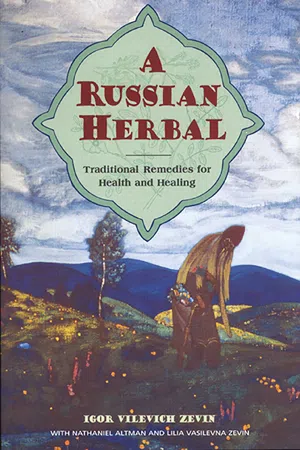
A Russian Herbal
eBook - ePub

A Russian Herbal

Traditional Remedies for Health and Healing

  1. 240 pages
  2. English
  3. ePUB (mobile friendly)
  4. Available on iOS & Android
eBook - ePub

A Russian Herbal

Traditional Remedies for Health and Healing

About this book

The first guide to the ancient traditions of Russian herbal medicine and their extensive medicinal applications today.
Drawing on a wealth of oral and written traditions, the authors examine the best-known Russian herbs (all of which are widely available in North America and Western Europe) and explain their folkways, properties, and uses. Offering time-tested advice for using herbs to maintain general well-being, they also give clear and simple recipes for treating specific health problems from asthma and migraines to influenza and high blood pressure. Blessed with a wide variety of climates, geography, and flora, early Russians developed a rich folk tradition of herbal healing that ranks among the most sophisticated in the world. Nearly every Russian medical school offers courses of study on the knowledge and application of herbs, and many maintain a special research department that investigates the properties and practical modern applications of herbal medicine.

This is the first book to examine the traditions of Russian herbal medicine.
Frequently asked questions

Yes, you can cancel anytime from the Subscription tab in your account settings on the Perlego website. Your subscription will stay active until the end of your current billing period. Learn how to cancel your subscription.
No, books cannot be downloaded as external files, such as PDFs, for use outside of Perlego. However, you can download books within the Perlego app for offline reading on mobile or tablet. Learn more here.
Perlego offers two plans: Essential and Complete
  • Essential is ideal for learners and professionals who enjoy exploring a wide range of subjects. Access the Essential Library with 800,000+ trusted titles and best-sellers across business, personal growth, and the humanities. Includes unlimited reading time and Standard Read Aloud voice.
  • Complete: Perfect for advanced learners and researchers needing full, unrestricted access. Unlock 1.4M+ books across hundreds of subjects, including academic and specialized titles. The Complete Plan also includes advanced features like Premium Read Aloud and Research Assistant.
Both plans are available with monthly, semester, or annual billing cycles.
We are an online textbook subscription service, where you can get access to an entire online library for less than the price of a single book per month. With over 1 million books across 1000+ topics, we’ve got you covered! Learn more here.
Look out for the read-aloud symbol on your next book to see if you can listen to it. The read-aloud tool reads text aloud for you, highlighting the text as it is being read. You can pause it, speed it up and slow it down. Learn more here.
Yes! You can use the Perlego app on both iOS or Android devices to read anytime, anywhere — even offline. Perfect for commutes or when you’re on the go.
Please note we cannot support devices running on iOS 13 and Android 7 or earlier. Learn more about using the app.
Yes, you can access A Russian Herbal by Igor Vilevich Zevin,Nathaniel Altman,Lilia Vasilevna Zevin in PDF and/or ePUB format, as well as other popular books in Medicine & Alternative & Complementary Medicine. We have over one million books available in our catalogue for you to explore.
1
FOUNDATIONS
INTRODUCTION
image
The healing properties of medicinal plants have been recognized since the beginnings of human civilization. Specialized knowledge about herbs has been part of the folk traditions of many of the world’s cultures, including the Indian, Chinese, Arabic, Tibetan, Russian, European, and Amerindian. Today, herbs are used by an estimated 86 percent of the world’s population to achieve and maintain good health.
Herbs contain substances that are found nowhere else. Because most pharmaceuticals are artificially synthesized, isolated substances, the body cannot always process them as it would more natural substances. Like pharmaceuticals, herbs have a therapeutic effect on specific organ functions, body systems, and disease symptoms. Yet unlike drugs, they do not produce as many adverse reactions, especially if they are used with wisdom and common sense.
Food—including herbs—also contains a variety of micronutrients that are not generally found in nutritional supplements. Although vitamins and minerals are essential for good health, herbs are able to address specific health problems more effectively and quickly than vitamins and minerals alone.
Russia has one of the greatest traditions of herbal medicine and one that is also the least known beyond its borders. Blessed with a country with a wide variety of climates, geography, and flora, the early residents of Russia and other former Soviet republics developed a rich folk tradition of herbal healing that ranks among the most sophisticated in the world. Because of the unique geographic and geopolitical position of the former Soviet Union and the frequent invasions of Tartars, Arabs, Scandinavians, Mongolians, and Turks, which took place over the centuries, the Russian people were able to draw from the herbal traditions of many of these cultures as well as their own.
Although traditional Russian herbalism has been practiced throughout the country for centuries, medical researchers did not take a serious interest in the medicinal value of plants until early in the twentieth century. Later, after the Second World War, the State totally subsidized widespread medical research in herbalism. As a result, many of the herbs described in this book have been subjected to exhaustive laboratory research and clinical trials. Many of them have been approved by government institutions in the same manner that pharmaceutical drugs are tested and approved for their safety and effectiveness in treating human diseases, and research continues in many parts of the Federation.
Although modern Western (allopathic) medicine is practiced throughout the former Soviet republics, nearly every medical school offers courses on the knowledge and application of herbs. Many maintain a special research department that investigates the properties and practical application of herbal medicine and coordinates detailed clinical trials on human patients. The All-Union Institute of Herbs and Aromatherapy in Moscow is perhaps the largest such center in the world. It and several other research institutes (such as the Herbal Institute of Uzbekistan and others in Tbilisi, Armenia, and Harkov) are known to medical researchers in the West. Hundreds of researchers are now in the field, interviewing traditional healers and seeking to document and verify the value of both traditional Russian herbs and the thousands of remedies made from them, both alone and in combination with other plants.
In Russia today, herbs are used as both adjuncts to and as alternatives to allopathic drugs. They are either used alone or as part of complex herbal recipes that have been developed over the years by folk herbalists, physicians, and researchers. Taken until symptoms disappear, they assist the body to heal itself. When the body is able to deal with the health problem on its own, dosage is usually reduced or stopped altogether. Herbs can also be used to help maintain good health as a refreshing relaxant or tonic or can be used as preventive therapy when the individual may be more prone to disease, such as during cold or flu season.
At the present time, about 30 percent of all medicines used in the former Soviet Union are derived from medicinal plants, which is slightly more than the approximately 25 percent derived from plants in the United States. There is also a large body of scientific data based on both early Russian herbal traditions and the more recent findings of modern Soviet scientists. However, because of a past lack of interest in the West, as well as language and political barriers, most of this knowledge has not spread outside the country until now.
A Russian Herbal is the first book published in the West that reveals both the ancient traditions of herbal medicine in the former Soviet Union and their modern scientific applications today. Drawn from a wealth of traditional knowledge (both from written and oral sources), this book not only examines the best-known Russian herbs, their folkways, properties, and uses but also offers simple and clear recipes for using the herbs for specific health problems in ways that have been tested and proved safe and effective by Russian medical research, both in the laboratory and in clinical practice. While many of the herbs will be familiar to Westerners, much of the information and guidance contained in this book has never before been seen by Western readers.
In the following pages, we examine approximately one hundred different herbs that are not only found in the Russian Federation, but which can also be easily obtained in North America. We also feature an herbal “selector” for different types of health complaints. This part of the book contains approximately two hundred complex recipes using combinations of different medicinal plants that help alleviate symptoms of some forty different health problems, including specific types of heart disease, stomach and intestinal problems, skin disease, hypertension, stress, rheumatism, arthritis, respiratory problems, and tonsillitis. Special care has been taken to insure that the recipes are simple to understand, and have been proved safe and effective in Soviet medical practice.
A goal of this book is to advise the reader of any herb that Russian scientists have found to contain poisonous compounds. Unfortunately, many herbal books and herbal preparations currently on the market still lack this information. Sometimes critics cite these poisonous substances to justify a condemnation of herbalism. They forget to mention, however, that every commercially prepared pharmaceutical drug on the market today can produce adverse side effects if not used properly.
When herbs are used according to established dosages, the chances of adverse reactions are rare. However, if you are presently taking medications, you will need to find out if the combination of an herb with a commercial drug can cause a problem. For example, echinacea is an immune booster. With some patients, it may cause adverse reactions when taken with a drug like cortisone, an immune suppressor. In general, pregnant women should be very careful about what they take into their bodies, including herbs. In the descriptions of individual herbs later on in the text, we have noted those that should not be taken by pregnant women.
People often make the mistake of expecting herbs to perform miracles or, at least, to cure them of their health problem more quickly than allopathic medicines can. In many cases (though not all), herbs act more slowly than allopathic medicines and often need to be taken for a longer period of time. One advantage is an absence of adverse side effects. In addition, the herb’s natural components are easily assimilated by the human body.
Finally, remember that the information in this book is for informational purposes only. In Russia, a good part of herbal medicine is used under the guidance of a physician. Treatment of serious or chronic conditions requires the care of a medical specialist or other licensed health professional.
RUSSIAN HERBALISM: A BRIEF HISTORY
image
We all have some idea about how modern medical science came into being. We know that medicine has evolved to its present state over thousands of years, not unlike the study of mathematics or astronomy. But sometimes we forget that nonsurgical medicine has almost always been based on the use of medicinal plants. In many of the world’s industrialized countries, the development of a wide variety of synthetic drugs like penicillin, tetracycline, and Valium has captured the attention of both the public and the scientific community, while interest in traditional herbal preparations has quietly slipped into the background. But recently herbal medicines have experienced a resurgence in countries like the United States, where health-care consumers are looking for low-cost, more natural preparations that are effective and have fewer adverse side effects than synthetic commercial drugs.
In many parts of the world, herbal medicine still plays a major role in healing. Even in the United States and western Europe, 25 percent of all commercial pharmaceuticals are plant based, while in Russia the number is closer to 30 percent. As botanists increase their investigations of medicinal plants from tropical rainforests and remote places in the north, such as Siberia and the tundra, this percentage is likely to increase, especially in the United States.
Although the present state of the Russian health-care system lags far behind those of the United States and western European countries, the level of medical research in Russian universities and medical centers has consistently remained at a world-class level. Like the development of nuclear weapons, rockets, and space stations, Russian medical research has always received far more emphasis than, for example, the development of consumer goods or building a viable free-market economy. The All-Union Exhibition of Achievements of National Industry in Moscow has a special pavilion devoted entirely to herbs and other medicinal plants in addition to exhibition halls devoted to spaceships, industrial technology, and agricultural machinery.
In addition to advanced study in synthetic pharmaceuticals in the former Soviet republics, ongoing research has long been undertaken in examining, evaluating, and verifying the medicinal value of herbs and the wide variety of other plants that can be found throughout the former Soviet republics. Many major medical research centers have a department specifically devoted to the study of herbs, and many Russian, Armenian, and Uzbek doctors are required to complete a course of study in herbalism before obtaining their medical degrees. Many Russian hospitals create herbal preparations in their pharmacies to give to patients, and herbs are widely available commercially throughout Russia and other former Soviet republics.
The history of herbalism traces its roots to the dawn of human existence. Like a tree with branches representing the world’s civilizations, the branches of herbalism reflect the cultures from where they came. Many of the earliest uses of herbs to treat disease were a result of trial and error—tribal healers or shamans using different plants in a haphazard fashion to treat a wide variety of health complaints. Over many generations, this trial-and-error approach gradually evolved into folk-healing traditions based on both the availability of the plants and the ever-changing needs of the population. As a result, Native Americans developed their own herbal tradition, while the Chinese, Egyptians, Indians, and Tibetans developed theirs. In the dense forests and rich meadows of what is now Russia, members of the Skif and Clavac tribes made their herbal preparations from the extraordinary variety of flowers, trees, and other plants that were found there.
At the present time we have five major developed branches of herbalism: European, Asian-Arabic, Chinese, Indian, and Russian. Many other traditions were significantly altered by invasions from other cultures. Native American herbalism, for example, was close to extinction after the European settlement of North America because many of the Europeans brought their own healing tradition with them. At the same time, the whites embarked on a genocidal campaign to subjugate and exterminate the Native Americans. This included outlawing many of their traditional healing practices of which herbalism was a major part. As the development of Western allopathic medicine grew in the late 1900s, traditional, indigenous methods of healing became less valued, even among Native Americans themselves. European science showed little interest in native herbal healing, and few herbs were ever studied in a scientific manner. Although many native herbal traditions remain, mostly passed on from generation to generation, what exists today is primarily a mixture of both European and Amerindian traditions. Of course, few of the five major herbal schools were ever completely isolated, since traders and military invaders brought their herbal traditions with them. However, they were able to remain more faithful to their original form than others.
Each branch or tradition of herbalism can be divided into two subtraditions: folk-herbalism, an oral tradition passed on from generation to generation, and the “official” tradition, which is based more on scientific investigation. Originally, these two subbranches were one and the same, but the development of the written word began to divide them. The evolution of these traditions varied from culture to culture. In ancient Greece, physicians like Hippocrates, Galen, and Diascorides wrote extensively on the medicinal value of herbs, many of which, incidentally, were found in the former Soviet republic of Georgia, known then as “the magic herbal garden.” Although official Russian herbal medicine came from these Grecian roots, it continued to evolve through the old word-of-mouth tradition as well.
When the early Romans conquered much of Europe, they brought their medical literature along with them. After the Roman Empire collapsed, the tribal peoples that succeeded them seized these herbals and medical texts. Over the centuries, many of these books were translated into local languages. As the many small European states became governed by more central authorities, the old oral herbal traditions (which were often fragmented and never organized) slowly lost favor. Gradually, herbalists began to place more trust in the written word than in the folk traditions. In addition, many practices were banned by the church, and many wise women (often considered to be “witches”) were persecuted and even killed for applying their ancient herbal and other healing traditions. By the eighteenth century, folk healing in Europe was almost completely replaced by official medicine.
In what is now Russia, the old folk-healing tradition existed independently until the tenth century, when herbal and medical literature was first introduced. At this time, a number of Greek herbals found their way into Russia and were eventually translated into the Russian language. Unlike herbal practice in other countries, however, the Russian herbal tradition was strong and well established. Some of the new translations of herbal books, in fact, were revised to include many aspects of folk healing. And because the country was larger, more isolated, and less centrally run than other European states, it was far more difficult to introduce new ideas from Greece and Rome than in many parts of western Europe.
The long evolution of Russian herbalism also set it apart from other traditions. In addition, Russia’s enormous size, different soils, and varied topography and climates favored the growth of an extensive number of herbs, trees, and other plants. This led to active interest in locally grown plants, which stimulated serious study by traditional healers and early official physicians alike.
Recently, an old chronicle was found that dates from the thirteenth century. It mentions that in the old city of Novgorod, Russian herbalists discovered the properties of the mold that eventually led to the development of penicillin in England some seven centuries later. The chronicle told how Russian herbalists (called “knowledgists”) were able to cure infected wounds with “banya’s mold.” This example gives a go...

Table of contents

  1. Cover Image
  2. Title Page
  3. Table of Contents
  4. Part 1: Foundations
  5. Part 2: A Russian Materia Medica
  6. Part 3: Complex Herbal Formulas
  7. Glossary
  8. Footnote
  9. Bibliography
  10. Herbal Suppliers
  11. About the Authors
  12. About Inner Traditions • Bear & Company
  13. Copyright & Permissions