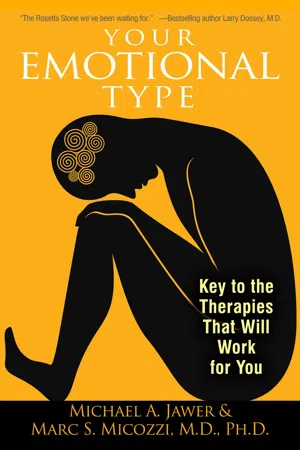
Your Emotional Type
eBook - ePub

Your Emotional Type

Key to the Therapies That Will Work for You

  1. 194 pages
  2. English
  3. ePUB (mobile friendly)
  4. Available on iOS & Android
eBook - ePub

Your Emotional Type

Key to the Therapies That Will Work for You

About this book

Your emotional type as the means to finding the right treatment for your chronic illness or pain • Provides an easy questionnaire to find your emotional type • Identifies the connections between emotional type and 12 common chronic ailments: asthma, allergies, chronic fatigue, depression, fibromyalgia, hypertension, irritable bowel, migraines, PTSD, psoriasis, rheumatoid arthritis, and ulcers • Explains which of 7 mind/body healing therapies works best for each emotional type Different people process their feelings in different ways--your emotional style is a fundamental aspect of who you are. It affects more than just your outlook on life; it can affect your well-being as well. Many chronic ailments are not the result of germs or genes but are rooted in our emotional biology. The link between emotional type and health explains why modern medicine--which views treatment as "one size fits all"--often fails to successfully treat chronic pain and illness. Examining the interplay of emotions, chronic illness and pain, and treatment success, Michael Jawer and Dr. Marc Micozzi reveal how chronic conditions are intrinsically linked to certain emotional types and how these ailments are best treated by choosing a healing therapy in line with your type. Explaining the emotional ties behind the 12 most common chronic illnesses--asthma, allergies, chronic fatigue, depression, fibromyalgia, hypertension, irritable bowel syndrome, migraines, post-traumatic stress disorder, psoriasis, rheumatoid arthritis, and ulcers--the authors provide an easy assessment survey that allows you to identify your emotional type as well as the ailments you are susceptible to. Extending this connection between mind and body, they assess 7 alternative healing therapies--acupuncture, hypnosis, biofeedback, meditation, yoga, guided imagery, and relaxation techniques--and indicate which methods work best for each emotional type. Empowering you as a patient to seek out the therapies that will work best for you, this book offers a welcome path to effective pain relief and sustainable health.
Frequently asked questions

Yes, you can cancel anytime from the Subscription tab in your account settings on the Perlego website. Your subscription will stay active until the end of your current billing period. Learn how to cancel your subscription.
No, books cannot be downloaded as external files, such as PDFs, for use outside of Perlego. However, you can download books within the Perlego app for offline reading on mobile or tablet. Learn more here.
Perlego offers two plans: Essential and Complete
  • Essential is ideal for learners and professionals who enjoy exploring a wide range of subjects. Access the Essential Library with 800,000+ trusted titles and best-sellers across business, personal growth, and the humanities. Includes unlimited reading time and Standard Read Aloud voice.
  • Complete: Perfect for advanced learners and researchers needing full, unrestricted access. Unlock 1.4M+ books across hundreds of subjects, including academic and specialized titles. The Complete Plan also includes advanced features like Premium Read Aloud and Research Assistant.
Both plans are available with monthly, semester, or annual billing cycles.
We are an online textbook subscription service, where you can get access to an entire online library for less than the price of a single book per month. With over 1 million books across 1000+ topics, we’ve got you covered! Learn more here.
Look out for the read-aloud symbol on your next book to see if you can listen to it. The read-aloud tool reads text aloud for you, highlighting the text as it is being read. You can pause it, speed it up and slow it down. Learn more here.
Yes! You can use the Perlego app on both iOS or Android devices to read anytime, anywhere — even offline. Perfect for commutes or when you’re on the go.
Please note we cannot support devices running on iOS 13 and Android 7 or earlier. Learn more about using the app.
Yes, you can access Your Emotional Type by Michael A. Jawer, Marc S. Micozzi in PDF and/or ePUB format, as well as other popular books in Medicine & Alternative & Complementary Medicine. We have over one million books available in our catalogue for you to explore.
Chapter 1
YOU ARE YOUR BODYMIND
How would you define personality? By any definition, it’s hugely important to our lives—and even our health. The personality of those closest to us and the interaction with our own personality profoundly affect how we feel and how we get along with family members, bosses, coworkers, neighbors, teachers, classmates, and even the people we encounter casually each day, such as waiters and waitresses, salespeople, or ticket-takers on the local commuter train.
If you’re having a bad day, the signals you put out (whether intentional or unintentional) can send other people scurrying. On the other hand, if the person behind the supermarket cash register is having a great day, he or she can lift you out of the doldrums through a megawatt smile, a brief conversation, or just a kindly look. We’re social creatures, and highly attuned to each other’s moods. But personality itself is something more permanent than mood, more characteristic of one’s self. It’s the underpinning of whatever the transient signals might be. Think of personality as climate—an overall expectation for a given place over time, regardless of the short-term shifts in temperature, wind, or rain.
The American Heritage Dictionary defines personality several ways, such as
  • the dynamic character, self, or psyche that constitutes and animates the individual;
  • the pattern of collective character, behavioral, temperamental, emotional, and mental traits of an individual; and
  • the embodiment of distinctive traits of mind and behavior.1
Taken together, these definitions reference important concepts: character, mind, psyche, self. The most important aspect, however, might be embodiment. We cannot be a self, or have a mind, temperament, or personality, without a body. Surely you’ve heard the phrase “I’m not feeling myself today.” That’s said by someone whose experience of him- or herself is a little off, due to how that person is feeling. And a feeling cannot be felt by anyone absent a body.
Now, fast-forward to a news report from the health sciences. It highlights research suggesting that extroverts who have high “dispositional energy”—a sense of innate vigor or active engagement with life—have dramatically lower levels of an immune system chemical known to trigger inflammation. The finding indicates that people who are extroverted and “engaged with life” may be better protected than are other people against inflammatory-related illnesses such as rheumatoid arthritis and stress-related events such as heart attack and stroke. The researchers surmise that a person’s engagement level “may reflect a fundamental, biologically based energy reserve, although no one has [yet] explained the biochemistry behind it.”2 This would come as no surprise to traditional Asian medical systems (see chapter 8), in which “vital energy” is considered key to health and disease prevention, causation, and treatment. This vital energy is seen as a fundamental aspect of living beings—it is literally embodied energy.
The researchers behind this particular health story, it should be pointed out, are part of a fast-growing discipline known as psychoneuroimmunology, which studies the interactions between brain and body, the nervous and immune systems, personality and stress, and emotions and health. It’s a wide and fertile field of investigation, with fascinating implications for what makes us human.
How energetic we are . . . what we’re concerned about . . . what animates or drives us . . . how we feel about ourselves and the life we’re leading . . . these are at the crux of personality. It should come as no surprise that our biology is inextricably linked with temperament, health, and, more generally, how we feel.
THE ENERGY OF EMOTIONS
That our feelings are dynamic and energetic is easy to demonstrate. Just envision a time you became frustrated or angry and impulsively struck a wall or some piece of furniture. Or consider how drained you can become when worrying about a loved one if that person’s health takes a turn for the worse. Take the energy released from crying, by a good belly laugh, or during sexual activity. The amount of energy involved can be immense.
We might picture one of our greatest feelings—joy—as a radiation of happy energy out into the world, and one of our worst feelings—despair—as an inhibition of energy as the individual recedes into him- or herself. That sense of movement is reflected in the word emotion itself, which comes from the Latin emovere, meaning “to move from” or “to move out of.” Such movement is characterized by actual changes in activity within our bodies—changes in the body’s chemical profile, in the organs, in the degree of muscle contractions, and in our neural circuitry. In sum, change connotes movement, and movement connotes energy.
While we use calories to measure the intake and expenditure of physical energy, there is no currently accepted “scientific” way to delineate emotional energy. However, an attempt to capture it linguistically has been attempted by many cultures and philosophies (and closely linked to concepts of health and healing). The Hindus call embodied energy prana; the Chinese know it as qi. Freud found something he termed the libido, and, around the same time as Freud, a French philosopher named Henri Bergson called it élan vital, or life force. Whatever we choose to call it, it seems to correlate with the dispositional energy that can protect people from the debilitating effects of stress.
This energy, this e-motion, also ties us together. It’s rather like a national currency. Our bills and coins go everywhere and are handled by everybody. We may feel flush with cash one day and relatively empty the next, but we feel something so long as we’re alive. Those feelings are part and parcel of who we are as living beings, as embodied selves who have a personality and the ability to make conscious decisions.
An important qualifier must be added here, namely that personality cannot be reduced to feelings alone. According to a leading personality theorist, Robert Cloninger of Washington University, emotional drives constitute four of seven proposed dimensions of personality. The four are novelty seeking, harm avoidance, reward dependence, and persistence. Together, they make up what Cloninger calls “temperament.” The other three dimensions (self-directedness, cooperativeness, and self-transcendence) relate more to conscious abilities and predilections than feelings; these he terms “character.” In Cloninger’s well-considered framework, character plus temperament add up to personality.3 Feelings, therefore, can be seen as a foundation of personality—even a driver—but not the entirety in any sense.
THE FAR-FLUNG REACHES OF THE BODYMIND
More than what we think, what we recall, or what we imagine—all of which is considered to be “in our heads”—what ultimately matters is the full body reality of our feelings. The late novelist Milan Kundera put it succinctly: “‘I think, therefore I am’ is the statement of an intellectual who underrates toothaches.”4
Indeed, as we go about understanding personality, it’s important to take into account a crucial premise of psychoneuroimmunology. Namely, that the brain and the rest of the body are not separate, but integrated and interdependent. And there can be no “mind” without a body. A term that captures this connection is bodymind, originated by futurist Ken Dychtwald in his 1977 book of that name.5
A helpful analogy is to picture Washington, D.C., and the rest of the country. If you were hosting a foreign visitor and wanted your guest to get to know the United States, you might start with Washington, D.C. (the nation’s capital and, in an admittedly limited way, its psyche). But, assuming you had the wherewithal, you’d also want to journey around, taking that person to places like Poughkeepsie, Mobile, Chicago, Bismarck, Salt Lake City, San Francisco (following our analogy, the various parts of the body). We are the “united” states of America—functioning as one country, and a foreigner would not understand us if he or she concentrated solely on Washington, D.C., or on anywhere else.
The bodymind, too, is united. It’s the amalgam of brain and body and all internal aspects of us—everything we feel, think, know, intuit, remember, or have forgotten. How does this work? Here’s an example. Think for a moment about your most indelible lifetime memory. What was it? Many citizens of a certain age and up would say it was President John F. Kennedy’s assassination in 1963. For others, it might be the explosion of the space shuttle Challenger in 1986. For still others it could be the time they bungee jumped or skied down a slope they never thought they could. Perhaps it’s when you won some major award, received a huge ovation, or heard your beloved say “I do.” The more intense the feeling or the more vivid the encounter, the stronger the recollection will be. Experiences that scare, shock, or thrill us are among our most indelible lifetime memories.
Such memories are whole body recollections, relying on connections between the amygdala (a part of the brain that stays on alert for major threats), the vagus nerve (which wanders all the way from the brain to the adrenal glands atop the kidneys), the adrenal glands themselves (which secrete hormones in response to “fight or flight” messages), and the rest of the vital organs and nervous system. The existence of this information loop—combined with the fact that the vagus nerve reaches almost all our internal organs—indicates that our most vibrant memories are encoded not just cognitively in the brain, but viscerally in the body. Furthermore, our vital organs together contain more chemical messengers (neurotransmitters and neuropeptides that are critical of brain activity), than does the brain itself!6 If you’ve ever had a “gut feeling” or experienced a “heartache,” you will understand that this is so.
MORE EVIDENCE FOR THE BODYMIND
Science is learning that the supposed line between the brain and the rest of the body is really no line at all. Chemical messengers are crossing it all the time. While researchers speak of the nervous system, or the endocrine system, or the immune system, the concepts are approximate—for study purposes, mainly. Scientists once believed they were separate working systems . . . but no more.
Psychoneuroimmunology is shedding light on the connections. The more that is learned, the more insight is gained on how extensive the overlap really is. Psychoneuroimmunology—the term itself—reflects this interface: psycho for mind; neuro for the neural and endocrine (hormonal) systems; and immuno for the immune system.
Take the immune system. In its detection and response to bacteria, viruses, and other foreign invaders, it is crucial, physiologically, to our sense of self.7 The components of the immune system are located throughout the body: in the thymus (at the base of the neck), the spleen, the lymph nodes (collections of tissue in the armpit, groin, neck, and elsewhere), the bone marrow, the tonsils, and especially the appendix. Immune cells—white blood cells—are sent throughout the body, especially to areas of injury or infection. Their activity produces the familiar inflammatory response as more blood is directed to the affected region and the surrounding tissues swell up.
That the immune system could be influenced by the brain—a truly seminal discovery—was first brought to light in 1975 by psychologist Robert Ader at the University of Rochester. He and his colleagues later advanced the idea that cells are lined with many specific receptors to which only specific molecules can attach themselves. These chemical messengers circulate throughout the body and are the vehicles through which the nervous, endocrine (hormonal), and immune systems communicate.
Such communication goes well beyond the immediate physical connection of neuron to neuron. Within the entire body, various “information substances” are constantly transmitting innumerable messages. Among these substances are peptides: chains of amino acids that are themselves the building blocks of proteins. A given peptide’s message is relayed through receptors—sites on the surface of nerve cells through which a given message is transmitted to the cell nucleus. (Peptides associated with the nervous system and brain are labeled neuropeptides.)
FEELING BLUE
Have you ever noticed how one consequence of feeling “blue” for an extended period of time is the greater likelihood of catching a cold or infection? This demonstrates how our state of feeling influences immunity. Stress, too, suppresses immune function through the action of adrenaline and noradrenaline along with other substances (collectively known as corticosteroids) released by the adrenal glands.
Psychoneuroimmunologists have found that such chemical messengers act reciprocally on the brain and the rest of the body. Researcher Candace Pert, then at Georgetown University, noticed a high concentration of peptide receptors “in virtually all locations where information from any of the five senses enters the nervous system.” The entire body can thus be characterized as a single sensing and feeling organ: a far-flung, unitary, psychosomatic network.8
THE MIND OF THE GUT
Surely you’ve experienced a “gut feeling” about something from time to time. Perhaps it concerned a relationship that seemed to be going well but somehow gave you pause . . . exchanges at your workplace that didn’t seem to add up . . . or a major decision you were on the verge of making but had a nagging doubt about. These feelings don’t come out of nowhere but emanate from a very tangible part of our body—the gut.
The gut actually possesses its own self-contained nervous system, known as the enteric nervous system, which can operate in the complete absence of input from the brain or even the spinal cord. It is vast, encompassing more than one hundred million nerve cells in the s...

Table of contents

  1. Cover Image
  2. Title Page
  3. Epigraph
  4. Acknowledgments
  5. Table of Contents
  6. Foreword by Deane Juhan
  7. Preface
  8. Introduction
  9. Chapter 1: You Are Your Bodymind
  10. Chapter 2: Our Boundaries, Our Selves
  11. Chapter 3: Personality Differences
  12. Chapter 4: Boundary Similarities and Differences
  13. Chapter 5: Feelings on Hold
  14. Chapter 6: Finding Your Boundary Type
  15. Chapter 7: Finding Your Remedy
  16. Chapter 8: Pushing Boundaries
  17. Appendix A: The Boundary Questionnaire
  18. Appendix B: Selected Studies
  19. Appendix C: Sources for Further Information
  20. Index
  21. Endnotes
  22. Bibliography
  23. About the Authors
  24. About Inner Traditions • Bear & Company
  25. Books of Related Interest
  26. Copyright & Permission