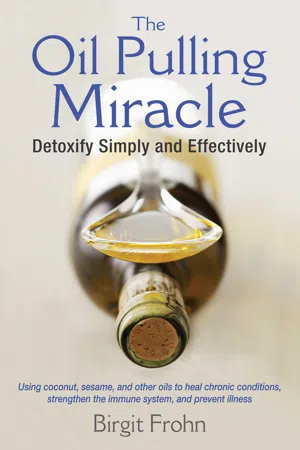
The Oil Pulling Miracle
eBook - ePub

The Oil Pulling Miracle

Detoxify Simply and Effectively

  1. 128 pages
  2. English
  3. ePUB (mobile friendly)
  4. Available on iOS & Android
eBook - ePub

The Oil Pulling Miracle

Detoxify Simply and Effectively

About this book

Using coconut, sesame, and other oils to heal chronic conditions, strengthen the immune system, and prevent illness • Details the process of oil pulling, including when to do it, how long to swish the oil in your mouth, and other oral care techniques that complement it • Explains the health benefits of 10 different cold-pressed oils, including sesame, coconut, and pumpkin seed, allowing you to choose the best oil for your needs • Includes a step-by-step 7-day detox plan and information on additional detox techniques that enhance the benefits of oil pulling Oil pulling is much more than an oral cleansing method. Originating in the ancient healing systems of Ayurveda and traditional Chinese medicine, where it is well known that "disease begins in the mouth, " this simple health practice triggers detoxification and healing throughout the entire body. The mouth and tongue are home to bacteria, fungus, and many toxins from the rest of the body. Oil pulling not only cleanses the mouth and tongue, preventing harmful bacteria and toxins from entering the bloodstream, it also triggers enzyme production in the digestive tract, which in turn activates cleansing processes throughout the entire body. Practiced daily, oil pulling leads to better dental and gum health, a stronger immune system, detoxification of major organs including the intestines, lungs, and liver, and healing from many conditions caused by internal toxins and chronic inflammation. In this practical guide, Birgit Frohn details the simple process of oil pulling, including when to do it, how long to swish the oil in your mouth, and other oral care techniques that complement it, such as tongue scraping. She explains the specific health benefits of 10 different cold-pressed oils that can be used in oil pulling, from traditional sesame oil to vitamin-packed pumpkin seed oil to highly popular coconut oil, allowing you to choose the best oil for your needs. She also reveals the vast number of ailments that can be healed and prevented by regular oil pulling practice, including:
• Acne
• Allergies
• Canker sores
• Arthritis
• Eczema
• Flu and Colds
• Sinus infections and Bronchitis
• Cavities and Gingivitis
• Headaches and Migraines
• Constipation
• And many more... Frohn also explores additional detox techniques that enhance the benefits of oil pulling and concludes with a step-by-step 7-day detox plan for those who want to maximize the effects of oil pulling and accelerate their return to better health.
Frequently asked questions

Yes, you can cancel anytime from the Subscription tab in your account settings on the Perlego website. Your subscription will stay active until the end of your current billing period. Learn how to cancel your subscription.
No, books cannot be downloaded as external files, such as PDFs, for use outside of Perlego. However, you can download books within the Perlego app for offline reading on mobile or tablet. Learn more here.
Perlego offers two plans: Essential and Complete
  • Essential is ideal for learners and professionals who enjoy exploring a wide range of subjects. Access the Essential Library with 800,000+ trusted titles and best-sellers across business, personal growth, and the humanities. Includes unlimited reading time and Standard Read Aloud voice.
  • Complete: Perfect for advanced learners and researchers needing full, unrestricted access. Unlock 1.4M+ books across hundreds of subjects, including academic and specialized titles. The Complete Plan also includes advanced features like Premium Read Aloud and Research Assistant.
Both plans are available with monthly, semester, or annual billing cycles.
We are an online textbook subscription service, where you can get access to an entire online library for less than the price of a single book per month. With over 1 million books across 1000+ topics, we’ve got you covered! Learn more here.
Look out for the read-aloud symbol on your next book to see if you can listen to it. The read-aloud tool reads text aloud for you, highlighting the text as it is being read. You can pause it, speed it up and slow it down. Learn more here.
Yes! You can use the Perlego app on both iOS or Android devices to read anytime, anywhere — even offline. Perfect for commutes or when you’re on the go.
Please note we cannot support devices running on iOS 13 and Android 7 or earlier. Learn more about using the app.
Yes, you can access The Oil Pulling Miracle by Birgit Frohn in PDF and/or ePUB format, as well as other popular books in Medicine & Alternative & Complementary Medicine. We have over one million books available in our catalogue for you to explore.
The Long Tradition of Oil Pulling
The practice of oil pulling can be traced back for over a thousand years. That this practice has such a long tradition should come as no surprise, for the insight that our body must be regularly cleansed of waste products and toxins to maintain our health is not new. Certainly, various methods of purifying and detoxifying the body have played an enduring role in the treatment regimens of many branches of the healing arts, in many cultures, since the beginning of medicine.
The purpose of this book is to introduce you to the practice of oil pulling and to provide tips and guidelines for its use. As well, there are a variety of other detoxification techniques that beautifully complement oil pulling that we shall touch on later in this book. To stay healthy, our body requires cleansing from the inside as well as the outside. As already noted, this is not a modern insight. Long ago, the physicians of ancient Egypt prescribed special therapies designed to purify the body of toxins. Some of these involved laxatives, while others consisted of herbal preparations for internal consumption to bring about specific cleansing effects in the organs. Oil pulling, too, found a way into the repertoire of the great ancient medical traditions. Because oil pulling was regarded as a comprehensively effective method for purifying and detoxifying, it was only natural that it would be incorporated into the materia medica of those classical systems of healing.
It may surprise a few people to know that the roots of our modern Western medical system reach all the way back to India, China, and the ancient cultures of the Mediterranean region. The founding fathers of these ancient systems of medicine include the scholar Charaka and the surgeon Sushruta, both of whom helped establish the ayurvedic tradition of India; the Yellow Emperor, Huangdi, the legendary founder of traditional Chinese medicine; and Hippocrates, who along with his students established the healing traditions of the ancient Greeks, on which much of our current medical model in the West is based.
Ayurveda—the Mother of Medicine and Oil Pulling
An ideal medicine not only heals illness; it provides effective, long-lasting prevention of getting sick in the first place. On this point, all of the Asian medical traditions agree. This is the reason why these ancient healing traditions continue to advocate the use of detoxifying and purifying regimens for maintaining health and well-being. Many of these resemble the practices of ayurveda, the traditional medicine of India, in which oil pulling plays a central role in both the prevention and the treatment of illness.
Ayurveda dates back to prehistoric times, to as early as 3000 BC. The word itself is a combination of ayus, “life,” and veda, “knowledge.” Thus the ayurvedic system is based on the “knowledge of life,” a perspective that well agrees with the principles of traditional Indian medicine: that the medical arts and the art of living are one and the same. Because the concepts of ayurveda encompass all aspects of daily life, they can be applied equally on both healthy and sick days.
Ayurveda formed the basis of many healing systems outside of India, including traditional Chinese medicine (TCM). Our Western medicine has also been decisively influenced by ayurvedic insights, for it has been said that the treatment methods of the Hippocratic physicians were closely based on many of the principles of classical Indian medicine. Ayurveda’s reputation as the “Mother of Medicine” is still acknowledged in our time. Although the traditional medicine of the Indian subcontinent was suppressed from 1858 to 1947 under the British Raj, ayurveda has reemerged today as an essential part of the Indian system of health care. And with our growing interest in all types of natural healing methods in the West, the Mother of Medicine has come to play an important role here as well. This has led to many scientific investigations of the efficacy of various ayurvedic therapies. The results of these investigations demonstrate that ayurveda has enormous potential as a modern system of holistic medicine that can be used to successfully treat a number of illnesses for which Western medicine has not yet found a cure.
image
Dr. Fedor Karach
Many people who have searched the Internet to learn more about oil pulling have repeatedly encountered one name: Dr. Fedor Karach, a physician from the Ukraine. Dr. Karach claimed to have learned a simple and very effective health practice from Siberian shamans: each morning for at least four weeks in a row, one spoonful of sunflower oil should be thoroughly “chewed” and swished and sucked through the teeth and around the mouth for at least ten minutes, after which you spit the liquid out (being careful not to swallow any) and brush the teeth as usual. This practice could draw out and remove all kinds of harmful toxins, including even heavy metals, from the body. This corresponded to a similar ayurvedic technique, except that sesame oil is used in ayurveda, and the oil is swished for only about two minutes.
Dr. Karach gave a lecture about this practice of oil pulling during a late 1980s meeting of a group known as the “All Ukrainian Association,” which was attended by a number of oncologists and bacteriologists who were members of the Academy of Sciences of the USSR. The title of his presentation was “One of the Many Possibilities to Provide Assistance to an Ill or No Longer So Healthy Body.” At the time, the practice of oil pulling was not well known in the West. The reaction to this presentation by those in attendance was overwhelmingly positive. Of course, there were also critics, but the main message did not go unheard.
It should be underscored that this time tested health practice described by Dr. Karach to his colleagues did not originate in Russian or Ukrainian folk medicine, although oil pulling goes back centuries in the traditional medicine of those countries. All Dr. Karach did was remind those of us in the West about something that has been known and practiced in India and China for a long, long time.
The Five Elements and the Three Types
The basic assumption of ayurveda is that all of nature is composed of one or a combination of the five elements of ether, air, fire, water, and earth, and that all five of these elements are found within the human body. As well, from the perspective of traditional Indian medicine, everything that exists is in interrelationship with everything else. As a result, the diagnostic methods of ayurveda are complex and not based solely on the examination of a person’s physical body; they also consider a number of other factors, such as the person’s psychological state, lifestyle, and nutritional status, and even the climate in which the person lives.
The second principle of ayurveda is the doctrine of the three doshas: vata, pitta, and kapha. The Sanskrit term dosha can be translated as “support,” a term that indicates its function; the doshas can be understood as the biological principles or bioenergies that support and control all of an organism’s processes. Because the relationship between the doshas is established for each person at the time of birth, the ayurvedic system assumes that people have different constitutional types. These types make it possible to identify and address a person’s health weaknesses and strengths.
The Five Treatments for Maintaining Health
All of the treatment methods used in ayurveda aim at maintaining or restoring the balance of the three doshas, the three supports. One of the methods involves the use of plant medicines—phytotherapy, in fact, plays a central role in the ayurvedic healing canon. Ayurvedic plant medicines are manufactured in a traditional manner and are based on recipes that have been passed down for centuries.
Ayurveda also makes use of purifying therapies intended to maintain or restore a person’s health. The most important of these are the panchakarma, the “five treatments.” These techniques, which are now recognized and practiced in the West, consist of a finely tuned system of purifying treatments and oil massages. One of these is gandusha, the ayurvedic practice of oil pulling.
image
Herbs and oils play an important role in the various treatments of ayurvedic medicine.
As the name itself suggests, the panchakarma are divided into five cycles, each of which is subdivided into a preparatory and a recovery phase. As the panchakarma are applied, the metabolic wastes and toxins in the tissues and organs are mobilized, enabling them to be more readily excreted or broken down by the body. This thorough “housecleaning” exerts enormously positive effects on all levels—physical, emotional, and mental. The intensive elimination and purification of harmful residues and waste products leads to an increase in the activity of the immune system and the restoration of balance in the nervous and endocrine systems. In addition, the panchakarma improve the circulation of the blood and strengthen the functioning of the organs. These are only some of the reasons why these treatments have long demonstrated themselves to be so useful in the prevention and treatment of so many illnesses. Later in this book we will more closely explore why therapies for purification and detoxification like panchakarma and oil pulling have such good results.
Gandusha—the Ayurvedic Practice of Oil Pulling
Ayurvedic oil pulling generally utilizes warm sesame oil or ghee (clarified butter). The ayurvedic method of oil pulling does not differ in any significant manner from oil pulling as we know it here in the West. However, traditional Indian medicine suggests that a person should first carry out certain preparatory steps. Before performing gandusha you should take some of the sesame oil or ghee to be used in the gandusha in your hands and softly rub it on your cheeks and neck. After that you saturate a small hand towel with warm water and with it remove the oil or ghee from the skin. This prepares the body for the gandusha so that its effects can more fully manifest.
The length of time that one should practice ayurvedic oil pulling differs from one person to the next. One sign that it has achieved its effects are tears in the eyes and a slight running of the nose; in some people this may occur sooner, while in others it may take more time.
Oil Swishing for Health
Oil swishing—another name for oil pulling—has long been practiced beyond the borders of India. One place where it has been practiced is Tibet, the “Roof of the World.” As well, the people of the Middle Kingdom—the metaphorical name for China—have also known about and made use of this knowledge for many centuries. As in ayurvedic Indian medicine, traditional Chinese medicine (TCM) continues to make use of oil pulling to prevent and to treat illnesses.
This oil-based system of maintaining health also made its way into Russian folk medicine, especially in Belarus and the Ukraine, regions known for longevity, where it is and has long been held in high regard. Typical among the healing traditions of these regions is the use of simple treatment methods, especially among those who lived in the vast stretches of Russia. Few of these people lived near doctors or pharmacies, and among those who did, only the upper classes could actually afford such “luxuries.” And so common people looked for other healing methods and remedies, and it was important that these be accessible and affordable to all. Both the Russian healers and those lay health practitioners who treated people found many of their treatments in nature—in the plant kingdom, in beekeeping, through agriculture, and in the earth. In addition, water and stones, and even the sun and the rain, were used as medicines. But most Russian folk remedies came from the kitchen. Knowing this, it is easy to understand how cooking oils came to be used for maintaining health. In the Russian folk medicine of our times, sunflower oil is still regarded as the best oil for oil pulling. But other oils are also suitable for this purpose, as we shall see later in this book.
image
Oil Pulling for Body, Mind, and Spirit
There are many reasons behind oil pulling’s long history of success. The health-promoting effects of pulling oil manifest throughout the body as well as mentally and emotionally. This is all the more remarkable when we consider how easy it is to pull oil!
The reasons why and how this simple method is able to produce such significant health benefits, as well as the specific effects it can have, will be discussed here. First, however, we should consider why detoxification and purification are so important for maintaining and restoring our ...

Table of contents

  1. Cover Image
  2. Title Page
  3. Table of Contents
  4. Chapter 1: The Long Tradition of Oil Pulling
  5. Chapter 2: Oil Pulling for Body, Mind, and Spirit
  6. Chapter 3: Five Minutes a Day for Your Well-Being
  7. Chapter 4: Complementary Detoxification Techniques
  8. Bibliography
  9. Footnotes
  10. About the Author
  11. About Inner Traditions • Bear & Company
  12. Books of Related Interest
  13. Copyright & Permissions
  14. Index