The High Blood Pressure Solution
eBook - ePub

The High Blood Pressure Solution

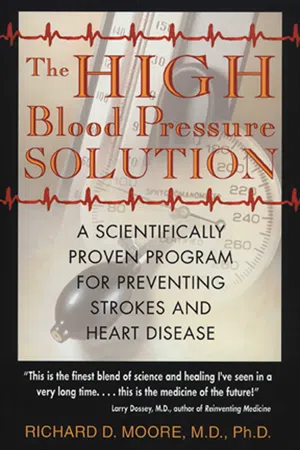
A Scientifically Proven Program for Preventing Strokes and Heart Disease

  1. 400 pages
  2. English
  3. ePUB (mobile friendly)
  4. Available on iOS & Android
eBook - ePub

The High Blood Pressure Solution

A Scientifically Proven Program for Preventing Strokes and Heart Disease

About this book

• Proves that the majority of cases of stroke, heart attack, and hypertension can easily be prevented by maintaining the proper ratio of potassium to sodium in the diet. • Updated with scientific evidence from a recent Finnish study showing a 60 percent decline in deaths attributed to strokes and heart attacks. • Provides a comprehensive program for balancing body chemistry at the cellular level. High blood pressure is entirely preventable, without reliance on synthetic drugs. Dr. Moore's approach is simple: by maintaining the proper ratio of potassium to sodium in the diet, blood pressure can be regulated at the cellular level, preventing the development of hypertension and the high incidence of strokes and heart attacks associated with it. Dr. Moore updates this edition with a new preface reporting on the latest scientific research in support of his program. The most striking results come from Finland, where for several decades sodium chloride has been replaced nationwide with a commercial sodium/potassium mixture, resulting in a 60 percent decline nationwide in deaths attributed to strokes and heart attacks. Extrapolated to America, the Finnish statistics would mean 360, 000 strokes prevented and 96, 000 lives saved every year. Dr. Moore makes it clear that high blood pressure is only one symptom of an entire systemic imbalance. He outlines a safe, effective program that focuses on nutrition, weight loss, and exercise to bring the entire body chemistry into balance. For those currently taking blood pressure medications, he includes a chapter on working with your physician to ensure that any reduction in hypertension drugs can be effected gradually and safely.
Frequently asked questions

Yes, you can cancel anytime from the Subscription tab in your account settings on the Perlego website. Your subscription will stay active until the end of your current billing period. Learn how to cancel your subscription.
No, books cannot be downloaded as external files, such as PDFs, for use outside of Perlego. However, you can download books within the Perlego app for offline reading on mobile or tablet. Learn more here.
Perlego offers two plans: Essential and Complete
  • Essential is ideal for learners and professionals who enjoy exploring a wide range of subjects. Access the Essential Library with 800,000+ trusted titles and best-sellers across business, personal growth, and the humanities. Includes unlimited reading time and Standard Read Aloud voice.
  • Complete: Perfect for advanced learners and researchers needing full, unrestricted access. Unlock 1.4M+ books across hundreds of subjects, including academic and specialized titles. The Complete Plan also includes advanced features like Premium Read Aloud and Research Assistant.
Both plans are available with monthly, semester, or annual billing cycles.
We are an online textbook subscription service, where you can get access to an entire online library for less than the price of a single book per month. With over 1 million books across 1000+ topics, we’ve got you covered! Learn more here.
Look out for the read-aloud symbol on your next book to see if you can listen to it. The read-aloud tool reads text aloud for you, highlighting the text as it is being read. You can pause it, speed it up and slow it down. Learn more here.
Yes! You can use the Perlego app on both iOS or Android devices to read anytime, anywhere — even offline. Perfect for commutes or when you’re on the go.
Please note we cannot support devices running on iOS 13 and Android 7 or earlier. Learn more about using the app.
Yes, you can access The High Blood Pressure Solution by Richard D. Moore in PDF and/or ePUB format, as well as other popular books in Medicine & Alternative & Complementary Medicine. We have over one million books available in our catalogue for you to explore.

Information

PART ONE
THE PROBLEM
Hypertension is the major determinant of coronary heart disease, the chief cause of cerebrovascular disease [primarily strokes] and the commonest reason for initiating lifetime medication.
Nissmen and Stanley1
Stroke is the third leading cause of death in the U.S. in addition to being a major cause of long-term debilitation. Every year in the U.S., 600,000 people have strokes and 160,000 people die2 from this mostly preventable tragedy. Strokes condemn many of the 440,000 who survive to a life of invalidism with paralysis, and often the inability to speak or hear. A neurologist friend of mine tells me that he thinks caring for stroke patients is the most discouraging thing in medicine.
The major cause of stroke is recognized to be hypertension, with about 80% of hemorrhagic strokes occurring in people with high blood pressure.3 This means that if we took the simple steps necessary to prevent and cure hypertension, we would eliminate about 480,000 strokes and about 128,000 deaths due to strokes each and every year. But this underestimates the potential savings. There is now solid evidence (see The Salt Solution) that many of the strokes that occur in people without elevated blood pressure are nevertheless due to this potassium-sodium imbalance.4 So a sizable percentage of the remaining 120,000 strokes and 32,000 stroke deaths that occur in the absence of elevated blood pressure could also be prevented. In other words, it is almost certain that we could prevent well over 80% and probably over 90% of strokes. And of course, in Finland, they have made a good start toward that goal—achieving a 60% reduction in both strokes and heart attacks.
In the middle part of the last century, the medical profession recognized that people with hypertension are at high risk for both strokes and heart attacks and that a surprisingly large percentage of Americans have hypertension. On the basis of the 1988 to 1991 National Health and Nutrition Examination Survey (NHANES III), about 50 million adult Americans—almost one out of every four—have hypertension.5 In addition to being the main cause of heart disease and stroke, hypertension can also result in heart failure, cause blindness or kidney disease, and contribute to loss of memory and osteoporosis. Together, heart disease and stroke cost Americans more than $259 billion in direct and indirect costs annually.6
In the 1950s, it was assumed that the high rate of strokes, heart disease and other problems in hypertension were due just to the pounding of the elevated blood pressure. Reflecting the persistence of this assumption—which was never tested—the U.S. Food and Drug Administration still approves antihypertensive drugs based only on their ability to lower blood pressure in short-term trials.7 So it is entirely understandable that with the appearance of a new class of drugs that can definitely lower blood pressure—the thiazide diuretics—these drugs were used to treat high blood pressure. As an intern in 1958, I started several hypertensive patients on thiazide diuretics myself. The success of these diuretics in lowering blood pressure led to the development of a series of new drugs designed to lower blood pressure.
At first, we were all enthusiastic and felt like this was another victory over disease, much like the apparent victory of antibiotics over infectious disease. Certainly, these drugs all did lower blood pressure toward—what was then considered—the normal range (see Chapter 1). And the fact that the number of deaths due to strokes in the United States had been steadily decreasing, especially beginning in the 1970s8 has been used as an argument that drug treatment is a success in maintaining good health.9 Unfortunately though, since 1993, while stroke rates decreased by about 60% in Finland, age-adjusted stroke rates have actually risen slightly in the United States!10
But within the medical establishment itself there were a few lone voices who didn’t believe drugs were the answer. For example, Dr. Walter Kempner, of Duke University Medical School, kept pointing out that his rice-fruit diet, which had a very high K/Na ratio, was a proven success for lowering elevated blood pressure.11 Also, Dr. Lewis Dahl12 and Dr. Lot Page13 could point to evidence that too much sodium was part of the problem (see Chapter 6).
But in view of the potency of the new thiazide diuretics in decreasing blood pressure, not many people wanted to be bothered with changing their eating habits. As a result, the production of drugs to treat hypertension grew into a multibillion-dollar-a-year industry. But attempting to prevent the terrible consequences of hypertension seemed worth it. So over the past forty odd years, the use of drugs has become the accepted means of treating everyone with hypertension.
By now, a lot of doctors have grown skeptical of drugs. Besides the frequent unpleasant side effects, many patients on drugs complain they just don’t feel good. But because of legal risks, lack of knowledge of a good alternative treatment, and the emphasis upon drugs they are taught in medical school, doctors continue to prescribe drugs for almost everyone with hypertension.
In 1982 came the first report that cast doubt upon the assumption that drugs are the answer to hypertension. This report was an article in the Journal of the American Medical Association, citing evidence that aggressive use of drugs failed to help about half of all the people suffering from hypertension.14 In some cases drug treatment actually increased their rate of death.
Then in 1985, came the second shock. In the British Medical Journal, the Medical Research Council of Great Britain reported the results of the best and by far the largest study of drug treatment of hypertension ever conducted.15 Although the study confirmed that drug treatment can lower the elevated blood pressure in almost all patients and reduce fatal strokes by 34%, the astonishing result was that although blood pressure was lowered into the “normal” range and stroke-related death was reduced, drug treatment of hypertension did not reduce the overall rate of death.
Partly because of the disappointing success in preventing “hard end points,” such as heart attack and death, using drugs, in recent years increased attention has been paid to “lifestyle changes” including dietary sodium, and more recently dietary potassium. Unfortunately, none of the official authoritative pronouncements reflect an awareness of all the evidence that both sodium and potassium are inextricably linked to one another and to the problem of hypertension. However, in contrast to the past these publications now acknowledge that there is no reasonable doubt that both sodium and potassium play key roles in lowering elevated blood pressure.16 The increased awareness about lifestyle almost got off the ground in 1993 when the National High Blood Pressure Education Program (sponsored by the National Institutes of Health) called for a national campaign focusing on the prevention of high blood pressure.17 Indeed, in late 1992 major newspapers carried articles announcing that this campaign was about to begin. However, for reasons that I don’t know—but can suspect—this campaign was aborted.
But slowly the establishment has begun to recognize the importance of diet. In 1988, The Joint National Committee of Detection, Evaluation, and Treatment of High Blood Pressure recommended that patients with borderline hypertension “and who are otherwise at relatively low risk of developing cardiovascular disease should initially be treated with nonpharmacological (nondrug) approaches.”18
In its 1993 Report the Joint National Committee recommended that treatment of most people with hypertension begin with a three- to six-month period of modification in lifestyle.19 And in its 1997 report, the JNC-VI recommends an even greater emphasis upon nondrug “lifestyle” changes plus, consistent with the 1993 prevention report, they emphasize the importance of prevention, advocating that we decrease sodium content in processed food, for example.20 Unfortunately, they didn’t point out the fact that in Finland there are now more than 1,000 processed foods in which a mixture of sodium, potassium, and magnesium is used instead of sodium chloride.21
It is the thesis of this book that the majority of the dire human and economic consequences of hypertension can be avoided. And in the process, we could significantly reduce the incidence of several other disease conditions (see The Salt Solution).22 As you will see, the scientific evidence to support this claim has steadily accumulated over the past half century.
But before going into specifics about the natural lifestyle approach described in this book, let’s look at the types of hypertension that exist and take a quick look at the effectiveness of drugs to not just lower blood pressure, but to prevent death and debilitation. That’s what Part I is about. It’s important that you know these facts before deciding how to use the rest of the book.
CHAPTER 1
What Is High Blood Pressure?
WHAT IT ISN’T
High blood pressure, or hypertension, is not the same thing as heart disease, but it can make heart disease worse. By damaging its arteries and making the heart work too hard, hypertension can help trigger (or be a risk factor for) heart attacks.
Both heart disease and hypertension can kill you. Heart disease can cause you to spend the rest of your life with chest pain or shortness of breath. But not only does hypertension make heart disease more likely, it can cause you to “stroke out” so that—even if you survive—you spend the rest of your life partially paralyzed, unable to hear, or unable to speak.
There are some similarities in the causes of hypertension and coronary artery heart disease. For a long time, we have understood that coronary artery heart disease is due to mistakes in lifestyle, especially nutrition (particularly an overindulgence of dietary fat). In this book we present the evidence that most cases of hypertension are also due to mistakes in lifestyle—primarily nutrition, but also lack of exercise.
But there are also critical differences in their causes. An important cause of coronary artery heart disease is dietary fat and cholesterol. The most important contributor to hypertension, however, is a low ratio of potassium (K) to sodium (Na)—the K Factor—in the food people eat.
Also, high blood pressure is not the same thing as, nor is it due to, “hardening of the arteries”—a term that refers to the cumulative effects of age and poor nutrition, in addition to hypertension, upon the arteries.
Finally, hypertension is not a type of nervous tension.
WHAT IT IS
Whether or not your doctor decides you have hypertension depends on how high your blood pressure is. That’s all there is to it.*27
Blood pressure is the pressure the blood exerts against the walls of all your arteries (the large blood vessels that carry blood from your heart to your body’s tissues). Your heart creates this blood pressure by pumping blood into the arteries. How can you tell if your blood pressure is too high? You can’t—unless it’s measured. In fact, about a third of the people with high blood pressure don’t realize they have it.1
HOW IT’S MEASURED
Your doctor measures your blood pressure by inflating a cuff around your arm with enough pressure to squeeze the artery inside your arm shut. By releasing the pressure of the cuff and listening to the sounds of the pulsating blood as the artery reopens, your doctor can determine your blood pressure. (We’ll describe how you can measure your own blood pressure in Part Four.)
WHAT THE NUMBERS MEAN
There are two different numbers that define your blood pressure, and each represents a pressure, the maximum and minimum during a complete pulse cycle. Every blood pressure reading is expressed by these two numbers.
As an example, a blood pressure reading of 120/80 (“120 over 80”) is not a fraction, even though it looks ...

Table of contents

  1. Cover Image
  2. Title Page
  3. Dedication
  4. Epigraph
  5. Acknowledgments
  6. Table of Contents
  7. How to Use This Book
  8. Preface to the Second Edition
  9. Introduction
  10. Part 1: The Problem
  11. Part 2: The Answer: Moving From the Myth of Control to a Balance with Nature
  12. Part 3: The Program
  13. Part 4: The Workbook
  14. Part 5: Additional Considerations
  15. Part 6: Salt, Blood Pressure Regulation, and Drug Action
  16. Part 7: For the Physician
  17. Footnotes
  18. Reference
  19. About the Author
  20. About Inner Traditions • Bear & Company
  21. Copyright & Permissions