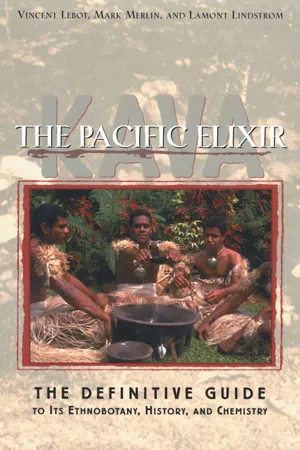
Kava: The Pacific Elixir
eBook - ePub

Kava: The Pacific Elixir

The Definitive Guide to Its Ethnobotany, History, and Chemistry

  1. 272 pages
  2. English
  3. ePUB (mobile friendly)
  4. Available on iOS & Android
eBook - ePub

Kava: The Pacific Elixir

The Definitive Guide to Its Ethnobotany, History, and Chemistry

About this book

• The most comprehensive book ever written on nature's most effective stress-relieving plant. • First paperback edition of the classic comprehensive text originally published by Yale University Press. This complete guide to kava summarizes the literature and research on a plant that is now considered comparable or superior to anti-stress prescription drugs, and describes its use in the religious, political, and economic life of the Pacific islands for centuries. Beyond its soporific qualities kava is also used throughout the the Pacific as an analgesic, a diuretic, and an anesthetic. There is even evidence suggesting it is effective in the treatment of asthma, tuberculosis, and venereal disease. Exhaustively researched, Kava: The Pacific Elixir offers an extensive survey of this amazing plant from the perspective of the horticulturist, the ethnobotanist, and the pharmacologist.
Frequently asked questions

Yes, you can cancel anytime from the Subscription tab in your account settings on the Perlego website. Your subscription will stay active until the end of your current billing period. Learn how to cancel your subscription.
No, books cannot be downloaded as external files, such as PDFs, for use outside of Perlego. However, you can download books within the Perlego app for offline reading on mobile or tablet. Learn more here.
Perlego offers two plans: Essential and Complete
  • Essential is ideal for learners and professionals who enjoy exploring a wide range of subjects. Access the Essential Library with 800,000+ trusted titles and best-sellers across business, personal growth, and the humanities. Includes unlimited reading time and Standard Read Aloud voice.
  • Complete: Perfect for advanced learners and researchers needing full, unrestricted access. Unlock 1.4M+ books across hundreds of subjects, including academic and specialized titles. The Complete Plan also includes advanced features like Premium Read Aloud and Research Assistant.
Both plans are available with monthly, semester, or annual billing cycles.
We are an online textbook subscription service, where you can get access to an entire online library for less than the price of a single book per month. With over 1 million books across 1000+ topics, we’ve got you covered! Learn more here.
Look out for the read-aloud symbol on your next book to see if you can listen to it. The read-aloud tool reads text aloud for you, highlighting the text as it is being read. You can pause it, speed it up and slow it down. Learn more here.
Yes! You can use the Perlego app on both iOS or Android devices to read anytime, anywhere — even offline. Perfect for commutes or when you’re on the go.
Please note we cannot support devices running on iOS 13 and Android 7 or earlier. Learn more about using the app.
Yes, you can access Kava: The Pacific Elixir by Vincent Lebot,Mark Merlin,Lamont Lindstrom in PDF and/or ePUB format, as well as other popular books in Medicine & Alternative & Complementary Medicine. We have over one million books available in our catalogue for you to explore.
1. Introduction
Kava (Piper methysticum Forst. f,), a member of the pepper family Piperaceae, is an outstanding ethnopharmacological species. The drug is, or once was, consumed in a wide range of Pacific Ocean societies, from coastal areas on the large Melanesian island of New Guinea in the west to isolated Polynesian Hawai'i, 7000 kilometers distant to the northeast. Kava is a handsome shrub that is propagated vegetatively, as are most of the Pacific's major traditional crops. Its active principles, a series of kavalactones, are concentrated in the rootstock and roots. Islanders ingest these psychoactive chemicals by drinking cold-water infusions of chewed, ground, pounded, or otherwise macerated kava stumps and roots.
One concern of this book is to pinpoint the place in the Pacific region where kava was first domesticated. Of the Pacific's two main traditional drug plants, kava is the indigenous species. The other, a palm (Aeca catechu), whose fruit is commonly called betel or betelnut, appears to have been domesticated in the vicinity of the Malay Peninsula and is used today throughout much of mainland and island Southeast Asia (Marshall 1987).
When European explorers first landed on remote Pacific islands, they encountered societies in which kava drinking was an integral part of religious, political, and economic life (figures 1.1, 1.2, and 1.3). Although cultivation and use of the plant has virtually disappeared from eastern Polynesia and Kosrae Island (previously Kusaie) in Micronesia, kava remains an important psychoactive drug in much of Melanesia, in most of the islands of western Polynesia (including Samoa and Tonga), and on Pohnpei Island in Micronesia (see appendix A).
Scientific observation of the use of kava dates to the earliest European voyages of exploration (figure 1.4). The eighteenth-century British explorer James Cook noted in his log that venturesome members of his crew who sampled heavy doses of the drug seemed to experience symptoms similar to those induced by opium. Cook's comparison was inaccurate, for kava is neither a hallucinogen nor a stupefacient. Rather, the drug is a mild narcotic, a soporific, a diuretic, and a major muscle relaxant.
Given the plant's complex and subtle psychoactivity, it is difficult to categorize in the terms of common drug classification schemes. Schultes and Hoffman (1979) follow Lewin (1924) and typify kava as both a narcotic and a hypnotic. Siegel (1989) describes the plant as a sedative hypnotic. The psychoactive potency of the drug can vary considerably, from very weak to quite strong. Kava may induce sociability, feelings of peace and harmony, and, in large doses, sleep, or it may fail to produce relaxation and provoke nausea. Typically, however, kava evokes an atmosphere of relaxation and easy sociability among drinkers. Although we use the terms intoxication, drunkenness, and inebriation to describe human physiological reaction to the plant, the state differs from that induced by ethanol or other familiar drugs found in the Western world.
image
Figure 1.1. "Poulaho, King of the Friendly Islands [Tonga) Drinking Kava," by J. Webber, artist on Captain James Cook's third voyage to the Pacific (courtesy of Hawaii State Archives, Honolulu).
image
Figure 1.2. Nineteenth-century studio photograph of kava preparation, Fiji (courtesy of the British Museum, Department of Ethnography).
image
Figure 1.3. Samoan taupou (ceremonial virgin) prepares kava (courtesy of Bishop Museum, Honolulu).
Kava has a strong but not unpleasant smell. Its taste, which can be acrid and astringent, has been characterized as earthy (or "like dirt" by less friendly drinkers). The botanist J. G. Forster (1777), who sailed with Cook on his first exploratory voyage, described kava infusions he sampled in Polynesia as either tasteless or mildly peppery. (We may assume that his sample was watered down; the flavor of kava is normally strong.) Like tobacco and coffee, kava for most people is an acquired taste.
The most reliable evidence suggests that cultivated kava derives from a wild progenitor, Piper wichmannii C. DC., a fertile Piper indigenous to New Guinea, the Solomon Islands, and Vanuatu (previously the New Hebrides). Although many Western botanists distinguish P. wichmannii from P. methysticum, we argue that there now exist convincing morphological, chemical, and genetic grounds for considering these two taxa of Piper to be wild and cultivated forms of the same species. Piper methysticum consists of sterile cultivars cloned ultimately from P. wichmannii in an ongoing selection process. When we speak of kava, or the kava drink, therefore, we refer in the main to what botanists know as P. methysticum, although Pacific Islanders also cultivate and use as kava several varieties of the plant that botanists label P. wichmannii. We also use the word kava synonymously, as do Pacific Islanders, to refer to both the plant itself and the psychoactive beverage made from its rootstock.
image
Figure 1.4. Piper methysticum, drawn in 1769 by Sydney Parkinson, the expeditionary artist on Captain James Cook's first voyage to the Pacific.
Today P. methysticum is a cultivated plant comprising many different cultivars grown widely throughout the insular tropical Pacific region. Each cultivar has specific requirements and a much more restricted range of distribution than P. methysticum as a whole. A remarkable variability in cultivar characters has developed over many generations of human selection of clones best adapted to the diverse local climates and soils.
The prehistory of the discovery and settlement of the remote tropical Pacific Islands has been a popular object of speculation and debate since the 1700s. It now is clear that Pacific Island peoples, along with most of their domesticated plant and animal assemblages, originated in Southeast Asia. Humans first colonized Sahul, the large land area of New Guinea and Australia (then connected by a land bridge), at least 40,000 years ago (Bellwood 1978). They reached the nearby islands of western Melanesia somewhat later (e.g., New Ireland circa 32,000 B.P.), and the western Solomon Islands circa 29,000 B.P.; Allen, Gosden, and White 1988). Until about 4000 years B.P., human settlement in the Pacific was restricted to these westernmost islands of Melanesia. Since then migrants in sailing canoes have located and populated all of the remaining inhabitable tropical and subtropical islands of the central and eastern Pacific.
The first settlers of Sahul foraged for food and other useful resources among the native plants and animals of newly occupied territories. Some of these people adopted agriculture at an early date. Archaeologists have found evidence of intensive agriculture in the highlands of New Guinea dating perhaps as far back as 9000 B.P. and certainly to 6000–5500 B.P. (Bellwood 1979; Golson 1985). Some prehistorians argue for an independent development of agriculture in New Guinea—perhaps even predating the emergence of agriculture in neighboring Southeast Asia. Others suggest, rather, that agriculture emerged simultaneously and independently in Southeast Asia and New Guinea.
Although some Pacific cultivars, such as fruited Pandanus, sugarcane, and the Australimusa banana, have been identified as New Guinea domesticates (Barrau 1965; Yen 1985, 1991), the major Pacific staple root crops, such as yams (Dioscorea spp.) and taros (Colocasia esculenta, Cyrtosperma chamissonis, and Alocasia macrorrhyza), appear to have been first cultivated farther to the west and traded or carried into New Guinea and the rest of the Pacific by migrant groups. As noted above, the Areca catechu palm, the other major Pacific drug plant, also probably has Southeast Asian origins and an easterly pattern of diffusion into the Pacific Islands region.
Not all of the Pacific's traditional crops trace back to Southeast Asian or New Guinean roots. Yen provides numerous examples of species he believes were domesticated or selected by central Pacific farmers (Yen 1985, 1991). He suggests that "the Oceanians retained (or reinvented) the ethnobotanical concepts of domestication throughout their geographical spread and individual paths of development" (1985). We argue that kava, too, is a Pacific domesticate that originated outside Southeast Asia and New Guinea. We suggest that farmers in the northern islands of Vanuatu were the first to select and develop the species as a vegetatively reproduced root crop. Given the archaeological evidence of the relatively recent arrival of humans in eastern Melanesia, a Vanuatu origin for kava suggests that P. methysticum is a fairly young domesticate—perhaps less than 3000 years old. From Vanuatu, kava was carried eastward into Fiji and Polynesia and westward into scattered areas of New Guinea and into two islands of central Micronesia. We dispute some recent speculation that kava may first have been domesticated in the neighborhood of the Bismarck Archipelago off northeastern New Guinea (Brunton 1989; cf. Yen 1991). The botanical, genetic, and chemical evidence that supports our assertion of kava's Vanuatu origins and its westward diffusion to New Guinea, Pohnpei, and Kosrae is provided in chapters 2, 3, and 4 of this book.
Few human cultures are unacquainted with psychoactive drugs of some sort. Reflecting on the consumption of self-administered drugs by laboratory animals, some pharmacologists have concluded that" animal data strongly suggest that from a biological viewpoint drug-seeking behavior is normal" (Schuster, Renault, and Blaine 1979). Jaffe similarly has noted that "drugs themselves are powerful reinforcers, even in the absence of physical dependence" (1985). According to Siegel (1989), "there is a natural force that motivates the pursuit of intoxication. This biological force has found expression throughout history. . . . It has led to the discovery of many intoxicants, natural and artificial, and to demonstrations of its irrepressible drive" (see also Weil 1972).
If humans are biologically attracted to psychoactive chemicals, one might easily imagine members of isolated Pacific island communities having the desire and curiosity to experiment with locally available flora. If the people who undertook remarkable voyages of discovery to the far-flung island groups of the Pacific neglected to bring along in their canoes any previously known psychoactive species, they may have been particularly motivated to seek out and experience alternatives, such as P. wichmannii, from available native flora.
In addition to the ordinary human proclivities toward drug use and the self-reinforcing character of psychoactive chemicals themselves, a cultural rationale for the ethnobotanical pursuit and domestication of drug species has been identified by the anthropologist W. La Barre. Most traditional religions worldwide—with the exceptions of the great monotheistic religions based on well-established written traditions, such as as Judaism, Christianity, and Islam—rely on revelation and inspiration for the production of religious knowledge and experience. Drugs are frequently an integral means to achieve psychic states amenable to religious inspiration. Referring to New World peoples, La Barre (l970) writes, "Whether shaman alone, or shaman and communicants, or communicants alone imbibe or ingest the Ilex black drink, datura infusions, tobacco in whatever forms, native beers and wines, peyote cactus, ololiu seeds, mushrooms, narcotic mint leaves or coca, the ayahausca (Banisteriopsis caapt) or 'death vine'—or any of the vast array of Amerindian psychedelics-the principle is the same. These plants contain spirit power." Given the common importance of revelatory religious experience, humans can be culturally programmed, as well as naturally inclined, to search for and experiment with mind-altering plants to gain insight into human existence. Drugs provide a means by which people can establish and maintain communication with their ancestors and deities. Harner (1973), following La Barre, notes: "We of a literate civilization may get both our religion and our religious proofs from books; persons in non-literate societies often rely upon direct confrontation with the supernatural for evidence for religious reality. Such divine communication may be induced by fasting, flagellation, sensory deprivation, yogic exercises, meditation, or ritual dancing or drumming; but predominantly it is induced through the consumption of psychoactive drug-plants."
Kava acts to transport imbibers to the realm of ancestors and gods. Although the relative importance of kava's religious and secular functions varies from island to island within Polynesia, Melanesia, and Micronesia, everywhere the drug serves (or served) as a means of religious inspiration. Kava drinking is "an important kind of ritual, usually involving the invocation of ancestral spirits" (Kirch 1984). Kava can thus be compared with many other psychoactive plants utilized by people around the world to transcend normal consciousness and experience and to reinforce and validate spiritual beliefs (see Schultes and Hofmann 1979; Wasson 1980).
We can surmise that the prehistoric peoples who first colonized the tropical Pacific Islands had powerful religious and biological motivations to investigate the mind-altering potentials of the plants native to their new island homes. The floral and faunal inventory of remote Pacific landfalls, however, is notably depauperate. The floral assemblages of even the higher, larger, and more ecologically diverse volcanic islands lack the typical variety of most tropical continental ecosystems because of the great dispersal barrier of the Pacific Ocean. Settlers in Vanuatu, for example, were confronted by as few as 1500 plant species (Cabalion and Morat 1983). In spite of this limited botanical biodiversity, they succeeded in locating, selecting, and domesticating a valuable ethnopharmacological species with prized psychoactive effects.
It is possible that humans were initially attracted to wild P. wichmannii because of its therapeutic effects. People from several northern Vanuatu islands still utilize this plant as a folk medicine. Significantly, a survey of folk medicines in Papua New Guinea discovered no therapeutic uses of P. wichmannii in areas where it grows naturally today (Holdsworth 1977). A vastly larger and more westerly land mass than Vanuatu, New Guinea has a floral assemblage of 1465 genera in 246 families (van Balgooy 1976), which is many times greater than that of Vanuatu. It may be that the relative impoverishment of the Vanuatu flora both required and enabled settlers to scrutinize the therapeutic and psychoactive potential of local species more intensively. In New Guinea, if residents overlooked the potentials of P. wichmannii, they did discover a spectrum of other psychoactive species. These include fungi (e.g., Boletus spp., Heimiella spp., Russula spp.), wild gingers (Alpinia spp., Hornstedtia spp., Zingiber spp.), and a variety of other potent tree leaves, barks, and saps, many of which do not occur on the more remote Pacific islands (see Schultes and Hofmann 1979; Marshall 1987).
Following its initial discovery, domestication, and diffusion throughout the eastern and central Pacific, kava became an integral part of island religious, economic, political, and social life. In the Pacific today, although some Islanders have abandoned its use, its traditional functions are being maintained and it is being developed into an important cash crop. The plant attracts a wide range of contemporary interest. For prehistorians and linguists, its distribution provides traces of the migrations of Oceanic peoples. For anthropologists and sociologists, the drug facilitates social interaction. For theologians, kava consumption is a religious act. For political scientists, kava ritual today symbolizes new national identities and unity within postcolonial Pacific states. Botanists are intrigued by the problems of defining the species and by the sterility of its cultivars. Geneticists have begun to survey its zymotypes and chemotypes. Agronomists view the plant as an increasingly valuable cash crop suited to the traditional agricultural practices of subsistence farmers. National development officials in some Melanesian countries suggest that investments in kava cultivation may generate desperately needed export earnings for newly independent Pacific Island nations. Pharmacologists search rain forests and folk medicinal systems for useful new therapies. And kava drinkers themselves may want to know more about their daily dose.
In the following chapters we discuss all these aspects of the Pacific drug. Ch...

Table of contents

  1. Cover Image
  2. Title Page
  3. Acknowledgments
  4. Table of Contents
  5. Chapter 1. Introduction
  6. Chapter 2. Botany: Morphology, Biogeography, and Origin of the Species
  7. Chapter 3. Chemistry: Active Principles and Their Effects
  8. Chapter 4. Ethnobotany: Cultivation, Classification, Preparation, and Medicinal Use
  9. Chapter 5. Anthropology: The Cultural Significance and Social Uses of Kava
  10. Chapter 6. Economics: Kava as a Cash Crop
  11. Chapter 7. Kava: A World Drug?
  12. Appendix A. Geographical Distribution of Past and Present Kava Use
  13. Appendix B. Names for Kava in New Guinea
  14. Appendix C. Names for Kava in Vanuatu
  15. Appendix D. Piper wichmannii and Piper methysticum Morphotypes
  16. Appendix E. Chemotypes, Morphotypes, and Zymotypes of Wild and Cultivated Forms of Kava
  17. Appendix F. Most Common Vanuatu Cultivars by Geographical Region
  18. Bibliography
  19. For further reading in Ethnobotany ...
  20. About the Authors
  21. About Inner Traditions • Bear & Company
  22. Books of Related Interest
  23. Copyright & Permissions
  24. Index