An introduction to the innovative therapy that restores optimal functioning of the brain after physical or emotional trauma
• Provides an alternative to the more invasive therapies of electroshock and drugs
• Shows how this therapy helps ameliorate anxiety and depression as well as childhood developmental disorders
• Includes extraordinary case histories that reveal the powerful results achieved
According to the Centers for Disease Control, each year 260,000 people are hospitalized with traumatic brain injuries. The Brain Injury Association reports 1.5 million injuries, many of which go undiagnosed but which lead to all kinds of cognitive and emotional impairments. While neuroscience has learned an enormous amount about the connection between brain trauma and personality changes, the methods proposed for resolving these alterations are generally limited to drug therapy or surgeries.
This book explores a much less invasive but highly effective technique of restoring brain function: the Low Energy Neurofeedback System (LENS). Developed by Dr. Len Ochs in 1992, it has had extraordinary results using weak electromagnetic fields to stimulate brain-wave activity and restore brain flexibility and function. The treatment works across a broad spectrum of human activity, increasing the brain’s abilities to adapt to the imbalances caused by physical trauma or emotional disorders--both on the basic level and in the more subtle areas of cognitive, affective, and spiritual processes that make us truly human. While the treatment has had remarkable results with individuals who have experienced severe physical trauma to the head and brain, Stephen Larsen sees it also as an important alternative to chemical approaches for such chronic behavioral disorders as ADHD and monopolar and bipolar depression.
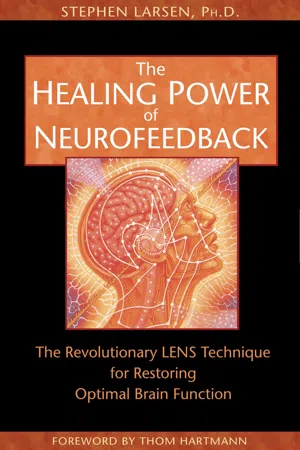
eBook - ePub
The Healing Power of Neurofeedback
The Revolutionary LENS Technique for Restoring Optimal Brain Function
- 456 pages
- English
- ePUB (mobile friendly)
- Available on iOS & Android
eBook - ePub
The Healing Power of Neurofeedback
The Revolutionary LENS Technique for Restoring Optimal Brain Function
About this book
Information
Topic
MedicineTable of contents
- Cover
- Title Page
- Dedication
- Acknowledgments
- Contents
- Foreword by Thom Hartmann
- Preface by Len Ochs, Ph.D.
- Introduction: Flexible Brain, Quiet Mind
- 1. The LENS in Clinical Practice
- 2. A Brief History of EEG Neurofeedback
- 3. The Development of the LENS Approach
- 4. Traumatic Brain Injury (TBI) and Spinal Injury and the LENS
- 5. Healing the Mind of Childhood: Cerebral Palsy, Reactive Attachment Disorder, Autism, Asperger’s Syndrome, ADD/ADHD, and Learning Disabilities
- 6. The Twilight Zone: Fibromyalgia, Lyme Disease, and Chronic Fatigue Syndrome
- 7. High Anxiety, Deep Depression: Panic, Obsessive-Compulsive Disorder, Anxiety, Phobia, Depression, and Bipolar Disorder
- 8. The Divine Madness: Epilepsy, Explosive Disorders, Tourette’s Syndrome, and Tics
- 9. Life Hurts: Post-Traumatic Stress Disorder, Pain, and Bereavement
- 10. Brain Attack: Aneurysm, Stroke, Alzheimer’s Disease, Parkinson’s Disease, and Headache
- 11. Alternative Approaches to Evaluation and Treatment Using the LENS Perspective
- 12. The LENS and Other Modalities: Psychotherapy, Conventional Biofeedback/Neurofeedback, HeartMath, Photonic Stimulation, Interactive Metronome, Deep Vascular Relaxation, Nutritional Support, Sudarshan Kriya Yoga, Qi Gong, and Open Focus
- 13. Speculations on Physics, Energy Psychology, Chaos Theory, and Magnetite in the Brain
- 14. The LENS with Animals: Improving the Behavior, Temperament, and Flexibility of Horses, Dogs, and Cats
- 15. Postscript: The Tao of LENS—Positive Psychology and Optimal Performance
- Resources
- Glossary of Acronyms
- Glossary of Diseases/Conditions
- Glossary of Healing Modalities
- Footnotes
- Notes
- Bibliography
- About the Contributors
- About the Author
- About Inner Traditions
- Copyright
Trusted by 375,005 students
Access to over 1.5 million titles for a fair monthly price.
Study more efficiently using our study tools.
Frequently asked questions
Yes, you can cancel anytime from the Subscription tab in your account settings on the Perlego website. Your subscription will stay active until the end of your current billing period. Learn how to cancel your subscription
No, books cannot be downloaded as external files, such as PDFs, for use outside of Perlego. However, you can download books within the Perlego app for offline reading on mobile or tablet. Learn how to download books offline
Perlego offers two plans: Essential and Complete
- Essential is ideal for learners and professionals who enjoy exploring a wide range of subjects. Access the Essential Library with 800,000+ trusted titles and best-sellers across business, personal growth, and the humanities. Includes unlimited reading time and Standard Read Aloud voice.
- Complete: Perfect for advanced learners and researchers needing full, unrestricted access. Unlock 1.5M+ books across hundreds of subjects, including academic and specialized titles. The Complete Plan also includes advanced features like Premium Read Aloud and Research Assistant.
We are an online textbook subscription service, where you can get access to an entire online library for less than the price of a single book per month. With over 1.5 million books across 990+ topics, we’ve got you covered! Learn about our mission
Look out for the read-aloud symbol on your next book to see if you can listen to it. The read-aloud tool reads text aloud for you, highlighting the text as it is being read. You can pause it, speed it up and slow it down. Learn more about Read Aloud
Yes! You can use the Perlego app on both iOS and Android devices to read anytime, anywhere — even offline. Perfect for commutes or when you’re on the go.
Please note we cannot support devices running on iOS 13 and Android 7 or earlier. Learn more about using the app
Please note we cannot support devices running on iOS 13 and Android 7 or earlier. Learn more about using the app
Yes, you can access The Healing Power of Neurofeedback by Stephen Larsen in PDF and/or ePUB format, as well as other popular books in Medicine & Alternative & Complementary Medicine. We have over 1.5 million books available in our catalogue for you to explore.