A practical guide to the correspondence between emotion, organ systems, and disease
• Identifies what emotional shocks will engender illnesses specific to a certain part of the body
• Shows how illness is an ally that enables individuals to restore balance to their health
Biogenealogy is a comprehensive new vision of health that takes the mind-body connection one step further by identifying and consciously addressing the emotional shocks that create physical disorders. Each symptom of an illness precisely indicates its emotional origin. Thus, far from being an enemy, the physical symptom is actually a valuable ally that provides the key to the cure of the physical disease as well as resolution of the emotional imbalance that created it.
Christian Flèche, the leading researcher and practitioner in the field of biogenealogy, explains that the “activation of illness” is the body’s reaction to unresolved events that are frozen in time. These unresolved traumas affect the body on the cellular level and manifest in minor as well as more serious chronic conditions. In The Biogenealogy Sourcebook, Flèche systematically chronicles all the major organs of the body and specifies the types of emotional conflicts that lead to illness in those areas. For example, he explains that conflicts of separation are evidenced in diseases of the skin; a reduction of self-worth or deep anguish will manifest in the lymph nodes. He also shows that unresolved emotional issues can also be passed down to future generations if left untreated.
Intended for therapists, researchers, and any person who wants to take his or her health in hand, this book is an important guide to understanding and decoding the causes and not just the effects of illness.
eBook - ePub
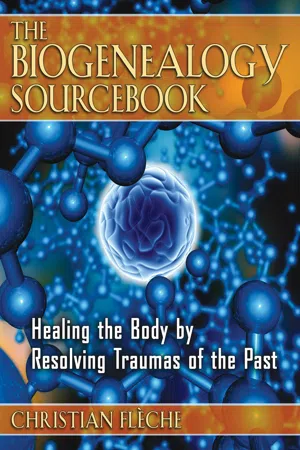
The Biogenealogy Sourcebook
Healing the Body by Resolving Traumas of the Past
- 224 pages
- English
- ePUB (mobile friendly)
- Available on iOS & Android
eBook - ePub
About this book
Information
Topic
MédecineTable of contents
- Cover Image
- Title Page
- Dedication
- Table of Contents
- Acknowledgments
- Preface
- Introduction
- Chapter 1: Cardiology
- Chapter 2: Dermatology
- Chapter 3: Digestive System
- Chapter 4: Endocrinology
- Chapter 5: Hematology
- Chapter 6: Neurology
- Chapter 7: Ophthalmology
- Chapter 8: Osteology and the Musculoskeletal System
- Chapter 9: Otolaryngology: Ear, Nose, and Throat
- Chapter 10: Pulmonology
- Chapter 11: Reproductive System: Andrology
- Chapter 12: Reproductive System: Gynecology
- Chapter 13: Urology
- Conclusion
- Glossary
- Footnotes
- About the Author
- About Inner Traditions • Bear & Company
- Books of Related Interest
- Copyright & Permissions
- Index
Trusted by 375,005 students
Access to over 1.5 million titles for a fair monthly price.
Study more efficiently using our study tools.
Frequently asked questions
Yes, you can cancel anytime from the Subscription tab in your account settings on the Perlego website. Your subscription will stay active until the end of your current billing period. Learn how to cancel your subscription
No, books cannot be downloaded as external files, such as PDFs, for use outside of Perlego. However, you can download books within the Perlego app for offline reading on mobile or tablet. Learn how to download books offline
Perlego offers two plans: Essential and Complete
- Essential is ideal for learners and professionals who enjoy exploring a wide range of subjects. Access the Essential Library with 800,000+ trusted titles and best-sellers across business, personal growth, and the humanities. Includes unlimited reading time and Standard Read Aloud voice.
- Complete: Perfect for advanced learners and researchers needing full, unrestricted access. Unlock 1.5M+ books across hundreds of subjects, including academic and specialized titles. The Complete Plan also includes advanced features like Premium Read Aloud and Research Assistant.
We are an online textbook subscription service, where you can get access to an entire online library for less than the price of a single book per month. With over 1.5 million books across 990+ topics, we’ve got you covered! Learn about our mission
Look out for the read-aloud symbol on your next book to see if you can listen to it. The read-aloud tool reads text aloud for you, highlighting the text as it is being read. You can pause it, speed it up and slow it down. Learn more about Read Aloud
Yes! You can use the Perlego app on both iOS and Android devices to read anytime, anywhere — even offline. Perfect for commutes or when you’re on the go.
Please note we cannot support devices running on iOS 13 and Android 7 or earlier. Learn more about using the app
Please note we cannot support devices running on iOS 13 and Android 7 or earlier. Learn more about using the app
Yes, you can access The Biogenealogy Sourcebook by Christian Flèche in PDF and/or ePUB format, as well as other popular books in Médecine & Médecine alternative et complémentaire. We have over 1.5 million books available in our catalogue for you to explore.