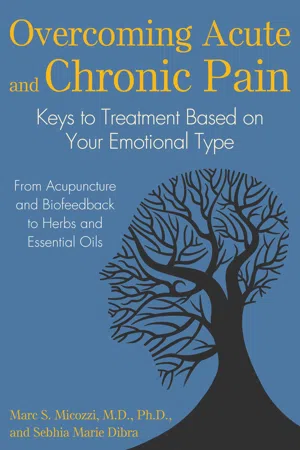
Overcoming Acute and Chronic Pain
eBook - ePub

Overcoming Acute and Chronic Pain

Keys to Treatment Based on Your Emotional Type

  1. 288 pages
  2. English
  3. ePUB (mobile friendly)
  4. Available on iOS & Android
eBook - ePub

Overcoming Acute and Chronic Pain

Keys to Treatment Based on Your Emotional Type

About this book

Find the holistic treatment that will work best for you based on your emotional type and specific pain condition• Provides an easy questionnaire to determine your emotional type and an interactive self-assessment for finding the right pain treatment for your condition• Explores mind-body treatments for many common pain conditions, including arthritis, back pain, fibromyalgia, irritable bowel, migraines, carpal tunnel, and PTSD• Reviews the scientific evidence in support of acupuncture, biofeedback, hypnosis, massage, chiropractic, yoga, herbs, and essential oilsThroughout history many healing traditions have focused on analgesia--the alleviation of pain--an area in which modern medicine provides few options beyond narcotics, steroids, and surgery. For those seeking drug- and surgery-free alternatives or complements to conventional pain management, the choices can be overwhelming. How do you know which method will work for you?In this guide to safe and effective natural therapies for acute and chronic pain, authors Marc S. Micozzi, M.D., Ph.D., and Sebhia Marie Dibra explain how your emotional boundary style--how you react to emotional, social, environmental, and physical stresses--affects which complementary treatments will work best for you. Providing an easy questionnaire to determine your emotional type and an interactive self-assessment for finding the right pain treatment for your condition, they explore the effectiveness of mind-body treatments for each emotional type and for many common pain disorders, including arthritis, back pain, fibromyalgia, irritable bowel, ulcer, migraine headaches, carpal tunnel, anxiety, PTSD, and other chronic pain conditions. They review the available research and scientific evidence in support of each therapy, suggesting only well-established, safe, and clinically proven alternative treatments, such as acupuncture, biofeedback, hypnosis, massage, chiropractic, yoga, herbs, and essential oils.Approaching pain holistically, they reveal how pain should be understood as a dynamic condition--an interaction between mind and body as well as between patient and therapy--and how your emotional type is key to long-lasting and successful results.
Frequently asked questions

Yes, you can cancel anytime from the Subscription tab in your account settings on the Perlego website. Your subscription will stay active until the end of your current billing period. Learn how to cancel your subscription.
No, books cannot be downloaded as external files, such as PDFs, for use outside of Perlego. However, you can download books within the Perlego app for offline reading on mobile or tablet. Learn more here.
Perlego offers two plans: Essential and Complete
  • Essential is ideal for learners and professionals who enjoy exploring a wide range of subjects. Access the Essential Library with 800,000+ trusted titles and best-sellers across business, personal growth, and the humanities. Includes unlimited reading time and Standard Read Aloud voice.
  • Complete: Perfect for advanced learners and researchers needing full, unrestricted access. Unlock 1.4M+ books across hundreds of subjects, including academic and specialized titles. The Complete Plan also includes advanced features like Premium Read Aloud and Research Assistant.
Both plans are available with monthly, semester, or annual billing cycles.
We are an online textbook subscription service, where you can get access to an entire online library for less than the price of a single book per month. With over 1 million books across 1000+ topics, we’ve got you covered! Learn more here.
Look out for the read-aloud symbol on your next book to see if you can listen to it. The read-aloud tool reads text aloud for you, highlighting the text as it is being read. You can pause it, speed it up and slow it down. Learn more here.
Yes! You can use the Perlego app on both iOS or Android devices to read anytime, anywhere — even offline. Perfect for commutes or when you’re on the go.
Please note we cannot support devices running on iOS 13 and Android 7 or earlier. Learn more about using the app.
Yes, you can access Overcoming Acute and Chronic Pain by Marc S. Micozzi, Sebhia Marie Dibra in PDF and/or ePUB format, as well as other popular books in Medicine & Alternative & Complementary Medicine. We have over one million books available in our catalogue for you to explore.
PART ONE
image
Mind-Body Techniques for Pain
1
Pain and Your Emotional Type
The current epidemic of prescription pain-medication use and abuse in the United States has led to government calls for reducing our dependence on them, as well as for reducing the hazard of abuse of these narcotics. In 2015, after a century of improving health and declining death rates among women in this country, the Urban Institute released a study showing dramatically increasing death rates among women, due primarily to the increase in the use of these dangerous narcotic pain drugs. Perhaps even more shocking is data from the National Academy of Sciences, analyzed by the 2015 Nobel laureate in economics, Angus Deaton, showing that the death rate among middle-aged, middle-class white people has increased by 22 percent in just the past fifteen years.1 The leading cause of death in this population is overdose of narcotic drugs and alcohol, whether intentional or accidental. No group of people anywhere in the world in our modern era has shown an increase in the death rate to this extent, and no population in history has shown such a great increase in the death rate in such a short time, with the exception of a disease epidemic or an ecological calamity of global proportions.
In addition, popular over-the-counter pain relievers like acetaminophen (Tylenol, Panadol) have long been known to be the leading cause of fatal liver toxicity in the United States; even worse is recent research showing that these medications are not even effective for back pain and other common pain conditions.
WHAT IS PAIN?
Pain is a complex perceptual phenomenon and the dynamic product of multiple neural circuits, as pain signals are transmitted in specialized nerve receptors along neurons, modulated at all levels of the nervous system, and finally processed in the higher cortical brain centers. Until very recently doctors and researchers said they could not locate any specific “pain center” in the brain. However, in 2015, scientists at the University of Oxford, England, identified an area of pain or a pain center in the brain located in the dorsal (top portion of the brain) posterior insular cortex. Activity in this area of the brain matched study participants’ self-reported pain-rating intensities. Researchers were able to find this area by developing a new method of tracking brain activity, which allowed more complex brain states to be analyzed. The results show that it may be possible to help control pain perception directly in the brain.2
Acute pain is the result of active tissue damage and the release of inflammatory and chemical pain mediators in any pain-sensitive tissue. Chronic pain states may result from a number of different processes occurring in the peripheral and central nervous-system tissues. Chronic pain may result from an abnormal peripheral or central pain “generator.” This type of pain is generally called “neuropathic pain.”
THE PERSONALITY BOUNDARY TYPE
Fortunately, there are safe, natural, affordable alternatives for relieving pain that are readily available today and have been hiding in plain sight. To learn which mind-body natural approaches will work best for you, it is important to understand a psychometric indicator developed over several decades at Tufts University Medical Center in Boston by the late Ernest Hartmann, MD, called “personality boundary type.” The application of this concept is related to the hypnotic susceptibility or suggestibility scales developed in the last century by American psychiatrist Herbert Spiegel, which have proven useful in predicting which 10 percent of patients are highly benefited by hypnosis, which 10 percent are impervious, and which 80 percent fall on a scale in between. Marc Micozzi and colleague Michael Jawer coined the term emotional type for the Hartmann boundary-type psychometric scale and adapted it to predict each person’s susceptibility to various kinds of alternative, nondrug treatments. The interactive tools that allow you to determine your individual boundary or emotional psychometric type, together with an assessment for matching your type to the most effective treatments currently available, are provided in this first chapter.
Two essential truths you should know as you embark on this book are the following: (1) most chronic pain results from both the reception of pain signals by pain sensors in the body and the perception and processing of pain sensation in the mind through nerve circuits in the brain and through various levels of consciousness; and (2) the reception and the perception of pain occur in a feedback loop, each continually aggravating the other until chronic pain is permanently cemented in place. The many mind-body therapies presented in this book can each work for most chronic pain conditions because they address these vital linkages, and the feedback loops between the mind and the body. However, not every mind-body therapy works equally well for everyone with chronic pain.
This brings us to the real breakthrough of finding an effective method of choosing from among all these safe and effective therapies the specific ones that will work best for you as a unique individual, and for your pain condition.
We have just now discovered an important way of understanding how the mind-body perceives and processes pain, as well as emotions, moods, and other feelings that affect and reflect our health. Ernest Hartmann worked over his long career on identifying and understanding the psychological and personality boundaries that affect how we process our feelings, emotions, and sensations. He found that people’s boundaries exist along a continuum of thin boundary to thick boundary on a spectrum of feelings and experiences—that is, how feelings are experienced and how experiences are felt. For example, Hartmann found that thin boundary people tend to be more artistic, more connected to their dreams, and more likely to see themselves “merge” in their relationships with others. Thick boundary people see clear divides between themselves and others and tend to see the world in black and white. People with thin boundaries are more susceptible to dozens of illnesses with stronger mind-body components, such as irritable bowel syndrome.
For the past twenty years Jawer has researched how it is that people with different boundary types are susceptible to different diseases and chronic pain conditions. Micozzi’s own review of thousands of research studies on natural therapies for six editions of his medical textbook Fundamentals of Complementary and Alternative Medicine, together with his understanding of the Hartmann-Jawer boundary types, has enabled the authors of this book to now determine which therapies will work best for you based on where you lie on this mind-body boundary-type spectrum. However, please note that the studies cited on the techniques addressed in this book have not distinguished thick from thin boundary types. Everyone gets thrown together in these studies regardless of boundary type. The fact that they work for people of all types is a powerful indicator of their benefits. We would only expect that study results would be even stronger when study participants are matched to the right therapy for each person.
A LITTLE BACKGROUND ON BOUNDARY TYPES
Boundaries are critical because, simply put, our “selves” require boundaries. Just as the skin is a boundary that protects our body from the outside environment, we also need boundaries around our heart energy and our mental consciousness, particularly when it comes to pain. Your sensitivities and reactions to external stimuli and internal states, especially pain, are determined by your qualities as a thin or thick emotional type. Thin boundary people are highly sensitive in a variety of ways and from an early age. Thick boundary people, on the other hand, are typically described as implacable, rigid, stolid, and thick-skinned. That does not mean that thick boundary people do not feel emotions. They may be unaware of them—but their bodies know. For each healing modality we discuss, we will describe why it would be suitable for certain boundary types (and perhaps not for others) and why it works for those types.
THE BOUNDARY QUESTIONNAIRE
As mentioned, the original BQ was developed by Ernest Hartmann based on research he conducted in the 1980s. The full version consists of 145 questions grouped into a dozen categories, reflecting themes such as “interpersonal,” “thoughts/feelings/moods,” “childhood/adolescence/adult,” and “sleep/dream/waking” (see appendix A for the full questionnaire). So, one can be a thin or thick boundary person overall but score differently along the boundary spectrum within these different categories. No one is reducible to a single “spot” on the boundary spectrum. Each of us is likely to be thin in some respects and thick in others.3
Where you place on the boundary spectrum is not strictly speaking a permanent position over your lifetime. People tend to develop thicker boundaries as they age, but everyone is different. A person may instead develop thinner boundaries as she gets older based on her unique experiences. Someone’s boundaries can even thicken or become thinned based on the medications she takes, or depending on how tired she happens to be.4 However, as a general personality trait, your boundary type won’t vary too much from day to day or from year to year.
A short form of the BQ is presented here. It consists of eighteen questions and usually takes under ten minutes to complete and score. For a quick way to assess your boundary type, the short-form BQ is easiest and most direct.5 We have found that this subset of eighteen questions captures most of the spectrum variability that is obtained in taking the complete, lengthy survey—that is, each of these particular questions in the short survey is highly correlated to the results of the total answers on the other 127 possible questions that are in the long survey. Moreover, the precision of this short survey is comparable to the precision of the research studies that assessed the effectiveness of different mind-body therapies for different pain conditions, which we used in evaluating their association with a specific boundary type.
Please note that there are no “right” or “wrong” responses. Consider these statements merely as prompts intended to feel you out as to where you are at this time in your life. Rate each of the statements from 0 to 4 (0 indicates “not at all true of me”; 4 indicates “very true of me”).
Try to respond to all of the statements as quickly as you can.
SHORT-FORM BOUNDARY QUESTIONNAIRE
1. My feelings blend into one another. 0 1 2 3 4
2. I am very close to my childhood feelings. 0 1 2 3 4
3. I am easily hurt. 0 1 2 3 4
4. I spend a lot of time daydreaming, fantasizing, or in reverie. 0 1 2 3 4
5. I like stories that have a definite beginning, middle, and end. 0 1 2 3 4
6. A good organization is one in which all the lines of responsibility are precise and clearly established. 0 1 2 3 4
7. There should be a place for everything, with everything in its place. 0 1 2 3 4
8. Sometimes it's scary to get too involved with another person. 0 1 2 3 4
9. A good parent has to be a bit of a child too. 0 1 2 3 4
10. I can easily imagine myself as an animal or what it might be like to be an animal. 0 1 2 3 4
11. I can easily imagine myself as an animal or what it might be like to be an animal. 0 1 2 3 4
12. When I work on a project, I don't like to tie myself down to a definite outline. I rather like to let my mind wander. 0 1 2 3 4
13. In my dreams, people sometimes merge into each other or become other people. 0 1 2 3 4
14. I believe I am influenced by forces that no one can understand. 0 1 2 3 4
15. There are no sharp dividing lines between normal people, people with problems, and people who are considered psychotic or crazy. 0 1 2 3 4
16. I am a down-to-earth, no-nonsense kind of person. 0 1 2 3 4
17. I think I would enjoy being some kind of creative artist. 0 1 2 3 4
18. I have had the experience of someone calling me or speaking my name and not being sure whether it was really happening or whether I was imagining it. 0 1 2 3 4
To obtain your score, simply add up the scores from 0 to 4 for all questions. The exceptions are questions 5, 6, 7, and 16, which are scored backward; i.e., for these questions the rating is reversed, such that a score of 0 is scored as 4, a 1 is a 3, a 2 is (still) a 2, a 3 is a 1, and a 4 is scored as 0.*1 Scores below 30 are considered definitely indicative of a thick boundary, and scores above 42 are considered definitely thin. Find out where you are on the spectrum below:
image
It turns out that your boundary type is related to the effectiveness of each of the common mind-body treatments for pain disorders based on our review of available research and scientific evidence. As you will learn from reading this book, there are many alternative mind-body medical treatments being studied for pain. Each of the treatments presented here is well established, safe, and effective and is rapidly becoming widely available. The effectiveness of each of these treatments for pain is evaluated on the basis of what has by now been proven. This information is provided as a useful guide for you. We do not get into any experimental or controversial treatments here. We are addressing only proven treatments that are widely available and have been used for decades, if not longer. The added benefit is that now you can determine which of these treatments is right for you based on your boundary type. If you find a treatment on this list, it is a reasonable that you can safely try it out.
THE RIGHT TREATMENTS FOR YOUR TYPE
Listed here in terms of their effectiveness are some of the major mind-body treatments for common and significant pain disorders. Then we score the degree of specificity for each treatment for your boundary type. Armed with this guide and knowledge of your boundary type, you can begin to select the right treatments for your specific pain condition.
The tables (below) show thick and thin boundary conditions, as well as the anxiety and depression that usually accompany all these disorders, and the relative effectiveness of each therapeutic modality for each of these conditions. Based on the available science and research, the treatments are ranked by their effectiveness and potencies on a scale of 1 to 5 relative to one another and relative to the most powerful treatments conventional medicine has to offer in terms of drugs, various procedures, and surgery (even when drugs and surgery are successful, which oftentimes they are not—and they are far more dangerous than any of these treatments). A 1 represents treatments that are somewhat effctive; a 5 represents those that are highly effective. Where no number appears it generally means there is not enough data to evaluate it.
The symptom of chronic pain, as shown in the boundary-independent conditions, typically...

Table of contents

  1. Cover Image
  2. Title Page
  3. Epigraph
  4. Acknowledgments
  5. Table of Contents
  6. Preface: Taking a Natural Approach to Pain
  7. Introduction
  8. Part 1: Mind-Body Techniques for Pain
  9. Part 2: Hands-On Healing
  10. Part 3: Managing Pain with Natural Products
  11. Appendix A: The Boundary Questionnaire
  12. Footnotes
  13. Endnotes
  14. Bibliography
  15. About the Authors
  16. About Inner Traditions • Bear & Company
  17. Books of Related Interest
  18. Copyright & Permissions
  19. Index