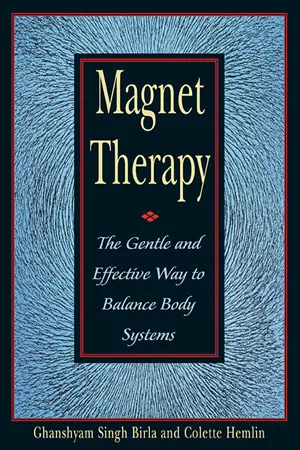
Magnet Therapy
eBook - ePub

Magnet Therapy

The Gentle and Effective Way to Balance Body Systems

  1. 160 pages
  2. English
  3. ePUB (mobile friendly)
  4. Available on iOS & Android
eBook - ePub

Magnet Therapy

The Gentle and Effective Way to Balance Body Systems

About this book

• The complete guide to magnetotherapy--the treatment that promises to revolutionize 21st-century medicine.

• Magnet therapy has been used by more than 100 million people worldwide.

• Clinical studies show magnet therapy to be an effective treatment for back pain, insomnia, high cholesterol and blood pressure, and many other ailments.

The recent discovery of magnetic receptors in the human brain has confirmed what the ancient Chinese, Indians, Egyptians, and Greeks always knew: that human beings are strongly influenced by the Earth's magnetic field, and that by subtly altering our own energy fields with magnets we can restore proper balance to our body systems. This science of magnetotherapy has already been successfully used by more than 100 million people in the United States and around the world. Numerous scientific studies show that many cases of stiff shoulders, back, or neck, unexplained chest pain and frequent headaches, as well as insomnia and general fatigue are actually caused by what is known as Magnetic Deficiency Syndrome, and double-blind tests reveal that magnets have brought rapid relief in 90 percent of these cases.

Magnet Therapy presents the history and science of this fascinating subject, explaining why magnets increase oxygenation in the blood, lower cholesterol and blood pressure, reduce pain, enhance cellular regeneration, and may even inhibit tumor growth. The authors detail methods for treating symptoms ranging from asthma to toothaches and weigh the benefits of magnetic necklaces, magnetic belts, and magnetized water, as well as traditional bipolar magnets. For devotees of alternative medicine, Birla and Hemlin explain how magnetotherapy fits into the context of other practices, such as Ayurveda and traditional Chinese medicine, and how it can be used in conjunction with acupuncture, massage, and other therapies. Complete with case studies and resource listings, Magnet Therapy is the comprehensive guide to what promises to be the next medical revolution.
Frequently asked questions

Yes, you can cancel anytime from the Subscription tab in your account settings on the Perlego website. Your subscription will stay active until the end of your current billing period. Learn how to cancel your subscription.
No, books cannot be downloaded as external files, such as PDFs, for use outside of Perlego. However, you can download books within the Perlego app for offline reading on mobile or tablet. Learn more here.
Perlego offers two plans: Essential and Complete
  • Essential is ideal for learners and professionals who enjoy exploring a wide range of subjects. Access the Essential Library with 800,000+ trusted titles and best-sellers across business, personal growth, and the humanities. Includes unlimited reading time and Standard Read Aloud voice.
  • Complete: Perfect for advanced learners and researchers needing full, unrestricted access. Unlock 1.4M+ books across hundreds of subjects, including academic and specialized titles. The Complete Plan also includes advanced features like Premium Read Aloud and Research Assistant.
Both plans are available with monthly, semester, or annual billing cycles.
We are an online textbook subscription service, where you can get access to an entire online library for less than the price of a single book per month. With over 1 million books across 1000+ topics, we’ve got you covered! Learn more here.
Look out for the read-aloud symbol on your next book to see if you can listen to it. The read-aloud tool reads text aloud for you, highlighting the text as it is being read. You can pause it, speed it up and slow it down. Learn more here.
Yes! You can use the Perlego app on both iOS or Android devices to read anytime, anywhere — even offline. Perfect for commutes or when you’re on the go.
Please note we cannot support devices running on iOS 13 and Android 7 or earlier. Learn more about using the app.
Yes, you can access Magnet Therapy by Ghanshyam Singh Birla,Colette Hemlin in PDF and/or ePUB format, as well as other popular books in Medicine & Alternative & Complementary Medicine. We have over one million books available in our catalogue for you to explore.
Chapter One
image
HISTORY
image
THE HISTORY OF BIOMAGNETISM
Although biomagnetism has only recently begun to be recognized by Western science and medicine, its origins are in fact very old. The effect of magnetic stone on iron has been known since ancient times, and many cultures have believed in the ability of magnets to cure certain illnesses. For centuries the people of India, China, and the eastern Mediterranean basin, as well as Australian aborigines and native Africans, were all familiar with the use of magnets. And certain paintings suggest that the high priests of ancient Egypt used magnets in some of their religious ceremonies.
The therapeutic use of magnetism dates back to very early times. In his book De Simplicium Medicamentorum Temperamentis Ac Facultatibus, the Greek physician Galen noted that magnetism was being used for its purgative powers around 200 B.C. Around A.D. 1000, a Persian physician named Ali Abbas was using magnetism to treat “spasms” and “gout.” In the sixteenth century, Paracelsus, an innovative Swiss physician, claimed to cure “hernias, gout, and jaundice” through the use of magnets. Around the same time, Ambroise Paré, a French surgeon who authored several medical books and later became known as the father of modern surgery, provided instruction on how to heal open wounds and injuries with finely powdered magnetite mixed with honey.*2 However, although these and other individuals understood the effect of magnetic fields on living beings, biomagnetism was not a widely recognized discipline in past centuries.
THE HISTORY OF MAGNETISM
To understand the history of modern biomagnetism, it is necessary to examine the earlier history of magnetism and electromagnetism. Electromagnetism is a relatively new field that emerged only a few hundred years ago, but the knowledge of magnetism goes back to ancient times.
According to legend, a shepherd named Magnes discovered a mineral that attracted the nails of his sandals (or the end of his cane in some versions) as he crossed Mount Ida in Asia Minor some twenty-five hundred years ago. Today, that mineral is known as magnetite. Other sources claim that the word “magnetism” comes from Magnesia, a city in ancient Asia Minor where the stone could be found. At some point it was observed that when a magnet is left free to spin, it always comes to rest in the same position. We don’t know exactly when this discovery was made, except for the fact that in 1269 Pierre de Maricourt differentiated the two poles. During the twelfth century A.D. this characteristic of magnets was being used in navigation by the Arabs, the Vikings, and the Europeans. The use of some form of magnetic compass was also commonly in use by the Chinese around A.D. 100.
However, detailed experiments and observations about the properties of magnetism were not documented until much later. Magnets are mentioned in several documents written before the thirteenth century, but the “broken magnet” experiment, which demonstrates that a magnet is actually composed of many smaller magnets, was not known until A.D. 1269. At that time, European seamen were aware that the magnetic needle of a compass did not always point exactly to the geographic north, a phenomenon recorded by the Chinese of the Tang dynasty almost seven centuries earlier. Although the exact nature of magnetism was not yet known, around 1550 the Flemish cartographer G. Mercator, who created the first map of the world, succeeded in solving, more or less, the problem of locating on a map the geographic north indicated by the magnetic needle. And in 1600, William Gilbert, the official court physician of Queen Elizabeth I, published his famous work De Magnete, which summarizes all that was known and believed about magnetism in the Elizabethan age and attests to the use of magnets in the treatment of illness.
It was not until about two hundred years later in the eighteenth century that the principles of magnetism began to be better understood. At that time, a renewed interest in the study of magnetism was developing throughout Europe among doctors, chemists, and especially physicists. German physician Franz Anton Mesmer was the first in a long line of scientists to claim that the properties of the magnet offered a cure for all illness. When he came to Paris from Vienna in 1778, his doctrine, known as mesmerism, briefly aroused great interest due to some well-publicized cures. Mesmer believed that all living beings are subject to the influence of a “magnetic fluid” that can be collected and rechanneled by “passes” and manipulation. A little later, in 1791, during his famous experiment conducted on frogs to study the effects of electricity on muscles and nerves, Italian physicist Luigi Galvani discovered what he believed to be the “animal magnetism” espoused by Mesmer. However, the spontaneous contractions observed in the experiment were not in fact caused by animal magnetism but rather by electrochemical phenomena.
The modern term “biomagnetism” refers to the study of the sensitivity and reaction of living organisms to the earth’s magnetic field and to artificial magnetic fields having similar intensities. The term is relatively recent and has replaced Mesmer’s term “animal magnetism.”
In 1778, the Dutch physicist Anton Brugmans discovered diamagnetism, a characteristic of those elements (including mercury, silver, and zinc) that are slightly repulsed by magnets. In the eighteenth and early nineteenth centuries, French physicist and engineer Charles-Augustin de Coulomb went on to establish the experimental and theoretical basis of magnetism and electrostatics. He was the first to make quantitative measurements of electric attraction and repulsion and to formulate a law governing these phenomena.
Another contribution to the field of magnetism came from Denmark. In 1820, Danish physicist Hans Christian Ørsted conducted his famous experiment demonstrating that a magnetic needle is deviated by an electric current, which suggested that magnetism could be described in terms of currents, even if those currents could not be observed by the human eye. This observation became the foundation of the field of electromagnetism.
THE BIRTH OF ELECTROMAGNETISM
Until the nineteenth century, electricity and magnetism were treated as two different branches of physics even though many important connections were known to exist between them. After Ørsted’s discovery of electrical currents in 1820, the gifted French scientist, mathematician, and physicist André-Marie Ampère took only a few days to formulate the theory of electromagnetism, and a new field was born. Ampère studied the influence that currents and magnets have on each other and theorized that magnetism is based on the existence of particular currents. He also invented the galvanometer, the first electric telegraph system, and the electromagnet. In the same year as Ørsted’s discovery, French scientist Dominique François Arago demonstrated that an iron bar could be magnetized if it was placed in a solenoid through which an electric current runs. Until that time, the only permanent magnets were those found in nature, and Arago’s discovery led to the manufacture of artificial magnets.
The nineteenth century was the golden era of physics. Throughout Europe, discoveries followed one another at an amazing pace. The English scientist William Sturgeon built the first electromagnet in 1825, using a horseshoe-shaped iron bar coated with varnish (which acted as an insulating agent) and wrapped in bare electric wire. However, the resulting electromagnet was not very strong and could lift only a few grams.
In 1831, a few years after the discovery of electromagnetism, British physicist and chemist Michael Faraday discovered the principle of electromagnetic induction. Electromagnetic induction is the production of electric current in a circuit by variations in the flux of magnetic induction to which the circuit is subjected; most modern electric generators and transformers depend on it. Faraday, who carefully recorded his more than sixteen thousand experiments and research projects, went on to become the father of several other new branches in the field of magnetism, including electromagnetism and magnetic force lines. A year after Faraday’s discovery of electromagnetic induction, American physicist Joseph Henry made the same discovery more than two thousand kilometers away. Faraday was the first to publish his findings and therefore the discovery was attributed to him, but the unit measuring electrical inductance in the International System of Units, henry or H, was named after Joseph Henry.
German astronomer, mathematician, and physicist Carl Friedrich Gauss, who made numerous discoveries in mathematics as well as in astronomy, also chose magnetism as his main field of interest. In 1839 he formulated the mathematical theory of magnetism and invented the magnetometer. His name was given to the magnetic induction unit in the centimeter-gram-second measurement system.
The Scottish physicist James Clerk Maxwell is known mostly for his contribution to the kinetic theory of gases and the discovery of magnetostriction (the phenomenon of substances changing in volume when placed in a magnetic field). However, he is first and foremost the author of the electromagnetic theory of light (1865), for which he devised the general equations of the electromagnetic field. In fact, Maxwell’s theory combines electric and magnetic phenomena, and his equations play the same role in electromagnetism as Newton’s principles and the law of universal gravitation do in the field of mechanics.
English physicist Oliver Heaviside and Dutch scientists H. A. Lorentz and Heinrich Hertz later clarified Maxwell’s theory, which caused the electromagnetism branch of physics to grow considerably. Hertz proved the existence of “Maxwellian waves,” now called short radio-electric waves. The inventor Guglielmo Marconi worked on the practical application of these waves and conducted the first radio transmission in 1896. In 1898 Danish engineer Valdemar Poulsen invented magnetically recorded sound, which many of us could not imagine being without! Many more applications of magnetism soon followed. Today, magnets and the practical application of magnetism are present in almost every aspect of our lives, from the magnetic levitation systems used in transportation and the magnetic resonance devices used in medicine to audio and video systems, personal computers, calculators, and doorbells.
Around 1895, the French physicist Pierre Curie established a clear distinction between paramagnetism, a property of those elements that acquire a weak magnetic charge of the same type as the field they are placed in, and diamagnetism, a property of those elements that acquire a weak magnetic charge opposite to that of the induction field. Based on an observation William Gilbert had made three hundred years earlier, Curie identified a rise in temperature as the characteristic that signaled a change from ferromagnetism, a property of those elements that acquire a strong magnetic charge of the same type as that of the induction field, to paramagnetism, and he discovered that each substance has its own critical temperature point beyond which it loses its ferromagnetic property. The critical temperature at which this change takes place is now known as the Curie point.
image
Fig. 1. Magnetometer
BIOMAGNETISM
Scientific interest in magnetism had almost disappeared by the early twentieth century. However, while most doctors and physicists concentrated their efforts on other areas of study, throughout the world a number of researchers continued the study of magnetism. They usually worked discreetly, as their work was often not taken seriously and was sometimes discredited by their colleagues. Nonetheless, they persisted in their endeavors.
In the mid-1930s, various studies and research reports dealing with magnets and the applications of magnetism to health problems started to emerge. For example, between 1935 and 1937, Dr. William Campbell of Cambridge University studied the physical effects of magnetic fields on rodents and other small animals. In Germany, Dr. H. Bingenheimer attempted to establish the effects of electromagnetic energy on living organisms in the hope of using electromagnetism to stimulate physical development. A little later, between 1956 and 1971, Dr. N. S. Hanoka of the University of Israel studied the effect of magnetic fields on the reduction of infection and the treatment of injuries. Researchers in other countries were involved with various other related studies, some of which confirmed what others had discovered before them.
Today efforts are ongoing to effectively apply magnetic properties to physiology. There have been many experiments and studies conducted in the United States, Germany, Russia, and other countries that have begun to establish the effects of magnetic fields on living organisms, and those experiments continue. However, even though these studies employ rigorous research methods, medical sectarianism often discounts therapies based on magnetism, as it does other alternative treatments and therapies. The development of biomagnetism has also been hindered by a lack of necessary equipment. Instruments able to measure very low-intensity magnetic fields, such as those found in the human body, have only recently become available.
In fact, it was not until 1911 that the German physician Heike Kamerlingh Onnes established the theory of superconductivity, a discovery that finally made it possible to manufacture the tools and instruments necessary to measure biomagnetic signals of very low intensity, such as those in the human body and heart. (Superconductivity is a characteristic of certain metals whose electrical resistance disappears almost completely at temperatures below a specific threshold, usually very low, around 5°K, or -268°C. The resistance of supraconductors is practically nil; a current flowing in a supraconductor circuit can last for weeks without decreasing, even though the circuit has no generator. But as soon as the temperature is raised slightly above the threshold the current quickly falls to zero.) Thus, the birth of biomagnetism can only be said to have taken place in 1962, when G. H. Baule and R. McFee succeeded in taking the first magnetocardiogram.
Another highlight in the study of magnetism is the discovery of the elementary magnetic moment, or magneton, made in 1921 by Otto Stern, a German-born American physicist. As a result of Stern’s work, we now know the magnetic properties of atoms. Later, in 1954, American chemist Linus C. Pauling was awarded the Nobel Prize in chemistry for his discovery of the magnetic properties of hemoglobin. This was a crucial discovery, and we now know that iron is not only involved in transporting the oxygen in hemoglobin, but also plays an important role in cell metabolism. All these discoveries have given us a better understanding of the effects and applications of magnetic and electric fields and have also contributed to the development of various magnetic resonance equipment now used in the field of medicine.
The study of biomagnetism continues to expand. The first International Conference on Biomagnetism took place in Boston in 1976. This conference was more a forum for discussion than a formal conference. Subsequent conferences saw a large number of presentations on subjects such as neuromagnetism, cardiomagnetism, and other practical applications of biomagnetism. In 1991, the eighth International Congress on Biomagnetism, held in MĂźnster, Germany, was attended by four hundred participants from over thirty countries, featured more than 240 presentations on various aspects of biomagnetism, and produced a total of 142 papers, which were eventually published in a nine-hundred-page book entitled Biomagnetism: Clinical Aspects.*3 By that time, improved data gathering in multiple areas made it possible to include a much greater number of clinical studies, which became the subject of the most recent conference.
At first, research in the field of biomagnetism was conducted only in physical-science or engineering laboratories, simply because the equipment was not available elsewhere. When the Superconductivity Quantum Interference Device (SQUID) system became generally available around 1971, research was extended to include the biological sciences. Since the early 1990s, this new field of knowledge is even being applied in clinical settings. However, powerful biomagnetic equipment is expensive, and less effective biomagnetic systems are only used in clinical environments when nothing else can replace them. When other less expensive systems are able to produce the same results, they can be used instead of the current biomagnetic devices. Researchers are in the process of trying to develop limited systems that cover the patient’s head or chest only, which would be less expensive alternatives to those...

Table of contents

  1. Cover Image
  2. Title Page
  3. Dedication
  4. Acknowledgments
  5. Table of Contents
  6. Foreword
  7. Introduction
  8. Chapter 1: History
  9. Chapter 2: Types of Magnets and their Production
  10. Chapter 3: Properties of Magnets
  11. Chapter 4: Biomagnetism
  12. Chapter 5: Magnet Therapy
  13. Chapter 6: Magnetized Water
  14. Chapter 7: Cases
  15. Conclusion
  16. Glossary
  17. Footnotes
  18. For More Information
  19. Index
  20. About the Authors
  21. About Inner Traditions • Bear & Company
  22. Copyright & Permissions