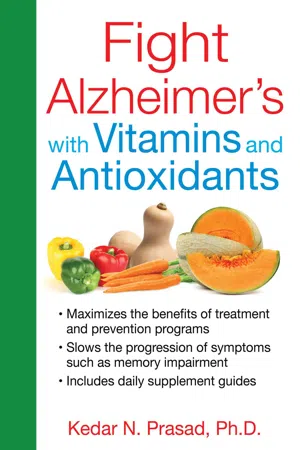
Fight Alzheimer's with Vitamins and Antioxidants
eBook - ePub

Fight Alzheimer's with Vitamins and Antioxidants

  1. 208 pages
  2. English
  3. ePUB (mobile friendly)
  4. Available on iOS & Android
eBook - ePub

Fight Alzheimer's with Vitamins and Antioxidants

About this book

The most complete and up-to-date resource on the powerful benefits of nutritional supplements for the treatment and prevention of Alzheimer's disease • Provides an easy-to-follow program of supplements to optimize the benefits of Alzheimer's treatment and maximize the impact of prevention strategies • Shows how standard treatments do not counteract the oxidative stress and chronic inflammation at the source of Alzheimer's • Also addresses related complications and symptoms such as altered sleep patterns, memory impairment, and behavior changes like depression and anger In this practical scientific guide, leading researcher in cancer, heart disease, and diabetes prevention Kedar N. Prasad, Ph.D., reveals the latest revolutionary discoveries on the use of antioxidants to prevent and treat Alzheimer's disease. He details how the proper combinations of vitamin and antioxidant supplements can greatly increase the effectiveness of standard medical treatments for Alzheimer's as well as delay or even prevent onset despite a family history of the disease. Prasad shows how oxidative stress and chronic inflammation play a significant role in the initiation and progression of neurodegenerative diseases like Alzheimer's. He provides an easy-to-follow daily supplement regime for multiple age groups to target free radical damage and inflammation and stop the progression of Alzheimer's and related complications such as altered sleep patterns, memory impairment, and behavior changes like depression and anger. Reviewing the scientific research on supplements and Alzheimer's, he debunks the flawed conclusions of the neurological community that vitamins and antioxidants are ineffective, revealing how their studies focused on specific micronutrients used alone rather than synergistic combinations. Offering the missing complement to the standard care of medications promoted by mainstream medicine, this guide provides a truly holistic approach to Alzheimer's prevention, treatment, and care.

Frequently asked questions

Yes, you can cancel anytime from the Subscription tab in your account settings on the Perlego website. Your subscription will stay active until the end of your current billing period. Learn how to cancel your subscription.
No, books cannot be downloaded as external files, such as PDFs, for use outside of Perlego. However, you can download books within the Perlego app for offline reading on mobile or tablet. Learn more here.
Perlego offers two plans: Essential and Complete
  • Essential is ideal for learners and professionals who enjoy exploring a wide range of subjects. Access the Essential Library with 800,000+ trusted titles and best-sellers across business, personal growth, and the humanities. Includes unlimited reading time and Standard Read Aloud voice.
  • Complete: Perfect for advanced learners and researchers needing full, unrestricted access. Unlock 1.4M+ books across hundreds of subjects, including academic and specialized titles. The Complete Plan also includes advanced features like Premium Read Aloud and Research Assistant.
Both plans are available with monthly, semester, or annual billing cycles.
We are an online textbook subscription service, where you can get access to an entire online library for less than the price of a single book per month. With over 1 million books across 1000+ topics, we’ve got you covered! Learn more here.
Look out for the read-aloud symbol on your next book to see if you can listen to it. The read-aloud tool reads text aloud for you, highlighting the text as it is being read. You can pause it, speed it up and slow it down. Learn more here.
Yes! You can use the Perlego app on both iOS or Android devices to read anytime, anywhere — even offline. Perfect for commutes or when you’re on the go.
Please note we cannot support devices running on iOS 13 and Android 7 or earlier. Learn more about using the app.
Yes, you can access Fight Alzheimer's with Vitamins and Antioxidants by Kedar N. Prasad in PDF and/or ePUB format, as well as other popular books in Medicine & Diseases & Allergies. We have over one million books available in our catalogue for you to explore.

Information

1
The Enigma of Alzheimer’s Disease
Alzheimer’s disease is a form of neurodegenerative disease characterized by the progressive loss of nerve cells from the cortex region of the brain. It is the main causative agent of memory loss (dementia), and it progresses slowly.*2 Individuals who are sixty-five years of age or older are at risk of developing Alzheimer’s disease; in the United States it is the sixth leading cause of death among people of this demographic. In 90 percent of cases the disease is acquired; only in 5 to 10 percent of cases is it inherited.
When Alzheimer’s strikes the damaged neurons of the brain render memory less reliable. Cognitive thinking, language skills, and one’s judgment are negatively impacted, and behavioral changes in the individual suffering from the disease are apt to be noted. Those with the disease tend to live, on average, for another eight years after their symptoms have become apparent, although this range can be anywhere from four years to twenty years, depending on other factors.
A diagnosis of Alzheimer’s disease is made by postmortem analysis of the brains of patients with dementia. A chief marker of Alzheimer’s disease is what is known as a neurofibrillary tangle (NFT), which is a conglomeration of proteins known as hyperphosphorylated tau protein and apolipoprotein E. Neurofibrillary tangles, found inside the nerve cells of the cortex region of the brain, are insoluble and are difficult to degrade by proteolytic enzymes. Senile (neuritic) plaques located outside of the nerve cells in the brain containing several proteins are also considered hallmarks of Alzheimer’s disease (Yankner and Mesulam 1991; Selkoe 1994; Kudo et al. 1994). Neuritic plaques are focal and spherical, and their size ranges from 20 to 200 microns in diameter. Activated microglia and astrocytes (markers of chronic inflammation) are present at the periphery of the plaques.
When one has Alzheimer’s disease the synaptic connections between nerve cells are often lost. Interestingly, a study has shown that Lewy bodies—bundles of proteins that manifest inside nerve cells and are characteristic of Parkinson’s disease—are also present in the brains of approximately 60 percent of Alzheimer’s cases (Hamilton 2000).
The mechanisms of the formation and dissolution of neurofibrillary tangles and plaques are under extensive investigation so that new drugs to improve treatment outcomes may be developed. Currently, there is no known cure for this puzzling disease. However, it’s my belief that increased oxidative stress and chronic inflammation are primarily responsible for its initiation and progression; therefore, attenuation of these biochemical defects may reduce the risk of development and progression of this disease and, in combination with standard therapy, improve the clinical outcomes.
This chapter discusses briefly the history, prevalence/incidence, and cost of Alzheimer’s disease. We then move on to a general discussion of oxidative stress and chronic inflammation and examine how these processes affect the body so that we may better understand their role. In the next chapter we’ll explore the human brain, before returning, in chapter 3, to a deeper discussion of oxidative stress and inflammation as they pertain to the manifestation of Alzheimer’s disease.
HISTORY, PREVALENCE/INCIDENCE, AND COST TO SOCIETY
History
Progressive memory loss (forgetfulness) has been known for centuries. Claudius Galen, a Roman physician who lived during the second century, described the age-related symptoms of absentmindedness. In the fourteenth century in England, a verbal test was utilized to evaluate one’s level of memory loss. In 1906 Dr. Alois Alzheimer, a German psychologist, cared for a fifty-one-year-old female who was suffering from severe memory loss associated with confusion. After her death he performed an autopsy on her brain and noted the presence of dense deposits (senile plaques*3) outside of its nerve cells, as well as twisted bands of fibers (neurofibrillary tangles) inside the nerve cells.
Subsequently, Dr. Alzheimer’s colleague, Dr. Emil Kraepelin, coined the term “Alzheimer’s disease.” He was so impressed with Alzheimer’s research that he appointed him head of pathology at the Psychiatric Institute in Munich, Germany (now the Max Planck Institute). In 1960 neuroscientists discovered a link between memory loss and the presence of senile plaques and neurofibrillary tangles. Later, several biochemical and genetic defects that play a central role in the initiation and progression of Alzheimer’s disease were identified.
Prevalence/Incidence
The term “prevalence” in a medical context is a measurement of how many cases of a disease exist in the population at a given time frame, whereas “incidence” refers to the number of cases of a disease that develop every year. It’s estimated that in the United States, approximately 200,000 people under the age of sixty-five have Alzheimer’s disease (Alzheimer’s Disease Facts and Figures, Alzheimer’s Association 2013). In 2014 5.2 million people age sixty-five or older suffer from it as well (3.2 million women and 1.8 million men). This represents 11 percent of people age sixty-five or over. By 2050 it is estimated that about 16 million Americans may suffer from this disease, if no breakthrough in prevention occurs. The incidence of Alzheimer’s and other types of dementia (memory loss) doubles every five years for those individuals in this group (age sixty-five or older).
About 16 percent of women age seventy-one or older have Alzheimer’s disease or another form of dementia, compared with only 11 percent of men in the same age group. This suggests that women are more prone to develop Alzheimer’s than men. Additionally, approximately 30 percent of the U.S. population age eighty-five and older have symptoms of this disease (Alzheimer’s Organization 2014).
INCIDENCE OF ALZHEIMER’S DISEASE*
Age (years) New cases/year/1,000 people
65–74 53
75–84 173
85 or older 231
*From Alzheimer’s Disease Facts and Figures, Alzheimer’s Association 2013
According to a 2010 U.S. Census Bureau report, by 2030 one individual in five will be over the age of sixty-five, and in 2050 the number of Americans age sixty-five and older is projected to be 88.5 million. Currently, there is no cure for Alzheimer’s. Consequently, in excess of half a million seniors die each year from this disease. Thus, it remains a major medical concern now as well as for future generations (U.S. Census Bureau, U.S. Department of Commerce 2010).
Cost to Society
At this time Alzheimer’s disease is the most expensive disease in the United States. According to the U.S. Census Bureau, costs of the disease to society, in 2014, were projected to be an estimated $214 billion annually (please see the breakout below). By 2050 Alzheimer’s is expected to cost $1.2 trillion per year (Alzheimer’s Disease Facts and Figures, Alzheimer’s Association 2013).
COST OF HEALTH AND LONG-TERM CA RE SERVICES PER YEAR
Medicare $113 billion
Medicaid $37 billion
Out-of-pocket costs $36 billion
Other sources: (HMOs, private insurance, managed care organizations, and uncompensated care) $28 billion
Total $214 billion
Despite extensive research and the publication of thousands of research studies on the causes of Alzheimer’s, it has not been possible to reduce the incidence or the rate of progression of this disease. However, these studies have identified some biochemical and genetic defects that contribute to the death of nerve cells in the brain of Alzheimer’s patients. Among these defects increased oxidative-stress-induced damage is one of the earliest biochemical markers indicating a degeneration of the brain’s nerve cells (Prasad and Bondy, 2014).
Oxidative stress occurs when free radicals overwhelm the protective antioxidant systems of the body. These systems are composed of antioxidant enzymes and dietary and endogenous antioxidant chemicals. Increased oxidative stress due to production of excessive amounts of free radicals derived from oxygen and nitrogen play a pivotal role in the development and progression of damage in neurodegenerative diseases such as Alzheimer’s disease and Parkinson’s disease. Other biochemical and genetic defects occur subsequent to increased oxidative stress. Together these combined factors participate in an escalating cascade to progress the development of Alzheimer’s in any given individual. Therefore, a basic understanding of oxidative stress and these other defects is essential for developing preventive and improved management strategies for Alzheimer’s disease.
Before delving into that, however, let’s look at the human immune system and the very important part it plays.
THE HUMAN IMMUNE SYSTEM
The immune system is a network of cells, tissues, and organs that work together in a highly coordinated manner to defend the body against foreign invading pathogenic (harmful) organisms and antigenic molecules and particles. As such, the immune system is essential for our survival. It is, however, also a double-edged sword. On the one hand it acts in the aforementioned defensive capacity. On the other hand it has the ability to produce chemicals that are toxic to the tissues. These chemicals include reactive oxygen species (ROS), which are free radicals derived from oxygen. Other chemicals that may be toxic to the tissues are pro-inflammatory cytokines, complement proteins, adhesion molecules, and prostaglandins, all of which may increase the risk of chronic diseases, including neurodegenerative diseases.
The organs of the immune system are located throughout the body and include lymphoid organs, which contain lymphocytes. Bone marrow is another important constituent of the body’s immune system. It contains all of the body’s blood cells, including lymphocytes. Thymus-derived lymphocytes are referred to as T-lymphocytes (T-cells). In the blood T-cells represent about 60 to 70 percent of peripheral lymphocytes.
Lymphocytes derived from bone marrow are referred to as B-lymphocytes (B-cells). They constitute about 10 to 20 percent of peripheral lymphocytes in the blood. B-cells mature to plasma cells, which secrete specific antibodies in response to a particular antigen.
Another type of cell that is germane to our discussion here is the neutrophil, which is formed from stem cells in the bone marrow. Likewise, macrophages are derived from monocytes of bone marrow and are part of the mononuclear phagocyte system. Macrophages exhibit phagocytic activity, which is essential for removing harmful organisms from the body. Macrophages and neutrophils are the most active in phagocytosis, following infection with pathogenic microorganisms.
Other types of cells play important roles, too. Natural killer (NK) cells represent about 10 to 15 percent of the peripheral blood lymphocytes but lack T-cell receptors. Like macrophages, they identify and kill harmful microorganisms by phagocytosis. Natural killer cells engulf pathogens that are trapped in an intracellular vesicle called a phagosome, which fuses with lysosomes to form phagolysosomes. The harmful organisms are killed by proteolytic enzymes (enzymes that can digest) of the lysosomes, aided by bursts of reactive oxygen species released by the phagocytes. Natural killer cells can kill tumor cells or cells infected with viruses.
A specialized form of cells with numerous fine dendritic cytoplasmic processes, called dendritic cells, do not exhibit phagocytic activity. Nevertheless, they play an important role in presenting antigen to T-cells.
Now that we understand a bit more about the components of a healthy immune system, let’s take a look at the two basic modalities of immunity: innate immunity and adaptive immunity.
Innate Immunity
The innate immune defense is nonspecific and is the dominant system of host defense (Litman, Cannon, and Dishaw 2005). The innate immune system responds to infection by inducing inflammation, releasing complement proteins, and recruiting leukocytes. Leukocytes include the phagocytes (primarily macrophages and neutrophils), dendritic cells, mas...

Table of contents

  1. Cover Image
  2. Title Page
  3. Epigraph
  4. Acknowledgments
  5. Table of Contents
  6. Preface
  7. Chapter 1: The Enigma of Alzheimer’s Disease
  8. Chapter 2: A Closer Look at the Human Brain
  9. Chapter 3: Oxidative Stress and Inflammation and Related Alzheimer’s Studies
  10. Chapter 4: The Antioxidant Defense System
  11. Chapter 5: The Role of Antioxidants in Reducing Oxidative Damage
  12. Chapter 6: Laboratory and Clinical Studies of Antioxidants and Alzheimer’s Symptoms
  13. Chapter 7: Alzheimer’s Disease Prevention and Management
  14. Appendix: Values of Recommended Dietary Allowances (RDA)/Dietary Reference Intakes (DRI)
  15. Abbreviations and Terminologies
  16. Footnotes
  17. Bibliography
  18. About the Author
  19. About Inner Traditions • Bear & Company
  20. Books of Related Interest
  21. Copyright & Permissions
  22. Index