Aromatherapy: Scent and Psyche
eBook - ePub

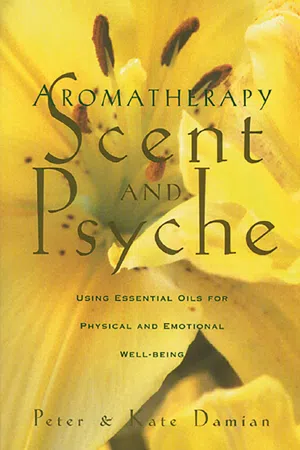
Aromatherapy: Scent and Psyche

Using Essential Oils for Physical and Emotional Well-Being

  1. 264 pages
  2. English
  3. ePUB (mobile friendly)
  4. Available on iOS & Android
eBook - ePub

Aromatherapy: Scent and Psyche

Using Essential Oils for Physical and Emotional Well-Being

About this book

Aromatic oils have been used for thousands of years not only for their fragrance but for culinary, therapeutic, ritual, and spiritual purposes. More than a fashionable trend, aromatherapy is coming into its own as a body of knowledge and practice with specific applications that have a solid scientific base. Drawing on research and clinical studies, Peter and Kate Damian look at many applications from treating viral infections with garlic or black pepper oil to using rose oil to relax patients undergoing chemotherapy; from aromatic massage to the "environmental fragrancing" of subways and supermarkets.
Explores: • How scent interacts with emotion, memory, mental acuity, and sleep • Why specific scents are so effective in therapeutic and ritual settings • Antiseptic and antimicrobial properties of essential oils
How men and women differ in their responses to odors • Provides a thorough exposition of the ancient practice of aromatics in China, India, Persia, and Egypt • Details our modern scientific understanding of the physiology and psychology of scent. • Includes annotated profiles for forty-four essential oils and specific instructions for creating essential oil blends.
Frequently asked questions

Yes, you can cancel anytime from the Subscription tab in your account settings on the Perlego website. Your subscription will stay active until the end of your current billing period. Learn how to cancel your subscription.
No, books cannot be downloaded as external files, such as PDFs, for use outside of Perlego. However, you can download books within the Perlego app for offline reading on mobile or tablet. Learn more here.
Perlego offers two plans: Essential and Complete
  • Essential is ideal for learners and professionals who enjoy exploring a wide range of subjects. Access the Essential Library with 800,000+ trusted titles and best-sellers across business, personal growth, and the humanities. Includes unlimited reading time and Standard Read Aloud voice.
  • Complete: Perfect for advanced learners and researchers needing full, unrestricted access. Unlock 1.4M+ books across hundreds of subjects, including academic and specialized titles. The Complete Plan also includes advanced features like Premium Read Aloud and Research Assistant.
Both plans are available with monthly, semester, or annual billing cycles.
We are an online textbook subscription service, where you can get access to an entire online library for less than the price of a single book per month. With over 1 million books across 1000+ topics, we’ve got you covered! Learn more here.
Look out for the read-aloud symbol on your next book to see if you can listen to it. The read-aloud tool reads text aloud for you, highlighting the text as it is being read. You can pause it, speed it up and slow it down. Learn more here.
Yes! You can use the Perlego app on both iOS or Android devices to read anytime, anywhere — even offline. Perfect for commutes or when you’re on the go.
Please note we cannot support devices running on iOS 13 and Android 7 or earlier. Learn more about using the app.
Yes, you can access Aromatherapy: Scent and Psyche by Peter Damian, Kate Damian in PDF and/or ePUB format, as well as other popular books in Medicine & Alternative & Complementary Medicine. We have over one million books available in our catalogue for you to explore.
1
Introduction To Aromatherapy
DEFINITIONS, EXPLANATIONS, FEATURES
Aromatherapy is a modern term for what are actually various therapeutic and aesthetic uses made of derivatives or extracts from a wide variety of plants. More precisely, aromatherapy is the specific use of pure essential oils by topical (skin) application or inhalation. A pure essential oil is the condensation of a plant’s vital “essence”—the soul of the plant—in which is stored vital solar energy. This essential oil is what gives the plant its fragrance. It is also where the plant’s most valuable therapeutic and nutritional properties are highly concentrated. The essence is produced by special cells within the plant and contains, among other things, phytohormones: “chemical messengers” that, like human hormones, transmit cellular information throughout the body in response to stress and environmental conditions. The essence or essential oil protects the plant from disease, parasites, and other would-be predators, while attracting certain insects for reproductive pollination. In some cases, essential oils act as selective weed-killers, allowing the plant to establish its territory by eliminating competitive vegetation. In harsh desert climates, myrrh and frankincense actually emit essential oil vapors to shield themselves from extreme sunlight.
The vital essences of plants are converted into pure essential oils and aromatic hydrosols (floral waters) by the mechanical process of steam distillation. Only after extraction by the production method of distillation does an essence become an essential oil. Although we generally use the term essential oil to describe all the oils employed by aromatherapy, those that are extracted by other methods are not precisely pure essential oils. For example, oils extracted by expression (cold pressing or pressure) retain more of the plant’s essence. Some plants (e.g., jasmine) will not release their oil unless a solvent is used. Oils obtained by such processes involving chemical solvents are called concrétes or absolutes. These and other production methods will be explained in chapter 6. For now it is enough to know that essential oils can be extracted from certain trees, shrubs, herbs, flowers, and grasses, wherein they may be found in virtually any part of the plant: seeds, flowers, fruit, leaves, stalks and stems, roots, bark, wood, needles, and resins.
The proportional yield of essential oil from plants will vary from a small fraction of 1 percent to as much as 10 percent. The process can be slow, laborious, and quite expensive. It takes 500 pounds of sage or rosemary to make a quart of oil; a ton of thyme will yield less than a quart. It may take thousands of pounds of rose petals to solvent-extract a pound of rose oil. More than 8 million hand-picked jasmine blossoms may produce a mere kilogram (2.2 pounds) of essential oil. (Jasmine and rose are two of the most costly essential oils.) The amount of plant material and the production time required—or allowed—to produce an essential oil will affect its cost and quality. Slow-distilling 1 kilogram of oil from 1,000 kilograms of prime-picked flowers will add to the cost of the oil as well as to the higher-quality concentration of its therapeutic and nutritional constituents and properties.
Most essential oils are colorless or pale yellow; some (e.g., German or blue chamomile) are deeply pigmented. The majority of colored oils (e.g., bergamot and jasmine) are either essences or absolutes. Although highly concentrated, essential oils are not oily. Lighter than water (with a few exceptions), they are usually highly fluid. That they are lipid (fat) soluble rather than water soluble is an important attribute that allows their easier, faster, deeper, and more thorough penetration into the skin. (Since the skin is waterproof, water-soluble substances are resisted.) The rapid skin absorbency of essential oils is also partly due to their highly volatile (evaporative) nature. The characteristics of essential oil molecules allow their ready passage into the bloodstream. Because of their volatility, essential oils are best packaged in airtight aluminum or amber glass containers, which should also be kept in cool, dark, dry storage.
A more inclusive term, phytotherapy—”plant therapy,” or plant medicine—better describes the varied treatment applications using plant extracts and materials other than, and including, essential oils. Phytotherapy incorporates the internal use of essential oils, principally by ingestion. The term phytotherapy is often combined with, or used interchangeably for, aromatherapy. However, it is just as applicable as a synonym for herbalism or herbology.
Additional methods of extraction that do not produce essential oils, such as the creation of tinctures or liniments, are included in phytotherapy. Two others are decoction (boiling of leaves or roots to gain an extract) and infusion (pouring hot water over herbs or flowers, then briefly steeping them much as one makes tea). Likewise, an infusion oil can be created by soaking aromatic plant material in vegetable oil, thereby infusing the oil with the plant’s fragrance. This is an ancient technique in the practice of aromatics.
Aromatics is the aesthetic or therapeutic use of scents and fragrances that are derived from plants but are not necessarily essential oils. Ancient aromatherapy practiced prior to the discovery or general implementation of distillation (and therefore of pure essential oils) is more appropriately considered aromatics. Aromatics ought not be confused with simple perfumery involving fragrances that largely contain synthetic oils or scents diluted in alcohol and water, which merely smell pleasant or mask other odors. Personal anointment with infused oils was understood to provide genuine health benefits as well as aesthetic appeal and, moreover, to confer protection from contagious disease, owing in part to the antimicrobial powers of the natural botanical ingredients.
HISTORICAL OVERVIEW
Although the term aromatherapy has been in use for less than a century, the therapeutic, spiritual (religious and liturgical), and cosmetic uses of aromatic oils have at least a 5,000-year history. Phytotherapy or herbology has surely been practiced even longer. The spread of aromatherapy (aromatics, phytotherapy) has followed the westward course of civilization, beginning in the oriental cultures of China, India, Persia, and Egypt. The earliest scriptures of the Hindu religion—the Vedas—mention several hundred perfumes and aromatic products, codifying them for both liturgical and therapeutic practices. This knowledge has been maintained for at least 3,000 years through the Indian practice of Ayurvedic medicine, in which many of the essential oils used in aromatherapy have been a useful part. A principal feature of Ayurvedic medicine is aromatic massage using infused oils made from indigenous herbs and woods. The ancient Chinese also advocated massage. The oldest surviving medical texts from China, each dating back to c. 2700 B.C., are classics of herbal medicine. It is very likely that the ancient civilizations of China and India were practicing some form of aromatics as well as phytotherapy while such practices were occurring in Egypt, about which we know considerably more.
The Middle East
As long ago as 3000 B.C., the Egyptians were utilizing plants for medicine, massage therapy, surgery, food preparation and preservation, religious rituals, and mummification. Since steam distillation had not yet been developed, they prepared aromatic oils and incense by soaking plant materials in base oils or fats. There is some evidence that later Egyptians experimented with crude methods of distillation. Zozime, a third-century chemist, reported designs for stills that he observed on a temple wall in Memphis.
Hundreds of plants contain high levels of antibacterial, antiviral, antifungal, and otherwise antiseptic constituents. The awareness of these properties of plant substances prompted their use in food preparation and preservation, and in mummification. During the thousands of years before refrigeration, people from India to Europe were using herbs and oils to preserve meats and to make them more digestible. This tradition endures in the culinary arts by the use of herbs, spices, and condiments to improve digestion, both by their stimulation of digestive processes and by their direct catalytic and antiseptic action upon meat. (Today, 50 percent of the world’s essential oil production is for the food industry’s use of flavorings; about 5 percent is for aromatherapy, a small but significant and increasing figure.) The Egyptians likewise embalmed their pharaohs in essential oils to kill and inhibit bacteria and thus limit decomposition. It is worth repeating that unlike synthetic perfumes or commercial aerosols and deodorants, the fragrance of an essential oil does not merely mask foul odors arising from putrefaction or infections; it actually suppresses them by a physicochemical action that destroys, hinders, or neutralizes germs.
In early Mesopotamia, the Sumerians, Babylonians, Hebrews and other ancient Semitic peoples also utilized aromatics (oils and incense) for religious purposes. Ancient spiritual healing and religious or liturgical practices in which aromatic oils and plants were used to expand consciousness and improve meditation should be viewed as the first applications of aromapsychology. Such practices naturally accomplished what modern medical science has attempted through the manufacturing and prescription of mood-altering drugs, hallucinogens, and other kinds of synthetic chemicals intended to improve physical or mental performance or otherwise alter and control human behavior. The aromatic fumigations and incense burning done to dispel various miasmic conditions—not just foul spirits—and purify the atmosphere are equivalent to the later use of disinfectant aerosols, atomizers, and humidifiers to cleanse and condition the air. Today’s psychologists are just now beginning to reconsider the more intelligent and safer prescription of natural mood-enhancing substances, among which none are better than essential oils.
The Greeks and Romans
The ancient Greeks were perhaps the first to distinguish those psychological disorders arising from organic causes from others of a supernatural or metaphysical origin. Mental illness was often diagnosed as a disorganization of temperament or imbalance of the humours, treatable by herbs, aromatics, or other natural means. The Greeks’ appreciation of aromatics and essential oils, although spiritual, was more systematically applied in medicine and also in warfare to stimulate aggression and to heal battle wounds. Like many Greek practices and traditions, these were passed on to the Romans. Dioscorides, a first-century Greek surgeon in the Roman army of Nero, included a chapter on oils in his medical encyclopedia, which remained a standard medical text for more than a thousand years. He too made early experiments with the crude distillation of the “quintessence” of plants, producing camphor and turpentine. Both before and after Dioscorides, Greek physicians such as Hippocrates and Asclepiades utilized aromatics. Hippocrates successfully combated plagues by fumigating the entire city of Athens with aromatic substances, a practice repeated somewhat less systematically centuries later in Europe during its notorious plagues and epidemics. In the nineteenth century, when perfumes were made with real, natural botanical fragrances, perfumery workers were virtually immune to the cholera outbreaks of the time.
Like the earlier Greeks and Romans, the eighth-century Arabs carried their knowledge of medicinal plants throughout Asia Minor, the Middle East, and by further invasions of Europe and North Africa. Later eleventh-century Christian Crusaders returned to Europe with much knowledge of the famous perfumes of Arabia as well as of alchemy, the forerunner of modern chemistry. These events continued the extensive trade in odoriferous plants already begun and which had spread from India throughout the Greek and Roman empires.
Avicenna
The invention of distillation is attributed to the Persians, particularly to the renowned physician, philosopher, and alchemist Hakim Abu Ali Abdulah Husayn Ibn Sina, known more familiarly in the West as Avicenna. Actually, some perfumed waters produced by primitive distillation had been used in Persia prior to Avicenna’s birth, and by the thirteenth century the famous Damascan rose water was being exported as far away as China, India, and Europe to be used for a variety of purposes. It seems, therefore, more likely that distillation, which produces both floral waters (aromatic hydrosols) and pure essential oils, was invented and developed over a century and was later perfected by Avicenna for the specific production of essential oils. Arabic manuscripts from his day show drawings of stills, the basic principles of which remain the same today despite modern advancements in design technology. The invention of distillation led to the discovery and production of alcohol. Alcohol and essential oils made the production of non-oily perfumes possible.
Despite Avicenna’s breakthrough, distillation remained, at least until the Middle Ages, primarily a means for preparing floral waters rather than essential oils. Evidently, whenever the process resulted in the precipitation of essential oil, such as the crystallization of rose oil on the surface of rose water (which was apparently Avicenna’s first successful experiment), the oil was more often regarded as an unwanted by-product than as a new and desirable one.
Born in A.D. 980 in what is now Uzbekistan, Avicenna displayed his extraordinary intelligence at a very early age. A child prodigy, whose genius was nurtured by his learned father, Avicenna was appointed chief physician of the royal court at age fourteen. His father’s death and local political upheaval drove Avicenna into a life of wandering that led him to Persia, where he found refuge and gained the patronage of Persian royalty.
Despite his brief lifetime (he died in 1037), Avicenna authored some 276 works, most in a series of volumes, dealing with an enormous scope of subjects ranging from science to religion, mathematics to music, and including astrology, history, and economics. Yet, his well-deserved fame as “Prince of Physicians” stands upon one work: Al-Qanun fi’l Tibb (The Canon of Medicine), which is highly regarded as one of the most famous, important, and influential books of medicine in the history of both East and West. Arranged in five volumes, the Canon summarized all the known medical knowledge of the civilized world, including that of the Greeks, Europeans, Persians, Arabs, Indians, and Chinese. Translated into nearly every language of the Western world, it became a standard text for 500 years and the basis for most medieval schools of medicine, and it remains the manual for all practitioners of the Tibb tradition that Avicenna founded. The traditional medicine of Islam, Tibb is the treatment for more than 1 billion Moslem and non-Moslem people worldwide. From an Arabic word meaning “medicine of the physical, mental, and spiritual realms,” Tibb is based on two concepts: the Doctrine of Naturals, establishing normal standards for the human body by which disease is surmised from contrasting abnormalities; and the Doctrine of Causes, which identifies and explains the origins of those abnormalities. Primary symptoms are considered signs indicating the imbalance or “intemperament” that allows the disease to first occur.
Implementing his system of therapeutics, Avicenna established hospitals and advanced the processes of filtration, sublimation, and calcination, which are indispensable to the distillation of pure essential oils. Besides imparting his knowledge of dietetics, Avicenna systemized methods of urinalysis, pulse diagnosis, spinal manipulations, and traction for broken limbs, and he assembled an extensive pharmacology of more...

Table of contents

  1. Cover
  2. Title Page
  3. Dedication
  4. Acknowledgments
  5. Contents
  6. Chapter One: Introduction to Aromatherapy
  7. Chapter Two: Phytoaromatherapy and the Theory of Disease
  8. Chapter Three: Smell and the Psychology of Scent
  9. Chapter Four: Aromatherapy Today and Tomorrow: Theory and Practice, Issues and Debates
  10. Chapter Five: Psychotherapeutic Effects of Essential Oils
  11. Chapter Six: The Chemistry of Essential Oils
  12. Chapter Seven: Essential Oil Profiles
  13. Appendix
  14. Charts and Tables
  15. Footnote
  16. Selected Bibliography
  17. Aromatherapy Essential Oil Companies
  18. About the Author
  19. About Inner Traditions
  20. Copyright