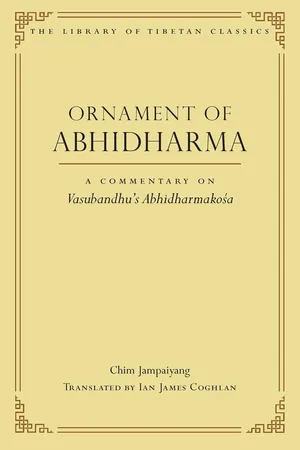
The single greatest Tibetan commentary—never previously translated—on one of the most well-known and cited works of classical Indian Buddhism.
This work by a scholar of the Kadam school is the most authoritative Tibetan commentary on Vasubandhu’s Treasury of Abhidharma (Abhidharmakosa). In terms of stature and authority, Vasubandhu’s Treasury rivals Buddhaghosa’s contemporaneous Path of Purification and deals with such central themes as the dynamics of emotions and karma, of mental and meditative states; it treats both the cosmos and the life within. Chim Jampalyang’s exposition of it is the greatest flowering of Abhidharma studies in Tibet. Usually referred to as the Chimzö, it is to this day a key textbook in the great monastic universities. A veritable encyclopedia, it spans all areas of classical Indian Buddhist knowledge and is an indispensable reference for scholars of Buddhism.
The Library of Tibetan Classics is a special series being developed by the Institute of Tibetan Classics to make key classical Tibetan texts part of the global literary and intellectual heritage. Eventually comprising thirty-two large volumes, the collection will contain over two hundred distinct texts by more than a hundred of the best-known Tibetan authors. These texts have been selected in consultation with the preeminent lineage holders of all the schools and other senior Tibetan scholars to represent the Tibetan literary tradition as a whole.
Frequently asked questions
Yes, you can cancel anytime from the Subscription tab in your account settings on the Perlego website. Your subscription will stay active until the end of your current billing period. Learn how to cancel your subscription.
At the moment all of our mobile-responsive ePub books are available to download via the app. Most of our PDFs are also available to download and we're working on making the final remaining ones downloadable now. Learn more here.
Perlego offers two plans: Essential and Complete
Essential is ideal for learners and professionals who enjoy exploring a wide range of subjects. Access the Essential Library with 800,000+ trusted titles and best-sellers across business, personal growth, and the humanities. Includes unlimited reading time and Standard Read Aloud voice.
Complete: Perfect for advanced learners and researchers needing full, unrestricted access. Unlock 1.4M+ books across hundreds of subjects, including academic and specialized titles. The Complete Plan also includes advanced features like Premium Read Aloud and Research Assistant.
Both plans are available with monthly, semester, or annual billing cycles.
We are an online textbook subscription service, where you can get access to an entire online library for less than the price of a single book per month. With over 1 million books across 1000+ topics, weâve got you covered! Learn more here.
Look out for the read-aloud symbol on your next book to see if you can listen to it. The read-aloud tool reads text aloud for you, highlighting the text as it is being read. You can pause it, speed it up and slow it down. Learn more here.
Yes! You can use the Perlego app on both iOS or Android devices to read anytime, anywhere â even offline. Perfect for commutes or when youâre on the go. Please note we cannot support devices running on iOS 13 and Android 7 or earlier. Learn more about using the app.
Yes, you can access Ornament of Abhidharma by Chim Jampalyang, Ian James Coghlan in PDF and/or ePUB format, as well as other popular books in Philosophy & Eastern Philosophy. We have over one million books available in our catalogue for you to explore.
This has three parts: core taxonomies of conditioned phenomena; synonyms; and elaboration of aggregates, bases, and elements.
Core taxonomies of conditioned phenomena
Also conditioned phenomena
are the five aggregates â form and so on.
They are the times, the basis of language,
definitely transcended, and they possess a basis. (1:7)
Question: What are those conditioned phenomena previously cited in the statement âConditioned phenomena, except for the path, are contaminatedâ (1:4bc)?
Reply: {Conditioned phenomena are classified in five: the basis of classification, that which is classified, the number of those classified, the definite number of those classified, and the purpose of such classification.
THE BASIS ON WHICH CLASSIFICATION IS MADE
Engaging in the Deeds of a Bodhisattva states:
There is nothing anywhere
fabricated from a single condition.216
The Collection of Birth Stories says:
There is nothing anywhere
established from a single cause.217
Therefore conditioned phenomena arise due to the assembly and convergence of many causes and conditions, since they do not arise from a single cause or condition. Moreover, [Vasubandhuâs] Rational System of Exposition explains that dharma has ten meanings,218 and it is said in the Miscellaneous Discourses that anything that retains its characteristics is called a dharma. Therefore objects of knowledge (jñeya) that retain their characteristics are dharmas. âAlsoâ (1:7a) indicates that not only do phenomena and unconditioned phenomena have classifications, but also conditioned phenomena have classifications.
THE THINGS THAT ARE CLASSIFIED
These are the aggregates of form, feeling, discernment, formation, and consciousness, which are differentiated from the liberated aggregates, such as the aggregate of ethics, and the five objects, such as form, because these latter categories do not include all conditioned phenomena. [27]
THE NUMBER OF THOSE CLASSIFIED
There are five.
THE SET NUMBER OF THOSE CLASSIFIED
They are definitely five in number because they are taught to be the bases grasped as âIâ and âmine.â Childlike beings predominantly hold consciousness to be âIâ and form and so on to be âmine.â Thus they think, respectively, that âexternal and internal material forms are related to the self who is the agent and object of actions; feeling is experienced by the self; discernment applies names by discriminating objects seen and heard and so on to be the self; and the mind grasping a self activates karmic formation that engages virtue and so on.â Thus these four are grasped as âmine.â The Great Treatise on Differentiation notes:
There are just five aggregates, neither more nor less, because they fully reveal the basis for grasping at âIâ and âmine.â Childlike beings predominantly hold consciousness to be âIâ and the remaining aggregates such as form to be âmine.â219
Also the Compendium of Abhidharma explains that the aggregates are fixed in number for a specific purpose when it reveals:
Five aggregates are taught in order to reveal the five bases that are held as the self.220
Again:
Conditioned phenomena are definitely twofold: form and that which is not form. That which is not form is definitely twofold: mind and that which is not mind. Conditioned phenomena that are neither form nor mind are definitely the three aggregates of feeling and so on.221
THE PURPOSE OF SUCH CLASSIFICATION
Question: Are the five aggregates different substances (dravya), are they synonyms, are they the same in nature but different conceptual isolates, or are they different distinct states?}
Reply: The form (rĆ«pa) aggregate and so on â referring to feeling, discernment, formation, and consciousness â are the five aggregates (skandha). Conditioned phenomena (saáčskáčta) are created through the assembly and convergence of conditions, and there are none whatsoever that are produced from a single condition.
Question: But how can instances of future nonarising be called âconditioned phenomenaâ?
Reply: They are called âconditioned phenomenaâ because they are similar in kind and characteristics to arisen states. It is like the milk in an unmilked cow being called âmilkâ since it is similar to the milk from the udder.
âAlsoâ teaches that not only are there classifications of unconditioned phenomena, but there are also classifications of conditioned phenomena. Stating âform and so onâ and âaggregatesâ (1:7b) excludes liberated aggregates, such as the aggregate of ethics, and the external bases.
Question: Which of these aggregates are substantially the same? Which are different? Which are different distinct states? Which are synonyms?
VaibhÄáčŁikas assert that they are substantially distinct. For they assert that the form aggregate consists of coarse form and subtle particles, and they claim both are types of substance. They assert that feeling, discernment, associated formative factors, form, and mind are different and also internally differentiated. They say that nonassociated formative factors are things (bhÄva) that are different from form, mind, and mental factors. Because consciousness is also different from the other aggregates, all five aggregates are substantially existent. Therefore the body of Devadatta is called âthe aggregate of formâ because it is an aggregate [28] as well as form, and as such, it comprises their common locus. This explanation also applies to the other aggregates.
SautrÄntikas assert form, feeling, discernment, associated formative factors, and consciousness to be substantially existent. Nonassociated formative factors are imputed in the context of form, mind, and mental factors, but they are not substantially existent. Particles and moments are substantially existent. But because gross entities and continua are not substantially existent, aggregates are nominally existent. Therefore, because form is substantially existent and aggregate is nominally existent, the form aggregate is a union of different components, like the various components of Devadatta. This should be applied in the same way to other instances.
YogÄcÄras assert that material form is not substantially different from minds or mental factors. They assert that the aggregates are nominally existent because nonassociated formative factors are not separate from them, and that continua are not substantially established.
Synonyms of âaggregatesâ
These are now stated since the Subcommentary declares:
Since Abhidharma in its entirety constitutes the meaning of the sĆ«tras, resolves the sĆ«tras, and explains the sĆ«tras, the identity of the synonyms of the aggregates, such as âtimeâ and so on, are expressed in the sĆ«tras.222
Those conditioned phenomena are called âthe three timesâ (adhvan) because those that have gone are past, those that are active are present, those that will come are future. So too, such conditioned phenomena are called the âbasis of languageâ (kathÄvastu) because discourse is {the sound of the letters themselves, or} speech.
Objection: Its basis is the names [or nouns] expressed, and only names are the basis of language.
Reply: That is not so because {all conditioned phenomena} are said to be the basis {of speech} and the basis {of language}. All conditioned phenomena are the basis of language because speech engages names, and those {names} express all conditioned phenomena. {Further, all conditioned phenomena are the basis of language since names are the explicit subject matter and their meaning is the conceived subject matter.} Although unconditioned phenomena are the subject matter of names, they are not taught to be the basis of language since they are not causes and since they are expressed less frequently. Thus Entering Discussion on the Abhidharma correctly affirms:
The basis of language is subsumed by the eighteen elements.223
Also, conditioned phenomena are âdefinitely transcendedâ (saniáž„sÄra) because definite transcendence is nirvÄáča, the misery definitely transcended is conditioned phenomena, and that which transcends misery is [29] that which is beyond conditioned phenomena.
Objection: Since the truth of path is not something you transcend, all conditioned states are not definitely transcended.
Reply: It is said in the Medium-Length Discourses:
If you abandon Dharma knowing it is like a ship which represents Dharma, then it goes without saying that you abandon that which is not Dharma.224
Ornament of the MahÄyÄna SĆ«tras also maintains:
Through understanding that you have passed beyond saáčsÄra,
you recognize all Dharma to be like a ship.225
Therefore, in entering nirvÄáča without remainder you definitely transcend conditioned phenomena.
Also, conditioned phenomena âpossess a basisâ (savastuka) because here basis is said to refer to â[those that possess] a cause.â These then are the synonyms of conditioned states.
In particular, regarding the synonyms of contaminated phenomena:
When they are contaminated, they are also
appropriated aggregates. They are also:
associated with conflict, suffering, origin, destructible,
the locus of view, and existence. (1:8)
When conditioned phenomena are contaminated (sÄsravÄ), they are also appropriated aggregates (upÄdÄnaskandha). Appropriated means âafflicted,â and they are appropriated aggregates since they are derived from affliction, like a grass fire or straw fire.226 {Again, since they rely on appropriation, they a...
Table of contents
Cover Page
Title Page
Message from the Dalai Lama
Special Acknowledgments
Publisherâs Acknowledgment
Contents
General Editorâs Preface
Translatorâs Introduction
Technical Note
Ornament of Abhidharma: A Commentary on the Verses of the AbhidharmakoĆa
Part I. Elements
Part II. Faculties
Part III. Cosmology
Part IV. Karma
Part V. Negative Tendencies
Part VI. Paths and Beings
Part VII. Epistemology
Part VIII. Meditative Attainment
Appendixes
Notes
SanskritâEnglish Glossary
Bibliography
Index
About the Contributors
The Institute of Tibetan Classics
The Library of Tibetan Classics
Become a Benefactor of the Library of Tibetan Classics