Understanding the Case Against Shukden
eBook - ePub

Understanding the Case Against Shukden

The History of a Contested Tibetan Practice

  1. 360 pages
  2. English
  3. ePUB (mobile friendly)
  4. Available on iOS & Android
eBook - ePub

Understanding the Case Against Shukden

The History of a Contested Tibetan Practice

About this book

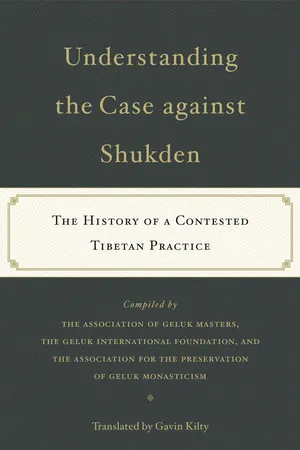
Leaders of the Dalai Lama's tradition illuminate the issues surrounding the Shukden controversy. Before the twentieth century, the figure of Shukden, or Dölgyal, was an obscure one in the pantheon of Tibetan Buddhism's many oracles and protectors. But after individuals within the Geluk tradition began to promote and disseminate the practice, division arose among Buddhists of different sects. Later, incidents within the exile community, as recounted in this book, prompted the Dalai Lama to investigate the practice more deeply. The fruits of this research are presented here, as are the statements made by His Holiness about it over the past forty years. Understanding the Case against Shukden uncovers the historical context behind this contentious practice, which dates back to the time of the Fifth Dalai Lama in the seventeenth century, and clarifies why the present Dalai Lama has been so vocal in countering it. Understanding the Case against Shukden is a clarion call for unity among the Tibetan people and a vision for a more harmonious Tibetan Buddhist community.
Frequently asked questions

Yes, you can cancel anytime from the Subscription tab in your account settings on the Perlego website. Your subscription will stay active until the end of your current billing period. Learn how to cancel your subscription.
No, books cannot be downloaded as external files, such as PDFs, for use outside of Perlego. However, you can download books within the Perlego app for offline reading on mobile or tablet. Learn more here.
Perlego offers two plans: Essential and Complete
  • Essential is ideal for learners and professionals who enjoy exploring a wide range of subjects. Access the Essential Library with 800,000+ trusted titles and best-sellers across business, personal growth, and the humanities. Includes unlimited reading time and Standard Read Aloud voice.
  • Complete: Perfect for advanced learners and researchers needing full, unrestricted access. Unlock 1.4M+ books across hundreds of subjects, including academic and specialized titles. The Complete Plan also includes advanced features like Premium Read Aloud and Research Assistant.
Both plans are available with monthly, semester, or annual billing cycles.
We are an online textbook subscription service, where you can get access to an entire online library for less than the price of a single book per month. With over 1 million books across 1000+ topics, we’ve got you covered! Learn more here.
Look out for the read-aloud symbol on your next book to see if you can listen to it. The read-aloud tool reads text aloud for you, highlighting the text as it is being read. You can pause it, speed it up and slow it down. Learn more here.
Yes! You can use the Perlego app on both iOS or Android devices to read anytime, anywhere — even offline. Perfect for commutes or when you’re on the go.
Please note we cannot support devices running on iOS 13 and Android 7 or earlier. Learn more about using the app.
Yes, you can access Understanding the Case Against Shukden by Gavin Kilty in PDF and/or ePUB format, as well as other popular books in Theology & Religion & Buddhism. We have over one million books available in our catalogue for you to explore.

Information

PART 1

The Seventeenth Century: Drakpa Gyaltsen and the Fifth Dalai Lama

1. The Rise of Tulku Drakpa Gyaltsen

The Upper and Lower Residences of Drepung Monastery

As is well known to us all, Drakpa Gyaltsen (1619–56), or Tulku Drakgyen, the Drepung Monastery Upper Residence incarnation, was said after his death to have been reborn as a worldly spirit known as the oath-breaking Dölgyal, or Gyalpo Shukden. To start, we need to identify the Drepung Upper Residence.
The Upper Residence (Simkhang Gongma) was the first residence of the refuge, protector, and great conqueror Gendun Gyatso, the Second Dalai Lama (1475–1542). Later, he moved to the Blue Stone House of Drepung, known as the Lower Residence, which was offered to him by the ruler of Nedong.6 These two residences are so called because of the features of the land on which they were built. The conqueror Gendun Gyatso offered the Upper Residence to his disciple Panchen Sönam Drakpa (1478–1554).7 From then on the Drepung Upper Residence was the residence, or labrang, of the incarnations of Panchen Sönam Drakpa.
The Lower Residence of Drepung, Blue Stone House, was given the name Drepung Ganden Phodrang and, from the time of Gendun Gyatso onward, became the residence and labrang of the successive incarnations of the precious Dalai Lamas.

Birthplace and Parents of Drakpa Gyaltsen

Tulku Drakpa Gyaltsen was born in the Tibetan earth-sheep year of 1619. His father was Namsé Norbu from the Gekhasa aristocratic family of Lhasa Tölung, and his mother was Lak Agyal of Gekhasa district. He was the third of five children.
It was said that his parents described many extraordinary signs seen at his birth and that, when the child was two years old, Panchen Losang Chögyen,8 who was traveling to Lhasa, was invited to their house. They requested him to perform a hand blessing and to give the child a name. He bestowed the name Chösang Gyaltsen on him. These accounts are described in Tulku Drakpa Gyaltsen’s autobiography, Jewel Casket: A Special Life-Story (2b1), handwritten and in long format:
On the fifteenth day of the month of miracles
in the wood-rabbit year, Tulku Gelek Palsangpo9
was invited to Trülnang Jampa Shingta,
where at the age of twenty-two he passed away.
Then, it is said, in a place known as Nup,
he entered a womb and was born,
but he did not reach a significant age
and again passed away.
Then I entered the womb, and at that time,
to the minds of the sacred objects of refuge,
rays of light like the sun appeared
emerging from the heart of the statue
of that tulku in Ganden and entering my home.
In particular, in the dreams of my mother
many signs of purification were seen,
such as a crystal shrine falling to her lap
and a saffron-robed monk calling from within.
In reality also, the form of Palden Lhamo
was seen to appear upon a rock,
and syllables miraculously formed on her body.
Many such amazing signs were seen, it is said.
Then in the siddhārtha female earth-sheep year,
at sunrise on the eighth day of the vaiśākha month,10
when the puṣya11 lunar mansion and Jupiter were conjoined,
I emerged from the womb with ease.
The general name of the area was Goser,
and my parents’ estate was Gekhasa.
My father was Namsé Norbu of aristocratic descent,
while my mother’s name was Lak Agyal.
Of five brothers and sisters, I was the third.
As soon as I was born I looked at my mother,
smiled, and even spoke some words, it is said.
These and other extraordinary actions pleased my parents.
Also, in the same work (3a3), it says:
When I was two, the omniscient Panchen
came to the vajra seat of this land of Tibet.
My parents invited him to their home,
and with both hands he bestowed on me a blessing.
He gave me the name Chösang Gyaltsen,
and because of pure prayers and pure karma,
my undying faith in him increased.
I received the nectar of his words
in the form of a long-life initiation and so on.
To my parents he gave much advice
on how this boy was no ordinary child.

The Political Situation in Tibet at That Time

The accuracy of any historical account, whether of an individual or a community, depends upon knowing the situation of the society at that time. Therefore, in order to understand the story of Drakpa Gyaltsen, the Drepung Upper Residence incarnation, we will present an overview of the situation of the Tibetan people at that time.
When Drakpa Gyaltsen was born, political rule in Tibet had been in the control of three generations of the kings known as the Tsangpa Desi.12 The generations of Tsang rulers were avid patrons of the Karmapa and his disciples, but toward other religious traditions, especially the Geluk, they were hostile and caused them much harm.
The Fourth Dalai Lama, the conqueror Yönten Gyatso (1589–1616), was invited to Central Tibet in the iron-ox year of 1601,13 where he was installed on the Ganden Phodrang throne. Panchen Losang Chögyen bestowed on him the vows of the novice monk and later those of the fully ordained monk. He immersed himself in the study and contemplation of the vast ocean of scriptures, both sutra and tantra. However, his lifetime was plagued by fierce territorial disputes between Tsang and Central Tibet. From the beginning, the Tsangpa Desi and his sons regarded the Geluk tradition as bitter enemies and suppressed them ruthlessly.
For example, in the wood-snake year of 1605, the Tsangpa ruler in collaboration with the head of the Drigungpas14 attacked and destroyed the ruling family of Kyishö,15 who were financial patrons of the Geluk. Also, around the water-ox year of 1613, the Tsangpa Desi attacked the Ngari king and marched into Phenyül, Shika Neu, and elsewhere and brought them under his control. He built a new monastery called Tashi Silnön16 between Tashi Lhunpo Monastery and Shigatsé town, thereby pursuing a policy of weakening the Geluk tradition, which was exemplified by Panchen Losang Chögyen of Tashi Lhunpo, and bringing the Geluk doctrine close to extinction.
At this point, the Tsangpa king was struck down with illness, and people said this was a sign that the conqueror Yönten Gyatso had performed a wrathful destruction ritual, sent as a warning to the Tsangpa king. From then on the great conqueror was also known as Thutop Gyatso.17 During this time, Mongolian armies initiated repeated military action in support of the Geluk tradition. However, the conqueror Yönten Gyatso would not accept their help and made efforts to turn them back. This is stated by the Great Fifth Dalai Lama in the Precious Garland: The Life of the Lord of the World, the All-Knowing and Glorious Yönten Gyatso (50a1):
During the time that this great master planted his lotus feet on this earth, the elder and younger sons of Lord Qoloci18 set out many times with their armies, preparing to wage great battles against those such as the Tsang Kur. However, as they approached Tibet, he sent out special messengers to them, and with wise words designed to restrain them, he restrained any proliferation of the conflict. Therefore, during the time his lotus feet were on this earth, no foreign army ever caused harm in Tibet.
Thus, during the lifetime of the conqueror Yönten Gyatso, no great damage was inflicted by the Mongolians in Tibet. However, in the fire-dragon year, on January 20, 1617, the conqueror Yönten Gyatso passed away suddenly at the age of twenty-eight. The Tsangpa Desi had blamed the conqueror Yönten Gyatso for casting a curse upon him earlier and so issued a proclamation forbidding the recognition of his reincarnation. Nevertheless, in the following year, the Great Fifth Dalai Lama, conqueror and guide of gods and humans, was born in Taktsé Chingwa in Chongyé of the Lhokha region. His father was Hor Düdul Dorjé of the line of the Sahor19 kings, and his mother was the noblewoman Tricham Kunga Lhadzé. However, under the suppression of the Tsangpa Desi, there was no easy way to identify him.
As mentioned, the Tsangpa had from its inception carried out disgraceful and abusive actions against the Geluk. In the fire-snake year of 1617, when a large group of Chokhur Mongolian pilgrims arrived in Central Tibet, they chased away some yak thieves belonging to the Tsangpa Desi, Karma Phuntsok Namgyal.20 In revenge, in the early autumn of 1618, he led a large military force to Central Tibet, where he wrought grave destruction upon Geluk religious establishments, particularly the great monasteries of Sera and Drepung. Many thousands of monks and laypeople were killed. As a period of continuous conflict had commenced between Tsang and Central Tibet, the monks of Sera and Drepung, who were powerless to do anything, fled to Phenyul, Taklung in the north, and elsewhere. Even Panchen Rinpoché had to seek refuge in Ngari. The Tsangpas had seized the whole of the Kyishö rulers’ estate, and the Kyishö family fled to Kokonor. Many of the Geluk philosophical systems were forcibly changed.
At this time, the Dharma master of Taklung Monastery sought a truce. The Sera and Drepung monks were allowed to live in their monasteries as before, but Drepung was levied with a fine of two hundred gold coins and Sera a hundred gold coins. Neither monastery could produce such an amount. Therefore Shalngo Sönam Chöphel21 of the Ganden Phodrang said he had to travel to Chökhor Gyal,22 to a treasury belonging to the former Dalai Lama, in order to fetch the gold. On the road to Chökhor Gyal, accompanied by a representative of the Tsang ruler, Sönam Chöphel fled and made his way to Mongolia by Nyangkong.
At first the Tsangpa Desi protected Hor Düdul Dorjé, the father of the Great Fifth. However, the Desi was completely hostile to the nobles of Yarlung and other districts, and soon strong resentment developed between the Tsangpa Desi and the Yarlung governor Kurap Namgyal. Hor Düdul Dorjé was thought to favor Kurap Namgyal, and in the earth-sheep year of 1619, the Desi seized the administrative district of Taktsé Chingwa from Hor Düdul Dorjé and handed it over to the Mukpo Né governors.
Düdul Dorjé was taken to Tsang and put in prison, where it was reported he was harshly treated, and ultimately he died there. Following the seizure of Taktsé Chingwa, the mother had been given Lhashong in Chushur as her inheritance, and so she had no choice but to go to Chushur. Later, the Desi ordered the mother and son back to Tsang. However, the governor of Nakartsé appealed to Tsang, offering to take responsibility for mother and son, and she was permitted to stay in her homeland of Nakartsé instead.
In the iron-bird year of 1621, a Mongolian force of two thousand soldiers led by the Mongolian Lhatsun Losang Tenzin Gyatso and Guru Khong Taiyiji and accompanied by Treasurer Sönam Rabten and the Kyishö ruler Tsokyé Dorjé, arrived in Lhasa to support the beleaguered Geluk. The Tsang army was camped on Mulé Plain, and there on August 27, during a break in the hot weather, the Mongolian cavalry attacked, and many hundreds were killed. Panchen Losang Chögyen was in retreat in Drepung at the time, and as soon as he heard this news he set out to negotiate a truce. This is described in his autobiography, Precious Garland: A Clear Account of the Deeds of the Dharma Proponent the Monk Losang Chögyen (66a5):
For a while I was in strict retreat. At the beginning of the seventh month the entire Tibetan army had camped on Mulé Plain. On the eleventh day, in a break from the heat, the Mongolian horsemen suddenly attacked the camp, and it was reported that many hundreds were killed. When this news reached my ears, I was unable to bear it and immediately left my retreat. Walking as far as the De...

Table of contents

  1. Cover Page
  2. Title Page
  3. Contents
  4. Foreword by Lama Zopa Rinpoché
  5. Translator’s Preface
  6. Introduction
  7. Homage and Commitment to Compose
  8. Part 1: Seventeenth Century: Drakpa Gyaltsen and the Fifth Dalai Lama
  9. Part 2: Eighteenth Century: The Sakya Tradition
  10. Part 3: Twentieth Century: Phabongkha Rinpoché
  11. Part 4: Today: Dölgyal in Exile
  12. Notes
  13. Glossary
  14. Bibliography
  15. Index
  16. About Wisdom Publications
  17. Copyright