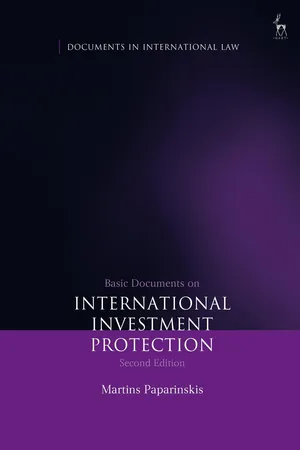
International law of foreign investment is a field of public international law that has attracted considerable attention from practitioners, academics, and policy-makers in the last two decades. Its key characteristic is the extent of substantive and procedural decentralisation: while often sharing certain structural elements, both substantive obligations and mechanisms of international dispute settlement are mostly opposable only between the particular parties, even when expressed in multilateral form. This makes a clear and comprehensive overview of the topic particularly important.
The second edition adopts a new structure that better reflects the concurrence of various reform proposals with the fairly stable stratum of instruments that inform the current practice. With this systemic dynamic in mind, the selected documents are divided into three parts: Past, Present, and Future. The Past sets out the legal background to modern investment protection law. The Present provides generalist international law materials (sources and responsibility), a selection of the more important instruments with substantive investment rules, and rules of international dispute settlement regarding investment protection. The Future (new for the second edition) lists a number of possible directions of future development, including a variety of approaches that maintain the traditional procedural kernel of investor-State arbitration as well as proposals for more significant change, with non-State actor involvement in dispute settlement either rejected or moulded into a judicial mechanism.
This highly regarded book is aimed at teachers, students, practitioners, and policymakers in the area. It can be used both as a practitioners' handbook and as a classroom companion for courses on international dispute settlement and investment protection law.
- 936 pages
- English
- ePUB (mobile friendly)
- Available on iOS & Android
eBook - ePub
Basic Documents on International Investment Protection
About this book
Information
C
International Investment Arbitration
I.International Centre for the Settlement of Investment Disputes
Convention on the Settlement of Investment Disputes between States and Nationals of Other States1
Done at Washington, 18 March 1965; entry into force, 14 October 1966
575 UNTS 159 [Registration Number 8359]
575 UNTS 159 [Registration Number 8359]
Preamble
The Contracting States
Considering the need for international cooperation for economic development, and the role of private international investment therein;
Bearing in mind the possibility that from time to time disputes may arise in connection with such investment between Contracting States and nationals of other Contracting States;
Recognizing that while such disputes would usually be subject to national legal processes, international methods of settlement may be appropriate in certain cases;
Attaching particular importance to the availability of facilities for international conciliation or arbitration to which Contracting States and nationals of other Contracting States may submit such disputes if they so desire;
Desiring to establish such facilities under the auspices of the International Bank for
Reconstruction and Development; Recognizing that mutual consent by the parties to submit such disputes to conciliation or to arbitration through such facilities constitutes a binding agreement which requires in particular that due consideration be given to any recommendation of conciliators, and that any arbitral award be complied with; and
Declaring that no Contracting State shall by the mere fact of its ratification, acceptance or approval of this Convention and without its consent be deemed to be under any obligation to submit any particular dispute to conciliation or arbitration,
Have agreed as follows:
CHAPTER I
INTERNATIONAL CENTRE FOR SETTLEMENT OF INVESTMENT DISPUTES
INTERNATIONAL CENTRE FOR SETTLEMENT OF INVESTMENT DISPUTES
Section 1
Establishment and Organization
Establishment and Organization
Article 1
(1) There is hereby established the International Centre for Settlement of Investment Disputes (hereinafter called the Centre).
(2) The purpose of the Centre shall be to provide facilities for conciliation and arbitration of investment disputes between Contracting States and nationals of other Contracting States in accordance with the provisions of this Convention.
Article 2
The seat of the Centre shall be at the principal office of the International Bank for Reconstruction and Development (hereinafter called the Bank). The seat may be moved to another place by decision of the Administrative Council adopted by a majority of two-thirds of its members.
Article 3
The Centre shall have an Administrative Council and a Secretariat and shall maintain a Panel of Conciliators and a Panel of Arbitrators.
Section 2
The Administrative Council
The Administrative Council
Article 4
(1) The Administrative Council shall be composed of one representative of each Contracting State. An alternate may act as representative in case of his principal’s absence from a meeting or inability to act.
(2) In the absence of a contrary designation, each governor and alternate governor of the Bank appointed by a Contracting State shall be ex officio its representative and its alternate respectively.
Article 5
The President of the Bank shall be ex officio Chairman of the Administrative Council (hereinafter called the Chairman) but shall have no vote. During his absence or inability to act and during any vacancy in the office of President of the Bank, the person for the time being acting as President shall act as Chairman of the Administrative Council.
Article 6
(1) Without prejudice to the powers and functions vested in it by other provisions of this Convention, the Administrative Council shall:
(a)adopt the administrative and financial regulations of the Centre;
(b)adopt the rules of procedure for the institution of conciliation and arbitration proceedings;
(c)adopt the rules of procedure for conciliation and arbitration proceedings (hereinafter called the Conciliation Rules and the Arbitration Rules);
(d)approve arrangements with the Bank for the use of the Bank’s administrative facilities and services;
(e)determine the conditions of service of the Secretary-General and of any Deputy Secretary-General;
(f)adopt the annual budget of revenues and expenditures of the Centre;
(g)approve the annual report on the operation of the Centre.
The decisions referred to in sub-paragraphs (a), (b), (c) and (f) above shall be adopted by a majority of two-thirds of the members of the Administrative Council.
(2) The Administrative Council may appoint such committees as it considers necessary.
(3) The Administrative Council shall also exercise such other powers and perform such other functions as it shall determine to be necessary for the implementation of the provisions of this Convention.
Article 7
(1) The Administrative Council shall hold an annual meeting and such other meetings as may be determined by the Council, or convened by the Chairman, or convened by the Secretary-General at the request of not less than five members of the Council.
(2) Each member of the Administrative Council shall have one vote and, except as otherwise herein provided, all matters before the Council shall be decided by a majority of the votes cast.
(3) A quorum for any meeting of the Administrative Council shall be a majority of its members.
(4) The Administrative Council may establish, by a majority of two-thirds of its members, a procedure whereby the Chairman may seek a vote of the Council without convening a meeting of the Council. The vote shall be considered valid only if the majority of the members of the Council cast their votes within the time limit fixed by the said procedure.
Article 8
Members of the Administrative Council and the Chairman shall serve without remuneration from the Centre.
Section 3
The Secretariat
The Secretariat
Article 9
The Secretariat shall consist of a Secretary-General, one or more Deputy Secretaries-General and staff.
Article 10
(1) The Secretary-General and any Deputy Secretary-General shall be elected by the Administrative Council by a majority of two-thirds of its members upon the nomination of the Chairman for a term of service not exceeding six years and shall be eligible for reelection. After consulting the members of the Administrative Council, the Chairman shall propose one or more candidates for each such office.
(2) The offices of Secretary-General and Deputy Secretary-General shall be incompatible with the exercise of any political function. Neither the Secretary-General nor any Deputy Secretary-General may hold any other employment or engage in any other occupation except with the approval of the Administrative Council.
(3) During the Secretary-General’s absence or inability to act, and during any vacancy of the office of Secretary-General, the Deputy Secretary- General shall act as Secretary-General. If there shall be more than one Deputy Secretary-General, the Administrative Council shall determine in advance the order in which they shall act as Secretary-General.
Article 11
The Secretary-General shall be the legal representative and the principal officer of the Centre and shall be responsible for its administration, including the appointment of staff, in accordance with the provisions of this Convention and the rules adopted by the Administrative Council. He shall perform the function of registrar and shall have the power to authenticate arbitral awards rendered pursuant to this Convention, and to certify copies thereof.
Section 4
The Panels
The Panels
Article 12
The Panel of Conciliators and the Panel of Arbitrators shall each consist of qualified persons, designated as hereinafter provided, who are willing to serve thereon.
Article 13
(1) Each Contracting State may designate to each Panel four persons who may but need not be its nationals.
(2) The Chairman may designate ten persons to each Panel. The persons so designated to a Panel shall each have a different nationality.
Article 14
(1) Persons designated to serve on the Panels shall be persons of high moral character and recognized competence in the fields of law, commerce, industry or finance, who may be relied upon to exercise independent judgment. Competence in the field of law shall be of particular importance in the case of persons on the Panel of Arbitrators.
(2) The Chairman, in designating persons to serve on the Panels, shall in addition pay due regard to the importance of assuring representation on the Panels of the principal legal systems of the world and of the main forms of economic activity.
Article 15
(1) Panel members shall serve for renewable periods of six years.
(2) In case of death or resignation of a member of a Panel, the authority which designated the member shall have the right to designate another person to serve for the remainder of that member’s term.
(3) Panel members shall continue in office until their successors have been designated.
Article 16
(1) A person may serve on both Panels.
(2) If a person shall have been designated to serve on the same Panel by more than one Contracting State, or by one or more Contracting States and the Chairman, he shall be deemed to have been designated by the authority which first designated him or, if one such authority is the State of which he is a national, by that State.
(3) All designations shall be notified to the Secretary-General and shall take effect from the date on which the notification is received.
Section 5
Financing the Centre
Financing the Centre
Article 17
If the expenditure of the Centre cannot be met out of charges for the use of its facilities, or out of other receipts, the excess shall be borne by Contracting States which are members of the Bank in proportion to their respective subscriptions to the capital stock of the Bank, and by Contracting States which are not members of the Bank in accordance with rules adopted by the Administrative Council.
Section 6
Status, Immunities and Privileges
Status, Immunities and Privileges
Article 18
The Centre shall have full international legal personality. The legal capacity of the Centre shall include the capacity:
(a)to contract;
(b)to acquire and dispose of movable and immovable property;
(c)to institute legal proceedings.
Article 19
To enable the Centre to fulfil its functions, it shall enjoy in the territories of each Contracting State the immunities and privileges set forth in this Section.
Article 20
The Centre, its property and assets shall enjoy immunity from all legal process, except when the Centre waives this immunity.
Article 21
The Chairman, the members of the Administrative Council, persons acting as conciliators or arbitrators or members of a Committee appointed pursuant to paragraph (3) of Article 52, and the officers and employees of the Secretariat
(a)shall enjoy immunity from legal process with respect to acts performed by them in the exercise of their functions, except when the Centre waives this immunity;
(b)not being local nationals, shall enjoy the same immunities from immigration restrictions, alien registration requirements and national service obligations, the same facilities as regards exchange restrictions and the same treatment in respect of travelling facilities as are accorded by Contracting States to the representatives, officials and employees of comparable rank of other Contracting States.
Article 22
The provisions of Article 21 shall apply to persons appearing in proceedings under this Convention as parties, agents, counsel, advocates, witnesses or experts; provided, however, that sub-paragraph (b) thereof shall apply only in connection with their travel to and from, and their stay at, the place where the proceedings are held.
Article 23
(1) The archives of the Centre shall be inviolable, wherever they may be.
(2) With regard to its official communications, the Centre shall be accorded by each Contracting State treatment not less favourable than that accorded to other international organizations.
Article 24
(1) The Centre, its assets, property and income, and its operations and transactions authorized by this Convention shall be exempt from all taxation and customs duties. The Centre shall also be exempt from liability for the collection or payment of any taxes or customs duties.
(2) Except in the case of local nationals, no tax shall be levied on or in respect of expense allowances paid by the Centre to the Chairman or members of the Administrative Council, or on or in respect of salaries, expense allowances or other emoluments paid by the Centre to officials or employees of the Secretariat.
(3) No tax shall be levied on or in respect of fees or expense allowances received by persons acting as conciliators, or arbitrators, or members of a Committee appointed pursuant to paragraph (3) of Article 52, in proceedings under this Convention, if t...
Table of contents
- Cover
- Title Page
- Editor’s Preface
- Contents
- List of Documents Arranged According to Subject Matter
- List of Documents in Chronological Order
- List of Documents in Alphabetical Order
- Abbreviations
- Introduction
- A. Past
- B. International Investment Law
- C. International Investment Arbitration
- D. Miscellaneous Documents
- E. Future
- F. Appendix
- Index
- Copyright Page
Trusted by 375,005 students
Access to over 1.5 million titles for a fair monthly price.
Study more efficiently using our study tools.
Frequently asked questions
Yes, you can cancel anytime from the Subscription tab in your account settings on the Perlego website. Your subscription will stay active until the end of your current billing period. Learn how to cancel your subscription
No, books cannot be downloaded as external files, such as PDFs, for use outside of Perlego. However, you can download books within the Perlego app for offline reading on mobile or tablet. Learn how to download books offline
Perlego offers two plans: Essential and Complete
- Essential is ideal for learners and professionals who enjoy exploring a wide range of subjects. Access the Essential Library with 800,000+ trusted titles and best-sellers across business, personal growth, and the humanities. Includes unlimited reading time and Standard Read Aloud voice.
- Complete: Perfect for advanced learners and researchers needing full, unrestricted access. Unlock 1.5M+ books across hundreds of subjects, including academic and specialized titles. The Complete Plan also includes advanced features like Premium Read Aloud and Research Assistant.
We are an online textbook subscription service, where you can get access to an entire online library for less than the price of a single book per month. With over 1.5 million books across 990+ topics, we’ve got you covered! Learn about our mission
Look out for the read-aloud symbol on your next book to see if you can listen to it. The read-aloud tool reads text aloud for you, highlighting the text as it is being read. You can pause it, speed it up and slow it down. Learn more about Read Aloud
Yes! You can use the Perlego app on both iOS and Android devices to read anytime, anywhere — even offline. Perfect for commutes or when you’re on the go.
Please note we cannot support devices running on iOS 13 and Android 7 or earlier. Learn more about using the app
Please note we cannot support devices running on iOS 13 and Android 7 or earlier. Learn more about using the app
Yes, you can access Basic Documents on International Investment Protection by Martins Paparinskis in PDF and/or ePUB format, as well as other popular books in Law & International Law. We have over 1.5 million books available in our catalogue for you to explore.