Should we talk of European jazz or jazz in Europe? What kinds of networks link those who make it happen 'on the ground'? What challenges do they have to face?
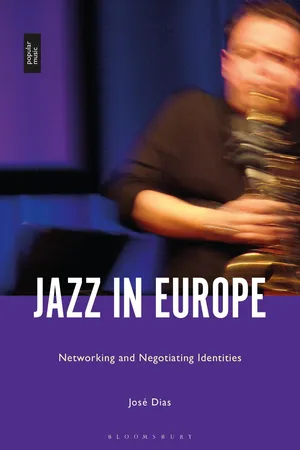
Jazz is a part of the cultural fabric of many of the European countries. Jazz in Europe: Networking and Negotiating Identities presents jazz in Europe as a complex arena, where the very notions of cultural identity, jazz practices and Europe are continually being negotiated against an ever changing social, cultural, political and economic environment. The book gives voice to musicians, promoters, festival directors, educators and researchers regarding the challenges they are faced with in their everyday practices. Jazz identities in Europe result from the negotiation between discourse and practice and in the interstices between the formal and informal networks that support them, as if 'Jazz' and 'Europe' were blank canvases where diversified notions of what jazz and Europe should or could be are projected.
- 200 pages
- English
- ePUB (mobile friendly)
- Available on iOS & Android
eBook - ePub
About this book
Information
1
Researching jazz in Europe today
Introduction
Europe is often represented by its political institutions as a cultural whole. However, Europe is an ever-changing and multidimensional entity. In the same way, cultural products within Europe tend to serve as complex, and at some points contradictory, representations of European and national identities. Europe seems to be much greater than the sum of its parts – an intricate and dynamic system in which each individual country signifies more than simply a piece of the European whole. Jazz is part of the cultural fabric of many European countries. From its role in music education, to cultural programming and academic research, jazz is present in various forms of cultural production in Europe and present in its official rhetoric. This exploration began to take shape when I was trying to understand some of these associations: the relationship between jazz and the representation of Europe; its presence across the EU official discourse; the formal and informal narratives it has conveyed; and how jazz actors in Europe – musicians, promoters, record label executives and festival programmers – have operated within the mist of such a complex musical whole.
The new European Jazz studies
Although clouded by the same complexity, European jazz studies have in recent years achieved significant results at various levels of academic research. Within the scope of historiography, academics in the international arena have presented biographical data on the musicians and promoters who pioneered jazz dissemination in Europe,1 sometimes against repressive regimes that did not favour jazz at all.2 These academics have examined the relationship between jazz and twentieth-century print media – the representation of jazz in literature,3 print and broadcast media; its presence in early radio and television broadcasting4 and in film.5 Academics have analysed how jazz became a symbol of (or soundtrack to) democracy,6 the exotic,7 sin,8 subversive youth movements,9 ideology,10 diplomacy,11 sophistication12 and of Europe’s Americanization.13
More recently, New European Jazz Studies14 has become increasingly attentive to transnational processes, has questioned aesthetic, geographic, social and cultural boundaries, and at the same time have communicated the need for a more interdisciplinary approach. In a seminal article, Tony Whyton (2012) has set the course for the New European Jazz Studies: ‘New European Jazz Studies should engage with national, trans-national and trans-continental exchange as a critical discourse, resisting essentialist ideologies and examining the way in which jazz cultures obtain their meaning in the function that the music has for its musicians, audiences and industry’ (378). This has been the role of the Rhythm Changes15 project, which has proved its success in filling an increasingly important gap that, by having been extended beyond its three-year program, has also become the primary forum for academic debate on jazz in Europe, with the contribution of other actors’ insights, such as those of journalists, promoters and radio hosts.
In recent years, a number of interesting studies have emerged on how jazz has influenced local and national popular culture,16 how it can serve as a vehicle for transnational musical dialogues and cultural processes,17 its role on music education,18 cultural policy,19 cultural identity,20 gender21 and the music industry.22 New European Jazz Studies has encouraged dialogue with other disciplines – such as media studies, cultural studies and gender studies – and listening to the voice of jazz’s cultural actors – musicians, promoters, media and cultural programmers – as part of its wider, inclusive agenda.
‘Jazz in Europe’ versus ‘European jazz’
As a result of my personal experiences as a jazz musician, I approached the field with the assumption that discourse does not always concur with practice. Musicians continually build and reinvent their own narratives and images by responding to institutional discourse, peer review, press and audience reception, so that their storyline will help them communicate their music, capture new audiences, achieve greater media exposure and obtain public funding. In the role of jazz academic, I believe the phenomenon of musicians building their own narratives warrants considerable exploration. In fact, those associated with New Jazz Studies challenge any narratives that neither question nor look beyond discourse.23 As Heli Reimann (2013) puts it, New Jazz Studies ‘generated the transformations that deconstructed established master narratives’ (9).
Yet, equally interesting are the issues associated with the blurred lines between what is said and done in jazz in Europe. For instance, what exactly do we mean by ‘European jazz’? Does this term refer to a distinct sound within the greater jazz pantheon? Can a single catchall describe jazz music from such a diversity of places within the same continent, or does it rather convey social processes around a particular genre? Since answers to these questions will be explored later in this book, the designation ‘jazz in Europe’ will be adopted, as opposed to ‘European jazz’, when addressing the various sonic and social manifestations of this genre in the European context.
Music networks and networking
How do jazz actors in Europe connect? I suggest that jazz networking in Europe is multidimensional and built from formal and informal networking interrelationships. Therefore, I will adopt the term ‘formal jazz networking’ when referring to organizations that have their own set of regulations – including membership admission, strategic lines of action, a hierarchical organizational structure and financial support endorsed by national and European public institutions. When referring to professional and personal relationships that come from my daily practices as a jazz musician and promoter on the ground, I will adopt the term ‘informal jazz network’.
At this point, I feel that I should differentiate ‘informal jazz networks’ from ‘music communities’. Henry Kingsbury (1988)24 and Bruno Nettl (1995)25 have observed two music education institutions that are characterized by hierarchal social structures. Kingsbury discusses how a classical music conservatory may be a metaphor for an extremely hierarchal society, established upon the notion of ‘talent’. Nettl observes how, within a music school, frictions occur between the students’ musical interests and the school’s canonized musical values. In both cases – for both music communities – there is a preconceived social structure and a set of values that govern that social structure. Informal jazz networks differ significantly from music communities because they do not establish themselves upon preconceived hierarchy – social or sympathetic – nor upon superimposed sets of values. Though interpersonal music- connected relationships are often, if not always, formed by hierarchal, social, aesthetic– and even economic – dynamics, an informal jazz network connects individuals who are essentially assumed as equal, and as equivalent contributors to the system. Informal networks are made of interest connections, which include mainly the exchange of information. Higher levels of hierarchy are therefore attributed by peers to those who have more contacts and relationships within that area of interest – that is, in the absence of an imposed hierarchy, actors within networks create their own hierarchy based on their own criteria. As I will illustrate, the Europe Jazz Network (EJN), a formal jazz network, is considered by its peers to be more significant than any of its associates including, in the main, formal jazz networks, because EJN brings together the combined resources – what we could call the ‘capital of information’ – of all of its associates.
Similarly, Ruth Finnegan (1989)26 has presented her theoretical model for a music community as result of her observation of amateur music-making in the English town of Milton Keynes. Finnegan’s concept of a music community is grounded on the premise that its members contribute to it by the sheer pleasure of making music or providing for it to be made; while the notion suggested in this book for informal jazz networking assumes that the web of relationships is woven and maintained by professional experiences and, in most cases, with commercial purposes. Like formal jazz networking, informal jazz networking comes from personal and professional relationships established on the ground. Some of the respondents to this research are former students of the Conservatory of Amsterdam and former European Jazz Youth Orchestra (EJYO) members. Quite often, most of their international sources of information about where to play and where to stay while they are on tour come from former colleagues. This is also the case with some transnational jazz ensembles that were born from these connections.
For that same reason, informal jazz networking as proposed here, though made transnationally and often using virtual communication tools, differs significantly from what Andy Bennett and Richard Peterson (2004)27 describe as ‘local’, ‘trans-local’ and ‘virtual music scenes’. For these authors, a music scene is a cluster of musicians, promoters and fans who share a common interest in a musical genre or musical taste. They suggest that a ‘local music scene … takes place in a delimited space over a specific span of time’ (8); the ‘trans-local music scene’ connects members of local music scenes through the exchange of cultural production and parallel expressions of musical taste in other regions of the world (Straw 2006: 478), such as recordings, bands, fans and fanzines (Bennett and Richards 2004: 8); and in ‘virtual music scenes’ its members, who rarely meet in person, communicate via chatrooms, online forums and websites (11). While the notion of ‘local music scene’ is very close to Travis Jackson’s (2012) definition of ‘jazz scene’ as a ‘socially constructed arena’ (67)28 and far from what is proposed here to define ‘jazz networking’, both ‘trans-local’ and ‘virtual’ scenes seem close to what is understood here as the networking process engaged by transnational jazz actors in Europe and their usage of virtual tools. However, in my research it is assumed that members of a jazz network perceive it primarily as a working tool to achieve greater dissemination of their music, to reach new fans and help organize their touring abroad. Building on these assumptions, my research questions the relationships between formal and informal jazz networks in Europe.
Cultural policies and formal support
EU cultural policies have been absolutely decisive in informing the correlation between formal support and jazz networks in Europe. In order to understand the mechanics of jazz networking in Europe, it became crucial to scrutinize how formal support works and to question whether it fulfils the priorities that emerge from the ground practices. As we will see further ahead, developing a social network has been a very effective strategy used by jazz actors across Europe in order to interpret funding calls, devise thematic bids and capture vital institutional support. A social network is, in essence, a social structure in which a group of individuals are connected by common interest and patterns of relations (Lorrain and White 1971: 49). One of the major purposes in Harrison White’s 1970s sociological study was to examine precisely how social networks could affect, and be affected by, social norms. We can find a very similar approach in the works of Paul Berliner (1994) and Ingrid Monson (2009). Monson defines jazz as a political, social and musical practice: ‘music itself is discursive – a world of sonic interrelationships created through music making and listening practices that are part of the construction of webs of larger social and cultural meaning’ (26). Therefore, I will adopt the term ‘jazz network’ when referring to a social structure of individuals with a common interest in promoting, performing and/or consuming jazz. Such a network is built upon several layers of dynamic forces between discourse and practices, formal and informal interrelationships, independent and institutional initiatives and national and transnational associations. The various ways in which jazz actors connect and operate to accomplish the common goals of promoting, performing and disseminating their music are also undoubtedly informed by the economic backdrops in which they have operated and which, in turn, will influence the real impact of public funding in jazz.
Do-it-yourself as new modus operandi
In recent European history, ‘do-it-yourself’ (DIY) has been an interesting response by creative practitioners within the cultural sector to the difficult economic environments that are brought to bear by politically driven austerity measures and resultant social unrest. In fact, recent public policies encourage a greater investment in entrepreneurship and innovation – for which DIY culture in jazz can be perceived as a good example. The increase in number and prominence of DIY netlabels and self-branding musician-led initiatives may well be a significant indicator of a paradigm shift in the music industry. Therefore, it is also essential to understand whether, in a musical tradition such as jazz, where records assume a canonizing role,29 digital music might have a central role in defining...
Table of contents
- Cover
- Halftitle Page
- Dedication Page
- Title Page
- Contents
- Preface
- Acknowledgements
- Abbreviations
- Introduction
- 1 Researching jazz in Europe today
- 2 Challenges for European jazz networking
- 3 Current strategies
- 4 Giving voice to ground players
- Conclusions
- Notes
- References
- Index
- Copyright Page
Trusted by 375,005 students
Access to over 1.5 million titles for a fair monthly price.
Study more efficiently using our study tools.
Frequently asked questions
Yes, you can cancel anytime from the Subscription tab in your account settings on the Perlego website. Your subscription will stay active until the end of your current billing period. Learn how to cancel your subscription
No, books cannot be downloaded as external files, such as PDFs, for use outside of Perlego. However, you can download books within the Perlego app for offline reading on mobile or tablet. Learn how to download books offline
Perlego offers two plans: Essential and Complete
- Essential is ideal for learners and professionals who enjoy exploring a wide range of subjects. Access the Essential Library with 800,000+ trusted titles and best-sellers across business, personal growth, and the humanities. Includes unlimited reading time and Standard Read Aloud voice.
- Complete: Perfect for advanced learners and researchers needing full, unrestricted access. Unlock 1.5M+ books across hundreds of subjects, including academic and specialized titles. The Complete Plan also includes advanced features like Premium Read Aloud and Research Assistant.
We are an online textbook subscription service, where you can get access to an entire online library for less than the price of a single book per month. With over 1.5 million books across 990+ topics, we’ve got you covered! Learn about our mission
Look out for the read-aloud symbol on your next book to see if you can listen to it. The read-aloud tool reads text aloud for you, highlighting the text as it is being read. You can pause it, speed it up and slow it down. Learn more about Read Aloud
Yes! You can use the Perlego app on both iOS and Android devices to read anytime, anywhere — even offline. Perfect for commutes or when you’re on the go.
Please note we cannot support devices running on iOS 13 and Android 7 or earlier. Learn more about using the app
Please note we cannot support devices running on iOS 13 and Android 7 or earlier. Learn more about using the app
Yes, you can access Jazz in Europe by José Dias in PDF and/or ePUB format, as well as other popular books in Media & Performing Arts & Ethnomusicology. We have over 1.5 million books available in our catalogue for you to explore.