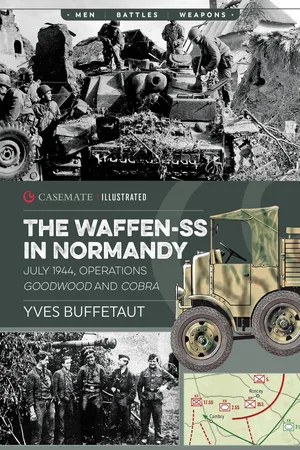
An examination of how the Waffen-SS fared in Normandy in June 1944 and whether they deserve their reputation of being the ultimate fighting soldiers.
One of the greatest paradoxes of the Battle of Normandy is that the German divisions found it much harder to reach the front line than the Allies, who had to cross the sea and then deploy in a cramped bridgehead until the American breakthrough of late July 1944. The Waffen-SS were no better off than the Heer units and German high command never quite got on top of operations, as the divisions were thrown into the melee one by one.
During the month of June 1944, the Panzer divisions present succeeded in containing the Allies in a small bridgehead. In July, the arrival of more SS divisions should have finally allowed the Germans to counterattack decisively. This was not the reality. The Allies had also strengthened in number and kept the blows coming, one after another. Each SS-Panzer division had a different experience of the fighting in July.
This Casemate Illustrated looks at the divisions one by one throughout Operations Goodwood and Cobra which saw large tank battles and the collapse of the German front in Normandy. It includes over 100 photographs, alongside biographies of the commanders and color profiles of trucks and tanks which played a key role in operations as the Americans succeeded in breaking through the German line of defense.
"A superb series." —
Miniature Wargames
- 128 pages
- English
- ePUB (mobile friendly)
- Available on iOS & Android
eBook - ePub
About this book
Information
Subtopic
European HistoryIndex
HistoryThe Waffen-SS in the Battles of July
During June 1944, the panzer divisions at the front managed to somehow restrict the Allies to limited bridgeheads. In July, the arrival of several fresh SS divisions should in theory have allowed the Germans to counterattack decisively. On the ground however, this did not happen, as the Allies were also receiving a steady stream of reinforcements and so a war of attrition developed.
On the Caen front, the 12th SS Panzer Division continued to fight mainly the Canadians, preventing their attempts at envelopment from the west. Due to the British offensive on the Odon, the front remained stable in the Caen area for almost four weeks. But the stalemate at Hill 112 prompted Montgomery to attempt a renewed frontal attack in early July. His first objective was the capture of Carpiquet, the 12th SS Panzer Division Hitlerjugend’s fortress.

An artillery column from the 2nd SS Panzer Artillery Regiment Das Reich, destroyed in the Roncey sector, at the end of July 1944. A self-propelled 15cm Hummel can be seen, as can an SdKfz 251 D. The Das Reich insignia is clearly visible on the latter, painted in bright yellow beneath the armored artillery tactical insignia. (U.S. National Archives)

This British Stuart never stood a chance against the panzers of the 12th SS Panzer Division Hitlerjugend’s. (Private collection, via J. Restayn)
In order to achieve his objectives, considerable resources were deployed, the task being allocated to the 8th Canadian Infantry Brigade, with considerable reinforcements: an attached battalion of the 3rd Canadian Infantry Division supported on the flanks by the 2nd Canadian Armoured Brigade:
•The Régiment de la Chaudière
•The North Shore Rifles
•The Queen’s Own Rifles
supported by:
•The Royal Winnipeg Rifles
•The Fort Garry Horse, with 48 Shermans
•The 22nd Dragoons, with mine-clearing tanks
•Several flame-throwing Churchill Crocodile tanks
•The Cameron Highlanders of Ottawa, a battalion of heavy machine guns and mortars
In Profile:
Waffen-SS Sturmgeschütz in Normandy

A StuG III of the 2nd SS Sturmgeschütz Battalion. Easier to build than tanks, StuG IIIs were commonplace in Normandy, though inadequate in marshland conditions.

A StuG III of the SS Sturmgeschütz Battalion, 1st SS Panzer Division LSSAH.

A Das Reich StuG I. This version on a Panzer IV frame was less common than those on Panzer III frames, but both the Das Reich and the Götz von Berlichingen used them.
Artillery support consisted of:
•12 field artillery regiments
•8 medium artillery regiments
•1 heavy artillery regiment
•Battleship HMS Rodney (9 406mm guns)
•Monitor HMS Roberts (2 380mm guns)
Air support comprised two squadrons of Typhoons, specially attached to the 8th Infantry Brigade. The assault was set to start at 0500 on July 4, with an artillery barrage against the Waffen-SS.
The First Assault
Operation Windsor opened with a fearsome artillery bombardment that failed to completely neutralize the enemy’s defenses. Author Jean-Pierre Benamou provides testimony of a German soldier:

An SdKfz 10 from the 12th SS Panzer Artillery Battalion Hitlerjugend. (Private collection, via J. Restayn)

A Hitlerjugend panzergrenadier inspects a British Sherman M4A1 hit several times by a Panzerfaust, judging by the weapon he is holding. (Private collection, via J. Restayn)

Hitlerjugend gunners manhandling an ammunition trailer. (Private collection, via J. Restayn)
In our individual foxholes, we were subjected to a terrible barrage that crushed us and threw us against the sides. Never before had we seen this. However, I managed to hold on to observe [what was happening] behind the wall of explosions that advanced 100 meters every three minutes; Shermans in huge numbers advanced and I fired a green rocket, which as a result attracted the nearest [enemy] tank to me. [A green rocket was a request for artillery support; red indicated that the enemy has reached the German trenches.]
The 12th SS Panzer Division at Carpiquet
The Canadians, advancing in the open, also suffered losses. Initially they believed that their own artillery was firing short, while in fact it was the Germans fighting back. However, this did not prevent the French Canadians of B Company, Régiment de la Chaudière from reaching the village of Carpiquet. En route a bunker on the side of the road resisted, but was destroyed by a Churchill Crocodile’s flamethrower.
By 0600 hours, the last few houses were occupied by Companies A and C. The fight was all the more violent in that neither side was willing to show any mercy: “We hardly took any prisoners, on either side,” a Canadian officer would say.

A Cromwell, destroyed by the Hitlerjugend. With no markings, it is unclear whether this tank is from the 7th Armoured Division or another armored division. (Private collection, via J. Restayn)

A self-propelled 3.7cm Flak gun on a Czech Panzer 38 (t) chassis. This one belonged to the 12th SS Panzer Division Hitlerjugend. (Private collection, via J. Restayn)
Two supporting Shermans were set ablaze in the middle of the village, but Carpiquet was taken. Only the aerodrome remained.
The Battle for the Aerodrome
The North Shore Regiment made scant progress toward the aerodrome, immobilized by devastating Nebelwerfer fire. The Canadians dug in, awaiting a second assault wave, but not before several of their number, who had only arrived in the battalion as reinforcements the day before, were killed
At 0830 hours, the Queen’s Own passed through the North Shore lines, toward the aerodrome’s administrative buildings. Their advance was promptly stopped by machine-gun fire emanating from bunkers that had survived the artillery barrage. A Churchill Crocodile approached, but its trailer with the incendiary liquid was hit and exploded. The other Crocodiles retreated.
It was therefore down to the infantry to neutralize the bunkers, throwing TNT charges into the vent system, though this was easier said than done. Dug-in panzers, intact too, also appeared at the last moment. The infantry requested assistance from the Typhoons, but Major-General Rodney Keller, commanding the Canadian 3rd Infantry Division, denied the request for fear that the Allied fighter-bombers might hit his own men. The assault was therefore halted in that direction.
The 12th SS Panzer Division Faces the Canadians
The depots on the southern side of the airfield were the objective of the Winnipeg Rifles. There too, the German defenses were strongly established in depth, with nests of machine guns, bunkers, dug-in panzers and a 28/32cm Nebelwerfer 41 rocket unit.
Companies A and D advanced toward the enemy barbed wire, where the Shermans of B Squadron, Fort Garry Horse were supposed to create openings, but four of the tanks were set ablaze in the attempt, causing the others to retreat. By noon, the attack had failed.

An SdKfz 223 from the 12th SS Panzer Reconnaissance Battalion, Hitlerjugend. This vehicle predated the war, not unlike the British Universal Carrier that also saw service throughout the conflict. (Private collection, via J. Restayn)
In Profile:
Waffen-SS SdKfz 251 Half-Tracks

An SdKfz 251 D from the 7th Company of one of the LSSAH panzergrenadier regiments.

The front view of SSBrigadeführer Harmel’s SdKfz 251, of the 10th SS Panzer Division Frundsberg..

Profile view of Harmel’s SdKfz 251.

A Büssing NAG workshop truck from the Hitlerjugend. Divisional workshops were under enormous p...
Table of contents
- Cover
- Title
- Copyright
- Map
- Contents
- Timeline of Events
- The SS Divisions’ Slow Road to the Front
- The Waffen-SS in the Battles of July
- On the Road to Falaise
- Afterword
- Further Reading
Trusted by 375,005 students
Access to over 1.5 million titles for a fair monthly price.
Study more efficiently using our study tools.
Frequently asked questions
Yes, you can cancel anytime from the Subscription tab in your account settings on the Perlego website. Your subscription will stay active until the end of your current billing period. Learn how to cancel your subscription
No, books cannot be downloaded as external files, such as PDFs, for use outside of Perlego. However, you can download books within the Perlego app for offline reading on mobile or tablet. Learn how to download books offline
Perlego offers two plans: Essential and Complete
- Essential is ideal for learners and professionals who enjoy exploring a wide range of subjects. Access the Essential Library with 800,000+ trusted titles and best-sellers across business, personal growth, and the humanities. Includes unlimited reading time and Standard Read Aloud voice.
- Complete: Perfect for advanced learners and researchers needing full, unrestricted access. Unlock 1.5M+ books across hundreds of subjects, including academic and specialized titles. The Complete Plan also includes advanced features like Premium Read Aloud and Research Assistant.
We are an online textbook subscription service, where you can get access to an entire online library for less than the price of a single book per month. With over 1.5 million books across 990+ topics, we’ve got you covered! Learn about our mission
Look out for the read-aloud symbol on your next book to see if you can listen to it. The read-aloud tool reads text aloud for you, highlighting the text as it is being read. You can pause it, speed it up and slow it down. Learn more about Read Aloud
Yes! You can use the Perlego app on both iOS and Android devices to read anytime, anywhere — even offline. Perfect for commutes or when you’re on the go.
Please note we cannot support devices running on iOS 13 and Android 7 or earlier. Learn more about using the app
Please note we cannot support devices running on iOS 13 and Android 7 or earlier. Learn more about using the app
Yes, you can access The Waffen-SS in Normandy by Yves Buffetaut in PDF and/or ePUB format, as well as other popular books in History & European History. We have over 1.5 million books available in our catalogue for you to explore.