The US intelligence community as it currently exists has been deeply influenced by the press. Although considered a vital overseer of intelligence activity, the press and its validity is often questioned, even by the current presidential administration. But dating back to its creation in 1947, the US Central Intelligence Agency (CIA) has benefited from relationships with members of the US press to garner public support for its activities, defend itself from its failures, and promote US interests around the world. Many reporters, editors, and publishers were willing and even eager to work with the agency, especially at the height of the Cold War.
That relationship began to change by the 1960s when the press began to challenge the CIA and expose many of its questionable activities. Respected publications went from studiously ignoring the CIA's activities to reporting on the Bay of Pigs, CIA pacification programs in Vietnam, the CIA's war in Laos, and its efforts to use US student groups and a variety of other non-government organizations as Cold War tools. This reporting prompted the first major congressional investigation of the CIA in December 1974.
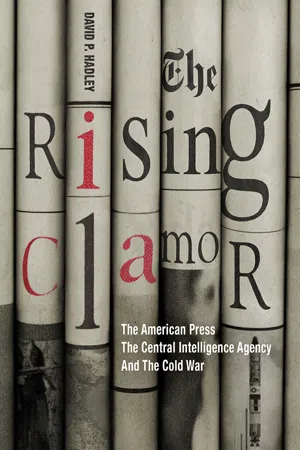
In The Rising Clamor: The American Press, the Central Intelligence Agency, and the Cold War, David P. Hadley explores the relationships that developed between the CIA and the press, its evolution over time, and its practical impact from the creation of the CIA to the first major congressional investigations of its activities in 1975–76 by the Church and Pike committees. Drawing on a combination of archival research, declassified documents, and more than 2,000 news articles, Hadley provides a balanced and considered account of the different actors in the press and CIA relationships, how their collaboration helped define public expectations of what role intelligence should play in the US government, and what an intelligence agency should be able to do.
eBook - ePub
The Rising Clamor
The American Press, the Central Intelligence Agency, and the Cold War
- 272 pages
- English
- ePUB (mobile friendly)
- Available on iOS & Android
eBook - ePub
The Rising Clamor
The American Press, the Central Intelligence Agency, and the Cold War
About this book
Information
Topic
SozialwissenschaftenSubtopic
Journalismus1
The Postwar Intelligence Debate and the CIA
In January 1953 the Washington Post published an unusual editorial. In response to the announcement that DCI Walter Bedell Smith was leaving the CIA to become undersecretary of state for the incoming Eisenhower administration, the author of the editorial took the opportunity to argue that the CIA was in need of reform.1 The CIA, the editorial noted, had embarked on dangerous activities, such as covert propaganda and secret operations, which were “incompatible with a democracy.”2
The editorial warned that the CIA was “apt to play hob with our foreign policy—indeed, to create trouble and even land us in war.”3 The author cited several worrisome stories that had emerged in the five years since the CIA had been founded. The CIA had illegally detained a Japanese citizen for eight months, had been caught tapping the phone of President José Figueres of Costa Rica, had armed guerrillas in Burma, and had tried to overthrow the democratically elected government of Guatemala. The CIA had even funded a neo-Nazi organization in Germany. With these facts public, the editorial noted, “God only knows” what the CIA had been up to that had not emerged in the press.4
Tucked away as it was on page 20 of a midsize newspaper, this editorial would have garnered limited attention. The Post in 1953 had a limited readership and geographic range compared to the New York Times. As recently as 1948 it had a circulation of only 180,000. Under the management of its new owner, Philip Graham, readership had increased, but not dramatically.5
The article, however, was an early criticism of the CIA’s operational record. The CIA certainly took notice, and, when it found that the Soviets had commented on the article, the agency sent a message to Graham to note that his paper’s criticism was aligned with Soviet interests. Though much of the CIA memorandum in which the editorial was discussed remains classified, the intent of the CIA in communicating with Graham can be inferred; it did not want to see more such editorials.6 Criticism of the CIA did not reappear in the Post’s editorial pages in the immediate future.
While not the center of attention, the CIA was not absent from the public eye in its early years. Commentators had criticized the agency’s creation out of fear of its potential to violate civil liberties. Others condemned the agency as an ineffective tool in the Cold War because of poor management, dilettantism, communist infiltration, or some combination of the three. The Post’s editorial was unusual, in that it actually discussed covert actions themselves. Despite occasional criticism, the general attitude of the U.S. press during the early Cold War was one of cooperation with the government and, at times, with U.S. intelligence services. These habits of cooperation proved significant to the growing U.S. intelligence establishment.
From 1946 and the creation of the first peacetime U.S. central intelligence organization, the Central Intelligence Group, to the eventual appointment of Allen Dulles as director of Central Intelligence in 1953, the issue of creating and refining a U.S. intelligence system was present though not prominent in U.S. newspapers and magazines. A key issue in discussions of intelligence was whether the focus of a covert intelligence agency ought to be limited to intelligence gathering or include more expansive covert warfare against communist powers. The latter dynamic was already winning out by 1953, when Dulles was made DCI and ensured the CIA would be conducting covert warfare.7
Press coverage alone was not causative in this shift toward operations, but it was an important contextual factor. Prominent reporters grew to favor an aggressive agency and refrained from reporting on the outcome of such aggression. As the CIA was under press scrutiny from the beginning of its existence, the press had a greater opportunity to affect the CIA than it had with older, established military intelligence agencies. Relationships between intelligence officers and members of the press began even before the CIA existed and helped shape the environment in which the CIA operated.
The Media Landscape before the Cold War
The experience of World War II was vital to shaping the generally cooperative nature of press relationships with the government in general and the CIA in particular in the immediate postwar era; the necessities of total war led to an understanding on the part of the press about cooperating with necessary secrets. Many foreign correspondents in the years after World War II had seen firsthand the toll the war had taken. James Reston, for example, a New York Times columnist and eventually chief of the Times’s Washington Bureau, had lived through the Blitz in London and later traveled to the Soviet Union as part of a junket with the Times’s owner and publisher, Arthur Hays Sulzberger. Before they became prominent columnists, Stewart Alsop and Thomas Braden had been members of the CIA’s predecessor, the Office of Strategic Services. Both had parachuted into occupied France.
Journalists working during the war operated under a system of press censorship. There were formal controls, but the system heavily depended on the discretion and loyalty of the press. Discretion was especially important among domestic reporters, who were guided by a system of voluntary censorship. The chief of the Office of Censorship, Byron Price, a former reporter himself, was aided by the fact that journalists were just as invested in U.S. victory as the average citizen.8
Of the 2,700 daily newspapers, 11,000 weekly newspapers, and 7,000 journals that the Office of Censorship identified during the war, there were no domestic cases of deliberate efforts by the print media to buck the censorship code. Though there were violations, these generally were accidental in nature.9 Several journalists, including the widely read Washington columnist Drew Pearson, knew some details of the Manhattan Project, but none revealed the existence of that secret initiative before the use of the bomb against Hiroshima.10
The war provided vivid examples to reporters of the need to accept censorship to prevent death and destruction from enemy action. When arguing for caution in the Times’s approach to stories, for example, Sulzberger reminded managing editor Turner Catledge of a story published in Britain that had resulted in the deaths of several relief workers. The story had contained a picture of an undetonated bomb being removed from ruins in London. This picture, according to Sulzberger, revealed enough about British procedures for the Germans to decide to hinder removal efforts and kill aid workers by booby-trapping bombs that would appear to be duds, only to explode when removed.11
Given their centrality to shaping the media landscape, it is worthwhile to examine some of the major publications and their leadership in detail. For example, Sulzberger’s thoughts on the subject of what to publish and what to avoid were particularly important given his position. The New York Times’s daily circulation was in the hundreds of thousands. It was one of the most prestigious papers in the United States, with a proven capability and experience in reporting foreign affairs. Even if a person did not read the newspaper itself, the stories the Times broke became national news.
Sulzberger had come to own the Times almost accidentally. He had in 1917 married Iphigene Ochs, daughter of the Times’s publisher at the time, Adolf Ochs. Taking a job with the Times shortly after his marriage, Sulzberger learned the newspaper business from his father-in-law. Ochs was by nature a cautious and conservative publisher, at times criticized for taking objectivity and neutral reporting so seriously that the finished product was too dull to read. Though he would seek to provide a more interesting product, Sulzberger sought to emulate the care and caution of Ochs.
Educated at Columbia University, Sulzberger was also well versed in the world of the American political elite. Throughout his life he maintained friendly relationships with such Establishment figures as Allen Dulles and Hamilton Fish Armstrong. He was something of a late entrant to this overwhelmingly Protestant group, having been born to a prestigious Jewish family in New York. While never seeking to distance himself from his Jewish heritage, Sulzberger strongly believed in the assimilation of ethnic minorities in American society.
Echoes of Sulzberger’s background and philosophy can be seen in another newspaper owner and publisher, Eugene Meyer. Like Sulzberger, Meyer was an assimilated Jewish American. Meyer purchased the Washington Post in 1933, two years before Sulzberger began his long tenure as the Times’s publisher. Meyer had gone to Yale, and he subscribed to its ethos of public service on the part of the elite and able.12 The Post, like the Times, cooperated with censorship during World War II.
Not everyone agreed with the principles of caution and patriotic cooperation with the government. The Washington Bureau of the Times, led by the so-called Dean of the Washington Newsmen, Arthur Krock, enjoyed and fiercely fought to defend a substantial degree of autonomy from the New York office. Originally from Kentucky, Krock was a Democrat vehemently opposed to the New Deal.13 He was frustrated on several occasions with the stories Sulzberger would prevent from running, such as a report that the U.S. Navy captured a German raider in late 1941 and a detailed report on the attack at Pearl Harbor.14
Krock was constrained by his publisher; there were no such issues at the Chicago Tribune. Its owner and publisher, Robert McCormick, was committed to freedom of the press and to total opposition to the New Deal. The grandson of the Chicagoan Joseph Medill, who purchased the Tribune in the 1880s, McCormick took over as publisher upon his return home from military service in World War I. McCormick had spent a great deal of his childhood in England, and he had attended both Groton and Yale. He wholeheartedly rejected, however, the Anglophilia and internationalism of many of his classmates, seeing only decay in the Old World while being totally convinced of “America’s moral and political superiority.”15
McCormick’s deeply conservative and decidedly isolationist worldview led him to be one of the foremost critics of Franklin Roosevelt. McCormick believed Roosevelt’s administration heralded a disaster for democracy in the United States, and he mightily resisted what he saw as undue government intervention in private business and U.S. engagement in the crisis engulfing Europe. McCormick spent a significant portion of the 1930s opposing New Deal regulations concerning newspapers as chair of the Freedom of the Press Committee of the American Newspaper Publishers Association (ANPA).
Knowing he was a controversial figure, and facing the escalating crisis in the Atlantic in the summer of 1941, McCormick offered to resign from the committee so that it could defend the freedom of the press without the distraction of attacks on him. The reply to his offer, however, delivered the unwelcome news that the ANPA had decided to close the committee entirely because of “present national conditions.”16 An unhappy McCormick did not follow the lead of his eastern fellow publishers in his approach to publishing during the months leading to war. He continued to fiercely criticize the government, dictating to his editorial writers which topics they should address, how the writers should address them, and, at times, phrases for them to use.17
While generally cooperative with the wartime censorship program, the Chicago Tribune famously circumvented that censorship to publish a potentially damaging revelation of U.S. intelligence abilities. The source was the Tribune’s reporter Stanley Johnston, who had been reporting from the USS Lexington until that ship sank because of damage inflicted during the Battle of the Coral Sea. On a transport to San Diego, Johnston struck up a friendship with a naval officer who informed him that Japanese ships were headed toward Midway. Following the Japanese defeat at Midway, Johnston reported that the United States had known about Japanese fleet movements in advance of the battle, which could have suggested to alert readers that the United States had broken Japanese codes.18
The U.S. government brought the Tribune before a grand jury on suspicion of violating the Espionage Act. McCormick, Johnston, and the Tribune escaped charges solely because the nav...
Table of contents
- Cover
- Title Page
- Copyright
- Dedication
- Contents
- List of Abbreviations
- Introduction: American Opinion Said Go
- 1. The Postwar Intelligence Debate and the CIA
- 2. Allen Dulles and Covert Intervention
- 3. The Increasing Public Profile of the CIA
- 4. The Fracture of the 1960s
- 5. The Clash of Intelligence Advocates and Critics
- 6. The Year of Intelligence Begins
- 7. The Year of Intelligence’s Contentious End
- Conclusion
- Acknowledgments
- List of Significant CIA and Press Figures
- Notes
- Bibliography
- Index
Trusted by 375,005 students
Access to over 1.5 million titles for a fair monthly price.
Study more efficiently using our study tools.
Frequently asked questions
Yes, you can cancel anytime from the Subscription tab in your account settings on the Perlego website. Your subscription will stay active until the end of your current billing period. Learn how to cancel your subscription
No, books cannot be downloaded as external files, such as PDFs, for use outside of Perlego. However, you can download books within the Perlego app for offline reading on mobile or tablet. Learn how to download books offline
Perlego offers two plans: Essential and Complete
- Essential is ideal for learners and professionals who enjoy exploring a wide range of subjects. Access the Essential Library with 800,000+ trusted titles and best-sellers across business, personal growth, and the humanities. Includes unlimited reading time and Standard Read Aloud voice.
- Complete: Perfect for advanced learners and researchers needing full, unrestricted access. Unlock 1.5M+ books across hundreds of subjects, including academic and specialized titles. The Complete Plan also includes advanced features like Premium Read Aloud and Research Assistant.
We are an online textbook subscription service, where you can get access to an entire online library for less than the price of a single book per month. With over 1.5 million books across 990+ topics, we’ve got you covered! Learn about our mission
Look out for the read-aloud symbol on your next book to see if you can listen to it. The read-aloud tool reads text aloud for you, highlighting the text as it is being read. You can pause it, speed it up and slow it down. Learn more about Read Aloud
Yes! You can use the Perlego app on both iOS and Android devices to read anytime, anywhere — even offline. Perfect for commutes or when you’re on the go.
Please note we cannot support devices running on iOS 13 and Android 7 or earlier. Learn more about using the app
Please note we cannot support devices running on iOS 13 and Android 7 or earlier. Learn more about using the app
Yes, you can access The Rising Clamor by David P. Hadley in PDF and/or ePUB format, as well as other popular books in Sozialwissenschaften & Journalismus. We have over 1.5 million books available in our catalogue for you to explore.