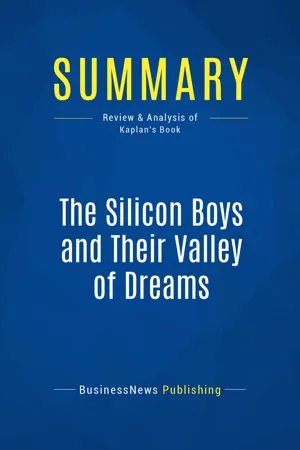
The must-read summary of David Kaplan's book: "The Silicon Boys and their Valley of Dreams: The Meek Didn't Inherit the Earth. The Geeks Did.".
This complete summary of the ideas from David Kaplan's book "The Silicon Boys and their Valley of Dreams" reveals the history and culture of Silicon Valley. In his book, the author brilliantly captures the image of the area that has now become the epicenter of the New Economy and the symbol of high-tech, genius and ineffable wealth. This summary is a must-read for anyone who wants to know more about the people behind these world-class companies and how they achieved success.
Added-value of this summary:
• Save time
• Understand key concepts
• Expand your knowledge
To learn more, read "The Silicon Boys and their Valley of Dreams" and discover more about the story behind one of the most dynamic places on the planet.
eBook - ePub
Summary: The Silicon Boys and Their Valley of Dreams
Review and Analysis of Kaplan's Book
- English
- ePUB (mobile friendly)
- Available on iOS & Android
eBook - ePub
Summary: The Silicon Boys and Their Valley of Dreams
Review and Analysis of Kaplan's Book
About this book
Information
Subtopic
Business BiographiesIndex
BusinessSummary of The Silicon Boys and Their Valley of Dreams (David Kaplan)
1. The Dream of Silicon Valley
“If Silicon Valley were a nation, it would rank among the world’s twelve largest economies.”
– David Kaplan
Silicon Valley actually had its first start-up company in 1909 when Cyril Elwell formed the Federal Telegraph Company with two assistants. The company’s backers included David Starr Jordan, the first president of Stanford University, who invested $500 in the new venture. The most well-known employee of Federal Telegraph was Dr. Lee de Forest who developed the first vacuum tube amplifier and oscillator in 1911.
Within a short period of time, two employees broke away to form their own company -- in this case the company that developed Magnavox loudspeakers -- using employees recruited from Stanford University’s electrical engineering school. That basic concept of breaking away from one company to start-up a new company to commercialize new technology is the business model around which Silicon Valley continues to be built today.
By the mid-1920s, the most highly sought Stanford students were those from the radio communications lab tutored by Frederick Terman -- who is today considered to be the “Father of Silicon Valley”. It was in one of Terman’s graduate courses that David Packard and Bill Hewlett met and became friends. Terman encouraged Packard and Hewlett to go into business, which they did commencing on January 1, 1939 in a one-car unpainted garage at 367 Addison Avenue, Palo Alto. Packard and Hewlett had $538 in the bank and no real business plan except to do anything they could.
While Packard and Hewlett busied themselves building HP, William Shockley, John Bardeen and Walter Brattain were developing the transistor at Bell Laboratories in New York. The transistor was announced on June 30, 1948, and by early 1956 Shockley had decided to leave Bell Labs and set up his own company to manufacture transistors and other semiconductor devices. The new company, Shockley Semiconductor Laboratory, would be located in the 650-acre industrial park next to Stanford University, and two of the new company’s key employees were Robert Noyce who had earned a Ph.D. at MIT and Gordon Moore, a 27-year old chemist from CalTech.
Shockley turned out to be a difficult person to work for, and his company failed to make any headway. While he was on vacation in the summer of 1957, eight of his key employees (including Noyce and Moore) decided to leave and form their own company. They sought start-up funding from Hayden Stone & Co., a New York investment bank, who sent a senior partner and a junior associate, Arthur Rock, out to meet the eight.
Arthur Rock talked to Sherman Mills Fairchild, one of the great industrialists of the age, about providing start-up funding for the eight ex-Shockley employees to go into business for themselves. Fairchild, who was one of the largest shareholders in IBM, had built his company Fairchild Camera and Instrument on the strength of his inventions such as the aerial camera and hydraulic brakes for aircraft, and he was then planning on diversifying into missile and satellite systems. He realized that transistors would be important to his future business, and he agreed to provide $1.5 million in start-up funding for a new subsidiary company. Each of the eight were offered a shareholding in the company for $500 each, with the proviso that Fairchild would have the right to buy them out of their shareholding for about $250,000 each within 5-years if the new company was successful. (This is widely considered to be the first venture capital investment made in Silicon Valley -- effectively marrying the money of the East Coast of the United States with the electronic frontier of the West Coast).
Fairchild Semiconductor was launched in late 1957 with 29-year old Robert Noyce as the business leader and Gordon Moore as the technical leader.
“Because of personality and job history, Noyce ran a loose ship. Hierarchy was an enemy: There were no reserved parking spots, no mahogany-paneled dining room, no private offices (not even for Noyce), no multilayered array of middle managers. At sales meetings, they served brownies and whiskey, which probably helped since early on many on the sales force had no inkling what a transistor actually was. Management strategy was an oxymoron, because Noyce didn’t do a lot of managing. But California casualness masked another part of the emerging tech lifestyle: Everybody worked like beavers. Fairchild Semiconductor was the first of the nerd-driven companies that embodied the Silicon Valley culture.”
– David Kaplan
By the end of 1958, Fairchild Semiconductor had achieved $500,000 in sales revenue -- no small feat considering the price of transistors had fallen from $45 each in 1950 to $2 in 1957 (and would continue to drop to milli-fractions of a cent by the 1990s). The great production restraint of the era was the time it took to connect scores of transistors together to build anything useful. The breakthrough invention that would solve this manufacturing bottleneck was the integrated circuit -- which had everything (transistors, connecting wires and other components) constructed on the same thin wafer of semiconductor material.
In January 1959, Fai...
In January 1959, Fai...
Table of contents
- Book Presentation: The Silicon Boys and Their Valley of Dreams by David Kaplan
- Summary of The Silicon Boys and Their Valley of Dreams (David Kaplan)
Trusted by 375,005 students
Access to over 1.5 million titles for a fair monthly price.
Study more efficiently using our study tools.
Frequently asked questions
Yes, you can cancel anytime from the Subscription tab in your account settings on the Perlego website. Your subscription will stay active until the end of your current billing period. Learn how to cancel your subscription
No, books cannot be downloaded as external files, such as PDFs, for use outside of Perlego. However, you can download books within the Perlego app for offline reading on mobile or tablet. Learn how to download books offline
Perlego offers two plans: Essential and Complete
- Essential is ideal for learners and professionals who enjoy exploring a wide range of subjects. Access the Essential Library with 800,000+ trusted titles and best-sellers across business, personal growth, and the humanities. Includes unlimited reading time and Standard Read Aloud voice.
- Complete: Perfect for advanced learners and researchers needing full, unrestricted access. Unlock 1.5M+ books across hundreds of subjects, including academic and specialized titles. The Complete Plan also includes advanced features like Premium Read Aloud and Research Assistant.
We are an online textbook subscription service, where you can get access to an entire online library for less than the price of a single book per month. With over 1.5 million books across 990+ topics, we’ve got you covered! Learn about our mission
Look out for the read-aloud symbol on your next book to see if you can listen to it. The read-aloud tool reads text aloud for you, highlighting the text as it is being read. You can pause it, speed it up and slow it down. Learn more about Read Aloud
Yes! You can use the Perlego app on both iOS and Android devices to read anytime, anywhere — even offline. Perfect for commutes or when you’re on the go.
Please note we cannot support devices running on iOS 13 and Android 7 or earlier. Learn more about using the app
Please note we cannot support devices running on iOS 13 and Android 7 or earlier. Learn more about using the app
Yes, you can access Summary: The Silicon Boys and Their Valley of Dreams by BusinessNews Publishing in PDF and/or ePUB format, as well as other popular books in Business & Business Biographies. We have over 1.5 million books available in our catalogue for you to explore.