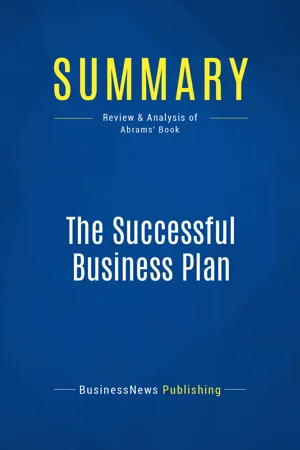
The must-read summary of Rhonda M. Abrams' book: "The Successful Business Plan: Secrets and Strategies".
This complete summary of the ideas from Rhonda M. Abrams' book "The Successful Business Plan" shows how a business plan is designed to be a road map for a company. A well-written and professional business plan articulates a company's goals and acts as a guide for future growth and development. In this book, the author explains that a good business plan should specify where the company is heading and how it plans to get there. The process of preparing a business plan is also highly instructional and provides an opportunity to learn more about the company. This summary provides a useful guide for creating a business plan that will not only get you funding, but will also provide you with a plan for reaching your goals.
Added-value of this summary:
• Save time
• Understand key concepts
• Expand your business knowledge
To learn more, read "The Successful Business Plan" and discover the key to creating the perfect business plan.
eBook - ePub
Summary: The Successful Business Plan
Review and Analysis of Abrams' Book
- English
- ePUB (mobile friendly)
- Available on iOS & Android
eBook - ePub
About this book
Information
Subtopic
Business StrategyIndex
BusinessSummary of The Successful Business Plan (Rhonda M. Abrams)
1. WHY WRITE A BUSINESS PLAN?
Main Idea
A business plan is designed to be a road map for a company. A well written and professional business plan articulates a company’s goals and acts as a guide for future growth and development.
The vast majority of business plans are written to secure funding. However, a well thought out business plan can be beneficial to any company whether it is large or small, just starting in business or long established. In essence, a business plan specifies where the company is heading, and how you plan on getting there.
Supporting Ideas
The advantages of writing a business plan are:
- It enables a manager to make better business decisions in the future.
- Preparing a business plan educates the management on the financial aspects of the company, particularly from a cash flow and break even perspective.
- A plan draws together in one document industry and marketing information critical to your business operations.
- The plan can anticipate future obstacles that may arise.
- A business plan sets out future goals and the criteria by which progress can be measured.
- A plan can highlight new and profitable operational areas that may be available to your company.
- A business plan can be persuasive to a funding source such as an equity investor, bank, etc.
- A plan enables a business manager to increase understanding of the company and gain an increased control over future success.
- A well written and refined business concept as detailed in an effective business plan will distinguish you from any competitors and give a competitive edge in many situations.
- An effective plan saves money and time by keeping your business operation focused on the area where you enjoy the greatest market advantages.
- The process of developing a plan is fun. It gives you a chance to visualize where the business is headed, and what you plan on achieving in the future.
The factors which contribute most to the success of any business and which should dominate a business plan are:
- The actual concept of the business. What is it the specific competitive advantage your company enjoys? Do you have something new, something better, service an untapped market or offer some other key benefit?
- An understanding of the market you service. Why is the market primed and ready to accept your product or service?
- The health of your industry. What are the general trends, and what factors have been taken into account in developing or expanding your business concept.
- The experience, skills and abilities of the management team. Who are in the key positions in the operation, and what blend of skills and experience do they bring to bear.
- Financial projections and control. Does the management have a realistic picture of what is required to operate and grow the company, and what specific mechanisms are in place or will be put in place to monitor and control the company’s finances.
- A clear and consistent business focus. How will the company ensure that it stays focused on its targets and resist the urge to branch out into other areas.
- Anticipation of change. What technological, demographical or competitive changes are anticipated in the company’s markets, and how will the business be positioned to benefit from these changes?
Generally speaking, developing a business plan involves five steps:
- Identifying your basic business concept. Develop a mission statement style paragraph which sets out exactly what your business is working towards. Decide on your goals and the purpose of writing a business plan.
- Gather all available data on the feasibility and the specifics of your business concept.
- Refine your business concept based on all the information gathered. Adapt your original business concept in the light of the market specific information.
- Outline the specific elements of the business plan that are applicable. Add information about your company, your product or service and your markets to the plan framework.
- Refine the plan, looking at it from the perspective of your target market. Put yourself in their position and look at your plan without bias.
Generally speaking, the business p...
Table of contents
- Book Presentation: The Successful Business Plan by Rhonda M. Abrams
Trusted by 375,005 students
Access to over 1.5 million titles for a fair monthly price.
Study more efficiently using our study tools.
Frequently asked questions
Yes, you can cancel anytime from the Subscription tab in your account settings on the Perlego website. Your subscription will stay active until the end of your current billing period. Learn how to cancel your subscription
No, books cannot be downloaded as external files, such as PDFs, for use outside of Perlego. However, you can download books within the Perlego app for offline reading on mobile or tablet. Learn how to download books offline
Perlego offers two plans: Essential and Complete
- Essential is ideal for learners and professionals who enjoy exploring a wide range of subjects. Access the Essential Library with 800,000+ trusted titles and best-sellers across business, personal growth, and the humanities. Includes unlimited reading time and Standard Read Aloud voice.
- Complete: Perfect for advanced learners and researchers needing full, unrestricted access. Unlock 1.5M+ books across hundreds of subjects, including academic and specialized titles. The Complete Plan also includes advanced features like Premium Read Aloud and Research Assistant.
We are an online textbook subscription service, where you can get access to an entire online library for less than the price of a single book per month. With over 1.5 million books across 990+ topics, we’ve got you covered! Learn about our mission
Look out for the read-aloud symbol on your next book to see if you can listen to it. The read-aloud tool reads text aloud for you, highlighting the text as it is being read. You can pause it, speed it up and slow it down. Learn more about Read Aloud
Yes! You can use the Perlego app on both iOS and Android devices to read anytime, anywhere — even offline. Perfect for commutes or when you’re on the go.
Please note we cannot support devices running on iOS 13 and Android 7 or earlier. Learn more about using the app
Please note we cannot support devices running on iOS 13 and Android 7 or earlier. Learn more about using the app
Yes, you can access Summary: The Successful Business Plan by BusinessNews Publishing in PDF and/or ePUB format, as well as other popular books in Business & Business Strategy. We have over 1.5 million books available in our catalogue for you to explore.