eBook - ePub
Available until 23 Dec |Learn more
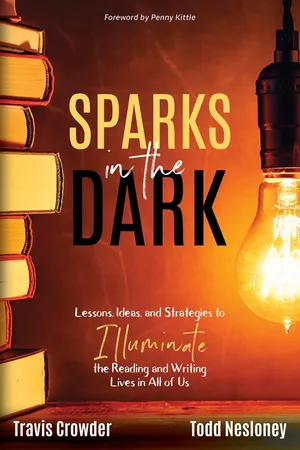
Sparks in the Dark
Lessons, Ideas and Strategies to Illuminate the Reading and Writing Lives in All of Us
This book is available to read until 23rd December, 2025
- 240 pages
- English
- ePUB (mobile friendly)
- Available on iOS & Android
eBook - ePub
Available until 23 Dec |Learn more
Sparks in the Dark
Lessons, Ideas and Strategies to Illuminate the Reading and Writing Lives in All of Us
About this book
More standards, tests, and mandates are not the answer to improving literacy. Travis Crowder and Todd Nesloney explain that sparking a passion for words, stories, and self-expression in learners is the surest path to instilling a lifelong love of learning. Through real-life stories and practical strategies they inspire educators in every subject area to incorporate reading and writing in meaningful and engaging ways.
Frequently asked questions
Yes, you can cancel anytime from the Subscription tab in your account settings on the Perlego website. Your subscription will stay active until the end of your current billing period. Learn how to cancel your subscription.
No, books cannot be downloaded as external files, such as PDFs, for use outside of Perlego. However, you can download books within the Perlego app for offline reading on mobile or tablet. Learn more here.
Perlego offers two plans: Essential and Complete
- Essential is ideal for learners and professionals who enjoy exploring a wide range of subjects. Access the Essential Library with 800,000+ trusted titles and best-sellers across business, personal growth, and the humanities. Includes unlimited reading time and Standard Read Aloud voice.
- Complete: Perfect for advanced learners and researchers needing full, unrestricted access. Unlock 1.4M+ books across hundreds of subjects, including academic and specialized titles. The Complete Plan also includes advanced features like Premium Read Aloud and Research Assistant.
We are an online textbook subscription service, where you can get access to an entire online library for less than the price of a single book per month. With over 1 million books across 1000+ topics, we’ve got you covered! Learn more here.
Look out for the read-aloud symbol on your next book to see if you can listen to it. The read-aloud tool reads text aloud for you, highlighting the text as it is being read. You can pause it, speed it up and slow it down. Learn more here.
Yes! You can use the Perlego app on both iOS or Android devices to read anytime, anywhere — even offline. Perfect for commutes or when you’re on the go.
Please note we cannot support devices running on iOS 13 and Android 7 or earlier. Learn more about using the app.
Please note we cannot support devices running on iOS 13 and Android 7 or earlier. Learn more about using the app.
Yes, you can access Sparks in the Dark by Todd Nesloney, Travis Crowder in PDF and/or ePUB format, as well as other popular books in Education & Education General. We have over one million books available in our catalogue for you to explore.
Information
Topic
EducationSubtopic
Education GeneralChapter 1
The Literacy Imperative

Rage, rage against the dying of the light.
—Dylan Thomas
Education has seen more major changes in the past decade than any single teacher can possibly synthesize. Standards, acronyms, policies, paperwork, and evaluations dominate our educational landscape. At the same time, students come into our classrooms, into a world filled with tight expectations, and they are, honestly, eager to learn. Their minds are full of questions, and they are curious about their world. They love doing science experiments, choosing their own books, reading those books aloud, and collaborating on projects. We know because we ask the students in our classes and in the schools we visit. What we find most often are students who abhor anything that interrupts the flow of learning. They do not describe their mindset in those exact terms, but their comments certainly convey that attitude. We hope Sparks in the Dark will create a rally cry, inspiring, challenging, and sparking changes, ones that will help other educators see how necessary meaningful reading and writing experiences are for students and teachers.
Meaningful teaching has always been necessary, but trends, programs, and fear often overtake education and pull us away from doing what we know is best for kids. We end up trying to find a silver bullet—that one research-based practice or district-mandated initiative that will help our students thrive like never before. Time and time again, we fall for the sales pitches and the beautifully designed data. We fall for the lie that a really good program is all it takes to change a child’s educational trajectory. We focus all our attention on increasing a reading level, a test score, or the number of books read. We give in to our fear of failure and our fear of trying something new, and we cling to tired, ineffective tools such as worksheets and multiple-choice answers. It’s safer that way, and for some of us, the reality is, if our kids don’t perform the way our administration expects, our jobs might be on the line.
How can we change that?
The answer is simple, but its implications are huge. If our goal is to build our students’ capacity as readers and writers, it is imperative that we participate in the process of reading and writing as well, in everything we do, in every subject we teach. It takes some work, yes, but the rewards of a rich reading and writing life are tremendous, and students will reap the benefits.
There is an alluring quality to every content area. The poetry of math, the metaphor of science, the humanity of history, and the literature of language arts combine to create a beautiful experience, all united by literacy. It is when these content areas are combined that they are potent and magical, and students can share the breathtaking view of the world that we, as educators, are privy to. Unfortunately, many of our students see school as a series of compartments, each with a skill set they must master before moving to the next grade. They do not have a chance to view the world through the lens of each subject area or see the threads that unite them.
Both of us come from a family of educators. It seems to run in our blood. We have experience at the high school, middle, and elementary levels as well as experience in school administration. Like so many professionals these days, we first met online through posts shared on our blogs and respective social media accounts. What started as a learning opportunity led to mutual respect and eventually a true friendship. Because of that friendship, we have enjoyed many open and honest conversations like the ones we hope to prompt with Sparks in the Dark. Conversations about instruction, classroom practices, beliefs about reading and writing, and so much more.
If our goal is to build our students’ capacity as readers and writers, it is imperative that we participate in the process of reading and writing as well, in everything we do, in every subject we teach.
In the past several years I (Todd) have gained a newfound passion for reading instruction and practices. My entire teaching career was in elementary school mathematics instruction. I loved it. I knew in high school I wanted to be a math teacher because I had always struggled with math as a student myself. I wanted to use the strategies I had learned to help other kids conquer their fears of math. In the classroom, I was that stereotypical math teacher. All about the numbers. We learned addition, subtraction, division, multiplication. We didn’t read about math, and for several years, we didn’t write about math. After all, my job was to teach math skills. Reading skills? That was the responsibility of my partner teacher across the hall. Boy, was I wrong.
During my first year as a principal, I read Donalyn Miller’s The Book Whisperer, a professional book that speaks to the power of independent reading, of choice, and the joy that is created when students are given opportunities to read books that match their interests. I finished it while sitting on an airplane and was moved to tears. As I read the final words on the last page and closed the book my first thought was, “I want to go back into the classroom and teach reading!” You see, as a student I was an avid reader. In the fifth grade, I came across the Animorphs book series by K.A. Applegate and was hooked. I devoured books constantly, but I never incorporated that love of reading into teaching. It never even occurred to me. After reading Miller’s book, my whole attitude toward reading and reading instruction shifted. I went back to my campus, bought her book for every staff member, and we began to read it and dive into our preconceived notions about reading and worked together on how we could promote that love of reading across our entire campus. I wrote about building that love of reading into our students in my book, Kids Deserve It.
As my team and I discussed this idea further, I read more books about reading and writing instruction and started connecting with other educators in this field through social media. I also diversified my own reading life, exploring fiction I had never previously considered. I saw my life changed when I read books such as The Hate U Give by Angie Thomas, Serpent King by Jeff Zentner, and I’m Not Your Perfect Mexican Daughter by Erika L. Sánchez. I watched my horizons expand, my mindsets shift, and my empathy deepen when I began to read about characters who looked and sounded nothing like me. Characters whose life experiences did not reflect my own. I connected with characters who dealt with racial profiling, death, loss, unique family dynamics, and prejudice. It gave me a new perspective about my students’ experiences helping me see more clearly what they were going through in their daily lives. These books gave me a lens into my students’ lives, a perspective that I had not previously possessed.
This kind of mindful reading changed everything for me. For the first time in my career, I truly understood the power that lies in stories. I began to see myself as more than just a math teacher or principal. I realized my role as an educator—no matter my subject specialty—is to use the tools of reading and writing to develop all of my students and staff. That insight has led to an awakening, a spark being lit that is impossible to extinguish. It’s why I wanted to write this book with Travis and why I can’t stop talking about this idea everywhere I go.
For Travis, it was a little different.
I (Travis) remember the moment the hard, honest truth hit me. It was a stinging, gut-wrenching truth I was resistant to accept. After seven years of teaching, after exploring complex themes in Shakespeare’s Hamlet and A Midsummer Night’s Dream, and guiding students through the desolation of Ray Bradbury’s Fahrenheit 451, I had convinced myself I was doing the right thing. By choosing rigorous texts, I was sharpening my students’ reading abilities, propelling them far beyond what any other educator had accomplished. Besides, if they could read the difficult stuff, testing would be easy.
My students demonstrated tremendous growth as a result of my instruction. Because my reading scores were improving, no administrator asked for my lesson plans or second-guessed my approach. I even talked up my students’ reading gains when discussing my teaching methods with colleagues or attending district and state conferences. But deep down I knew the truth—none of my students were leaving my classroom with a love of reading and writing. Change was necessary.
I began sharing concerns with my coworkers, explaining that my students were largely resistant to my style of teaching. I had recently returned from the National Council of Teachers of English (NCTE) conference, and while there, I had gleaned a wealth of knowledge from writers and educators. The NCTE conference is a powerful experience and involves a supportive network of educators, of leaders in our field. I knew coming back that I wanted to read The Book Whisperer by Donalyn Miller and revisit In the Middle by Nancie Atwell. Atwell’s book in particular was incredibly transformative early in my career. I remember reading it having my mind blown with the idea that students could actually be engaged in the act of reading and writing. When I paired what I learned from In the Middle with what Donalyn talks about in The Book Whisperer, I was provided with a tool chest full of ideas that would alter the way I viewed reading and writing instruction forever. I had experimented with nontraditional classroom teaching and the outcome had been subpar, but I was willing to try again.
Within a week, I had finished The Book Whisperer, and by the time I returned from spring break, I was ready to implement a reading and writing workshop as an initiative in my eighth-grade classes. In a workshop classroom, emphasis is placed on student interest and choice in their reading and writing lives. It is less focused on lecture and more on the application and acquisition of skills.
My students were not sure what to think about the markedly different curriculum I was offering, especially when they fell in love with books and could not stop talking about their reading lives.
In retrospect, I am filled with gratitude when I consider this moment in my teaching life. Since then, my professional library has grown exponentially, and my Twitter feed is filled with updates from professionals I respect and adore. Their thinking and leadership improve my teaching and the education my students receive. Most importantly, I have come to understand that books matter, reading matters, and without either, students’ educational experiences suffer.
When you teach someone how to read or how to express themselves using the written word, you change a life.
We believe this book matters because reading and writing are the foundation of all we do. When you teach someone how to read or how to express themselves using the written word, you change a life. You introduce them to magical worlds, teach them how to access the voice within, and empower them to affect that same change in the lives of others. You also learn to take resistance seriously, understanding that pushback from students might be a sign that coursework is too difficult, possibly irrelevant, and might not have been as astounding as you thought.
Education is important. We all know that. Equally important is building a true love of reading and writing. That inexorable need to escape into a world far different from your own. That drive to learn more about people who changed the course of history or unravel a mystery. The experience of feeling as if characters are truly family as you walk through their struggles with them. Or the moment the words you struggled to say aloud finally flow from your pen onto the page.
Those are the sparks in the dark we want our students to have because, in those moments, lives are truly changed.
THINGS TO THINK ABOUT AND TWEET
Why is reading and writing important to you?
How has a character in a book affected you personally?
How do you view reading or writing in your own life? Do you enjoy it? Approach it with ambivalence? Fear it? And why?
#SparksInTheDark
Chapter 2
Disturbing the Universe
Do I dare disturb the universe?
—T.S. Eliot
Even today, in 2018, the discipline of language arts is often taught in a traditional manner. Almost every school has at least one classroom where students are all reading the same novel, at the same pace, and completing the same activities. Writing prompts are teacher-generated, and student responses often lack voice and passion. In some classrooms, reading passages are handed out weekly, and students are asked to closely read the text ...
Table of contents
- Foreword
- Prologue
- Chapter 1: The Literacy Imperative
- Chapter 2: Disturbing the Universe
- Chapter 3: It Starts with a Bookshelf
- Chapter 4: Professional Responsibility in Teaching
- Chapter 5: If We Let Them
- Chapter 6: Choice in All Classrooms
- Chapter 7: Critical Conversations
- Chapter 8: Challenge Them
- Chapter 9: Living a Writerly Life
- Chapter 10: Changing Course: Vision and Revision
- Chapter 11: The Noble Heart of a Teacher
- Chapter 12: From Whom Do We Learn?
- Chapter 13: Gathering Resources
- Epilogue
- Bibliography
- Acknowledgments
- More From Dave Burgess Consulting, Inc.
- About the Authors